Notice: I am no longer allowing comments on this post. They have become redundant and mostly an exercise in venting. Enough. Thank you for understanding.
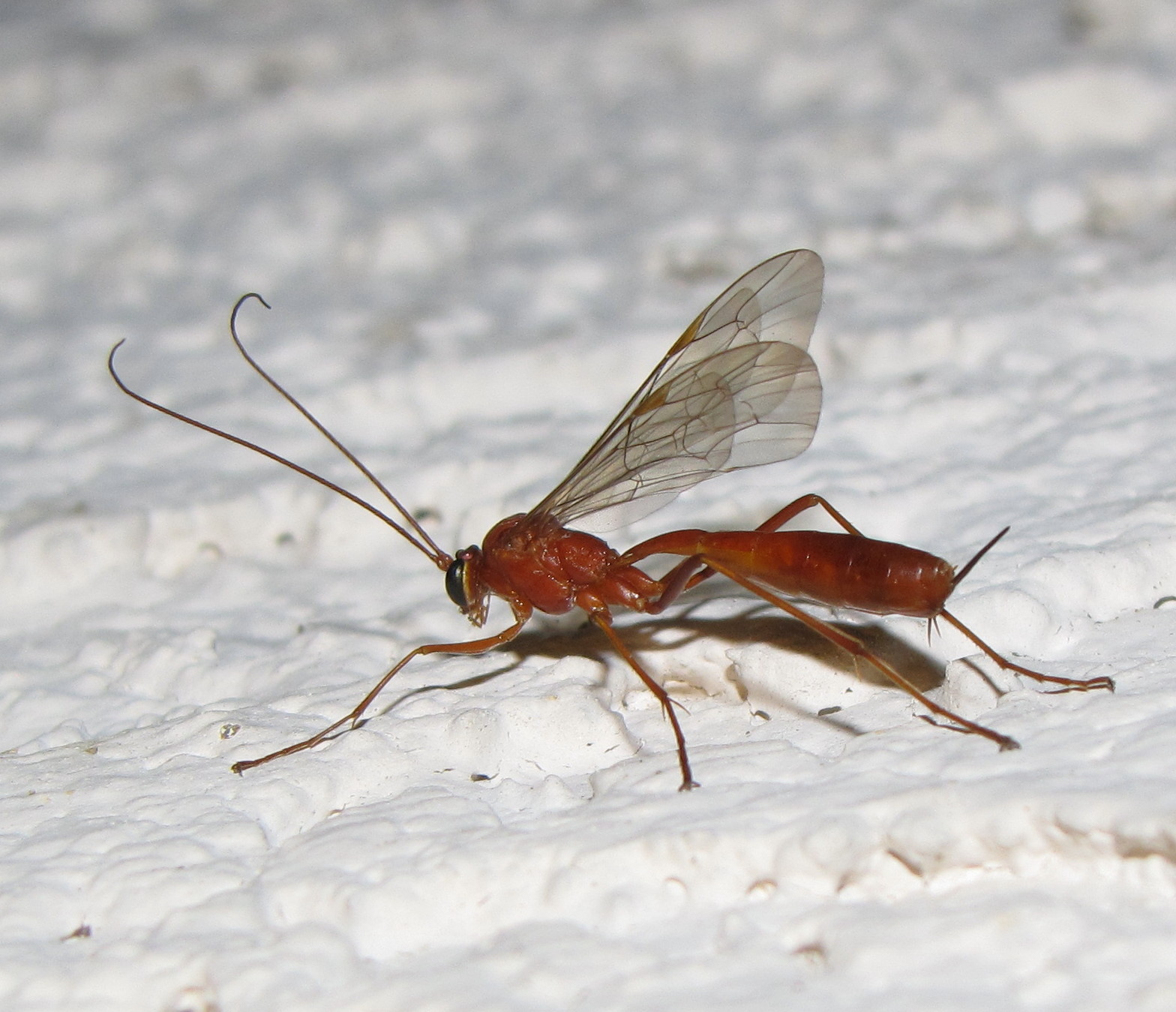
Surprisingly, you may find some wasps at your porch light after dark. Among the more common nocturnal hymenopterans are ichneumon wasps in the subfamily Ophioninae. They are large, gangly wasps, usually uniformly orange in color with long antennae and large ocelli (“simple eyes” arranged in a triangle at the crown of the head, between the compound eyes). The ovipositor is very short, if it is even evident at all.
If you see a slightly smaller orange ichneumon with a longer ovipositor, it is likely to be a wasp in the genus Netelia, in the subfamily Tryphoninae. There are currently 73 species in six subgenera in North America north of Mexico (Carlson, 2009).
Unlike many ichneumon wasps, the females of Netelia can sting painfully if handled carelessly. The sting is mostly used to temporarily paralyze the large caterpillar hosts of these parasites. The female then lays an egg on the stunned victim, puncturing the body wall of the caterpillar in doing so. The egg is stalked, and in newly deposited eggs the coil of the stalk is elastic. It later becomes rigid. The egg holds firmly to the flexible exoskeleton of the host larva by means of a plug or anchor.
The larval wasp that hatches from the egg remains attached to it via specialized bristles on its posterior end. The wasp larva feeds on the caterpillar as an external parasite. Parasites that do not arrest the development of their host, but allow it to grow normally instead, are called “koinobionts.” Netelia ichneumons are placed in this category.

Below is an example of an ichneumon in the subfamily Ophioninae for comparison to Netelia.

Note in particular the absence of an obvious ovipositor at the end of the abdomen. More on the Ophioninae in a later edition of “Wasp Wednesday.” Look for both species coming to outdoor lighting near you!
Sources: Carlson, Robert W. 2009. "Database of Hymenoptera in America North of Mexico: Superfamily Ichneumonoidea, Family Ichneumonidae," Discover Life
Goulet, Henri and John T. Huber, eds. 1993. Hymenoptera of the World: An identification guide to families. Ottawa, Ontario: Agriculture Canada. 668 pp.
Kasparyan, D. R. 1989. Fauna of the USSR: Hymenoptera vol. III. Brill Archive. 414 pp.


Hi BugEric,
ReplyDeleteThanks for the great photos and description of this huge red-orange wasp-waisted bug. It looked like a wasp to me but didn't act like the much smaller (and more aggressive) wasps back home. But it does act just like you described ... there are 6 bouncing around the light fixture early this morning, and many more buzzing around the palm fronds outside our hotel balcony (at the north end of Mazatlan). They are HUGE and seemed freaky so I'm glad to know that even though they are a wasp, they are unlikely to sting ... and I certainly don't plan on handling them!!
Polly: Mexico is a whole 'nother ballgame! You could be describing almost anything, including nocturnal social wasps that *do* sting. Netelia are not really that big, either....
DeleteI know this is an old post. But had one sting me for no reason. Didn't know what it was... until this post came along. I didn't provoke it I was asleep and felt something stinging on back of leg and then it decide to fly off and come back to attack me and it was hard to kill.
DeleteOne stung me last night. In my room, unprovoked. I live in WA state grays harbor county. Does this mean there is a nest some where? I caught the little guy and put him on a piece of tape. He kept stinging until he died, An hour later. Since your last comment was in 2013, I am not sure this is an active page I hope not
DeleteSame thing just happened I woke up in the middle of the night to go to the toilet and when I got back I jumped face first onto my bed but jumped up as I had been stung and I saw a glimps of it flying off in my room and then I saw it 5 minutes later and I caught it with a cup a paper, I'm now sleeping in baggy clothes (fully clothed wondering if there will b more )
DeleteI know this is an old post but would like to add, I have just searched for the bug I had bumping into my tv, after swatting it I picked it up and had never seen anything like it before, I’m 99% sure it was this strange looking fella, only thing is I live in a place called worthing, West Sussex, on south coast of England. Not heard of another report of them here would be interested to hear of more
DeleteI'm in South Wales and my daughter has just been stung by one of these! Never heard of or seen them before! Did you find anything out about them in the UK?
DeleteI've just come back from holiday and there have been 5 already in my room alone, I'm wondering if there is some sort of infestation?
DeleteJust been stung after I grabbed it thinking it was a daddy long legs. Nutley, East Sussex UK
DeleteAre they new to the UK? we've had 2 in as many days in our house and we live in Norfolk. They seem to like the light like moths as they gravitate to them. And only ay night. Googled it... apparently they are a type of wasp? Should I be worried!
DeleteGot stung by one last night thought it was a daddy long legs and swatted it and stung my finger never see one before was really hard to kill and this was in swansea south wales finger hurt for about 10-15mins it seemed to be attracted to the light in the bedroom
Deletejust had one of these fellas (or something similar) in the west mids - seemed to be above average size so maybe something different but it's the first time i've ever seen one
Deletethey seem to be pretty much harmless - they're not as aggressive as normal day-wasps and seem to LOVE light so much that unless you're sat under one they'll probably ignore you
i don't know much about these things but i do know that other bugs the same sort of shape tend to do better in heat - it's possible that global warming and the increased temps recently have led to more of them... :(
I'm in Surrey, UK and just had one fly in this evening. Thought by the shape it was a type of wasp but not seen one before till now. Swatted it n it repeatedly stung the swatter.
DeleteYo what's up I'm from 2023
DeleteMore seriously tho, I'm from France and literally googled the specie up cause I had never seen one of these before and it just flew right onto my screen tonight and seemed pretty aggressive. When I turned on my flashlight to see it, it frantically flew near my leg and almost stung me. I hit the thing like 20 times with a plushie (that's all I had near me OKAY!?) that thing wasn't hurt at all. I had to crush it with a tissue. I just heard another one nearby oh someone help me. WHEN WILL THESE BUGS UNDERSTAND I'VE GOT A LIFE TO LIVE AND DAYS TO WAKE UP EARLY TO.
I love bugs a lot. BUT NOT IF THEY'RE BEING ASSHOLES WHEN I'M JUST BREATHING.
Hello fellow 2023 human. Same, I just got stabbed (a tiny sting) from one of these assholes. I'm in the uk and thought it was a crane fly so I grabbed it to chuck it outside. It stung and damn I was so surprised (my neighbours probably think I was murdered by how I shouted). Hope these guys have finally left u alone lmao Love your vibe btw I can relate. But if it's between me and my pushies I'm protecting my plushies with my life.
DeleteI understand! These wasps seem to have a knack for getting themselves into trouble by accident, and then stinging. So sorry about your experience!
DeleteBruh I’m in 2024, found one in the side of a can of Guinness in my room, and it seemed to be really chill then turned on the light next to it and it wasn’t happy, after I put it in a glass, it started smacking the sides almost as hard as hornets do, based of its size to a hornet and that sound I think it’s a lil annoyed
DeleteThey r annoying
DeleteHi, 2024 my husband has just been stung by one, we live nr London!
DeleteI was wondering if anyone knows where they nest! Should I be pulling cupboards out?
To Anonymous on November 4, 2024, these wasps do not make nests, and do not live indoors. They are frequently attracted to lights at night, though, and may sneak indoors as a result.
DeleteI don't even have to be handling them carelessly,all i have to do is be by one of them and they sting me, and when they do sting me i have an allergic reaction to them and i do not have a reaction to any other kind of wasp or bee. just these ones. :(
ReplyDeleteI'm at a loss to explain that, Bobbi.
Delete"I'm at a loss to explain that"
DeleteLol, I think that's partially what makes an entomologist. They don't attack without provocation. Then, when entomologists hear anecdotes of wild, unprovoked singing - it sounds "unusual".
I say that with no disrespect, just slight envious comedy =)
Yes they sting me all the time. I'll be on the porch and I'll feel a sharp pain a then it swells up and it's super painful. It's like when the land they auto sting
DeleteAutosting is a perfect description. One just hit my neck and I swear it stung me immediately I had no time to react before I was lit up. Totally got me by surprise it straight attacked me. Idk why people say they aren't aggressive, by far more aggressive than any other wasp around here (southern Louisiana) Gotta stay on my toes now!
DeleteI think I just got stung by one of these! I live in Southwest Ohio - do they live here? The sting burned for a few minutes but that's all. It hurt like crap when it happened, though! It flew/crawled up my pant leg and got me. After, it curled up and I flicked it off my pants onto the floor. It curled up tighter and I thought it was dying, then it got up and flew away! -.-
ReplyDeleteSame thing happened to me just now.
DeleteThat's weird. I live in Southwest Ohio too (Cincinnati) and literally just got stung by one of those things. Came out of nowhere and stung the crap out of my arm. I tried to swat it with a magazine but no luck. Now I'm paranoid it will come back and bite me again! I googled the description and found this page, but have never seen one of those bugs in my life. Weird. And I've lived in the same house for 17 years so you'd think I would have seen them at least once before...but I got stung in the morning and it sounds like they are more night-time bugs?
DeleteI live in western canada, and I was just stung by one. it came in and was buzzing around the light. As soon as I got close, it was super aggressive, and tried to get me several times. I lost sight of him for a second and he got me on the arm. It was a hot burning pain and now i have a hot, hard, baseball sized lump on the inside of my elbow. it happened about an our ago and now my elbow joint is extremely stiff and sore. I took some benedryl and the lump stopped growing. This is the third one I have encountered and they have all been super aggressive, not giving up at all. They seem to be extremely tough and hard to kill as well. Not a fan.
DeleteHey Eric! Do you have any info on the toxin in their sting or their prevalence in the North East US, namely Massachusetts? I'd never run into these guys until the other night when one flew into the convertible, while driving, on my own street and proceeded to sting my girlfriend and myself. Any info or links you've got would be greatly appreciated. Thanks!!
ReplyDeleteWell, if the wasp was driving down the street, too, then all bets are off ;-) Seriously, though, that is unusual to have an unprovoked sting from *any* kind of wasp. They certainly are not dangerously venomous to the average healthy person or pet.
DeleteI have lived in Oklahoma for 9 years from Washington State. I was introduced to red wasps, and wood bees. Two years ago we started seeing these orange wasps. None of the locals had seen them before. I was watching T.V when I received my first ever wasp sting, and from the orange wasp. It is no where as painful as these weird flying beetle bugs that showed up last year. They have a reddish butt (not the red shoulder beetle). It feels like a lit cigarette is being put out on the skin when they bite. They leave a circle indentation and missing skin in the center. It doesn't trickle blood, but will be red, and stings.It soon swells in the center, and become a hard lump. Thankfully the pain doesn't last long. My camera won't take a good picture of them. Do you have any idea what this beetle is, what its purpose is, and also why the orange wasp and these beetle suddenly started becoming the norm here?
ReplyDeleteCora: I suspect the "beetle" you are referring to is the "Black Corsair," Melanolestes picipes, a type of assassin bug in the family Reduviidae. I may do a blog post on those soon. They are common to abundant in eastern North America. The males fly very well and are attracted to lights at night. Carelessly swatting one will yield the painful results you describe....The red ichneumon wasps are also common and native.
DeleteHey Eric,
ReplyDeleteThank you so much for this article on this beautiful bug.
I've seen one in the Netherlands in 2010, caught it on camera but could NOT identify it. This helped a lot!
You are most welcome, Karin; but I don't know whether this genus occurs in the Netherlands. There are certainly plenty of ichneumon wasps over there, though!
DeleteHi Bug Eric,
ReplyDeleteI live in Adelaide South Australia. I have just had about 15 of these wasps trying to get in the glass sliding door. Is there any way to get rid of them? I am seriously NOT a fan of flying bugs especially ones that may sting.
Sarah, I have no idea which ichneumon wasps you have in Australia, so I can't offer much help. I would suggest that, if it is at night that you are having the problem, reduce outdoor lighting that may be attracting them. Otherwise, I'm not sure there is much else you *can* do other than to address what is making you fearful of them.
DeleteWhat about indoor lighting as I have to leave the toilet light on for my partially blind daughter and they come in the slat winows (that are closed), I live in new zealand by the way
DeleteAgain, I cannot speak to experiences outside of the U.S. Here, this genus of wasps is apparently far less of an issue than it is overseas. Please consult local entomologists at your universities, museums, nature centers.
DeleteIm in the uk and saw one of these tonight.
ReplyDeleteMy 3 year old daughter picked one of these things up thinking it was a daddy long legs until it stung her!! trusty google led us the above post. we are in the UK - I've never seen one before!
ReplyDeleteThank you for sharing, hope she is all better now!
DeleteMy 3 yr. Old had an allergic reaction to a "sting" it stung her hand and a red line and bumps following her vain in her arm very scary she is in emergency room now
DeleteThanks for this. Another UK sighting here too. Never seen one before.
ReplyDeleteJust had about 20 on our verandah and flyscreen today in Geelong, Victoria, Australia.
ReplyDeleteJeepers......I just walked the dog around Highton (suburb of Geelong, Victoria, Australia and there are hundreds in every tree. Must be a plague of them. Nasty sting for a couple of minutes and then OK. Need to put an ice block on the sting though to settle it down. Regards Geoff
ReplyDeleteGeoff, I'm very sorry for your painful experience; but, I must stress again, I am NOT familiar with Australian insects and cannot verify that it was one of *these* wasps that you encountered. I am writing (mostly) about North American insects. Do get well soon!
DeleteHi :)
DeleteIm in Melbourne Australia and we have the exact same wasp as pictured above
I came across one tonight when it flew into my jacket. Im absolutely petrified of any bugs with stingers haha
So I decided to look up what it was and here I am :D
Thankyou so much for your information on these creepy bugs :)
You're welcome, Danielle, thank you for writing!
DeleteHi, last night I encountered one of these for the 3rd time this week. I found it flying around inside so I attempted to let it go. After 5 minutes of trying he accidentally flew into the fireplace and I started crying for 20 minutes. Every day for three whole days, he would come inside and I let him back go again which made it even sadder for him to do that. :(
DeleteI appreciate your empathy for the insect. Thank you for your caring heart. Since these wasps are attracted to lights at night, turning off outdoor lighting, and closing curtains, can be helpful. Otherwise, the fate of the creatures is out of your hands.
DeleteIs there anyway to get rid of these? They swarm my porch light every night and come in the house when you open the door. I'm so sick of getting stung and having to chase them down in my house with the fly swatter. It's a huge source of anxiety for me nightly.
ReplyDeleteThe easy answer is to not turn on the porch light. Beyond that, I'm really not sure. I've never been in a place where you could consider these wasps a nuisance by virtue of large numbers of them. I usually see only a few at any one time.
DeleteI'm not sure why there are so many, but unfortunately we need the porch light when the puppy goes outside. If they didn't love to sting me it wouldn't be an issue. But thank you for your reply, I was just hoping for a solution! Lol.
DeleteRaid works really well! it sound like most here have an appreciation for insects and that's great. Let's get serious though. When these things start affecting your life they went from a charm beautiful wasp to a pest. I just got stung by one of these thing tonight. Thank you Eric for the information.
ReplyDeleteYou're entitled to your opinion.
Delete@ Jenn Raid works well! It sounds like many here have an appreciation for insects and that's great! Let's get serious here though! When these things start negatively effect your life they go from beautiful and charming creatures to pests. I just got stung by one of these tonight and it hurt enough for me to look into it further. Thank you Eric for the information! Good luck!
ReplyDeleteBased on your previous responses and the nature of your website it'safe to assume you disagree. I find different point of views interesting. With that said, do you feel it is ever justified to exterminate? If so, in what case? How about bed bugs, lice, cockroaches ect? I'm just curious. Thanks again for your info and being a good sport toward others that may differ in opinion.
ReplyDeleteTermites and other structural pests, lice, bed bugs, sometimes mosquitoes....yes, you definitely need to consider professional help. I can't, however, understand how anyone can get stung by a wasp or bee without that person being the aggressor. Certainly, solitary wasps like the one I have written about here, are never aggressive. You have to physically grab or trap one to provoke it to sting. Considering the great benefit of wasps in killing many *true* pests like caterpillars and flies, we should have a much better opinion of them. Thanks for the compliments.
DeleteI appreciate your post here, and I'm sure you are much better at identifying bugs than myself, but I do doubt your knowledge about wasps if you say they attack unprovoked. They do so all the time. Not just these little buggars, but all sorts of wasps will buzz and attack you for no reason. Of course, if you consider being within 10 ft of their nest a reason, that's one thing, but just walking near a nest isn't "provocation". My poor nephew got repeatedly stung on a playground for just being near a nest. And these little red things will attack you of you get about 2 ft from them. They get into my house and repeatedly bump into the lamps (often times even try and sting the lamp). If you stay 2 ft+ away, they completely ignore you. But if you get closer than that, they will immediately get frantic and start to buzz you. Fortunately a I'm good with a swatter and have no problem killing a pest that can cause physical harm to myself and my children. Imagine being ok with killing bed bugs but not a vicious wasp that apparently has lead to allergic reactions that land people in emergency rooms... strange. But whatever. Thanks for helping me to identify these nasty things and I will find another page that knows more about their nesting habits and how to exterminate them.
DeleteWow, and caterpillars are more worrisome than wasps?? You realize they turn into butterlies, right? Bizzare.
DeleteThe truth is I have no idea how it got down my back and got me. I certainly didn't provoke it. However it matches to your description of feeling trapped (even if it is by their own hand) well I actually learned something and have to admit they are pretty interesting so thank you for indulging me.
ReplyDeleteHi Eric;
ReplyDeleteI have killed one exactly the same as the one in your picture 15 minutes ago. It's the first one I've ever seen in my life of that kind. I was at home, in Madrid, Spain, and I first thought it was a mosquito by looking at the erratic movements. And it turned to be a resilient insect for I hit it hard a few times!
There is one in my room and it was really loud. I live in Colorado so I don't know if it is usual but how long do they live for and what can I do to get rid of it?
ReplyDeleteHey Eric,
ReplyDeleteYou say these wasps only become aggressive if provoked but I have seen otherwise. I walked from my car, up the steps to my house every day, same as always, but today one of those weird wasps came at me and stung me on the back 3 times. There was no provocation on my part just doing what I always do, walking up the steps to my house. Also this past Fall my brother and I encountered the most aggressive wasps I've ever seen. I walked out on the deck in my backyard and stood there for awhile and suddenly a wasp flew at me full speed straight between my eyes. It felt like I was shot he hit me so hard and where he stung was bleeding and swelled up hugely. My brother went out side later and a wasp flew at him full speed and hit him in the back of the head stinging twice. They were like kamikaze wasps, flying at top speed to crash full force into their intended victims and stinging as much as possible before they died. Have you ever heard of such a thing?
I cannot comment further without seeing the specimens that caused you and your brother such anguish. It would be irresponsible, in fact, to comment without evidence to examine.
DeleteYeah, I just got stung by one that got into my house when I let the Cat in and it was flying around my light, do I just paid it no mind til' it flew down my shirt and stung me in the back.
ReplyDeleteI was able to shake it out and jig around til' I saw it fall on the floor. I tried to step on it, but as I was stepping I remembered that if I grind it up with my foot, I'll never know what stung me.
I hadn't stepped hard enough to kill it, but it was down for the count, so I put it in a jar and put it in the freezer next to the Bald Faced Wasp that got in two weeks ago.
Anyhow, when I was starting to look for what it was online, the first things I found images of were these ichneumon wasps that lay eggs, and I was all freaked out, thinking it had impregnated me!
Thanks to this article showing the one I just got stung by I realize I'm not going to have wasp babies.
Thanks.
Ha! I suspect your story is typical, complete with assumptions made from too little information. Thank you for sharing, you are doing a good service to others by doing so!
Deletei just got bit by what seems to look as an ichneumon wasp yesterday while teaching a class. i see articles online saying that it stings and injects eggs into the 'host'. i am worried and confused. Does this mean i have its eggs under my skin now?
DeleteNo, you do not have eggs under your skin. Some ichneumon wasps can sting in self-defense, but they ONLY lay eggs in their hosts, which are *always* other insects, often caterpillars.
Deletethank you very much for your reply, Eric!
DeleteI’ve just been stung by one of these and I have got a large swollen area on the side of my hip I have a knot as big as two base balls (not exaggerating). I went to go sit down and I guess it was at the end of my bed when I sat up it stung me. Felt like a thin hot needle was inserted which dispersed into my skin greatly affecting A good amount of my skin. This is day three and it’s the largest Knot I’ve seen (6 1/2 inches). Be careful with children imagine this on a small child I was glad my kids were not stung.
DeleteDear Eric, at night we have filmed an insect that we think may be Netelia, but not sure about the subfamily. Can you help?
ReplyDeleteNot sure the link will show (in case it doesn't, you can see it by typing "dzikieswinie netelia" on YouTube)
https://youtu.be/b0uoASSm2E4
Appreciate your help! We filmed it in Central Europe (Poland) near the Baltic Coast.
I am not familiar with the European fauna, but my instincts tell me your wasp is different. With your permission I will share the video link on a Facebook group with many wasp experts including several from Europe. I'll await your response.
DeleteThanks! We will keep on checking your website!
DeleteHi im from nz and think i saw a Netelia species had a long stinger and was redish just wondering what it was and is it deadly?
ReplyDeletePlease do not ask me about fauna outside of the United States and Canada. Thank you, and I'm sorry but I'm not knowledgeable on anything but the nearctic region.
DeleteKia ora, it is spring, here in the Waikato we have been getting a few of these Ichneumonid wasps in the house at night, i even caught one on the window during the day, trapped it in a jar and put it outside on the fence, the stinger looks pretty long for its size, though i have yet to be stung by one.
DeleteThese things have been around for as long as i can remeber and are many seen in the summer months.
In Northern Ireland and encountered one of these in my bedroom last night after leaving the window open and light on. Had no idea what it was. Thank Goodness I only found out it could sting after I got rid of it, as flying insects are terrifying as it is!!
ReplyDeleteOn a weekend away in Dorset, UK this weekend I experienced a sting from one of these (or so I think) after mistaking it for a common British moth and cupping my hands around it to throw it outside. The back door and outside like had been on, which may explain its appearance. As I cupped my hand it began to frantically sting the palms of my hands (horrible experience) - is there any way that this wasp would've impregnated itself somewhere within my hand, or is it more than likely the human body would just flush it out? Serial worrier here who has no idea about bugs, all I know is - IT HURT!!
ReplyDeleteI had an identical question from someone else here, too....Some ichneumon wasps can sting in self-defense, but they ONLY lay eggs in their hosts, which are *always* other insects, often caterpillars. You have nothing to worry about other than residual pain, which should have worn off by now. So see your physician if symptoms worsen or persist; BUT, you do *not* have wasp eggs inside you.
DeleteThis comment has been removed by the author.
ReplyDeleteYes, this is a widespread genus of ichneumon wasps; but there are a number of look-a-likes as I mentioned.
DeleteInteresting info I've had about 10 inside my house since it's still cold and snowing in CO mtns. Don't seem aggressive. Maybe they are too cold. I've never seen them here before. I'm wondering if they laid eggs on the tussock moths we were invaded by last summer. Any ideas?
ReplyDeleteI have put down everything I know about these wasps in the post itself. Interesting hypothesis about the tussock moths!
DeleteOh my gosh I've been seeing these things fly around for years in the Mojave Desert region of California. Swear to god I've always thought they were invincible mosquitos (thinking they were mosquitos I've tried to squash a few; it's not easy, most of the time I have to wait until they fall in some liquid and drown). I always thought it was strange that there were so many mosquitos around but no one had ever been bit. Now it makes sense!
ReplyDeleteThis time of year they're attracted to the light inside the house, sitting on doors and windows until they're opened and the opportunity to come in presents itself. I've tried keeping the blinds closed and such to no avail. Any suggestions on how to keep them out? Or successfully kill the ones that get inside? I've got a few small pets and a small human on the way, so my concern with bugs has...mutated so to speak haha.
Also, are there maybe certain plants they're attracted to? Like I said, just trying to figure out the best (or any for that matter) way to keep them out of/away from our living spaces. Thank you SO MUCH for all the great information!!
I do not ever recommend ways of killing insects. At most these wasps are a nuisance. Since they won't sting unless you forcibly grab one (and a female at that), they should be considered largely innocuous.
DeleteGreat article. We live in the High Desert in California & I do believe these guys are in the hundreds at night by the river bed. Best way to keep them out is to keep a light on Away from the doors to your home & don't forget to shut them quick!
ReplyDeleteI live in Phelan California. 3500 feet elevation. They are bu the hundreds outside my home by the porch lights and a few more inside. I have been stung 3 times. Painful and then itchy. Like everyone else ,I did not provoke but I always felt it sting me and then shook out my clothes and there they were. How long will they be around? How long do they live? What can I do to prevent them from coming in my house?
ReplyDeleteOk, I must admit I have never heard of *so many* wasps at one time around lights at night, which has me wondering if they are something other than the one that is the subject of this post. I would need to examine specimens and do more research to answer your questions. Entomology is a highly inexact science, especially over the internet. Thank you for understanding.
DeleteI am the one from Phelan, California. If these wasps are the ones u are talking about, how long will they be around? What is their lifespan?
ReplyDeleteI don't know. A few weeks at most I would think.
DeleteAlso, I do not ever give advice on how to kill insects.
DeleteI got stung on a few different occasions by solitary ones of these that had gotten in my room at night in NC. They get in your clothes easily with the odd way they fly (dying, maybe?). The sting didn't hurt badly. But what was disturbing is that my skin had a hole in the center of the welt for days and it itched.
ReplyDeleteThe itching may just be me with a histamine reaction to many kinds of bug bites (and I get hives sometimes). But the missing center of skin really was unusual! It did it several times. They healed quickly and easily enough but with small scars where the holes were!
I am sorry you had to experience that! I hope it doesn't happen again.
DeleteI have been getting inundated with comments claiming unprovoked stings by this wasp. First, some of the comments are coming from outside of North America, where I have no expertise; also, without seeing a specimen of what stung you, or at least an image, there is *no way* to know if we are even talking about the same insect. Further comments on this post that are related to stinging episodes will be deleted. Thank you for understanding and respecting my points.
ReplyDeleteI hate to be a broken record, but one of these just entered by room and I sprayed at it, slapped at it with an old t-shirt and it disappeared. It's 2am. I can't sleep. I have my room light on. I know it's alive somewhere, and waiting to sting me.
ReplyDeleteDidn't know about this bug until tonight, and don't know anything about bugs in general - but just by seeing it - red and long - my mind automatically thought, "some type of stinging wasp!"
Came on here to confirm, and viola - it is a painfully singing wasp.
I know you like your bugs, I know, I get it. But now, I can't possible fall asleep knowing I'm just hours or moments away from being stung. God, what a nightmare. And university papers are due. How frustrating your little bugs are.
I had no idea this was a wasp D: I live in NZ so i didn't think there were any insects other than Bees and (normal) wasps that stung! I caught one for my lizard but for some reason they weren't eating it, then i picked it up by the wings and it attempted to stab me with its ass but i managed to squish it before then :D Those things are scary asf
ReplyDeleteFound one of these in my room but has stinger like thing on the back can someone tell me if this is supposed to be in england uk alextullett6@gmail.com please let me know
ReplyDeleteI live in Geelong Australia and have had a problem of them coming in when we open a door at night. We are getting at least one every night and it's still winter. I see them hovering around our conifers during the day. It's been a couple of years now and they are still hanging around. In my experience they only sting when they feel in danger and the pain doesn't last long. It's annoying because it stops us enjoying our outside space in the evenings. I would love to move them on. Any ideas?
ReplyDeleteAs I have said previously on the comments here, I have no clue whether the wasps from continents other than North America are even Netelia, or even ichneumon wasps, for that matter. So, I cannot advise with any degree of accuracy.
DeleteHiya I live in britan in the uk and I've just killed the exact insect what's on this picture. I thought it was a mosquito but this picture is identical to the one I found and killed in my bathroom. All I'm worried of is there sting dangerouse and if we were asleep would we feel it sting us just myself and my daughters have woke up with red spots on us what look like bites ant advice would be gratefully appreciated.
ReplyDeleteForgive me, but how many times must I say that I cannot say this is the same wasp on any other continent than North America. I wish I had a way to shut off comments. I can't help you without seeing the specimen to know what you are dealing with. I'm sorry.
DeleteEric,
ReplyDeleteShould have stopped by long before now to say thanks for your informative---and patient!---blog. I run across your posts all the time while Googling to identify some insect or arachnid that I've photographed.
Unlike most of your commenters here, while I was photographing moths in the wee hours of the morning here, I was _thrilled_ to run across a beautiful, orange Ichneumonid wasp that was attracted to the garage lights. So, after getting my first nighttime wasp shots, I appreciate you getting me into the right subfamily of Ophioninae. Will go dig around BugGuide and see if I can narrow it any further.
Thanks again, Eric, and keep on doing what you do: sharing your enthusiasm of and educating others about 'bugs.' :)
Thank you kindly for the compliments and encouragement. :-)
DeleteQuite welcome! :) From looking at the wing venation, turns out my orange beauty was some sort of Enicospilus sp. Am still combing the web to see if I can identify it to species.
ReplyDeleteBe good to you! Thank you again for all that you share.
I found one of these under my garage light last night so I took a picture and as soon as the flash went off it flew up and nailed me. It hurt pretty good too. I was taking a picture cause I thought it was a crane fly but it looked different.
ReplyDeleteI got stung by one ov these yesterday new zealand greymouth westcoast
ReplyDeleteWe have heaps and heaps of them here in Kyneton Victoria Australia. NEVER been stung by one. Other than a slight nuisance buzzing around the light I don't mind them at all.
ReplyDeleteI was just stung by one last night on the back of my neck. I live in Southern California and I've never seen these until last year (2016). They gather around my porch light next to the entrance to my house. I have to kill about 10+ before i enter my home every night. I caught one a few months back, pinned it down and poked at it. After seeing the stinger, I knew i had to make sure they don't enter my house when I arrive from work. Sooo, last night I think one landed on the hood of my hoodie (assuming) before entering the house. I walked around for a few minutes and then I felt something on the back of my neck. I did a quick brushing movement with my hand thinking it was a hair, a string, or something.....then it got me. It felt like a hair was pulled off my neck. I reached back, realized it was an insect and had a mini panic attack. Now i'm here, figuring out if i'm going to die or turn into a zombie...or worse, a flat earther. I didn't have an allergic reaction, its not itchy like a mosquito bite. Just a small red bump on the back of my neck.
ReplyDeleteYou should not be affected any more than what you have already experienced. Get well soon!
DeleteOne is inside my house I doot see a stinger but im not entirely sure if i should attempt to kill it. The bug lover in me wants to catch it and free it outside and then the cautious me want to kill it before it makes babies in a caterpillar and comes back with an army.
ReplyDeleteHad my window cracked at night and one flew in my room. Seemed docile, and gravitatedto my lamp. At first I wasn't sure if it was a wasp, thought maybe a mimic like species. It hopped around flying by lamp, seemed confused, held a paper plate next to it, it landed on it and I just shook the plate outside window and it left.
ReplyDeleteThese things are all over at night time, never see them in the day here in STL county MO. I swear they seem nocturnal only and attracted to lights like moths.
They are indeed nocturnal, and drawn to lights.
DeleteThey indeed attack with no reason. And sting multiple times. I encountered my first one this afternoon in the barn I was looking at an item on my workbench and out of nowhere it appeared like a mosquito catcher (very spindly legs no sound) in front of my face and then hit me under the eye and then went into my shirt where of course it stung me in the chest . I was able to secure it and am going to make a video later showing the insect and the stings. I looked at the stinger under magnification and wow. It's meant to cause damage. It hurt alot ! I was confused as it looked like a different bug and made no sound at all.
ReplyDeleteI'm sorry I should clarify , I live in Southwestern Ontario and it was the Netelia type.
DeleteIm using my fiance's google account. I live in Georgia. I got stung by one of these. Should i be woryed. I read on other pages that only the females sting and that they inject eggs. I have high anxiety so this is really freaking me out. Ive never seen or hear of these.
ReplyDeleteI may have to take this post down....I am truly sorry that you were stung, please believe me; but the female wasp lays eggs ONLY in caterpillar hosts. Did I not make that clear? Do get well soon.
DeleteAll these comments make me laugh and your responses Eric. I'm just going to commemt because I think it's interesting just how many places this bug lives. I live in southern CA and today one stung me on the beach in Malibu. I was sitting on a pile of rocks looking for sea glass... felt something weird by my crotch and then again a pinch... looked down and there it was but it was moving slow and almost acted drunk...
ReplyDeleteThank you so much I have been researching for two days trying to figure out what this bug was! Never seen one until 2 nights ago. I have a window fan and a bunch of moths where flying in, I was trying to take care of the moth problem when I felt a sting. I smacked it and it was this bug! The sting felt like a hardcore masquito bite. The pain lasted for maybe 30 seconds and left no mark or anything. Their behavior is exactly how you described, they love the light. I really appreciate this post thank you for the knowledge!!!
ReplyDeleteI have just been stung by one of these, at night in the uk. I initially thought it was a funny coloured daddy long legs, went to grab it and put it outside. On grabbing it, I realised it had to be something else. I could feel a strange stinging sensation within my hand. Made me chuckle reading all these posts dating back over last few years!
ReplyDeleteSo sorry you got stung! Glad to see you are still in good humour :-)
DeleteI have also just encountered one of these in the UK. I can only assume that it was attracted to the house by the light at the back door. As I did not recognise it I did unfortunately kill it. But it's good to know what it was. Just strange that I have never seen one in uk.
ReplyDeleteI'm pretty sure this is what stung me while I was sleeping in bed. I saw it buzzing around my room last night, but thought it was a crane fly and didn't worry about it. While I was sleeping under the covers, I started itching on the inside of my arm, then my other arm, then my chest. I started to wake up, then I felt something under me, so I scooped it up and it stung my pinky finger too!
ReplyDeleteTonight is the first time I've ever seen these in North Texas. Extremely annoying. Took my dogs out and these acted like a swarm on knats. There are probably 50 or so flying around my backdoor. Only one got in, no stings. Post was extremely helpful in identifying
ReplyDeleteI just got stung by what appears to be a kind of ichneumon wasp. Surprised me in January, in Guernsey Channel Islands, because I had never heard of them. I was trying to put it outside in cupped hands because it was trapped indoors for a couple of days. Won't be sorry for the next one!
ReplyDeleteJust now got stung back of my calf burning for two minutes didn't even try evasive maneuvering flight pattern just calmly ensued climbing the couch and I flicked him real good and unbothered tossed him outside into the night and he flew off.
ReplyDeleteI'm in North Texas and saw my first one of these tonight. Reading this it looks like they, or their close kin, are everywhere!
ReplyDeleteDo these compete for territory with the usual day light active wasps? Just had to spray the eaves to deter a spring wasp population
explosion. Had 11 new nests and two scared little kids.
Now that they're gone, I see my first one of these.
You are talking about two entirely different kinds of wasps. I assume the "nests" you refer to are made by paper wasps (Polistes spp.) which are social. This wasp (Netelia sp.) is solitary. They do not compete for "territory." I do wish you would investigate non-chemical alternatives to insect control around your home, especially with children present. Thank you.
DeleteI have Mast Cell Activation Disorder, so not using chemicals is important, but it is equally important that I not get stung. How do I get rid of these things other than turning off all the lights? Some of them have been getting in. Thanks for your blog!
DeleteI have just had one of these fly in to my room whilst i was watching a film. It hasn't stung me and i was able to contain it in a jar before it had the chance. I would like to know if these wasps are common in Britain as that is where i live, and if they don't how did this one travel so far to fly through my window. I would also like to know a was of disposing of the wasp so it does not return as it has done 3 time already after me throwing him out the window repeatedly. Many thanks Poppy
ReplyDeleteFound exactly the same as pictured in my window right now in WA.
ReplyDeleteSeriously.....F#$! these things. Im in jacksonville florida. I dont know if they are in the walls of this old country house im in or if they are liv8ng in my carpet or what. But, i have been dealing with them for 2 months now and im the only one they harass like this. Not sure what i did or why they aren't bothering anyone else. I have had 2 friends say they have gotten one or two stings every so often here but mostly everyone thinks im crazy. I want them gone for good cause they are driving me crazy. Please help.
ReplyDeleteI thought it was a mosquito eater, grabbed it for my cat (she was climbing on my computer to try and get it). It stung me. I had never seen a red one before, had to look up what it was. Won't be grabbing them carelessly anymore. I did end up grabbing it's wings and flushing the dang thing.
ReplyDeleteThanks for the info.
LaLena
Just had one of these sting me.There were 2 in my room that I killed last night.This one was in the bathroom and I was stung unexpectedly. I didn't know what they were but I knew they sting or would bite. Nice to know what they are now. Deborah from Northern California
ReplyDeleteAhh yeah I had just seen what I thought was a crane fly - I tried to catch it to feed to my grey tree frogs, and to my surprise I got a sting! It felt like a slight little electrical shock. I pinned it down with a stick and saw that it was arching its abdomen, something crane flies cant seem to do... thats when I realized it was some sort of wasp, so I decided to look it up and found this here. They bounce around lights, and seem to have trouble landing - just like a crane fly,(daddy longlegs to some) so from a distance it is very easy to confuse these two.
ReplyDeleteFor the first time in my life i saw one of these and managed to catch it i wanted a better look so i put it under a microscope and took some photos and damn this thing looks creepy, I can share photos if interested? im from Australia btw
ReplyDeleteI saw this on my wall at home and wondered what it was. Looked like it could sting but caught it in a glass and released it outside.
ReplyDeleteFirst time im seeing this and im near London, UK
I have always had an issue with these things. I live in North Carolina and whenever one is near me they attack. This has been going on since I was little. I'm glad to finally find out what it is.
ReplyDeleteI'm in Australia and I've never seen one of these before. Most of our wasps are very passive and rarely sting. This one directly attacked me, stinging me before flying away. I thought it was a spider at first.
ReplyDeleteHave had a very intense reaction to it with sweating, elevated hear rate, itchiness and upset stomach. First insect bite I've ever been allergic too.
Thank you for this post!! I just grabbed one of these things off my window, thinking it was a harmless may fly, to let it go outside. But it stung me!! My fault for holding it. I was just trying to help it to freedom! No good deed goes unpunished, I suppose.
ReplyDeleteOuch! So sorry about your encounter. You are welcome for the post.
Deletei just had the exact same experience and i think that's pretty silly
DeleteHello from the Adirondack mountains of NYS. Never saw one of these wasps until tonight. Was laying in bed with light off and felt something in my hair. Put my hand up to feel my hair and I was stung on the finger. (Sharp sting but lasted only fleetingly and small red spot where I was stung). I jumped up and started hitting it with a book, and I could not kill it! Finally captured and flushed in down the toilet.
ReplyDeleteI am no longer responding to comments on this post. Please consult a local expert if you have concerns. Thank you.
ReplyDeleteHi bug Eric. I know you are not responding to comments on this post anymore, but just in case you were interested in their whereabouts and sightings, I am looking at one now, I've never seen one before, not even on the internet until tonight. Kilkenny, Ireland.
ReplyDeleteUK here. Thought one was a daddy long legs, grabbed it and threw it out the window, the little bugger stung me! on the hand You say in the article it lays eggs in its host. It wouldnt lay it in my sting would it? Scary thought. Whole thing was pretty quick. Thanks.
ReplyDeleteHi there
ReplyDeleteI've just been stung by this wasp. It has exactly the same features as this you've described in this article.
And boy did the sting STING.
Judging by what I've read so their toxin doesn't do much to the human body. It just hurts.
NZ example.
ReplyDeletehttps://photos.app.goo.gl/fx8cZtUFmZUgKjny6
Came across one of these today. I was vacuuming in my kitchen and up flew up from beneath my oven. I’m totally not a fan of bugs so it was priority I catch it. Not knowing at the time what it was I trapped it with a cup against my wall and then got it into a ziplock bag. It definitely was not friendly to me but luckily I didn’t get stung. First time seeing one of these and I live in NJ.
ReplyDeleteDo these live in the uk? As I have just found one in my home.
ReplyDeleteJudging by the comments, these do occur in the UK, yes.
DeleteOne of these landed on my leg while I was reading in bed last night. Elsuive and persistent. I was able to capture it with a tissue when it landed on a wall. At first thought it was a Schecid - the behavior is similar to a cricket hunter, but finally found the correct image online. I will release it to the outdoors.
ReplyDeleteHi not sure which kind is coming into my home but I had a few fly at me over the summer. I live in NJ by Toms River, which is an Estuary. One just went by my ear and buzzed. It surprised me so I jumped up. Then it landed on my sweatshirt and started to repeatedly try to sting me, so I grabbed it by its wing and took it outside and let it go The very small ones look greenish orange the bigger ones are usually all orange and some have a reddish tint too. The area where it was stinging is a little red but I didn't feel anything. Not sure if it got me But all bugs like me LOL
ReplyDeleteI encountered one recently too and found your site while reading up on it. Really surprising to see that they come up at night, it certainly did give me a scare! Wasps are fascinating creatures but certainly wouldn't want to be its victim!
ReplyDeleteThank you for making this. I had no idea what it was. It flew into our room and I thought it was a mosquito hawk because we have tons of those, until it landed on my shoulder and I saw it was orange. I swept it off of me, though. It didn't sting me but I was really spooked. It was hit with a piece of cloth, it flew to the ceiling, got squished with a paper towel, then when I asked to take a picture of it, it was STILL ALIVE. He flushed it, but that really spooked me. Seeing all of these comments, I'm really surprised it didn't sting me.
ReplyDeleteLate here in the UK near LHR, just seen one in our toilet - like most in the UK was intrigued as have not seen an insect like this, found the patent very helpful, was calm and still so managed to send on his way
ReplyDeleteBug Eric
ReplyDeletePlease do not take this post down. Please do not disable comments.
People are finding your post AND ITS COMMENTS very helpful to find info on this insect, even if some may be different species as you say, and even though you cannot help with species outside North America.
Please disregard any comments you don't agree with or can't help with but they are still useful to visitors of your site.
Of course it's your website, do what you will. Just came across this page and found it very helpful, that's all!
Hope you consider keeping it online.
PS another UK sighting here pretty sure it's the same insect but I'm no expert.
Thanks
Tom
Point taken, Tom. Thank you for the kind comments!
Deletegood info
ReplyDeleteThank you!
DeleteI just found one of these wasps on my bed. A month ago I got bit or stung by something on my face during the night. It got huge and was affecting my left eye. It swelled and kept getting bigger. I went to emergency with diabetic ketoacidosis and they gave me an antibiotic for 8 days in the hospital for the bite. It felt like worms in my face! Finally the doctor stuck a needle in the area where it was swelling and sucked out like infection. I am thinking it may have been one of these wasps. All along, I thought it was a spider bite.
DeleteThanks for the nice write up on these creatures! I just met one unexpectedly here in NW Colorado and thought it was a crane fly. I was a bit too forward when I did what I usually do when I meet a crane fly – gently remove it from the house and put it outside (do you think this injures a crane fly?) Anyway, the one I met this evening didn’t like that approach, and reminded me quickly it was no crane fly! My hand has quit hurting now, and I am left with the satisfaction of knowing that at least I was not left paralyzed with a wasp egg inside me. Thanks again - I love finding these posts from way back that are still so relevant!
ReplyDeleteOne of them just flew into my house. Act like drunk and seems to be shielded with some magic. After ten slaps with a slipper she just lay down for a while and flies back. I am from northeast Europe and I have never seen any of them here.
ReplyDeleteI’ve just had my 2nd one of these in my house. Both have been met with a deadly end as anything that’s remotely beastie like isn’t alive long in my house… petrified so I am of all creepies haha I’m from Fife in Scotland uk
ReplyDeleteNE Oklahoma here. First time I've ever seen one of these wasps, have lived here my whole life (40+ years)! Found it on my lamp yesterday, didn't know what it was, but as soon as I saw the stinger, I had to kill it. Sorry, but I have 2 kids known to be allergic, and 3 little ones unknown, but don't want getting stung. It was not aggressive, didn't fly at or try to sting me, but it was very hard to kill, took 4 or 5 fly swatter swats. Looked exactly like your pics, long copper body, stinger, clear wings. I'm imagining you with a large world map, putting little color-coded pins all over for the sightings of these wasps reported here! 🤣
ReplyDeleteWell, I'm very sorry to hear about all of this. I am empathetic to the hypersensitive immune systems of your children. I am also empathetic to wasps, obviously. They can usually be relocated outdoors easy enough by placing a clear container over them, slipping a card over the mouth of the container, and trotting outside to release the insect (or spider, etc). I hope you might go to that trouble next time. Thank you.
DeleteMy god,
ReplyDeleteI got 5 in my kitchen at noin today, I killed one by one with kitchen paper as they appeared frim nowhere in short hours ,Hard to kill though, Got two kids small toddler and one year old,
I saw these are strange never seen them before, I got so scared of them , yes the light in the garden was on and window was open,
Immediately found comments helpful in here, thank god didn't sting my kids, I am freaking out, Dangerous wasps!
I wonder y never seen them before? Never London Uk
I have just been stung this weekend by one of these wasps and I live in Lincolnshire, UK Was quietly climbing in to bed in the early hours using my mobile phone as a torch. This thing flew at me out of nowhere, very aggressively, and stung my finger. Very painful and jumped up to run to the bathroom and alert my daughter. We managed to catch it and let it have a swim in the bathroom basin whilst we identified it. The thing is I am allergic to the common wasp (almost lost a couple of ring fingers on a common wasp encounter) so my daughter did not want to panic me by identifying this insect as a type of wasp. We waited an hour and no allergic reaction to this one, thankfully. Left with a very painful lump on my finger. I will repeat that it was very aggressive and definitely unprovoked on my part - I just got in the way of it going for the light.
ReplyDeleteI am the blog author, experiencing difficulties in commenting....I'm sorry you had this experience. I hope you are feeling much better now.
ReplyDeleteI just had one land between my glasses and cheek. It immediately stung face just below eye. Sting is dissipating after about 5 minutes. Google lens brought me here. Never seen one before. We are on south Oregon coast and I've lived in and around the north west for 60 years.
ReplyDeleteUsefull article. Had one of these in the house. Beautifull creature, wasn’t stung and didn’t kill it of course. So sorry to see all those unprovoked comments from our fellow humans
ReplyDeleteOne stung me at the beach. It was sitting in my hair and stung when I tried to put my hair up. I am in NY on Erie Lake.
ReplyDeleteJust had 2 of these in our house! My husband caught them by the wings whilst they rested on our ceiling light and put them back out the window. We live in North Wales, UK. Never seen them around here before.
ReplyDeleteI live in a small town in nsw and we get so many of (presumably) these bugs, just recently fought one to the death as my cat tried to eat it and it wasn’t very happy… I’m really glad they don’t seem venomous though but sure as hell not getting stung haha
ReplyDeleteHello everyone, I got stinged in my forehead several times by a Netelia wasp during the night while I was sleeping. I didn't feel it in my deep sleep. The next morning I noticed red spots on my forehead. I found the orange wasp and killed it, which was very hard. The shell is so thick. The spots swoll up my forehead, eyes and cheeks during a couple of days. I had fever, headaches, tiredness and issues with my memory. I went to the emergency and had to stay a week for antibiotic and anti-allergic treatment. The stinges had been infected with streptococcus bacteria and started to spread into the brain. The doctors had never seen a wasp like this before. Luckily, the medicines helped and am ok again. I live in Bavaria, Germany.
ReplyDelete