Showing posts with label parasitoid. Show all posts

Saturday, April 11, 2026

The Beetle and the Bee

At the end of February, I finally found a beetle I had been looking for here, for years. Perhaps I had not been scouting for it early enough, but we barely had a winter this year, and I suspect that most years it would have been evident in March. The key was finding an aggregation of its host organism.

Tricrania sanguinipennis is a blister beetle in the family Meloidae. The adult insects measure 9-15 millimeters, but are bright enough, and active enough, that they are easily seen. Their wings, hidden under their red, leathery elytra, are almost vestigial, so they are flightless. Instead they crawl, but rather rapidly, over the surface of the soil, periodically digging where they detect the possible presence of a host.

Kansas is about as far west as this beetle is found, though there are records well north into Saskatchewan, Canada. It occurs over the eastern U.S. to extreme northern Florida, and up into adjacent southern Canada.

The limiting factor is that Tricrania sanguinipennis is a parasitoid of solitary bees that nest in dense aggregations, namely cellophane bees in the genus Colletes.

We have the Unequal Cellophane Bee, Colletes inaequalis, nesting in our yard and/or the adjacent neighbor’s lawn, depending on the year, but those locations are apparently blister beetle-free. It took finding a small aggregation of the bees in a forested park to locate the beetles.

An Unequal Cellophane Bee lurks just inside the entrance to her burrow.

The bees nest in burrows, ideally in sandy soil. The vertical, subterranean tunnels branch into several individual cells, each one an “apartment” for a single bee larva. The grub feeds on a nearly liquid loaf of pollen and nectar. The walls of its room are coated in a type of natural plastic manufactured in glands in its mother’s abdomen, which essentially waterproofs the chamber, and retards mold and fungus.

Back to the beetles. What the female beetles lack in mobility, they more than make up for in fecundity. Each lady can produce hundreds of eggs, over a thousand in some documented instances. How, then, do the beetles gain entry into these tunnels? The answer is that they do not. The larvae do.

The larval stage is unusually lengthy, progressing through six instars. An instar is the interval between molts. It is also strange in that it includes hypermetamorphosis. In this case that means the larval form changes radically in both appearance and behavior from one molt to the next.

Several male Unequal Cellophane Bees waiting for females to emerge.

The first instar larva that emerges from the egg is a sleek, streamlined, highly mobile bee-seeking missile called a triungulin. At the time they are active, it is almost exclusively male Colletes bees that are active, buzzing about and frequently landing to investigate a potential site where a female could emerge. It is at these brief moments when a blister beetle triungulin scampers aboard, affixing itself to the hairs on the underside of the bee’s abdomen.

Oops! An overeager male mistakes another male for a female.

When the male bee at last is able to mate, the triungulin transfers to the female bee. In at least a few instances, the triungulin may attach directly to a female bee that it encounters on the ground. She will eventually, and unwittingly, ferry that parasite, and probably several others, to her new nest burrow. Once inside, it disembarks and infiltrates one of the subterranean nest cells.

The beetle larva usually consumes the egg of the host immediately, but not always. The bulk of its diet will be the honey and pollen left by the bee for its offspring in the cell. It may be a frequent occurrence that more than one beetle larva invades a single bee cell. In that event, cannibalism of the competition resolves the conflict.

The meal of the host egg or larva is usually enough nutrition to trigger the beetle larva’s molt to the next instar. This results in a shocking change from that sleek, active larva into the insect equivalent of a couch potato. The second instar is, shall we say….rotund, and boat-shaped. It commences feeding on the pollen and nectar stores in the cell of the now missing bee offspring. The insect retains this form for the remainder of its larval life. The first three instars shuck their old exoskeleton completely, but the fourth and fifth instars retain each molt in its entirety. Think of it as an object inside a balloon (inside another balloon by the fifth instar). Those larvae actually shrink in size to fit inside the shed “skins.” When molting into the pupa stage, the sixth molt is again broken during shedding, and compacted at the rear of the pupa, which is still inside those other exoskeleton balloons.

It takes until late summer or early fall for the life cycle to complete, the adult beetle remaining encased in its final one or two larval exuviae, where it overwinters, still inside the cell in the host’s nest burrow.

You would think that the bee species hosting this diabolical beetle would be decimated by it, but such is not the case. Each spring there are plenty of the adult bees. What is more of a threat is the potential disconnect between the bees and their nectar plants. Colletes inaequalis visits flowering trees almost exclusively, especially Eastern Redbud, and maple trees. As the phenology of the blooming cycles becomes increasingly unpredictable thanks to climate change, the appearance of the flowers may cease to always coincide with the emergence of the bees that pollinate them.

Sources: Messinger Carril, Olivia, and Joseph S. Wilson. 2021. Common Bees of Eastern North America. Princeton, NJ: Princeton University Press. 286 pp.
Parker, J.B. and Adam G. Boving. 1925. “The Blister Beetle Tricrania sanguinipennis - Biology, Descriptions of Different Stages, and Systematic Relationship,” Proc U.S. Nat. Mus. 64(2491): 1-40. This is a wonderfully exhaustive article, with illustrations of all larval instars.

Wednesday, January 21, 2026

Another Micro Mystery

One way that I find insects in winter is by scraping off paper wasp nests that have been abandoned by the past season’s generation of wasps, and placing the nests in a transparent container. What usually happens is that one or more kinds of insects will eventually emerge from these nests. Allow me to share one example.

Dibrachys sp.

I started collecting recent, abandoned paper wasp nests (Polistes metricus is the common species around our home here in Leavenworth, Kansas, USA) when I saw a social media post by Sloan Tomlinson (@thatwaspguy on Instagram). He had reared a type of small parasitoid wasp as a result: the eulophid wasp Elasmus polistis. That species is a parasitoid of the brood (larvae, pupae) of paper wasps. Cool. I could add another species to my home biodiversity list.

So many tiny wasps!

I was excited to find, in January of 2022, that this method had worked, as I saw tiny wasps running around inside the container with the old paper wasp nest. Photographing the little creatures, and then cropping those images, it became apparent that what I had was not what I expected. I was left with a mystery that took me awhile to solve, even though I’m fairly good at researching.

I eventually found a journal article chronicling a study of various parasitoids of paper wasps collected from nests in Missouri, the state immediately adjacent to Kansas. In fact, Leavenworth is right across the Missouri River from Missouri. One of the creatures listed was a wasp in the family Pteromalidae. They had only eighty-seven specimens, though. I was looking at hundreds by the time they finished emerging.

Male wasps attempting to mate with a female.

The species name given was Dibrachys cavus. More recently, it has been revealed to be a “species complex,” and has a new assigned name: Dibrachys microgastri. It represents one of *three* species, any one of which could potentially be my creature. Collectively, they are parasitoids of pretty much any insect with complete metamorphosis. That makes it difficult to determine exactly which one I have. Even placing a specimen under a microscope might not be enough magnification for these two-millimeter wasps.

Dibrachys is unusual for a single genus of wasps in having such a wide range of potential hosts. At least some species, or perhaps most, are hyperparasitoids of tachinid flies and braconid or ichneumon wasps that are themselves parasitoids of moth pupae. This makes me wonder if these minions are part of this puzzle that I documented in 2022.

I find unsolved mysteries intriguing, and delight in them even if I never reach any verifiable conclusion. There will always be *something* that defies explanation in the natural world.

This little cobweb weaver spider may have been making a killing, literally.

Sources:Gibson, Gary A.P., John T. Huber, and James B. Woolley (eds). 1997. Annotated Keys to the Genera of Nearctic Chalcidoidea (Hymenoptera). Ottawa, Ontario: NRC Research Press. 794 pp.
Peters, R.S. & Baur, H. 2011. A revision of the Dibrachys cavus species complex (Hymenoptera: Chalcidoidea: Pteromalidae). Zootaxa, 2937 (1), 1-30.
Whiteman, Noah K. and Brett H.P. Landwer. 2000. Parasitoids Reared From Polistes (Hymenoptera: Vespidae: Polistinae) Nests in Missouri, With a State Record of Elasmus polistis Burk (Hymenoptera: Elasmidae). J Kansas Ent Soc 73(3): 186-188.

Thursday, August 22, 2024

A One Millimeter Mystery

Sometimes a minor disaster turns into something positive, like a fallen tree limb revealing a hidden relationship between a wasp, a fly, and a saw blade. All of this in the front yard of our house in Leavenworth, Kansas, USA.

Yikes!

Upon returning from a week-long road trip in late June that took us into Arkansas, southeast Missouri, and southern Illinois, we pulled up in front of our home to discover that a massive tree limb had broken off the ancient Pin Oak, miraculously landing between our house and the neighbor’s house, with no significant damage to either structure. This makes the third such incident since we moved here in May of 2021.

Ugh, I've got a big job ahead of me.

We do not own a chainsaw, so I started cutting off the smaller branches with a couple of manual saws that we have. The odor emanating from the cuts attracted several wood-boring beetles right away. Close behind them were parasitoid wasps looking to oviposit on the eggs or larvae of their beetle hosts. While this was entertaining, and resulted in adding a new longhorned beetle to our home list of animal life, a more intriguing scenario attracted my attention.

My saws bring all the wood-boring insects to our yard.

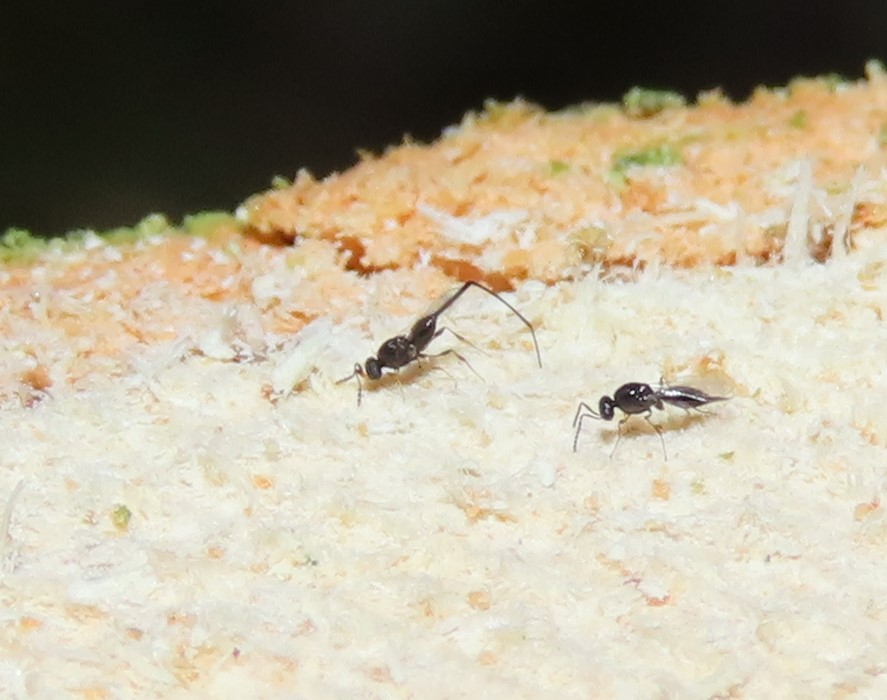
Awhile later, I noticed several minute black specks moving over the surface where I removed the branch. They had to be insects, but I could not tell what kind. I took a few photos, and was shocked to find they were miniscule wasps. Some had greatly elongated abdomens, others did not.

At least the long-bodied wasp is a Synopeas sp. platygastrid wasp.

I submitted a couple of photos to the Hymenopterists Forum, an interest group on Facebook, to solicit an identification from true expert specialists. They did not disappoint.Bob Zuparko suggested they might be in the family Platygastridae, and that was confirmed by Kendrick Fowler. He also suggested a genus, Synopeas, and subgenus Dolichotrypes. He wasn’t sure the wasp with the “normal” abdomen was even a male of the same thing. It might be something else entirely.

Fowler went on to explain that this is a known behavior, the attraction to freshly cut oak, and that the host is presumably some sort of fly in the gall midge family Cecidomyiidae. That floored me because until then I thought all gall midges attacked foliage and/or stems. Also, how did this behavior evolve? There weren’t saws of any kind until recently, in the evolutionary sense. Beavers?

I decided to dig a little deeper and discovered that there is a genus of gall midges that oviposits in this situation: Xylodiplosis. I went back out and looked at some of the branch stumps again. Amazingly, I managed to find a few gall midges laying eggs. They were much more difficult to photograph than the wasps, and not as numerous, either. Why the wasps arrived before their hosts is a mystery to me. Oh, and there is also Ledomyia, another genus of gall midge that lives in freshly cut wood like this. I’m honestly not positive which one I documented.

Female gall midge, probably Xylodiplosis sp., ovipositing.

It turns out that Xylodiplosis gall midges have all kinds of enemies. They are attacked by nematode worms (family Ektaphelenchidae), mites (family Tarsonemidae, tribe Pseudotaesonemoidini), even another kind of gall midge (Lestodiplosis xylodiplosuga). Most of the research on these has come out of Europe, by the way, so it may not apply here in North America.

Back to the wasps. Synopeas larvae do do not begin to develop until after the host gall midge larva leaves its lair in the xylem wood to pupate in the soil. The adult wasp emerges about fourteen days after the unparasitized adult of the host gall midge, according to one source (Rock and Jackson, 1985). In their findings, the rate of parasitism was about five percent, and that included another platygastrid wasp in the genus Leptacis.

In at least one of my photos of the wasps (first photo of them in this post), I can barely make out the short spine on the scutellum (top rear of thorax) that separates Synopeas from similar genera of platygastrids. Identification of species is not possible without examination of a specimen under high magnification. There are currently forty-four known species of Synopeas found in the Nearctic (North America more or less north of Central America). I will leave you to go farther down the research rabbit hole.

Sources: Awad, Jessica N. 2020. “Building a diagnostic framework for the genus Synopeas Forster (Hymenoptera: Platygastridae: Platygastrinae) based on reared specimens from Papua New Guinea.” Master of Science thesis, University of Florida.
Crawford, J.C. and J.C. Bradley. 1911.”A New Pelecinus-like Genus and Species of Platydateridae,” Proc. Ent. Soc. Wash. 13: 124-125.
Gagne, R.J. 1985. “Descriptions of new Nearctic Cecidomyiidae (Diptera) that live in xylem vessels of fresh-cut wood, and a review of Ledomyia (s. str.),” Proc. Ent. Soc. Wash. 87(1): 116-134.
Hooper, D.J. 1995. “Ektaphelenchoides winteri n. sp. (Nematoda: Ektaphelenchidae) from wood fly larvae Xylodiplosis sp. (Diptera: Cecidomyidae),” Fundamental and Applied Nematology 18(5): 465-470.
Khaustov, Alexander A., Arne Fjellberg, and Evert E. Lindquist. 2022. “A new genus and species of Pseudotarsonemoidini (Acari: Heterosstigmata: Tarsonemidae) associated with xylophagous gall midges in Norway,” Systematic and Applied Acarology 27(6): 1020-1034.
Rock, E.A. and D. Jackson. 1985. “The biology of xylophilic Cecidomyiidae (Diptera), Proc. Ent. Soc. Wash. 87(1): 135-141.
Skuhrava, M. and K. Dengler. 2001. “Lestodiplosis xylodiplosuga sp. n., a predator of Xylodiplosis sp. (Diptera: Cecidomyiidae): morphology of developmental stages, biology and behaviour,” Acta Societatis Zoologicae Bohemicae 65(1): 57-68.

Wednesday, August 26, 2015

"Zombie Ladybugs"

We have had an exceptionally wet, cool spring and summer here along the Front Range; and perhaps it was raining lady beetles, because there are more coccinellids than I have ever seen before. With the lady beetles come their insidious parasite, a wasp in the family Braconidae that goes by the name of Dinocampus coccinellae.

Convergent Lady Beetle Host, California

I first encountered the work of these bizarre wasps in southern California. Upon close inspection of a surprisingly inert Convergent Lady Beetle, I found it had beneath it a silken cocoon. I had heard of Dinocampus before, but never seen any life stage in person until then. What scientists have discovered about the species since then is nothing short of mind-blowing.

Ok, so the tiny female wasp sneaks up on an unsuspecting beetle and drives a single egg into its body using her spear-like ovipositor. The wasp larva that hatches then begins feeding as an internal parasite of the beetle. It may not kill its host, however. No, what happens is far more weird than that.

An article on the National Geographic website describes a fascinating if not frightening addition to the wasp versus beetle equation. Besides laying an egg in the host, the wasp also deposits a virus. This virus, called D. coccinellae Paralysis Virus (abbreviated "DcPV"), takes up residence in the wasp larva where it replicates.

Once the wasp larva is ready to enter the pupa stage, the virus migrates to the beetle host's nervous system where it has a paralyzing effect. The wasp larva then exits the beetle and spins a silken cocoon beneath it. While the host is helpless to move of its own free will, the virus apparently triggers periodic twitches in the beetle, enough to make it appear capable of attacking any potential parasites of the wasp cocoon.

Parasitized Lady Beetle from Plant Nursery, Colorado

Since lady beetles themselves are well-defended by toxic alkaloid chemicals in their bodies, it is unlikely any predator would attempt to attack the beetle and the wasp cocoon it is guarding. Ironically, a volatile chemical compound given off by lady beetles is what may attract the parasitic wasps to being with.

My wife found one of these beetle-and-cocoon conglomerations on the leaf of a tomato in our community garden plot here in Colorado Springs; and I found another one attached to the blade of an ornamental grass at my workplace, a plant nursery, also in Colorado Springs. Meanwhile, a friend from Facebook, Ryan Nefcy, found his own specimens and committed to rearing out the wasp.

Seven-spotted Lady Beetle Host, Colorado
© Ryan Nefcy

Rayan's stunning pictures of the miniscule wasp are shown here. His images are all the more remarkable considering ".... this thing hatched and it is SO FRICKIN SMALL. And it's moving at 100 mph trying to find a way out of the vial I have it in," as Ryan put it in one of the comments on his Facebook postings.

Adult braconid wasp © Ryan Nefcy

Ryan collected the lady beetle and cocoon on August 12, and the wasp emerged on August 21. The lady beetle host also resumed normal mobility in the aftermath, as about one-third of the victims recover from the whole ordeal.

© Ryan Nefcy

Dinocampus coccinellae is found pretty much worldwide, and is not specific as to which lady beetles it uses as hosts. Presumably, the larger the host the better, but most victims here in the U.S. appear to be either the Convergent Lady Beetle or the introduced (from Europe) Seven-spotted Lady Beetle.

Because lady beetles are important predators of aphids, scale insects, and other pests, there is at least mild concern over the impact of the braconid parasite, especially in agricultural systems that rely on biological control. Female beetles may be preferentially targeted; and the feeding activities of the wasp larva may even sterilize the host, which means that even if a victim recovers, it will be unable to reproduce.

Parasitized Lady Beetle from Community Garden, Colorado

This has been one of the most-studied members of the family Braconidae, and one may find numerous scientific papers in professional journals and online.

Sources: S. Al Abassi, M.A. Birkett, J. Pettersson, J.A. Pickett, L.J. Wadhams, and C.M. Woodcock. 2001. "Response of the Ladybird Parasitoid Dinocampus coccinellae to Toxic Alkaloids From the Seven-spot Ladybird Coccinella septempunctata," J. Chem. Ecol. 27(1): 33-43.
Schimming, Lynette. 2009. "Species Dinocampus coccinellae," Bugguide.net.

Wednesday, March 6, 2013

Wasp Wednesday: Not What You Think

Note: Special thanks to Bob Carlson and David Wahl for reviewing these images and confirming the identification. Ichneumon wasps are a tricky lot!

It is well known that many different kinds of insects mimic stinging wasps in order to foil their own predators. This is known as Batesian Mimicry, whereby the harmless or nearly defenseless animal achieves protection by resembling a poisonous or venomous “model” animal. There is another type of mimicry known as Müllerian Mimicry in which unrelated poisonous or venomous organisms share bold patterns, typically black and yellow, black and red, black and orange, or black and white. Tarantula hawk wasps, which deliver a very painful sting, are typically colored black or metallic blue with bright orange or red wings. In southeast Arizona, there is a large ichneumon wasp, Rhynchophion flammipennis, that also sports this wardrobe.

The wasp is a member of the subfamily Ophioninae, most if not all members of which are capable of stinging themselves, using their short, sharp ovipositors in self-defense. So, it is possible that this mimicry is Müllerian rather than Batesian. Many ichneumon wasps that do not sting still mimic the stinging spider wasps (Pompilidae), thread-waisted wasps (Sphecidae), and crabronid wasps (Crabronidae).

At least one host for Rhynchophion flammipennis is the Tobacco Hornworm, Manduca sexta. The female wasp locates the host caterpillar and injects an egg into its body. The wasp larva that emerges from the egg then feeds as an internal parasite (endoparasitoid). They are “koinobionts,” meaning that they attack very young caterpillars, and draw out their own life cycle such that the host caterpillar continues to grow and mature.


The closely-related Tomato Hornworm, Manduca quinquemaculata

The wasp larva inside waits patiently, then feeds in earnest as the caterpillar nears pupation, destroying it before it actually does pupate. The wasp larva then spins a dense silken cocoon in which it pupates. Since sphinx moth caterpillars pupate underground, the wasp cocoon is likewise located in the pupal chamber in the soil.

This species is known to occur in Arizona, Mexico, Nicaragua, and Ecuador. It is a member of the tribe Enicospilini, most of which are tropical wasps. There are only two other known species in the genus. While most Ophioninae are nocturnal, Rhynchophion are day-active. They even visit flowers for nectar.

Curiously, I have found other images of this species online, but in every case the antennae are black. Perhaps antenna color varies with gender? Certainly much remains to be learned about this spectacular wasp, including whether it has other hosts. Anyone who rears sphinx moths from Arizona, Mexico, or Central America should make note of any parasitic Hymenoptera that emerge from their livestock.

The specimen imaged here was observed at the mouth of Madera Canyon in Pima County, Arizona on August 21, 2011. It hung motionless from the Desert Broom plant it was clinging to. Perhaps it collided with a vehicle entering the canyon and was recuperating.

Sources: Carlson, Robert W. 2009. “Family Ichneumonidae,” Database of Hymenoptera in America north of Mexico. Discover Life.
Gauld, Ian D. and David B. Wahl. 2013. “Subfamily Ophioninae,” Genera Ichneumonorum Nearcticae. The American Entomological Institute.
Kester, K. and J. Tuttle. 1999. “Host identified for Rhynchophion flammipennis (Hymenoptera: Ichneumonidae). Southwest. Nat. 44(1): 87-88.

Wednesday, February 6, 2013

Wasp Wednesday: Orussid Wasps

I do not select stories for this blog based on maximum weirdness, they just turn out that way. Take for example the strange case of wasps in the family Orussidae. For starters, they are not often seen in the forests they inhabit; and they are easily mistaken for carpenter ants at first glance.

There are only 75 species known, in sixteen genera, for the entire world. Nine species, in four genera, occur in North America north of Mexico.

What makes these wasps truly unique is their history of defying proper classification within the order Hymenoptera. Let us start with the fact that evidence points to a parasitic lifestyle in the larval stage. Ok, so they must be related to Braconidae and Ichneumonidae. Nope. Anatomical features of adult orussids are much more similar to horntails and sawflies. No way! Way! At one point, two scientists tried to solve the dilemma by erecting an entirely new suborder, the Idiogastra, just for the Orussidae. Until recently, many entomologists lumped the Orussidae as an aberrant family within the suborder Symphyta, making them the most advanced of that group, and the most primitive of parasitic wasps.

Today, the family is placed in its own superfamily, Orussoidea, in the suborder Apocrita, the umbrella group for all parasitic and parasitoid Hymenoptera (Vilhelmsen, 2003).

Adult orussids are most often found on logs and dead, standing trees in those sections where the bark has been stripped off. Solid, but sun-bleached wood seems to be favored, and the female wasps crawl and dart across the surface in search of the tunnels of wood-boring insects. Each female detects a larval host through “vibrational sounding,” much like a bat hunts moths at night. She taps her antennae on the surface of the wood, and apparently receives the reverberating “echoes” through a subgenual organ inside each front tibia (the “shin” joint of the leg) (Broad & Quicke, 2000). Indeed, the tips of her antennae are thickened and club-like; and the tips of the front tibiae have thin cuticle concealing the vibrational receptors.

It is assumed that orussids are general parasitoids on various wood-boring insects including horntails, longhorned beetles, and jewel beetles. Most confirmed records in North America have been for jewel beetles (family Buprestidae). The female wasp usually accesses the host grub by backing into an exit hole from which another host beetle had already emerged. She may reach a grub with her ovipositor, which while coiled within her thoracic and abdominal cavities, can be more than twice the length of her body (Vilhemsen, et al., 2001).

The larva that hatches from the extremely long, slender egg is probably not entirely immobile, being equipped with a row of backward-curving spines on all dorsal thoracid and abdominal segments. The spines probably help it inch its way down tunnels to reach a host. Once it finds a host grub, the orussid larva attaches itself as an external parasite.


© Scott Justis via Bugguide.net

Look for adult orussids in both coniferous and deciduous forests, especially along the edges of meadows or where there are other sunny openings in the canopy. The wasps not only pace rapidly back and forth over a log, changing direction abruptly, but they can also jump.

Our four species in the genus Orussus are the ones you are most likely to see, if you don’t assume they are ants. Dark bands on the otherwise clear wings help disguise them as carpenter ants when the wings are folded over their back. Note the very globular head, with antennae inserted just above the mouth. There are teeth or tubercles on the top of the head.


© M J Hatfield via Bugguide.net

Our understanding of these insects, their geographic distribution, and behavior, are still sparse, so your observations can be key. Take a look at these images by Stephen Hart and these by Rollin Coville for inspiration.

Sources: Broad, Gavin R. and Donald L.J. Quicke. 2000. “The adaptive significance of host location by vibrational sounding in parasitoid wasps,” Proc. R. Soc. London B 267(1460): 2403-2409.
Goulet, Henri and John T. Huber, eds. 1993. Hymenoptera of the World: An identification guide to families. Ottawa: Agriculture Canada. 668 pp.
Powell, J.A. and W.J. Turner. 1975. “Observations on Oviposition Behavior and Host Selection in Orussus occidentalis (Hymenoptera: Siricoidea),” J. Kans. Ent. Soc. 48(3): 299-307.
Vilhelmsen, Lars. 2003. “Phylogeny and classification of the Orussidae (Insecta, Hymenoptera), a basal parasitic wasp taxon,” Zool. J. Linnean Soc. 139: 337-418.
Vilhelmsen, Lars, Nunzio Isidoro, Roberto Romani, Hasan H. Basibuyuk, and Donald L.J. Quicke. 2001. “Host location and oviposition in a basal group of parasitic wasps: the subgenual organ, ovipositor apparatus and associated structures in the Orussidae (Hymenoptera, Insecta),” Zoomorphology 121(2): 63-84.

Wednesday, November 28, 2012

Wasp Wednesday: Carrot Wasps

Around the holidays, we humans tend to pack on the pounds as we indulge in feasts and parties at Thanksgiving and Christmas. Wasps do not have this problem. One family of wasps in particular manages to stay super-slim and slender: the Gasteruptiidae or “carrot wasps.”

There are at least fifteen species of carrot wasps in North America, all in the genus Gasteruption. Five of those occur in the eastern U.S. and Canada. At first glance, they might be mistaken for ichneumon wasps, or even sphecid wasps in the genus Ammophila. This is probably not coincidental, since carrot wasps do not sting, but could benefit by looking like other wasps that can sting.

You can easily identify carrot wasps by the following characters:

  • Pronounced “neck” between head and thorax.
  • Abdomen attached high up on the thorax, not between hind legs.
  • Hind tibiae swollen (think “leg warmers”).
  • Antennae with 13 segments (male) or 14 segments (female). Ichneumon wasps have far more antennal segments.
  • Ovipositor sometimes with a white tip
Species identification often hinges on the texture of various parts of the thorax; and to a lesser degree on color pattern.

These are not terribly large insects, from 13-40 millimeters depending on the species, and much of that length owing to the long ovipositor in females. They are so skinny they remind one of a flying needle.

The adult wasps are most often encountered at flowers, especially those umbelliferous blooms in the parsley family, hence their common name of “carrot wasps.” I have also seen them at White Sweet Clover (Melilotus alba) and Desert Broom (Baccharis sarothroides), and Leafy Spurge (Euphorbia esula). Flight activity seems to peak in late spring (latter half of May) and/or mid-summer (July).

male

The biology of gasteruptiids is rather poorly known, but so far our North American species appear to be parasites of solitary bees and wasps that nest in twigs or borings in wood. The female wasp needs her long ovipositor to reach the depths of a host’s tunnel and deposit an egg. The larval carrot wasp that hatches usually feeds on the pollen, nectar, or prey stored as food for the host larva, rather than the host larva itself.

Trap-nesting for solitary bees and wasps could easily reveal many more host records for Gasteruption wasps, if one keeps careful notes.

Sources: Jennings, John T. and Andrew R. Deans. 2006. “Gasteruptiidae,” The Tree of Life Web Project, Version 22.
Smith, David R. 1996. “Review of the Gasteruptiidae (Hymenoptera) of Eastern North America,” Proc. Entomol. Soc. Wash. 98(3): 491-499.
Townes, Henry. 1950. “The Nearctic Species of Gasteruptiidae (Hymenoptera),” Proc. U.S. Nat. Mus. 100(3259): 85-145 (Note that this reference includes what is now the family Aulacidae).

Wednesday, November 14, 2012

Wasp Wednesday: Blue-winged Wasp

One of the most common solitary wasps of late summer and fall is a member of the family Scoliidae known as the “Blue-winged Wasp,” Scolia dubia. This is a fairly large insect, 20-25 millimeters in length, and easily identified by its bi-colored abdomen: Black on the upper half and red on the bottom half, with two bright yellow spots in the red area. There is rarely any variation in that color scheme, either. The common name stems from the brilliant blue highlights in the black wings that shine when sunlight hits them just right.

Scolia dubia is also a widespread species, found from Massachusetts to Florida, and west to Colorado, Arizona, and southern California. I have found them in New Jersey, Ohio, and Colorado. They are parasites of the grubs of scarab beetles, particularly the Green June Beetle, Cotinis nitida, and Japanese Beetles, Popilla japonica. Since Colorado has neither of these species, the Blue-winged Wasp must exploit a different host here. We certainly have plenty of May beetles (genus Phyllophaga), and the Bumble Flower Beetle (Euphoria inda), so I suspect those are the local hosts here in Colorado Springs.

The female wasp somehow divines the presence of beetle grubs underground while flying low over the surface of the soil in what approximates a figure-eight pattern. When she detects one, she lands, and sets about unearthing it. Scoliid wasps have strong legs that are heavily spined. This adaptation facilitates their digging activities.

An exposed scarab grub will writhe around and seek to rebury itself immediately. The wasp stings the larva to paralyze it and allow her to manipulate it. She may leave the grub in situ, or tunnel below it, excavating a small chamber where she deposits the beetle larva and lays an egg on it, perpendicular its body. She then seals the chamber and leaves to start the process all over again, often staying underground and digging her way to the next grub.

Interestingly, these wasps may sting several grubs without laying eggs on them. The paralysis of the beetle larva is usually permanent, so regardless of whether they become food for larval wasps, the beetle grubs are unable to complete their own life cycle. This is a good thing if you happen to have an infestation of “white grubs” in your lawn or garden.

Back to the egg on the beetle grub, though. The wasp larva that hatches feeds as an external parasite on the grub for one or two weeks before spinning a silken cocoon around itself. There it will remain as a pre-pupa for the winter, pupating the following summer and eventually emerging as an adult wasp.

Male and female scoliid wasps commonly visit flowers to feed on nectar (and perhaps pollen). I find them most often on White Sweet Clover, Melilotus alba, thoroughworts (genus Eupatorium), and goldenrod (Solidago spp.). Males can be identified by their long antennae and overall more slender appearance. Males have a distinctive, three-pronged “pseudostinger” that is part of their external genitalia. Males cannot sting, and females are loathe to sting unless physically molested.

Another interesting aspect of the males is their behavior. Males also fly near the ground in a sinuous pattern, hoping to detect virgin females emerging from the ground. This usually happens in the morning, and males abandon their searching by late afternoon. At that time, they may gather together to roost for the night on vegetation, as the image below depicts.


© Tim Moyer via Bugguide.net

Keep an eye out for the Blue-winged Wasp in your own yard. Remember they are beneficial, but beware that large numbers of them may indicate you have a serious problem with white grubs.

Sources: Grissell, Edward E. 2007. “Scoliid Wasps of Florida, Campsomeris, Scolia, and Trielis spp. (Insecta: Hymenoptera: Scoliidae),” Featured Creatures, document EENY-409, Entomology and Nematology Department, Florida Cooperative Extension Service, Institute of Food and Agricultural Sciences (IFAS), University of Florida.
Rau, Phil and Nellie. 1918. Wasp Studies Afield. Princeton, NJ: Princeton University Press. 372 pp (Dover Edition).