Showing posts with label Coleoptera. Show all posts

Wednesday, August 12, 2026

Jewel Beetle Spring

As I write this, Leavenworth, Kansas, USA, is under an (checks notes) “extreme heat warning,” expected to last for another two days at least. It has been an excessively hot summer, and I am recounting memories from spring more than I am making new discoveries. One thing that stands out was the diversity of jewel beetles, family Buprestidae, that I found during the month of May this year.

Blue Spotwood Borer, Agrilus acutipennis

Jewel beetles are also known as metallic woodborers for their often brilliant, iridescent colors; and called flathead borers for the flattened larval stage. The adult beetles are frequently alert, dashing or flying away at the first hint of potential danger, making them a challenge to photograph. Others are exceptionally cryptic, relying on camouflage and stillness to avoid detection in the first place. Some species exhibit all of these characteristics and behaviors.

Emerald Ash Borer from May 30, 2021, Leavenworth, Kansas.

Yes, some species can be pests, namely the Emerald Ash Borer, Agrilus planipennis, but that is a species native to east Asia. It is extremely problematic where it has been introduced. Most jewel beetle species are kept in check by parasitoid wasps, predatory beetles, and other natural controls.

Unidentified Agrilus sp. from Weston Bend State Park, Missouri.

On May 4, Heidi and I went across the river to Weston Bend State Park in Missouri, one of our favorite haunts during spring bird migration. It turned out to be pretty good for insects, too, including some jewel beetles. I spotted one of the many species of the genus Agrilus that can be found in our neck of the woods. These are small, usually well under ten millimeters, very narrow and elongate, and more often than not have muted colors. They are most often seen on foliage in sunny spots in the forest understory, or along forest edges.

Texania campestris, Weston Bend State Park, Missouri.

Heidi, while taking pictures of moss or mushrooms on a stump, suddenly exclaimed that she saw a huge buprestid. Indeed, she found a big specimen of the Hardwood Heartwood Buprestid, Texania campestris. It is very likely the largest species of jewel beetle in our immediate area, ranging from 20-30 millimeters. It can be confused with the pine-boring genus Chalcophora that is found elsewhere in Missouri.

Texania campestris

T. campestris occurs east of the Great Plains, but is more common in the southern U.S. than elsewhere. Known host plants for the larvae include American Beech, American Sycamore, maples, and Black Willow.

Texania campestris

Closer to home, I visited Havens Park here in Leavenworth, on May 13. It is the closest thing to a “wild” park within walking distance. It is a hilly park, at the top of which is something of a plateau. There, at the summit, more or less, is a degraded glade habitat, more xeric than the surrounding forest, dominated by Eastern Redcedar, and some of the hardier oaks.

Blue Spotwood Borer, Leavenworth, Kansas.

I found a handful of jewel beetles flying around, and landing on, some oak saplings in one sunny spot. They turned out to be the Blue Spotwood Borer, Agrilus acutipennis, infrequently to rarely collected, according to one recent source. This is a spectacular species for the genus, at 7-10 millimeters in length, and vivid metallic blue with white scales highlighting the edges of the pronotum (top of thorax), and the sides and venter of the abdomen.

Blue Spotwood Borer

The Blue Spotwood Borer is found east of the Great Plains, well into Canada. Larvae are known to bore in Eastern White Oak, and Overcup Oak, but the adult beetles alight on all kinds of other oaks, hickories, and walnut.

Brachys ovatus, Havens Park, Leavenworth, Kansas.

In contrast to that showy species, I also noticed a Brachys ovatus, doing its best impression of a dried-up leaf edge. At only 4-7 millimeters, it is easily overlooked despite how relatively common it is, throughout eastern North America. Oddly, males of this species are rarely seen, and it may reproduce by parthenogenesis. Larvae bore in Northern Red Oak.

Common Hackberry Agrilus, Havens Park, Leavenworth, Kansas.

I also found an unusually lethargic Common Hackberry Agrilus, Agrilus lecontei, also on an oak leaf. I thought it might even be dead, a victim of a robber fly or other predator. I collected it into a vial, and by the time I got home it was apparent it was very much alive.

Common Hackberry Agrilus alive and well!

This is another small (4-7 mm) species that is supposedly uncommon, despite its widespread distribution east of the Great Plains.

Redbud Borer, Leavenworth, Kansas.

We have several Eastern Redbud trees “volunteering” in our yards, so it was not surprising to discover a Redbud Borer, Ptosima gibbicollis, on one of them on May 18.These little beetles are only 4-7 millimeters, but black with bright yellow markings, so they are easy to see.

Redbud Borer

On May 20, I was surprised and delighted to spot a Two-lined Chestnut Borer, Agrilus bilineatus, on a leaf near our front steps.

Two-lined Chestnut Borer, Leavenworth, Kansas.

Despite the name, this beetle uses a variety of oak species as host trees. It is a widespread and common species east of the Great Plains, but this is the first time I have seen one. It is 4-10 millimeters long.

Two-lined Chestnut Borer

I walk our neighborhood regularly, weather permitting, but on May 22 I took only my phone with me. Naturally, I found a lovely specimen of Anthaxia cyanella on a leaf in a hedge adjacent to an open field.

Anthaxia cyanella, Leavenworth, Kansas.

This brilliant blue beetle is only 4-5 millimeters long, and is apparently infrequently encountered. Larvae are known to bore in Eastern Redbud, Honeylocust, Downy Serviceberry, and River Birch. Adult Anthaxia species in general are usually seen on flowers, especially composites.

Beech Borer, Leavenworth, Kansas.

On May 26, once again with only my phone at hand, I noticed a Beech Borer, Agrilus obsoletoguttatus, in the little butterfly garden along one exterior wall of our local library.

Beech Borer from blacklighting in Leavenworth on June 10, 2021.

This beetle, 4-8 millimeters in length, is quite common east of the Great Plains. Larval host trees include Dwarf Chinkapin Oak, Northern Red Oak, Ohio Buckeye, Eastern Hophornbeam, and Honeylocust, among others.

Heidi and I hiked the VA Trails, another mostly wild park along the Missouri River on the Kansas side here in Leavenworth, on May 27. I didn’t see any jewel beetles until we came back to the parking lot and I noticed a large, recently-downed limb of an oak tree about fifty yards away.

Chrysobothris sp., VA Trails, Leavenworth, Kansas.

Storm damage provides woodboring beetles of all sorts with fresh resources that they quickly locate and oviposit into. Among the more reliable arrivals will be jewel beetles in the genus Chrysobothris. The bad news is that they all look very similar and are extremely challenging to identify.

Sure enough, I found several of these cryptic gems running over the bark of the tree limb. The Chrysobothris femorata species complex is probably what this one falls under. The species is named the Flatheaded Appletree Borer, but there is a wide range of deciduous trees used as hosts. These are probably opportunistic generalists that take advantage of storm damage and logging operations. Chrysobothris are midsize jewel beetles, ranging from 7-16 millimeters in this particular instance.

Chrysobothris sp. Males thump their butts on the log to get the attention of females.

Jewel beetles can be found during most of the warmer months, but spring, even early spring, is perhaps the best time to be looking for them. They are well worth pursuing, and you can help add to our collective scientific knowledge by sharing your observations on iNaturalist, Bugguide, and elsewhere. Happy Hunting!

OK, BYE-E-E-E!

Sources: Paiero, Sten M., et al. 2012. Field Guide to the Jewel Beetles (Coleoptera: Buprestidae) of Northeastern North America. Canadian Food Inspection Agency. 411 pp.
Solomon, J.D. 1995. Guide to Insect Borers of North American Broadleaf Trees and Shrubs. Agriculture Handbook 706. Washington, DC: U.S. Department of Agriculture, Forest Service. 735 pp.

Saturday, April 11, 2026

The Beetle and the Bee

At the end of February, I finally found a beetle I had been looking for here, for years. Perhaps I had not been scouting for it early enough, but we barely had a winter this year, and I suspect that most years it would have been evident in March. The key was finding an aggregation of its host organism.

Tricrania sanguinipennis is a blister beetle in the family Meloidae. The adult insects measure 9-15 millimeters, but are bright enough, and active enough, that they are easily seen. Their wings, hidden under their red, leathery elytra, are almost vestigial, so they are flightless. Instead they crawl, but rather rapidly, over the surface of the soil, periodically digging where they detect the possible presence of a host.

Kansas is about as far west as this beetle is found, though there are records well north into Saskatchewan, Canada. It occurs over the eastern U.S. to extreme northern Florida, and up into adjacent southern Canada.

The limiting factor is that Tricrania sanguinipennis is a parasitoid of solitary bees that nest in dense aggregations, namely cellophane bees in the genus Colletes.

We have the Unequal Cellophane Bee, Colletes inaequalis, nesting in our yard and/or the adjacent neighbor’s lawn, depending on the year, but those locations are apparently blister beetle-free. It took finding a small aggregation of the bees in a forested park to locate the beetles.

An Unequal Cellophane Bee lurks just inside the entrance to her burrow.

The bees nest in burrows, ideally in sandy soil. The vertical, subterranean tunnels branch into several individual cells, each one an “apartment” for a single bee larva. The grub feeds on a nearly liquid loaf of pollen and nectar. The walls of its room are coated in a type of natural plastic manufactured in glands in its mother’s abdomen, which essentially waterproofs the chamber, and retards mold and fungus.

Back to the beetles. What the female beetles lack in mobility, they more than make up for in fecundity. Each lady can produce hundreds of eggs, over a thousand in some documented instances. How, then, do the beetles gain entry into these tunnels? The answer is that they do not. The larvae do.

The larval stage is unusually lengthy, progressing through six instars. An instar is the interval between molts. It is also strange in that it includes hypermetamorphosis. In this case that means the larval form changes radically in both appearance and behavior from one molt to the next.

Several male Unequal Cellophane Bees waiting for females to emerge.

The first instar larva that emerges from the egg is a sleek, streamlined, highly mobile bee-seeking missile called a triungulin. At the time they are active, it is almost exclusively male Colletes bees that are active, buzzing about and frequently landing to investigate a potential site where a female could emerge. It is at these brief moments when a blister beetle triungulin scampers aboard, affixing itself to the hairs on the underside of the bee’s abdomen.

Oops! An overeager male mistakes another male for a female.

When the male bee at last is able to mate, the triungulin transfers to the female bee. In at least a few instances, the triungulin may attach directly to a female bee that it encounters on the ground. She will eventually, and unwittingly, ferry that parasite, and probably several others, to her new nest burrow. Once inside, it disembarks and infiltrates one of the subterranean nest cells.

The beetle larva usually consumes the egg of the host immediately, but not always. The bulk of its diet will be the honey and pollen left by the bee for its offspring in the cell. It may be a frequent occurrence that more than one beetle larva invades a single bee cell. In that event, cannibalism of the competition resolves the conflict.

The meal of the host egg or larva is usually enough nutrition to trigger the beetle larva’s molt to the next instar. This results in a shocking change from that sleek, active larva into the insect equivalent of a couch potato. The second instar is, shall we say….rotund, and boat-shaped. It commences feeding on the pollen and nectar stores in the cell of the now missing bee offspring. The insect retains this form for the remainder of its larval life. The first three instars shuck their old exoskeleton completely, but the fourth and fifth instars retain each molt in its entirety. Think of it as an object inside a balloon (inside another balloon by the fifth instar). Those larvae actually shrink in size to fit inside the shed “skins.” When molting into the pupa stage, the sixth molt is again broken during shedding, and compacted at the rear of the pupa, which is still inside those other exoskeleton balloons.

It takes until late summer or early fall for the life cycle to complete, the adult beetle remaining encased in its final one or two larval exuviae, where it overwinters, still inside the cell in the host’s nest burrow.

You would think that the bee species hosting this diabolical beetle would be decimated by it, but such is not the case. Each spring there are plenty of the adult bees. What is more of a threat is the potential disconnect between the bees and their nectar plants. Colletes inaequalis visits flowering trees almost exclusively, especially Eastern Redbud, and maple trees. As the phenology of the blooming cycles becomes increasingly unpredictable thanks to climate change, the appearance of the flowers may cease to always coincide with the emergence of the bees that pollinate them.

Sources: Messinger Carril, Olivia, and Joseph S. Wilson. 2021. Common Bees of Eastern North America. Princeton, NJ: Princeton University Press. 286 pp.
Parker, J.B. and Adam G. Boving. 1925. “The Blister Beetle Tricrania sanguinipennis - Biology, Descriptions of Different Stages, and Systematic Relationship,” Proc U.S. Nat. Mus. 64(2491): 1-40. This is a wonderfully exhaustive article, with illustrations of all larval instars.

Saturday, December 14, 2024

Sunday, July 10, 2022

It Pays to do the Dishes: A Rarely-Seen Beetle is Found

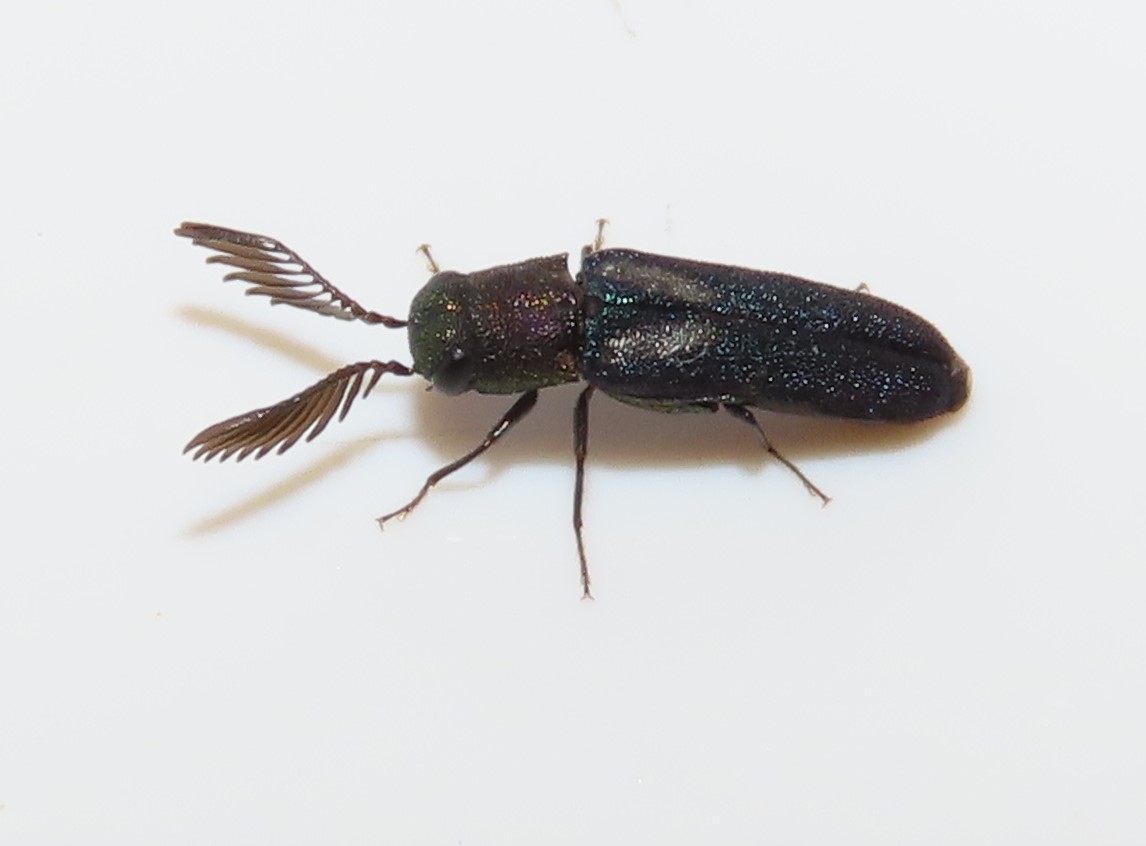
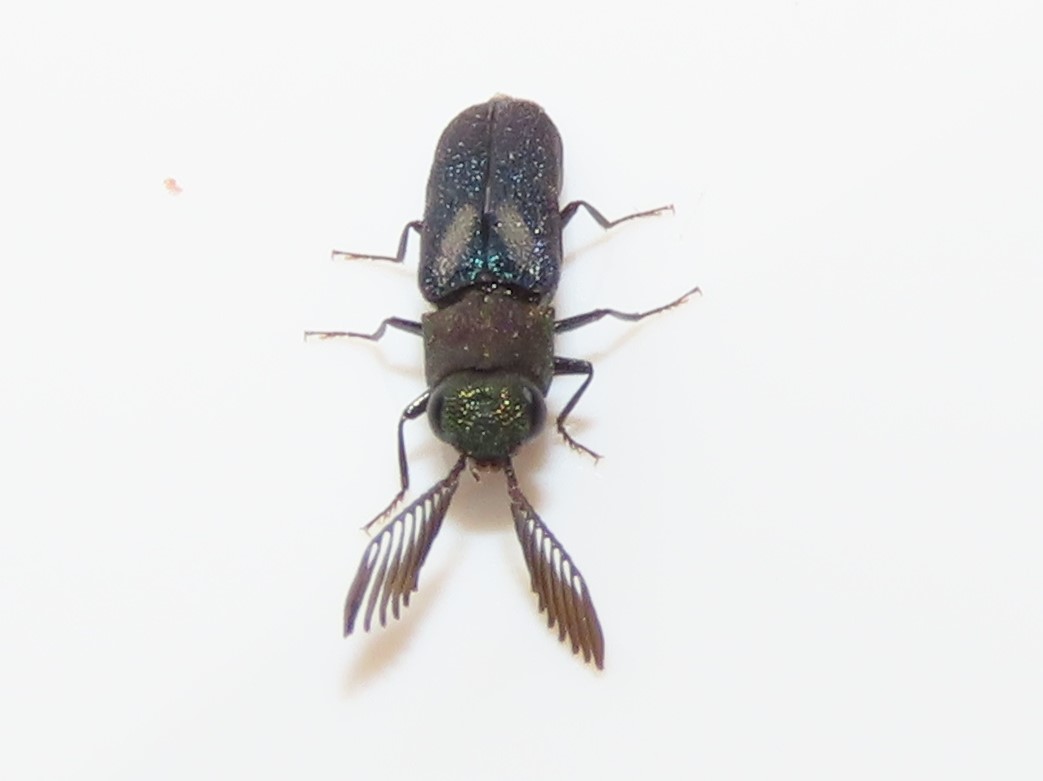
The other day, July 7, I was washing the dishes and noticed a small insect clinging to the outside window screen. Perhaps it had taken shelter during the early morning storms that day….When I was finished with the plates and silverware, I went out to see what the creature was. It was a small jewel beetle, family Buprestidae. I took a picture and decided it was a species of Agrilus that I had not seen before in our Leavenworth, Kansas, USA yard. Boy, was I wrong.

When I first saw it, the beetle had all its appendages tucked in pretty close to its body, but when I disturbed it, it unfurled comb-like (pectinate) antennae, something you do not expect to see in a buprestid. I knew there was at least one species in which the male has this brand of antennae, so I looked it up.

Turns out it is the rarely-seen Xenorhipis brandeli. This specimen is on the large end of the 3-7 millimeter size scale for the species. Given that it is not economically important (damaging), a surprising amount of information is known about it. Unfortunately, most of the relevant papers are locked behind pay walls, and therefore not readily accessible to me.

Xenorhipis brendeli is one of only three species in the genus found in North America north of Mexico, and the only one ranging into the northeast U.S. All exhibit sexual dimorphism in the antennae, females lacking the branches that the males do.

Ringo Compean, commenting on one of my Facebook posts, said “That’s an eyelash bug.” How perfectly descriptive! It is still a subdued beetle compared to many members of the Buprestidae. It is basically black or dark brown with blue, green, and/or bronzy highlights, and yellowish accents on the “shoulders.”

Besides the extravagant antennae, males have a pair of large pits on the underside, on what amounts to their “chest.” These cavities are lined with many setae (hairs) that probably have some sort of chemosensory function. The antennae are definitely tuned to the species-specific pheromone released by virgin females. The insects are diurnal, but there is a narrow window when females emit their attractive scent. Males, at least, are very short-lived, so there is great urgency in finding a mate.

The preferred host trees for Xenorhipis brendeli are apparently hickories (Carya spp.), which includes pecans. There are plenty of hickories in Leavenworth, plus pecans in the bottomlands on Fort Leavenworth. Other known hosts include River Birch and Eastern White Oak.

The female beetle lays her eggs in crevices of bark on small limbs, about 5/8ths inches in diameter. This is of interest because I had piled small, dead and broken tree branches from our yard into a backyard brush pile for birds over the winter months. These were mostly from Pin Oak and maple, though.

The larvae that hatch from the eggs bore under the bark….and that is the extent of the preview I am allowed for the 1966 paper by S. G. Wellso.

The fate of this specimen is spoken for. It will be in the collection of a friend and colleague in Arizona, where it will have relative immortality beyond this blog post, eventually available for loan to scientists elsewhere in the world. Meanwhile, I might have to inspect that brush pile again.

Sources:Paiero Steven M., Morgan D. Jackson, et al. 2012. Field Guide to the Jewel Beetles (Coleoptera: Buprestidae) of Northeastern North America. Ontario: Canadian Food Inspection Agency. 411 pp.
Evans, Arthur V. 2014. Beetles of Eastern North America. Princeton, New Jersey: Princeton University Press. 560 pp.
MacRae, Ted C. 2012. “Extreme sexual dimorphism in Buprestidae: Xenorhipis hidalgoensis,” Beetles in the Bush.
Wellso, S.G. 1966. Sexual Attraction and Biology of Xenorhipis brendeli (Coleoptera: Buprestidae). J. Kansas Ent. Soc. 39: 242-245.
MacRae, Ted. 2008. “A new species of Xenorhipus from Baja California,” Beetles in the Bush.

Thursday, April 25, 2019

Borids Are Not Bor-ing

Well, that will teach me to never go anywhere without a vial or other appropriate vessel for containing a live insect. It is impossible to know when you will be presented with an unusual or rare species, so best to be prepared. A case in point occurred on Saturday, April 20, while I was manning the booth for the Mile High Bug Club at the Earth Day expo in Garden of the Gods Park here in Colorado Springs.

Lecontia discicollis, 12-23 millimeters

We had erected a canopy over our table, and at one point I noticed the shadow of a beetle atop the white tarpaulin. I did not think much of it initially, but curiosity got the better of me and I went to inspect it. I am not a tall person, so all I could manage, even on my tip-toes, was a vague, rear perspective of the insect. It was enough to convince me this was something interesting, so I grabbed the beetle. It was shiny black, and slippery thanks to its convex, bullet-like shape.

Mile High Bug Club booth

A closer examination left me stumped. It reminded me of a bark-gnawing beetle in the family Trogossitidae, but those are highly agile and usually at least slightly iridescent or metallic. This beetle was jet black and decidedly slow-moving. Meanwhile, the antennae were bead-like and reminiscent of a darkling beetle (family Tenebrionidae). Few tenebrionids are so narrow-bodied, though, and those exposed jaws suggested it was something else.

Bark-gnawing beetle, Temnoscheila sp., Colorado

I had not packed any kind of container with me, even though I knew our booth would be in the visitor center parking lot. It has been a long winter and cool, slow, spring, so I wasn't expecting to see any insects.

I racked my brain for potential solutions. Ah, a little ziplock baggie I have my business cards in! Oops, so old it has a gaping hole in it. Now what? I pawed through the compartment in my backpack and managed to find a case for eyeglasses, which thankfully shuts tight enough to hold an invertebrate. In goes the beetle.

EBCD: Emergency Beetle Containment Device

Back home, I take a closer look and start leafing through my beetle books. Still scratching my head I look at all things related, even remotely, to darkling beetles. Lo and behold, I turned to an illustration that looked pretty much identical to my specimen. Above the drawing I read "Boridae," and "Family common name: The conifer bark beetles." Never heard of them. That is how diverse beetles are. Entire families can escape your attention.

Anyone hearing "bark beetle" assumes the creature in question is some type of forest pest, but many kinds of beetles associated with the trunks of trees have been assigned some derivative of "bark beetle," and almost none of them are the least bit destructive. That appears to be the case here, too, but we have a collective void of knowledge about borids.

The base of the antenna is concealed by a ridge, a helpful identification character

Consulting several references, I could find little information. The family is obscure enough that several books did not even include them, or were of sufficient vintage that the family did not yet exist. Previously, borids had been part of the Salpingidae (narrow-waisted bark beetles). Most other information I could excavate amounted to "found under bark on conifers." It seems these beetles also like their trees baked. Ok, singed. Fine, they are basically drawn to charred timber, three to five years after a fire.

Once I had the specimen in the right family, identifying the genus and species was easy. There are only two genera, with one species each, found north of Mexico. The one in my hand was Lecontia discicollis.

I turned to Facebook, in particular the group "Friends of Coleoptera at the Natural History Museum [London]," for more help. The resulting discussion included this shared passage from Pollock (2010) in the Handbook of Zoology, Coleoptera vol. II (Leschen, Beutel & Lawrence, eds.):

"Relatively little is known, or at least published, on the habits and habitats of members of Boridae....Larvae of Lecontia discicollis are also associated with dead conifers, and seemingly are restricted to moist decayed areas in the root system of standing trees killed by fire or bark beetles (Young et al. 1996)."

Another colleague added "Lecontia discicollis is not rare if you know how to find them. Fairly common in the Black Hills [South Dakota] in and around fire killed 8-15 year old Ponderosa pine, 3-5 years after death. Larvae in soft and moist white-rotted wood near and below ground-level."

The consensus seems to be that these may be common beetles, but because they occupy such a narrow, extreme niche, you are not likely to see them very often. I will consider myself lucky, then.

Sources: Elliott, Lynette, et al. 2005. "Family Boridae - Conifer Bark Beetles," Bugguide.net
Evans, Arthur V. 2014. Beetles of Eastern North America. Princeton, New Jersey: Princeton University Press. 560 pp.
Pollock, Darren A. 2002. "Boridae" in Arnett, Ross H., Michael C. Thomas, Paul E. Skelley, and J. Howard Frank. American Beetles volume 2. Boca Raton: CRC Press. pp. 534-536.

Sunday, October 21, 2018

A Couple of Weirdos

My last post here focused on the joys of National Moth Week, but what I neglected to mention was the added benefit of other insects being attracted to blacklights. Sometimes you get strange and significant surprises at your ultraviolet beacon. This is the story of two of those.

Clown beetle, Ulkeus intricatus, from Chico Basin Ranch

During our first moth week event at Chico Basin Ranch on July 21, we were all taking images of the moths that were drawn to our lights. There were plenty of other insects, too, like true bugs, flies, even a few wasps, plus lacewings, antlions, and beetles. I tried to document most everything, but it was not until I began editing my pictures that I noticed something spectacularly wierd. In one corner of an image of a moth was a beetle I recognized instantly as a "clown beetle" in the family Histeridae, but it had strange flanges on its legs and was a lot more bristly and "groovy" than the usual hister beetle.

It was reddish in color, too, while nearly all other clown beetles are jet black. I was aware that some clown beetles are found only in association with ants, and so I began looking at various species in the subfamily Hetaeriinae. Sure enough, up popped Ulkeus intricatus as the most likely suspect.

Legionary ants, Neivamyrmex sp., hosts of the clown beetle

So, now I begin researching this species, or at least the genus, to find out what its life history is like. It turns out that it is found only in the company of legionary ants in the genus Neivamyrmex, which makes things stranger still. Legionary ants are in a group of ants that includes army ants. They are nomadic, and mostly nocturnal, raiding the nests of other ants to prey on the larvae and pupae. This explains why the beetle was flying just after sunset: It was looking for a party of legionary ants and got distracted by our UV lights.

Exactly what the beetle does with, or to, the ants is largely unknown. My references say that the beetles are "guests" of the ants, which could mean anything from mutualism to kleptoparasitism (mutually beneficial relationship versus stealing the ant's food), or something else entirely. Exactly how the beetle would complete its life cycle if its host has no nest raises questions, too, though Neivamyrmex colonies are known to be sedentary over the winter.

Male legionary ants like this one fly to lights at night, too

There are six recognized species in the genus Ulkeus in the U.S., collectively ranging from North Carolina and Tennessee to Florida and west to Texas and Arizona. Five of those species are yet to be named and described, so I may be jumping the gun to assign a species to this one, especially since I never saw the thing let alone collected it. For all I know it is a seventh species.

Braconid wasp, Chrysopophthorus americanus

My wife and I put out a blacklight near Lyons, Colorado on July 22, despite cool and damp conditions, and among the many insects that flew in was a small, ghostly-looking wasp. I recognized that it was probably a member of the family Braconidae, wasps parasitic on other insects, but was baffled after that. Thankfully, there is Bugguide.net, and I started browsing the images to see if anyone else had recorded this wasp and, if so, was it identified.

Lo and behold, there it was, identified as Chrysopophthorus americanus. That almost never happens, being able to get a species identification that way. What's more, I learned that this wasp is a parasite of adult green lacewings (Neuroptera: Chrysopidae). Talk about a specialized niche. Since lacewings are often attracted to lights, it stands to reason that their parasites would be, too. Apparently the female wasp inserts her egg into the abdomen of the lacewing. The larva that hatches then feeds as an internal parasite inside the lacewing, eventually exiting to pupate.

Those beautiful emerald eyes!

What a wacky couple of "bugs." That is what I love about entomology, and natural history in general: You never know where one observation is going to take you, how one species intertwines with others....It is supposed to be a mild night here on October 21 and I am half-tempted to put the sheet and the blacklight out.

Sources: Caterino, Michael S. and Alexey K. Tishechkin. 2009. "A New North American Genus of Hetaeraiinae (Coleoptera: Histeridae), with Descriptions of Six New Species from the U.S.A. and Mexico," Zootaxa, 2311: 1-18.
Maxwell, John R., et al. 2008. "Species Chrysopophthorus americanus," Bugguide.

Wednesday, April 4, 2018

Odd Little Weevils

Over the eons....ok, decades, but it seems like eons, I have honed my search image for cryptic insects that other people overlook. Last week I was rewarded for discerning a pebble-mimicking insect from debris on the sidewalk. I will not disclose the number of times I have scrutinized some little object that turned out to be an actual pebble, bird poop, or other inanimate thing. This particular creature turned out to be a common but seldom-seen "bison dung weevil," genus Thecesternus.

These beetles, also known as "bison snout beetles," get their name from having first been discovered as habitually seeking shelter under chunks of bison dung on the North American plains. The weevils are nocturnal, flightless, and need protection from the searing heat of the day. Back in the day, "buffalo chips" were the most plentiful answer to that problem.

There are seven species of Thecesternus collectively found in the central, eastern, and southwest U.S. north to Alberta in Canada. They are only about six millimeters in body length, have a very truncated "nose," and are expert in feigning death by drawing in their face, antennae, and, to some degree, legs when frightened by a potential predator. It was difficult to get images of this particular specimen with its antennae extended, so sensitive was it to motion, vibration, and apparently even the camera flash. This represents only the third specimen I have found in Colorado, and one of the other two was dead when I discovered it.

What little we know about these beetles is thanks to the evaluation of one species, T. hirsutus, as a potential biological control in Australia for Parthenium hysterophorus, variously known as Santa Maria, Santa Maria Feverfew, Whitetop Weed, Famine Weed, and Bhajpa Weed, among other aliases. Native to the New World tropics, this plant is known for causing respiratory allergies, contact dermatitis, and genetic mutations in both people and livestock. It is not without redeeming attributes, too, but it has no place in regions where it did not originate. Consequently, several insects have been employed to control it.

Thecesternus hirsutus spends the winter in the larval stage, underground. Larvae hatch from eggs laid in the soil by the adult female weevils in the fall, when autumn rains trigger growth in plant life. The C-shaped grubs then burrow deeper and begin feeding externally on the roots of the host plant. Their activity stimulates the formation of a gall that eventually reaches about ten millimeters in diameter. Each larva encloses itself in an earthen chamber around its feeding site for protection from soil-dwelling predators. The cell is initially rather fragile, but is reinforced internally by anal secretions the larva applies to the interior walls with its mouth. The resulting "room" is quite durable.

The larvae feed into the winter months, reaching maturity between December and February (remember we are talking northern Mexico). The larvae remain dormant until early April when they molt into the pupa stage. Adult beetles emerge in April or May. The beetles feed above ground over the summer before starting the cycle anew.

In the laboratory rearing of T. hirsutus, a few young larvae were found in spring, indicating that some adult females may oviposit (lay eggs) at that time, resulting in a partial second generation of grubs during the summer months when it is usually adults that are present. Both of the living adult specimens I have encountered were found in April here in El Paso County, Colorado.

T. hirsutus turned out to be a poor candidate for control of Parthenium hysterophorus, but the rearing of the weevils demonstrated how well adapted they are to unpredictable weather patterns and volatile changes in climate. This may be a genus of beetles worth examining more in-depth as models of flexibility in the face of global warming and its attendant yearly extremes of heat, drought, and deluge.

The first specimen I discovered in Black Forest, Colorado

Sources: Arnett, Ross H., Jr., Michael C. Thomas, Paul E. Skelley, and J. Howard Frank, eds. 2002. American Beetles (vol. 2). Boca Raton: CRC Press. 861 pp.
Jacques, H.E. 1951. How to Know the Beetles. Dubuque, Iowa: Wm. C. Brown Company Publishers. 372 pp.
McClay, A.S. and D.M. Anderson. 1985. "Biology and Immature Stages of Thecesternus hirsutus Pierce (Coleoptera: Curculionidae) in North-eastern Mexico," Proc. Entomol. Soc. Wash. 87: 207-215.
Patel, Seema. 2011. "Harmful and beneficial aspects of Parthenium hysterophorus: an update," 3 Biotech 1(1): 1-9.