Showing posts with label Syrphidae. Show all posts

Saturday, August 20, 2016

Don't Sweat 'em

During the heat of summer, we all perspire. Some insects find that bodily function irresistible. Among them are sweat bees, various flies, and even butterflies. It is believed that the salts, minerals, and other compounds in our sweat are necessary for these insects, and difficult to find elsewhere. While you might assume that any insect landing on you intends to bite or sting, rest assured these insects are harmless.

Female sweat bee, Halictus rubicundus

Solitary and semi-social bees in the family Halictidae are collectively known as "sweat bees" because of their habit of lapping up human sweat with their short "tongues." They may tickle at most, but if you smack one absent-mindedly, it may indeed sting if it is a female bee. Male bees lack stingers.

Two different sweat bees, both Lasioglossum species

Sweat bees come in a variety of sizes and colors, from miniscule brassy Lasioglossum species to brilliant metallic Agapostemon species (and related genera). Members of the genus Halictus are medium-sized and brown or blackish with white bands across the abdomen. Nearly all species nest in the soil, each female excavating her own burrow.

Female sweat bee, Agapostemon sp.

Compounding the problem of recognizing the different insects that seek out your sweat is the fact that many flies in the family Syrphidae are wrongly called "sweat bees" in casual and regional language. Syrphid flies are more properly called "flower flies" here in the U.S. and Canada, and "hover flies" in Europe.

Tiny Toxomerus syrphid flies are often mistaken for sweat bees

Like bees, they can be important pollinators of flowers, but it is in their youth that they are most beneficial. The larvae of many flower flies prey on aphids, which are major crop and garden pests. Thus, the more syrphid flies, the better, even if they do want to drink your perspiration.

Unidentified syrphid fly on my arm, lapping sweat

Plenty of other flies, mostly blow flies (family Calliphoridae), and flesh flies (family Sarcophagidae), will land on us, too. Even some tachinid flies (Tachinidae) will wander around on bare hands and arms. They may not all be there for moisture or salts.

Tachinid fly using me as a lookout post

Some of these flies may be males that are simply using us as convenient perches from which to defend their territory. They will periodically fly off to chase away competing males, or pursue passing females.

Some butterflies are well-known for requiring certain minerals to complete their life cycle. Usually, male butterflies congregate around mud puddles, puddles of urine or piles of scat left by mammals, or even rotting carcasses, where they obtain nutrients that they will pass to females during mating.

Hackberry Emperor butterfly getting salts from animal dung instead of sweat

Males with a higher mineral content are more desirable to females, though how this is determined remains something of a mystery. She puts the transferred chemicals to good use in producing her eggs.

Occasionally, some butterflies will use us as substitutes for their usual mineral resources. I once had a Hackberry Emperor butterfly land on my toe while I was sunbathing in a park in Cincinnati. I had another land right on my sunglasses in a different location in Ohio, but he viewed me as a convenient perch from which to defend his territory.

Female Lasioglossum sweat bee with tongue extended, lapping sweat

Most research into the attractiveness of human sweat to insects has been directed at blood-feeding insects such as mosquitoes and other biting flies. Consequently, there is relatively little known, and much assumed, about the fascination non-biting "bugs" have with our skin pore excretions. One thing scientists can agree on? Don't sweat the sweat bees.

Tiny female Lasioglossum sweat bee on my fingernail

Source: Gibb, Timothy. 2015. "Do Not Confuse Hover Flies with Sweat Bees," Purdue Plant & Pest Diagnostic Laboratory, Purdue Extension, Purdue University.

Unidentified tachinid fly grooming itself on my arm

Friday, May 27, 2016

Eight Illinois Wasp and Bee Mimics in Twenty Minutes

One of the few entomologically-rewarding stops on our recent road trip was at the National Trail Rest Area on Interstate 70 near Altamont, Illinois, on May 16. A brief bit of sunshine warmed the woodland edges enough to bring out a wealth of fly diversity, many of which were mimics of various wasps and bees. There were even a few real wasps.

Somula decora syrphid fly

Large patches of touch-me-nots (aka "jewelweed") carpeted the edges of the lawn where it gave way to forest, and the leaves of this plant offered places to bask for many insects. The first fly I spotted was one of my favorites in the family Syrphidae (flower flies). Somula decora is roughly the size of a honey bee, black in color but heavily marked with golden yellow. I suspected that this species is a mimic of scoliid wasps, but at this time of year a more likely candidate for a model would be a queen yellowjacket.

Helophilus sp. syrphid fly

Helophilus spp. are also probably yellowjacket mimics. The vertical yellow stripes on the thorax help to identify them fairly easily. Apparently the larvae develop in decaying plant matter that is submerged in water, as do other Syrphidae species like the "rat-tailed maggots." The adults certainly are sun-loving as their genus name suggests.

Temnostoma sp. syrphid fly

Syrphid flies in the genus Temnostoma are likely mimics of the solitary mason wasps that are in the same family as the social yellowjackets. They carry their mimicry to astonishing extremes. Note that the leading edge of their wings is darkened, mimicking the longitudinal folds of a vespid wasp's wings at rest. Wasps have long, reasonably thick antennae, which Temnostoma flies don't have. No worries, the fly compensates by waving its front pair of legs in front of its face, just like wasp antennae. Wh-a-a-a-a-t?! I know! Next time I'll take video.

Male Ancistrocerus sp. mason wasp

Well, lookie lookie, here comes an honest-to-goodness, certifiable mason wasp. This is a male, as the tip of each antenna is hooked, a distinguishing characteristic for many male eumenine wasps. I am a little hard-pressed for a genus, but I suspect it might be Ancistrocerus. Female mason wasps usually nest in pre-existing cavities like old beetle borings in logs, hollow twigs, etc.

Chalcosyrphus piger syrphid fly

Yet another kind of syrphid fly we saw was this Chalcosyrphus species. They are typically assumed to be mimics of solitary wasps in the families Pompilidae, Crabronidae, or Sphecidae. Indeed, some species even flick their wings like wasps while they run around on foliage or the surface of logs. Their larvae live in decaying wood, but at least a few may feed on fermenting sap. This species has a red abdomen, but others are wholly black or otherwise colored differently. There are 22 species in North America, so identification is difficult without putting a specimen under a microscope.

Xylota sp. syrphid fly

Closely allied to Chalcosyrphus is the genus Xylota. Oddly, this specimen reminded me most of a sawfly or an ichneumon wasp, neither of which is usually capable of stinging in self-defense. The adult flies rarely visit flowers, instead feeding on pollen grains from the surface of leaves. The larvae develop in rotting wood.

Mallota posticata syrphid fly

Many syrphid flies use leaves as a platform on which to groom, which explains the yoga-like moves of this specimen of Mallota posticata, a bumble bee mimic. I swear, grooming flies must be the envy of contortionists. As larvae, these flies grow up in rotting holes in trees.

Eastern Yellowjacket queen, a real wasp!

My, my, here we have another actual wasp, a queen of the Eastern Yellowjacket, Vespula maculifrons, pausing from her search for an underground nesting site. She is likewise grooming. This particular species is very likely the "model" for most of the "mimic" flies we were seeing....and arguably the best mimic was yet to come.

Sphecomyia vittata syrphid fly

The syrphid fly Sphecomyia vittata is simply stunning. It is about the same size as a queen yellowjacket, and even has longer, thicker antennae than almost any other fly, the better to resemble its sting-equipped model. This insect even flies like a queen yellowjacket, in the lazy, zig-zag manner of a queen looking for a nesting site. I recall capturing one of these in Cincinnati and being convinced it was a wasp right up until I had it in the jar. I was jaw-droppingly impressed.

Ichneumon wasp

Ah, here is an ichneumon wasp that looks suspiciously like that Xylota flower fly we saw a few minutes ago. At least some members of the subfamily Ichneumoninae can sting, so maybe looking like one is a better strategy than first imagined.

Laphria sp. robber fly

Somewhere along the line my wife spotted this fly, which I never saw. It is obviously a bumble bee mimic, but it is not a syrphid. It is a robber fly in the family Asilidae, genus Laphria. Looking like a bumble bee works to its advantage in two ways: its potential predators assume it stings. Meanwhile the fly's potential prey assume it is a bee seeking flower nectar. Interestingly, Laphria seem to be particularly fond of small, flying beetles, which they spot from their perches, apprehend in mid-air, and return to a leaf or log to feed upon.

Common Gartersnake, Thamnophis sirtalis

What a rewarding rest stop. Oh, and there was this bonus Common Gartersnake, Thamnophis sirtalis, also soaking up some rays. It never moved an inch as we worked around it to take insect images. Thanks to the maintenance crews at this rest stop for recognizing the importance of leaving natural elements intact around the area, including dead wood for insects to feed on, and birds to nest in. May other states follow your example.

Source: Marshall, Stephen A. 2006. Insects: Their Natural History and Diversity. Richmond Hill, Ontario: Firefly Books, Ltd.732 pp.

Friday, October 30, 2015

The Maggot on the Rosebush: Aphid-eating Flower Fly Larvae

Gardeners cannot always be faulted for not understanding who their insect friends are. Entomologists have done a relatively poor job of advising the public on what garden insects are pests, and which are beneficial. It is especially problematic when you consider metamorphosis. You do not always know which larva corresponds to which adult, and whether both life stages are helpful or harmful. Case in point, larvae of flower flies (family Syrphidae), also known as "hover flies."

The overwhelming majority of flower flies in the subfamily Syrphinae are aphid predators in their larval stages. What you might easily mistake for just another flower- or foliage-munching caterpillar on your rosebush is probably one of these allies in your war on pests.

Killing an aphid!

Not that you would even notice them, as they can be incredibly cryptic, disguised as a discolored patch on the edge of a leaf, or a shed pollen cone on a pine tree....

Flower fly larva on pine needle

Female syrphid flies lay eggs in or near aphid colonies. The tiny larvae that hatch feed and grow, with three instars before pupation. An instar is the interval between molts. Despite its elastic appearance, the larva still has an exoskeleton that must be shed in order for the insect to grow larger. The final molt results in the pupa stage, a convex pear-shaped lump attached to a leaf, stem, or other substrate. The adult fly eventually emerges from the capsule-like pupa.

A little Allograpta sp. flower fly

Most adult syrphids strongly resemble wasps or bees, to the degree that they frequently fool entomologists. Like their hymenopteran models, the flies are capable pollinators of various flowers, visiting blossoms for nectar and picking up pollen in the process.

Adult female Syrphus sp. laying eggs in aphid colony

Flower flies can be recognized by their hovering behavior (few bees are capable of hovering, oddly enough), enormous eyes that meet at the top of the head in males, and nearly meet in females, and only one pair of wings to a bee's two pairs. Flower flies also have very short antennae in most cases, whereas bees and wasps have longer, thicker antennae, often "elbowed" where the first, long segment is connected to the remaining shorter segments.

A tiny Toxomerus sp. pollinating a flower

Lastly, while bees and wasps have chewing mandibles and sometimes a tongue-like arrangement of other mouthparts, flower flies have an extendable...."arm" tipped with a sponge-like pad. This organ is retracted under the fly's "chin" when not in use.

Adult Eupeodes or Syrphus sp.

Syrphid flies are among the most abundant of garden insects, especially conspicuous in spring and fall when aphid populations are at their peak. Watch for them and be careful not to accidentally kill their larvae when you are contemplating taking aphid control into your own hands. Between syrphid larvae, lady beetle larvae, and lacewing larvae, you may not have to do anything to keep aphids from reaching destructive numbers.

Another one bites the dust!

Sources: There are several excellent online resources about syrphids.
Rotheray, Graham E. 1993. "Colour Guide to Hoverfly Larvae in Britain and Europe," Dipterists Digest. No. 9. Sheffield, England: Derek Whitely and the Royal Museum of Scotland. 160 pp.
Flower Fly Survey of Los Angeles County
University of California Integrated Pest Management website on syrphids.
Texas A & M University website

Friday, July 10, 2015

Fly Day Friday: Rat-tailed Maggots

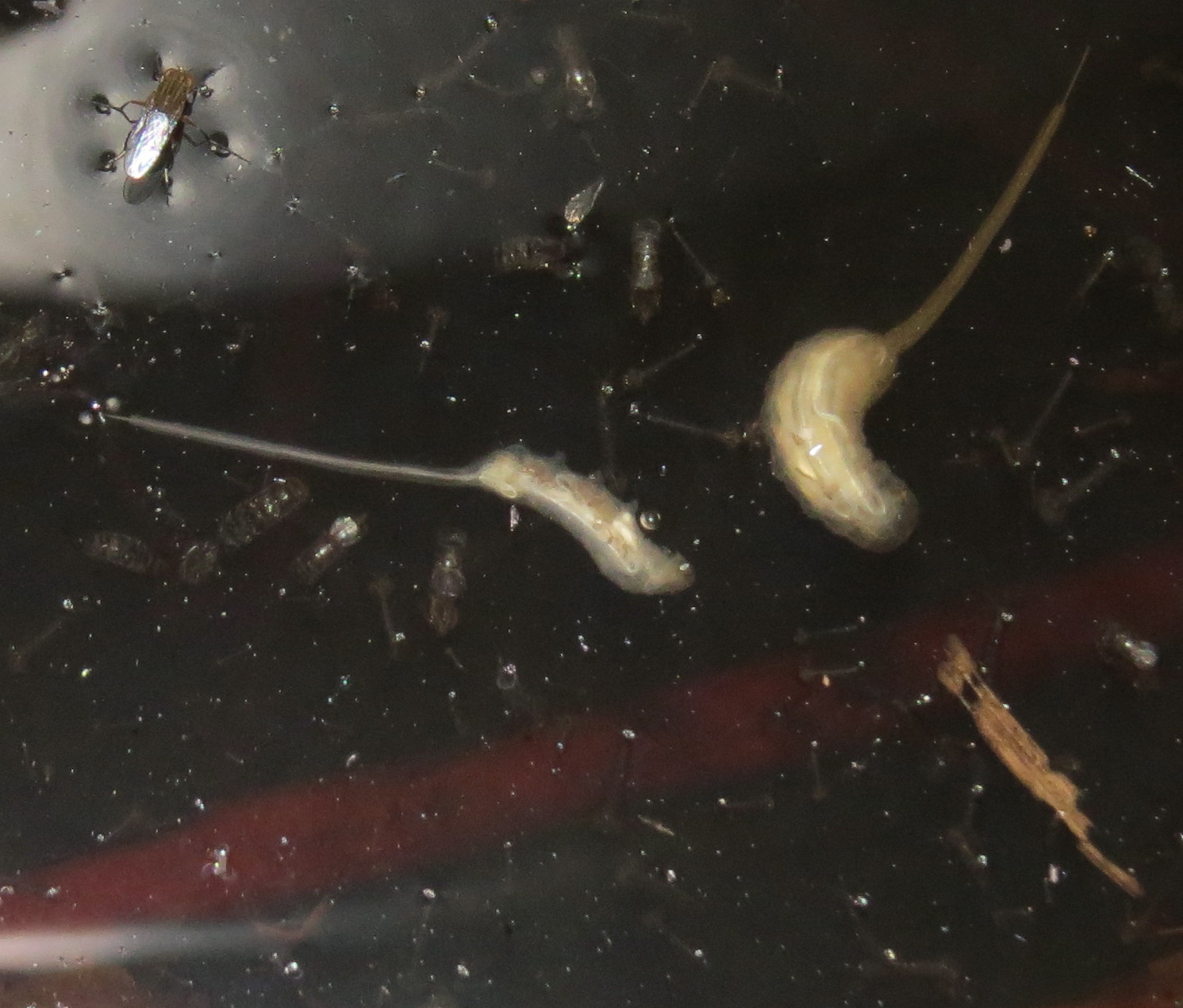
I recently started working part-time at Songbird Supplies, LLC, located inside Summerland Gardens here in Colorado Springs. One of the perks has been encountering insects I seldom see. Julie, the proprietor of Summerland Gardens, called me over the other day to help her identify a "primordial soup" bug in one of the water gardens she is cultivating. I was surprised and delighted to find the critters in question were "rat-tailed maggots," the larvae of flower flies in the tribes Eristalini and Sericomyiini (subfamily Eristalinae, family Syrphidae). I had seen them maybe one other time previously.

The conundrum faced by folks with water container gardens is this: do I put in "mosquito dunks" to kill the mosquito larvae, or do I refrain so that the syrphid larvae can grow up into pollinator-capable adult flies? There is no right or wrong answer. Syrphid flies are definitely not endangered species, so I might deploy the dunks.

Note the leg-like "knobs" along the length of the body of the rat-tailed maggot on the left

The rat-tailed maggots are named for the posterior spiracles, which are fused into an extensible breathing siphon that connects them to the water surface at all times. Meanwhile, at the other end, they are filtering bacteria and other microbes from organic matter in the water. Larvae of some species exist in rather dense material like saturated manure, which barely qualifies as aquatic, but is too wet for other dung-eating fly larvae. The low oxygen levels in this kind of substrate are no problem because the maggot's spiracles are always connected to the surface.

The length of the "snorkel" varies greatly depending on the genus of flies. Eristalis larvae have very long tubes, as shown in the images here; Chrysogaster falls at the other end of the spectrum, with quite a short siphon.

Different genera occupy different aquatic niches. Mallota and Mylopeta, for example, live in the water that collects in tree holes. Sericomyia larvae live mostly in bog mat pools. Chrysogaster thrive along the edges of ponds and among emergent vegetation. The most commonly-encountered species are probably in the general Eristalis, Eristalinus, Helophilus, and Palpada, since they are most likely to be seen in urban, suburban, and rural areas. They live in putrid and organic-rich standing water. I know they are sometimes found while cleaning rain gutters.

Once the larva reaches maturity, it seeks dry land on which to pupate. Teh pupal capsule is hard, and resembles a tiny mouse in shape.

Adult Drone Fly, Eristalis tenax, Colorado

The "Drone Fly," Eristalis tenax, is the most common adult version of a rat-tailed maggot that one is likely to see. It is a stunning mimic of the honey bee. Likely introduced ages ago from Europe, it is now an established and widespread species across the entire North American continent. It is also a fairly respectable pollinator, visiting wildflowers, and the blossoms of orchard trees and landscape plants.

Here is an interesting piece of trivia: It is speculated that it was rat-tailed maggots that gave rise to the biblical account of "bees" spontaneously appearing from the rotting carcasses of animals. Certainly, the fluid decomposing material in a corpse would be a perfectly acceptable habitat for Drone Fly larvae.

Adult male Eristalis tenax, Arizona

Sources: Carr, John F. 2013. "Rat-tailed Maggots," Bugguide.net.
McAlpine, J.F. (editor). 1987. Manual of Nearctic Diptera Volume 2. Ottawa: Agriculture Canada. Monograph No. 28. pp. 675-1332.
Merritt, Richard W. and Kenneth W. Cummins. 1978. An Introduction to the Aquatic Insects of North America. Dubuque, Iowa: Kendall/Hunt Publishing Company. 441 pp.
Pfiester, Margaret, and Phillip E. Kaufman. 2009. "Rat-tailed Maggot," Featured Creatures. University of Florida Department of Entomology and Nematology.

Friday, August 30, 2013

The "News Bee"

It is Fly Day Friday, and I have been neglecting the Diptera for far too long. Last week, my wife Heidi and I were in Ohio where we saw many striking members of this order. Friday, August 23, we hiked the trail to Buzzardroost Rock, a preserve maintained by The Nature Conservancy in Adams County (south central Ohio). Near the top of the ridge we heard a loud buzzing and saw a large insect hovering in the sun near a large log. Periodically it would perch on a leaf or the ground and it was then apparent what it was: a flower fly in the family Syrphidae. This particular species was the spectacular Milesia virginiensis.

At 18-28.5 millimeters in body length, and brightly colored in yellow, brown, and black, this fly could easily be mistaken for a European Hornet or queen yellowjacket. The ominous droning buzz it makes only heightens the visual mimicry. Some speculate that this species mimics the Southern Yellowjacket, Vespula squamosa. Indeed, Southern Yellowjackets were also active in the area, but the workers are substantially smaller than this fly. It is too early for the yellowjacket queens to be appearing, but they make for a better “model” in both size and color pattern.

Milesia virginiensis figures in American folklore and superstition. It is still known in many hamlets as the “News Bee,” for it will sometimes hover in front of a person, as if it were “giving them the news.” It is also considered to be good luck if one of these flies alights on your finger. I was surprised that this particular individual allowed me a very close approach, so maybe it is not out of the realm of possibility than one of these insects could perch on a patient person.

Perhaps the idea of these flies broadcasting the local gossip stems from confusion with real bees. Another old wives’ tale suggests that a bee buzzing in one’s ear means that important news will arrive shortly.

Larvae of the News Bee apparently feed in the wet, rotting heartwood of stumps and logs, which might explain why this adult fly showed so much interest in the log. Males might recognize a log as a potential resource for females to lay eggs in, and guard a territory around it.

This species is found throughout most of eastern North America, from Kansas to Minnesota and Ontario, south to Texas and Florida. Nowhere does it seem to be abundant, however. Look for the adults from late May to November in southerly latitudes, and mid-summer to early fall elsewhere. Two other species in the genus, M. bella and M. sctutellata range in the southwest U.S. and southeastern U.S. (southeast Oklahoma to North Carolina), respectively.

Milesia virginiensis is also known as the Yellowjacket Hover Fly and the Virginia Flower Fly. While there are records of them visiting Queen Anne’s Lace, Rattlesnake Master, and other wildflowers, I personally have not seen them nectaring. Almost invariably, I find them hovering in sunny spots in the understory of hardwood forests.

Sources: Coin, Patrick, et al. 2012. “Species Milesia virginiensis - Yellowjacket Hover Fly,” Bugguide.net
Skevington, Jeff H. 2012. “Field Guide to the Syrphidae of Northeastern North America,” Canadian National Collection of Insects, Arachnids, and Nematodes.

Wednesday, July 20, 2011

Wasp Wednesday: Not Wasp III

When it comes to mimicry of wasps, the flower flies of the family Syrphidae are perhaps unequaled. They are convincing enough that I myself remain prone to being fooled by some of these imposters. Among the best of the best are members of the genus Spilomyia, which not only look like yellowjackets, but even sound like them.

A recent trip to Colorado Springs, Colorado revealed just how easy it is to pull the wool over my eyes. At the Cheyenne Mountain Zoo I had been seeing both Aerial Yellowjackets (Dolichovespula arenaria) and Western Yellowjackets (Vespula pensylvanica) licking aphid honeydew off of leaves on a young aspen tree. One of the “yellowjackets” didn’t look quite right, though, and a closer inspection revealed it to be a fly.

One way I am able to tell flower flies from yellowjackets is by the antennae. Yellowjackets have long, thick antennae, whereas most of the flies have very short antennae with a hair-like appendage called an arista on the very tip. Some flower flies, including those in the genus Spilomyia compensate for this difference by waving their front legs in front of their faces to simulate the longer, thicker antennae of the wasps.

Fine. I can always tell the difference by the eyes. Flies have very large eyes that meet at (males) or near (females) the top of their heads. This should be easy. Ok, wait a minute, exactly where do this fly’s eyes end and the rest of its face begin? Swell. The ornate black and yellow markings on the fly’s eyes now make sense: they break up the outline of the eyes, making them appear smaller than they actually are.

Alright, I don’t give up that easily. Flies have only one pair of wings, while wasps have two. Ha! I got you now. Also, the wings of yellowjackets are folded longitudinally when the wasp is at rest, so the wings appear thinner and darker….Uh oh. This fly actually has the front half of each wing darkened to mimic that fold. Unreal.

The flies are also the same size as yellowjackets, varying from 12-17 millimeters in body length. But, as if visual appearance and behavior are not enough to convince a would-be predator not to mess with the fly, this mimic even sounds like a wasp. The frequency of its wingbeats in flight is nearly identical to that of its yellowjacket model. One has to wonder if any predator or parasite can see (and hear) through this charade.

Flower flies are more than just a pretty face, though. The adults visit flowers, and they can be at least adequate pollinators as a result of this behavior. The larval stages of Spilomyia apparently dwell inside water-filled tree holes, feeding on decaying organic matter. So, they are valuable recyclers and decomposers, too.

The next time you think you see a yellowjacket in your yard or garden, do a double-take; maybe a triple-take. You might just be seeing a fly in disguise. Spilomyia is a very widespread genus with about 13 species in North America, so chances are good that they are in your neighborhood.

Wednesday, March 9, 2011

Wasp Wednesday: Wasp/Not Wasp

Previously on “Wasp Wednesday” we featured keyhole wasps of the genus Trypoxylon. Like most stinging insects, these wasps are models for other harmless insects that escape predators by pretending to be something more dangerous than they are: a sheep in wolf’s clothing if you will. Meet Pseudodoros clavatus, a near perfect imposter of a keyhole wasp.

A biologist friend once cautioned me on jumping to conclusions about which insects serve as models for various mimics, but just look at this fly. The elongated abdomen even has pale markings to make it appear narrower than it actually is. At 7-12 millimeters long, it is also similar in size to many Trypoxylon wasps. Besides looking like the wasp, the fly even behaves like it. Male keyhole wasps often hover in front of vertical objects, and the fly hovers just as well, if not better than, the wasp.

Ok, so how do you tell them apart, anyway? Above is the wasp. Note that it has two pairs of wings (though connected to each other they are usually still discernible as separate). The antennae of the wasp are thick and relatively long. They eyes are large, but do not take up the entire head or face of the wasp. Now look at the fly below. It has only one pair of wings. The antennae are so short they are scarcely visible. The eyes cover most of the head of the fly, and are not notched on the inner margin like those of the wasp.

Pseudodoros clavatus is a member of the family Syrphidae, collectively known as “flower flies” (“hover flies” in Europe). They are frequent, abundant visitors to flowers of all kinds. While they may be insignificant pollinators, they play their part in perpetuating wildflowers. Their good deeds extend to the larval stage as well. The maggots of Pseudodoros are voracious predators of aphids.

Seeing one of these slug-like larvae on your rose bush might lead you to think that it is also eating the plant, but watch one closely and you will see it methodically slaying aphids, seizing the tiny sap-suckers and hoisting them off the stem. The fly larva then sucks the hapless pest dry and discards the empty husk of its exoskeleton.

Look for this species from coast to coast in the United States and southern Canada. It may be confused with the similar genera Baccha and Ocyptamus in some parts of its range, but Ocyptamus species have at least faint dark markings on the wings (if only a bold leading edge to the wing). Baccha is more difficult to distinguish, but at least one species has a distinctly banded abdomen. The image below is still a Pseudodoros.