Showing posts with label moths. Show all posts

Tuesday, March 24, 2026

Blacklighting Already?

Considering that we have hardly had winter at all here in Leavenworth, Kansas, USA, this year, I probably could have started blacklighting for moths and other insects near the end of February. Instead, I waited until March 14 for my first effort, in our back yard. There is a whole suite of moth species that emerge very early, and then never seen again until the following year, so it pays to put up a UV light, or even simply turn on your porch light, and see what flies in.

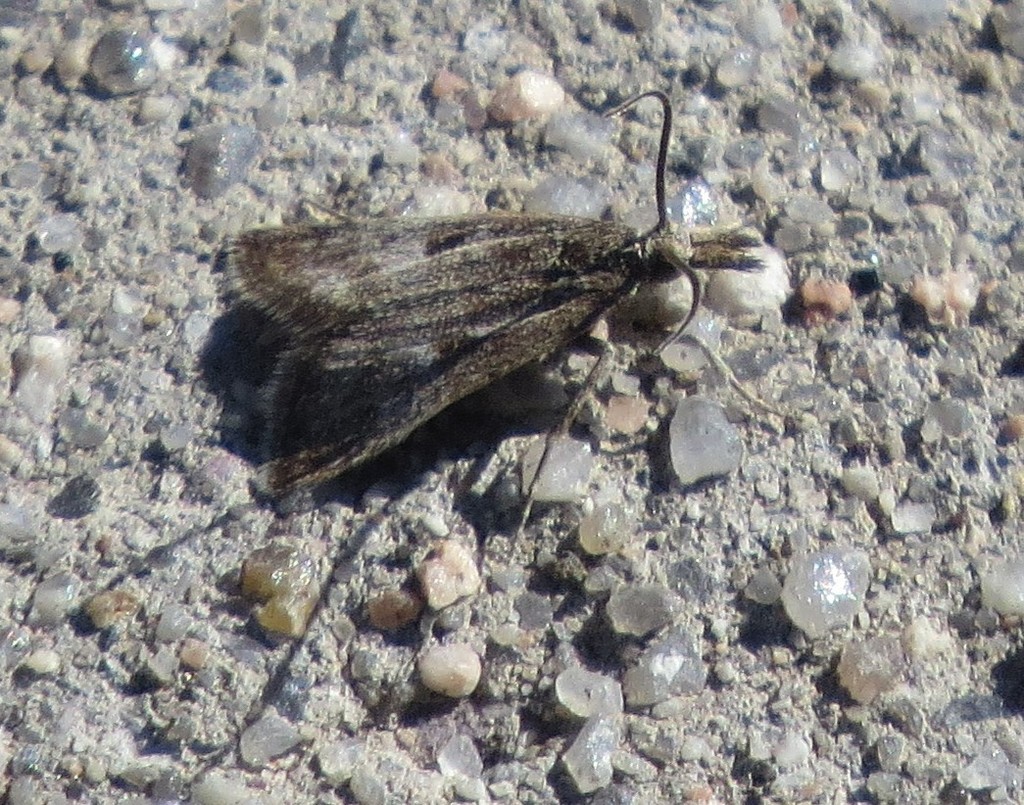
Unidentified knot-horn moth, family Pyralidae, subfamily Phycitinae.

The unseasonably high temperature for March 14, 2026 was sixty-eight degrees Fahrenheit. Other insects besides moths appeared, including various flies, beetles, lacewings, barklice, and aphids and their kin. Many of these insects can overwinter as adults, but others eclose from the pupal stage early in spring.

Damsel bug, Nabis sp.

We now know that artificial lights at night do not “attract” moths, but disorient them. Insects fly with their backs to the stars and moon, so when a light appears on the horizon, or below, they flip their bodies accordingly, and end up in a spiraling flight to the source of illumination. Since the exercise of blacklighting is pretty much another version of light pollution, and because I am not doing scientific collecting or rigorous record-keeping, I do this infrequently, usually once every other week, alternating between the front yard and the back yard.


Moths
Moths are why most bugwatchers and insect collectors suspend a blacklight and/or a mercury vapor light, in front of a white sheet or other reflective surface. Moth diversity is several orders of magnitude greater than butterfly diversity, and we know relatively little about species that are not economic pests.

Roland's Sallow.

On this particular night, the most obvious moths were owlet moths in the family Noctuidae, particularly Roland’s Sallow, Psaphida rolandi. This is a widespread species from the eastern fringe of the Great Plains to the Atlantic and Gulf coasts. In the southern states in can appear as early as February, and disappears by May. The only known host plants for the caterpillars are oaks. They may feed high in the canopy, as they are seldom encountered. The species winters in the pupa stage, and can stay there for up to seven years, presumably to weather unfavorable conditions.

Speckled Green Fruitworm Moth.

Another owlet seen was a single individual of the Speckled Green Fruitworm Moth, Orthosia hibisci. This species occurs in forested areas across the entire U.S., and well into the heart of western Canada. The caterpillars are generalist feeders on mostly deciduous trees and shrubs, but even some conifers are on the menu. Like Roland’s Sallow, there is but one generation per year, with adults flying mostly in March and April, a few persisting into June in northern latitudes.

Green Cloverworm moth.

I had seen a couple Green Cloverworm moths, Hypena scabra, during daylight hours in late February and early March respectively, but one appeared at the sheet on this night, too. This is an abundant species in a variety of mostly open habitats east of the Rockies, with at least three generations per year. Food plants for the caterpillars include clover, alfalfa, ragweed, strawberries, and raspberries.

Spring Cankerworm moth, male.

Geometer moths, also known as inchworm moths, were also present. Spring Cankerworm, Paleacrita vernata, was one of them. I know the individuals I saw were all males because the females are wingless. The species ranges east of the Rockies in both the U.S. and Canada. As is the case with most wingless moth species, it is the first instar caterpillar, fresh from the egg, that is the dispersal stage. The larva issues strands of silk from its mouth that catch the wind and blow it to a host plant. Many deciduous trees and shrubs can serve as hosts. This is a winter and early spring species.

Small Phigalia moth, male.

Another such geometer is the Small Phigalia, Phigalia strigataria. It has a nearly identical life history, geographic and temporal distribution as Spring Cankerworm.

Small Engrailed.

One other “geo” almost escaped my notice because it landed off the sheet, on our wooden fence where it blended in almost seamlessly. As near as I can tell it is a Small Engrailed, Ectropis crepuscularia, an extremely variable species in terms of color and pattern (or lack thereof). It ranges east of the Great Plains, and also in the Pacific Northwest, north to the panhandle of Alaska. The flight period varies, but generally begins in March and ends in October. There are two generations each year in most places. Caterpillars feed on deciduous trees, but also some conifers.

Red-banded Leafroller moth.

The most confounding moths that flew in were members of the family Tortricidae, collectively known as leafroller moths for the habits of the caterpillars. Most specimens on the sheet defied identification, even to genus, save for the Red-banded Leafroller, Argyrotaenia velutinana. It is exceptionally common at our lights over much of the year, and the species ranges from the eastern Great Plains eastward. The caterpillars feed on an array of deciduous and herbaceous plants, eating both leaves and fruits. They pupate in a folded leaf on the ground, from which they emerge as adults.

Unidentified leafroller moth.
Beetles

I was mildly surprised by the variety of beetles I saw. Here is a small selection.

Seedcorn beetle, Stenolophus sp.
Marsh beetle, Contacyphon sp., I believe.
Variegated mud-loving beetle, Tropicus sp.
Likely a silken fungus beetle, Atomaria sp.
Locust Seed Beetle, Amblycerus robiniae.
Northern Plantain Flea Beetle, Dibolia borealis.
Lacewings
Lacewings spend the winter as adults, and even the green lacewings in the family Chrysopidae are mostly brown, pink, or reddish in autumn and the following spring. They are on the hunt for aphid colonies, the major food source for their voracious predatory larval offspring.

Green lacewing, Chrysoperla sp.
Brown lacewing, Micromus posticus.
Brown Pine Lacewing, Hemerobius stigma.

I was surprised to learn I had two different species of brown lacewings on this night, thanks to identification by a reliable expert on iNaturalist.

True Bugs

As luck would have it, the lacewing’s prey was also present. I had two species of aphids fly to the light. Many aphids alternate hosts between spring and fall, overwintering on the autumn host, and flying to new host plants or trees as those begin to increase their flow of phloem, the sap that aphids extract with their tubular mouthparts.

Unidentified aphid.
I think this is a woolly aphid.

Psyllids are relatives of aphids, and the hackberry psyllids, genus Pachypsylla, are especially common, having overwintered as adults in snug, concealed places. I suspect we have at least three species of these in our immediate neighborhood. They each make a type of gall on hackberry, within which the nymph stages grow and mature.

Hackberry gall psyllid, Pachypsylla sp.

One mirid plant bug came to the light briefly, as did two predatory stink bugs. You heard that correctly, I said predatory. The Spined Soldier Bug, Podisus maculiventris, has a sturdier, shorter rostrum than its plant-feeding cousins, the better to stab insect prey. They can take down insects several times their size, and walk around towing their prize as they feed. Last fall, this species was surprisingly abundant, and here they are again this spring.

Spined Soldier Bug.
Flies

Flies are ever present, some of them practically year-round. This is especially true for non-biting midges in the family Chironomidae. They are frequently mistaken for mosquitoes, but are even more abundant. The majority are aquatic in the larval stage. Though they can fly far from water, the fact that we have a prefabricated, roughly forty-gallon pond sunk into our back yard probably boosts their populations and diversity.

A typical non-biting midge, male.
Non-biting midge, Psectrotanypus sp., female.

There were a smaller number of biting midges, family Ceratopogonidae. Not to fear, the vast majority of these tiny flies bite other insects, feeding on the hemolymph of their targets.

Biting midge,

Dark-winged fungus gnats, family Sciaridae, are equally difficult to identify beyond family level, but are recognized by a “tuning fork” branch in one of the wing veins. They are quite small, but abundant. Some species are common indoors, breeding in the soil of overwatered house plants.

Dark-winged fungus gnat.

A nice surprise was a type of sun fly, genus Oecothea, family Heleomyzidae, kindly identified by Chris Angell on iNaturalist. The family is somewhat easily identified by the long, perpendicular spines on the leading edge of the wing. This feature rules out many similar-looking flies. Heleomyzids are most often seen in early spring and late fall. They breed in rotting organic matter of all origins, though some are associated with bird or mammal nests, or fungi.

Sun fly, Oecothea sp.

All fifty-two of my observations can be found on this iNaturalist page, where the status of their identification my be updated over time by specialist experts.

Ichneumon wasp, Ophion sp.

I have since done another night of blacklighting, on March 21, but I am not sure if I will get those front yard observations up any time soon. Suffice that I added at least two new species to our yard list as a result. Meanwhile, please share what you are seeing in your own yard. Include a link to your own iNaturalist account if you wish. Happy (nocturnal) bugwatching!

Sunday, November 2, 2025

Remembering Moth Week 2025

Yes, I am terribly behind in making public my sightings of insects, arachnids, and other wildlife this year. I finally have my observations for National Moth Week 2025 loaded onto iNaturalist, but I will share some of them here in this post.

Zebra Conchylodes Moth, Eddyville, Kentucky.

Heidi was generous enough to secure us tickets to the Coldplay concert in Nashville, Tennessee, USA, so we spent almost the entirety of the week in that area of the country. We began in the Land Between the Lakes National Recreation Area. When we arrived, the weather was rainy and not at all conducive to looking for insects, but it was also the day before the start of National Moth Week.

This Pink-shaded Fern Moth was the first of its kind I'd ever seen.

We stayed at a small rental house near Eddyville, Kentucky, surrounded by deciduous forest. The first night, we simply left the front porch light on, and looked at the few insects that flew in, using the awning over the porch as convenient cover from the showers.

This Lost Owlet moth was also new to me.

The subsequent two nights were better. We put out our blacklight the second night, under the carport by a large metal garage building. The building had its own, motion-activated light, which helped draw more bugs to our sheet. The landscape was still quite wet, however.

Tulip-tree Beauty, a large geometer moth, was common at our lights....
....but harder to see on a tree trunk!

We debated whether to turn on the blacklight for our third and final night in Eddyville, but I decided against it. We did turn on a light over the back porch, though, and that attracted a good number of insects, including moths.

A Posturing Arta moth, posturing.

As we headed south, we entered Tennessee, and stopped at the lovely Cedar Pond Picnic Area. The sun had broken through permanently by now, so there was more insect activity. Around the pond were a couple of overlooks, and at one of those we startled a butterfly off a pile of scat from some mammal’s recent visit. On closer inspection, we noticed there was also a Nessus Sphinx Moth taking advantage of the fresh dung.

Nessus Sphinx moth enjoying(?) fresh dung.

While we were in Nashville, we stayed at a hotel that did not permit us to do any blacklighting. Plus, there was the concert itself. If you have never been to a stadium concert for your favorite band, I recommend the experience. Highly exhilarating, and worth the expense.

Deep Yellow Euchlaena Moth, Giant City State Park, Illinois.

From Nashville we headed west to southern Illinois, an area rich in both biodiversity, and protected natural areas in which to enjoy it. There are wildlife refuges, state parks, and other places that have grassroots support from local friends groups, resulting in excellent maintenance and outstanding sources of firsthand knowledge.

Rosy Maple Moth.

We decided to visit Crab Orchard National Wildlife Refuge on the way to our destination of Giant City State Park. The visitor center was being remodeled, and it was about to close for the day, but we met a couple who volunteer there. They were friendly, and very helpful. Exploring the exterior of the building, I found a beautiful Rosy Maple Moth, still hanging out by a light it had been drawn to the previous night.

Caterpillars, like this one of a tussock moth, count, too, during National Moth Week. Lower Cache River, Illinois.

Jennifer Randolph, the naturalist and nature center manager at Giant City State Park had invited me to give a presentation on moths for her volunteers and anyone else interested, so we stayed at a cabin in the park for three nights.

The "working" part of our vacation, presenting on moths at Giant City State Park.

The first two nights we set up a blacklight on our cabin porch, and were rewarded with a spectacular variety and quantity of insects. The cabins are basically duplexes (front to back) offering comfortable accommodations for guests, and situated far enough apart that you are not disturbing your neighbors with quiet nighttime activities.

The Bad-wing is actually a real beauty.

On our last night, we set up our lights a fair distance away at a picnic shelter elsewhere in the park. There was a pole light by the shelter that complemented our dim white light and portable blacklight. We did not see many species different from what we had at our cabin, but there were some notable exceptions.

A large and lovely Azalea Sphinx.

On our drive back home, we stopped for a rest, rather randomly, at a Casey’s store in New Florence, Missouri. When I glanced up as we pulled into our parking spot, I could hardly believe my eyes. I blurted out an excited “Oooh, oooh!,” and pointed, wide-eyed, at the enormous female Imperial Moth perched on the wall beneath a light.

Imperial Moth, female.

Moth Week could have ended there and I would have been happy, but we got home to Leavenworth, Kansas in time to set up our blacklight in the front yard for the final night, July 27. A few more species were added, and then it was over.

Unidentified dagger moth, genus Acronicta, Leavenworth, Kansas.

All of my observations can be seen at the hyperlink in the first paragraph of this blog post. Meanwhile, Heidi’s observations can be found here. We almost always see different species, even in the same place. Plus, her photos are usually better.

Linden Prominent moth was a new visitor to our Leavenworth, Kansas yard.

While there is an official National Moth Week, almost any time of the year can be its own moth week. There are still moths flying here in Leavenworth, at least until the first hard freeze. Turn on your porch light and see what lives in your own neighborhood.

Basswood Leafroller Moth, Leavenworth, Kansas.

NOTE: In the current, highly-charged political atmosphere, I strongly suggest navigating friends group websites for recreation areas, national parks, wildlife refuges, and other properties operated by the federal government, to avoid being subjected to biased and irrelevant content. Thank you.

Wednesday, July 16, 2025

Accidental Achievement

When we lived in Colorado Springs, I would walk our neighborhood regularly, if not daily, unless the weather was severe. Little did I know that one such constitutional would yield something globally significant.

My photo of the male moth.

On the afternoon of November 5, 2020, passing a vacant lot up the street that I had passed by almost daily, I noticed small moths flying around. Many moth species fly late into autumn, so that alone did not intrigue me. Many moths fly during daylight hours, so that was not unusual, either. Curious me wanted to document the thing anyway, but that was easier said than done. The moths were wary, and quickly disappeared into weeds when they landed, camouflaged.

Finally, one of them landed on the sidewalk, and as I recall a bit of a breeze kept it from taking flight again immediately. Not the best of photos, but I put it on iNaturalist anyway. I wasn’t even completely sure of the family, but I figured something so common would be recognized by an expert eventually.

My iNaturalist entry.

Fast forward to November of 2024, and I receive an email from Andrew Warren informing me that not only was this moth a species new to science, but that it also qualified to be in a new genus. I was shocked. How could something that abundant be completely overlooked until now?

It turns out I had the correct family (Crambidae), but obviously could not have put a more specific name to it. It didn’t have one! The paper describing the moth is now published, and anyone can view it here. I was not at liberty to share this story until after the publication, as a common courtesy to the authors.

Better image of a male, photo © Andrew Warren.

Allow me to briefly summarize, if you do not want the long story in the journal article. The moth has so far been collected between October 20 and November 22. Mine is so far the only record for El Paso County, but it is suspected to occur all along the Front Range, possibly into Wyoming in the north and New Mexico in the south. This is based on the host plant for the caterpillar, which is a grass known as Sand Dropseed, Sporobolus cryptandrus.

The larvae probably feed on the roots of the plant, because the moths have only been found in situations where the dropseed was either mowed or trampled. Seriously. Where the plants are upright, no moths. Sure enough, the vacant lot where I found mine was mowed regularly, much to my dismay until I learned this story.

The female moth, photo © Christian Nunes.

The females of the moth, which now bears the name Coloradactria frigida, are flightless, with heavy bodies and short wings. No wonder I never saw those. They certainly must emit a pheromone to attract the males.

Other known localities for the moth are in Douglas County around Castle Rock, and in Weld County, all in Colorado. Late autumn searching elsewhere should certainly turn up new records.

A mating pair of the moths, photo © Christian Nunes.

The lesson I have learned from this is that you can, and should, never assume anything when it comes to entomology. You do not even have to know what you are doing to make an earth-shattering discovery. We collectively know very little. It is your curiosity that counts. That, and your willingness to share what you find with others. Do the documenting with photographs, videos, and sound recordings, and put them out there. Please.

Source: Warren, Andrew D., Clifford D. Ferris, Bernard Landry, Jeremy Authier, Theo Leger, Julia Bilat, and Christian A. Nunes. 2025. “A New Genus and Species of Crambinae (Pyraloidea: Crambidae) With Brachypterous Females From Colorado, U.S.A.,” Journal of the Lepidopterists’ Society 79 (2): 73-84.