Showing posts with label discovery. Show all posts

Wednesday, July 16, 2025

Accidental Achievement

When we lived in Colorado Springs, I would walk our neighborhood regularly, if not daily, unless the weather was severe. Little did I know that one such constitutional would yield something globally significant.
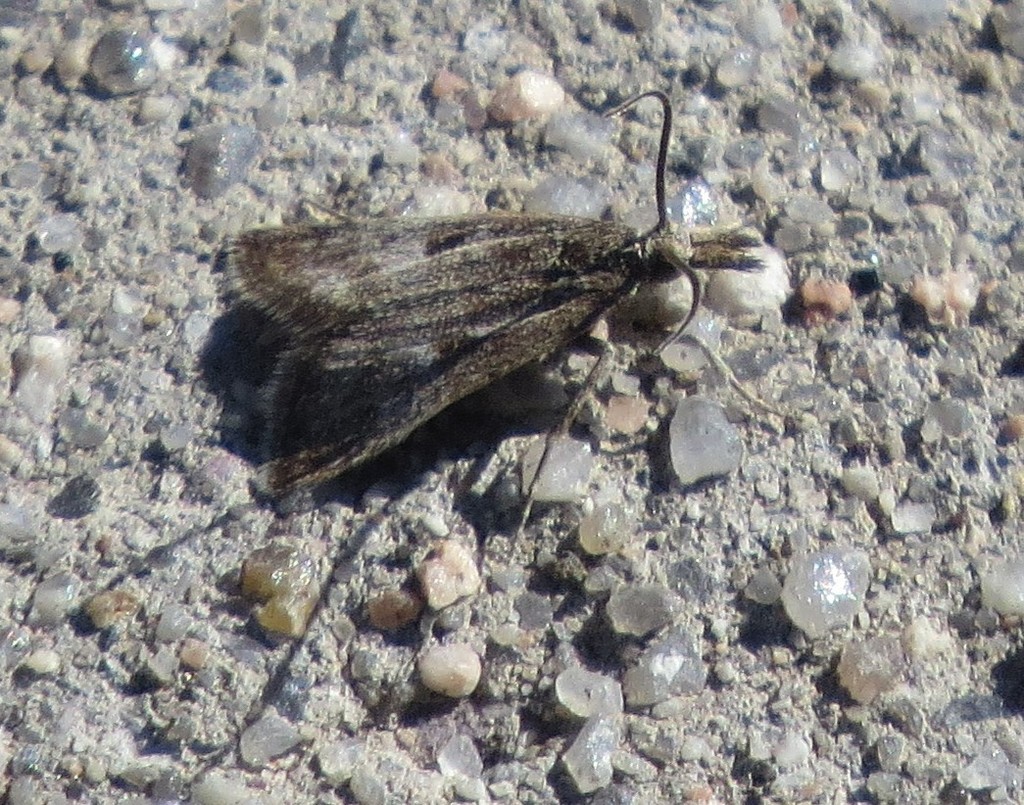
My photo of the male moth.

On the afternoon of November 5, 2020, passing a vacant lot up the street that I had passed by almost daily, I noticed small moths flying around. Many moth species fly late into autumn, so that alone did not intrigue me. Many moths fly during daylight hours, so that was not unusual, either. Curious me wanted to document the thing anyway, but that was easier said than done. The moths were wary, and quickly disappeared into weeds when they landed, camouflaged.

Finally, one of them landed on the sidewalk, and as I recall a bit of a breeze kept it from taking flight again immediately. Not the best of photos, but I put it on iNaturalist anyway. I wasn’t even completely sure of the family, but I figured something so common would be recognized by an expert eventually.

My iNaturalist entry.

Fast forward to November of 2024, and I receive an email from Andrew Warren informing me that not only was this moth a species new to science, but that it also qualified to be in a new genus. I was shocked. How could something that abundant be completely overlooked until now?

It turns out I had the correct family (Crambidae), but obviously could not have put a more specific name to it. It didn’t have one! The paper describing the moth is now published, and anyone can view it here. I was not at liberty to share this story until after the publication, as a common courtesy to the authors.

Better image of a male, photo © Andrew Warren.

Allow me to briefly summarize, if you do not want the long story in the journal article. The moth has so far been collected between October 20 and November 22. Mine is so far the only record for El Paso County, but it is suspected to occur all along the Front Range, possibly into Wyoming in the north and New Mexico in the south. This is based on the host plant for the caterpillar, which is a grass known as Sand Dropseed, Sporobolus cryptandrus.

The larvae probably feed on the roots of the plant, because the moths have only been found in situations where the dropseed was either mowed or trampled. Seriously. Where the plants are upright, no moths. Sure enough, the vacant lot where I found mine was mowed regularly, much to my dismay until I learned this story.

The female moth, photo © Christian Nunes.

The females of the moth, which now bears the name Coloradactria frigida, are flightless, with heavy bodies and short wings. No wonder I never saw those. They certainly must emit a pheromone to attract the males.

Other known localities for the moth are in Douglas County around Castle Rock, and in Weld County, all in Colorado. Late autumn searching elsewhere should certainly turn up new records.

A mating pair of the moths, photo © Christian Nunes.

The lesson I have learned from this is that you can, and should, never assume anything when it comes to entomology. You do not even have to know what you are doing to make an earth-shattering discovery. We collectively know very little. It is your curiosity that counts. That, and your willingness to share what you find with others. Do the documenting with photographs, videos, and sound recordings, and put them out there. Please.

Source: Warren, Andrew D., Clifford D. Ferris, Bernard Landry, Jeremy Authier, Theo Leger, Julia Bilat, and Christian A. Nunes. 2025. “A New Genus and Species of Crambinae (Pyraloidea: Crambidae) With Brachypterous Females From Colorado, U.S.A.,” Journal of the Lepidopterists’ Society 79 (2): 73-84.

Tuesday, February 7, 2017

It's Always Something....

To quote the lovely Ms. Rosanne Roseannadanna, "It just goes to show you, it's always something." It may take months, even years, to learn that something you observed and recorded is noteworthy, or potentially so. Such was a recent case in which an image I posted on Bugguide.net was finally identified, more or less, leaving still more questions than answers.

November 27, 2014, Thanksgiving Day in the U.S., I was at the Cheyenne Mountain Zoo where my wife works as a primate keeper. The zoo restaurant staff caters a holiday lunch, and employees bring potluck dishes to supplement. Before and after the feast, I was out looking for insects, as the weather was reasonably conducive to finding late autumn macro-fauna.

On a wooden fence railing I spotted what at first I thought might be an aphid. Upon closer inspection, it was an aphid relative known as a "jumping plant louse" or psyllid. This is a tiny insect. Total body length is only 2.6 millimeters, or 4-4.5 mm if you measure from head to wingtip. It varies from light green to greenish gray.

Psyllids were once lumped into a single family, but research has shown that there are several families. A few species are very abundant and conspicuous, like hackberry psyllids. A few others are economically impactful, especially in orchard crops. The remaining majority are poorly known, keeping a very low profile on native plants.

The image I uploaded to Bugguide understandably floundered in obscurity until February 2 of this year when I received notification that someone had left comments and even moved the image into genus-level classification. I was grateful, but also surprised by the comments left by Chris Mallory:

"Bactericera nr. arbolensis
In nearly every regard it is consistent with this Shepherdia-associated species originally described from Arboles, CO. However, the medial cell of the forewing is much smaller than described and illustrated, and in this aspect it does not agree with any known described species.
There could be several reasons for this. First, the size of the medial cell of B. arbolensis may be more variable than the literature suggests. Alternatively, this may be an undescribed but related species. In either situation it is a very interesting find. I'd love to see more of them."

Wow. Chris Mallory is an expert on the superfamily Psylloidea; and is also one of the individuals behind the comprehensive online guide SoCalFauna.net, a photographic gallery of most of the animals one is likely to encounter in southern California.

Thanks to the in-depth profile page at Chris's Psyllids.info website, I learned that the species he thinks it might be is known from Silver Buffaloberry, Shepherdia argentea and Canadian Buffaloberry, Shepherdia canadensis. Neither of those plants is very common, if found at all, along the Front Range of Colorado. It is, however, conceivable that the zoo landscapes with one or both of them, so I will have to check out that possibility. Meanwhile, there are few literature records of the psyllid itself: MONTANA: Roosevelt County; WYOMING: Sweetwater County: Green River; COLORADO: Montrose County: Cimarron; LaPlata County: Durango; Archuleta County: Arboles. All but the Montana record are from west of the Continental Divide. The type specimens, those from which the insect was described and named, were 3 males and 4 females collected by C.F. Baker in Arboles.

There are 24 known species of Bactericera found in North America north of Mexico, and mine is potentially a twenty-fifth. This just goes to show you, you never know what you might turn up if you point your gaze, and camera or phone, at a yittle, teeny-tiny bug.

Sources: Crawford, D.L. 1914. A Monograph of the Jumping Plant-lice or Psyllidae of the New World. 85: 186 pp. Government Printing Office, Washington, DC.
Tuthill, L.D. 1943. "The Psyllids of America North of Mexico: (Psyllidae: Homoptera)," Iowa State College Journal of Science. 218 pp.

Sunday, August 19, 2012

Spider Sunday: Breaking News

I was debating with myself about what species to feature in this week’s “Spider Sunday,” when I got wind of a story that immediately trumped all other options. Not only was there the formal announcement of a new species of spider, but one that represented an entirely new family of spiders as well. It takes a very unique species to demand its own family, but this arachnid is strange indeed.

Several press outlets carried the story, many including images of this odd spider. Not surprisingly, there is some conflicting information and perhaps exaggeration.

What is known for certain is that the spider had to be formally described and named before the discovery could be made public. That official record is in the latest issue of the professional journal ZooKeys, a peer-reviewed online publication of Pensoft Publishers. This in itself is newsworthy. Online journals shrink the timeline between discovery of species and the broadcast of those discoveries. Even so, this spider was found initially in 2010. Online journals also mean that you don’t have to live next to a university library to be able to access authoritative serial publications.

Let’s get back to the spider, though. What makes it unique? There is no question that the most distinguishing feature is the long, articulated, blade-like claws on the tip of each leg. The spiders are found on the ceiling of caves in southern Oregon (one report included northern California and British Columbia in the distribution), suspended upside down in very small, minimalist webs. It is thought that they wait for small, flying insects to come within range of their lanky legs, then hook their prey with those sickle-like claws.

These are not small animals. The legspan of a mature specimen can exceed two inches (five centimeters). As scientist Charles Griswold, the lead author in the journal article, explained in a BBC radio interview, they look even larger in the beam of a headlamp. The spiders are not blind, but have only six eyes as opposed to the usual eight for most spiders. Live specimens in Griswold’s lab at the California Academy of Sciences refused to eat.

The last time a new species of spider required the erection of a new family was back in 1990, when a South African spider was described. You have to go back to the 1890s to find the last time a new family of spiders was established for a North American spider.

The new family is named Trogloraptoridae. The spider’s official species name is Trogloraptor marchingtoni. The genus name is a combination of Greek and Latin that translates to “cave robber.” The species is named for Neil Marchington, a deputy sheriff for Deschutes County, Oregon, who first showed scientists the spiders inside a cave. Marchington is also a member of the Western Cave Conservancy and an amateur biologist.

Cave organisms in general are poorly understood, and highly vulnerable. Populations of cave animals tend to be small, specifically adapted to a lightless habitat, and prone to perish with the slightest change in that environment. It is largely thanks to the efforts of organizations like the Western Cave Conservancy that any effort at all is made to preserve and protect caves. Irresponsible spelunkers (cave explorers) can easily damage a cave just by touching formations and thereby changing the chemistry that forms caves. Vandals can deface and destroy caves; and development above a cave can result in contamination of groundwater that courses through the cave, if not causing the cave to collapse in part or in its entirety.

I take special delight in learning that this new species was found in my home state of Oregon. The coniferous forests there have relatively poor biodiversity compared to deciduous forests, deserts, and rainforests, but there is no argument that the species found in the Pacific Northwest are often unique. I hope to get back there again in the future, if only to find insects and spiders that I know exist there, but that I have never seen. I’ll have to add this spider to that list!

Thursday, February 18, 2010

Another Discovery

Perusing the website Bugguide.net today, I was prompted to comment to one post regarding the whereabouts of specimens I had lent to the person posting the image. What I learned in his private reply was a delightful surprise.

First off, I must apologize to one Robert Otto for taking our personal business to a public forum. I had misplaced his e-mail, but that is really no excuse. It is not very good ‘netiquette, and it won’t happen again.

Bob was kind enough to write me back straight away, and explained in a very professional manner what had become of my specimens. He and a team of other entomologists are revising the classification of “false click beetles” in the family Eucnemidae. My specimens, and the accompanying data, are part of that effort. They are nearly finished with their work, and then specimens will be returned.

Well, it turns out there is very good reason they are hanging on to a few of mine permanently. Among the common species, like Isorhipis obliqua, were specimens of a species new to science.

My specimens will be “paratypes,” a scientific term for specimens from a particular geographic location that are a subset of a larger series of specimens from which the species will be described and named. The specimens will be deposited in a museum for security, and for the accessibility of scientists wishing to study them.

This marks the third species I have helped to discover. The first two were a species of robber fly in the genus Laphria, and a spider wasp in the genus Dipogon. I collected all three species in parks in Cincinnati, Ohio.

While this is all very exciting, it is also fairly mundane in the world of entomology. Many new species are “discovered” each year. A few of these are discovered in the field while collecting, especially in the tropics where insect diversity is poorly known. Perhaps a greater proportion of “new” species are created as a result of revisions of genera. Specimens once thought to belong to one species are found to actually be complexes of several species. Molecular analysis and other DNA work has revealed that there are often many “cryptic” species within current classifications based solely on morphological characters.

I am often asked “Do you get to name the species?” or “Will they name it after you?” There are strict rules for naming species, genera, and other taxa, set forth by the International Commission on Zoological Nomenclature. That body enforces the International Code for Zoological Nomenclature. It is considered in poor taste to name something after yourself, but honoring a mentor, colleague, spouse, or celebrity is not uncommon.

It is enough for me to know that I’ve made a small contribution to the scientific community by making my specimens accessible to researchers like Bob Otto who are doing serious work, and I don’t say this with any false modesty. I am not a scientist, but find my own niche in bridging the gap between entomologists and the general public. That is my work.