Showing posts with label new species. Show all posts

Wednesday, July 16, 2025

Accidental Achievement

When we lived in Colorado Springs, I would walk our neighborhood regularly, if not daily, unless the weather was severe. Little did I know that one such constitutional would yield something globally significant.
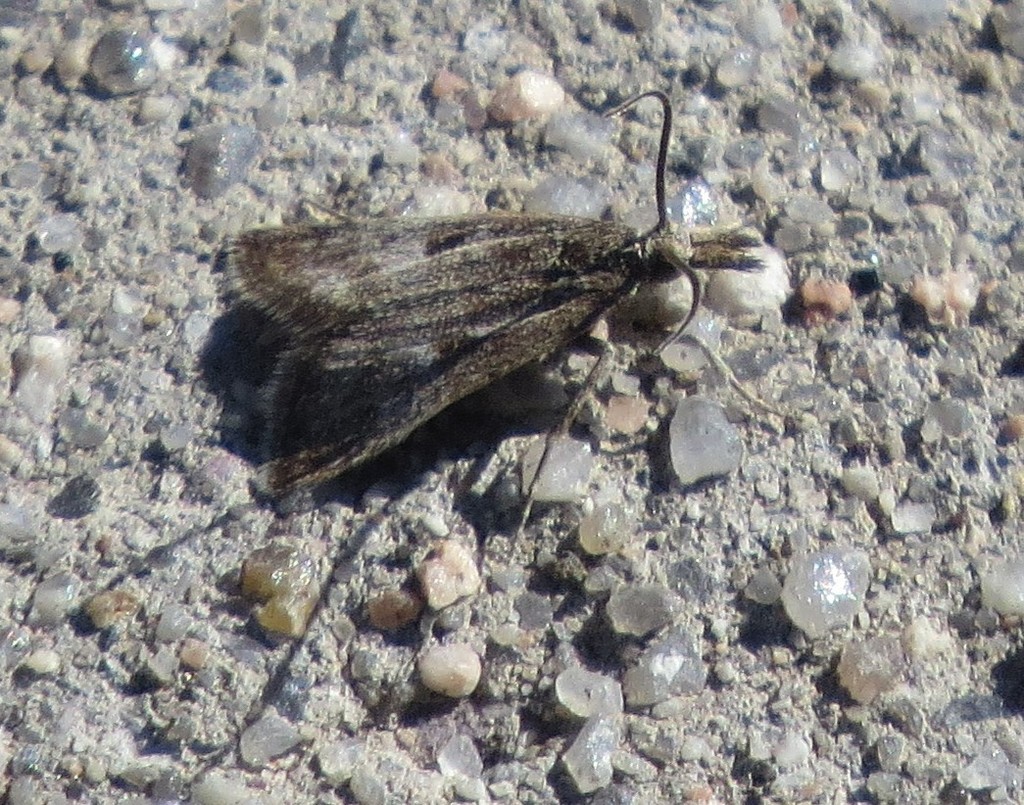
My photo of the male moth.

On the afternoon of November 5, 2020, passing a vacant lot up the street that I had passed by almost daily, I noticed small moths flying around. Many moth species fly late into autumn, so that alone did not intrigue me. Many moths fly during daylight hours, so that was not unusual, either. Curious me wanted to document the thing anyway, but that was easier said than done. The moths were wary, and quickly disappeared into weeds when they landed, camouflaged.

Finally, one of them landed on the sidewalk, and as I recall a bit of a breeze kept it from taking flight again immediately. Not the best of photos, but I put it on iNaturalist anyway. I wasn’t even completely sure of the family, but I figured something so common would be recognized by an expert eventually.

My iNaturalist entry.

Fast forward to November of 2024, and I receive an email from Andrew Warren informing me that not only was this moth a species new to science, but that it also qualified to be in a new genus. I was shocked. How could something that abundant be completely overlooked until now?

It turns out I had the correct family (Crambidae), but obviously could not have put a more specific name to it. It didn’t have one! The paper describing the moth is now published, and anyone can view it here. I was not at liberty to share this story until after the publication, as a common courtesy to the authors.

Better image of a male, photo © Andrew Warren.

Allow me to briefly summarize, if you do not want the long story in the journal article. The moth has so far been collected between October 20 and November 22. Mine is so far the only record for El Paso County, but it is suspected to occur all along the Front Range, possibly into Wyoming in the north and New Mexico in the south. This is based on the host plant for the caterpillar, which is a grass known as Sand Dropseed, Sporobolus cryptandrus.

The larvae probably feed on the roots of the plant, because the moths have only been found in situations where the dropseed was either mowed or trampled. Seriously. Where the plants are upright, no moths. Sure enough, the vacant lot where I found mine was mowed regularly, much to my dismay until I learned this story.

The female moth, photo © Christian Nunes.

The females of the moth, which now bears the name Coloradactria frigida, are flightless, with heavy bodies and short wings. No wonder I never saw those. They certainly must emit a pheromone to attract the males.

Other known localities for the moth are in Douglas County around Castle Rock, and in Weld County, all in Colorado. Late autumn searching elsewhere should certainly turn up new records.

A mating pair of the moths, photo © Christian Nunes.

The lesson I have learned from this is that you can, and should, never assume anything when it comes to entomology. You do not even have to know what you are doing to make an earth-shattering discovery. We collectively know very little. It is your curiosity that counts. That, and your willingness to share what you find with others. Do the documenting with photographs, videos, and sound recordings, and put them out there. Please.

Source: Warren, Andrew D., Clifford D. Ferris, Bernard Landry, Jeremy Authier, Theo Leger, Julia Bilat, and Christian A. Nunes. 2025. “A New Genus and Species of Crambinae (Pyraloidea: Crambidae) With Brachypterous Females From Colorado, U.S.A.,” Journal of the Lepidopterists’ Society 79 (2): 73-84.

Sunday, August 19, 2012

Spider Sunday: Breaking News

I was debating with myself about what species to feature in this week’s “Spider Sunday,” when I got wind of a story that immediately trumped all other options. Not only was there the formal announcement of a new species of spider, but one that represented an entirely new family of spiders as well. It takes a very unique species to demand its own family, but this arachnid is strange indeed.

Several press outlets carried the story, many including images of this odd spider. Not surprisingly, there is some conflicting information and perhaps exaggeration.

What is known for certain is that the spider had to be formally described and named before the discovery could be made public. That official record is in the latest issue of the professional journal ZooKeys, a peer-reviewed online publication of Pensoft Publishers. This in itself is newsworthy. Online journals shrink the timeline between discovery of species and the broadcast of those discoveries. Even so, this spider was found initially in 2010. Online journals also mean that you don’t have to live next to a university library to be able to access authoritative serial publications.

Let’s get back to the spider, though. What makes it unique? There is no question that the most distinguishing feature is the long, articulated, blade-like claws on the tip of each leg. The spiders are found on the ceiling of caves in southern Oregon (one report included northern California and British Columbia in the distribution), suspended upside down in very small, minimalist webs. It is thought that they wait for small, flying insects to come within range of their lanky legs, then hook their prey with those sickle-like claws.

These are not small animals. The legspan of a mature specimen can exceed two inches (five centimeters). As scientist Charles Griswold, the lead author in the journal article, explained in a BBC radio interview, they look even larger in the beam of a headlamp. The spiders are not blind, but have only six eyes as opposed to the usual eight for most spiders. Live specimens in Griswold’s lab at the California Academy of Sciences refused to eat.

The last time a new species of spider required the erection of a new family was back in 1990, when a South African spider was described. You have to go back to the 1890s to find the last time a new family of spiders was established for a North American spider.

The new family is named Trogloraptoridae. The spider’s official species name is Trogloraptor marchingtoni. The genus name is a combination of Greek and Latin that translates to “cave robber.” The species is named for Neil Marchington, a deputy sheriff for Deschutes County, Oregon, who first showed scientists the spiders inside a cave. Marchington is also a member of the Western Cave Conservancy and an amateur biologist.

Cave organisms in general are poorly understood, and highly vulnerable. Populations of cave animals tend to be small, specifically adapted to a lightless habitat, and prone to perish with the slightest change in that environment. It is largely thanks to the efforts of organizations like the Western Cave Conservancy that any effort at all is made to preserve and protect caves. Irresponsible spelunkers (cave explorers) can easily damage a cave just by touching formations and thereby changing the chemistry that forms caves. Vandals can deface and destroy caves; and development above a cave can result in contamination of groundwater that courses through the cave, if not causing the cave to collapse in part or in its entirety.

I take special delight in learning that this new species was found in my home state of Oregon. The coniferous forests there have relatively poor biodiversity compared to deciduous forests, deserts, and rainforests, but there is no argument that the species found in the Pacific Northwest are often unique. I hope to get back there again in the future, if only to find insects and spiders that I know exist there, but that I have never seen. I’ll have to add this spider to that list!