Showing posts with label wood-boring. Show all posts

Saturday, June 25, 2016

Beetle Bonanza

Back on June 13, while my wife and I were headed to a different destination, we passed by a logging mill operation in Black Forest, northeast of Colorado Springs. I wanted to go back another time, and did so on my own this past Thursday, June23, but not without much trial and error. It was a rewarding outing once I got there, with beetles of all kinds flocking to the freshly-cut Ponderosa Pine logs.

Jewel beetle, Chrysobothris dentipes

It turns out I had not been paying enough attention to the route we had taken the first time, and so on Thursday I became hopelessly lost. I phoned my wife and she informed me I was nowhere near the right road. Consequently, I got to the site in the late morning. When I arrived, there was no one to be seen. I looked around anyway, as there were also no postings against trespassing.

The first insects I saw were what I expected: medium-sized jewel beetles, Chrysobothris dentipes, as depicted above. These members of the family Buprestidae look exactly like little shards of pine bark, but they move often enough to be easily seen. Several males were engaging in "butt-thumping" displays to nearby females. Below is a very brief video depicting this. It is surprisingly audible, and also hilarious. I hope to go back again and get a longer video segment.

Also present were a fair number of the magnificent metallic green Phaenops gentilis. Though they are only about 8 millimeters in length, these buprestids are still conspicuous. Like most jewel beetles they are quick to fly when disturbed, though they usually simply run so erratically as to be nearly impossible to get an image of. Females pause often to lay eggs, though, so that is your one opportunity. The one below took time to groom itself and luckily I was in the right place at the right time.

Jewel beetle, Phaenops gentilis

While I was photographing another insect, I glanced down to see a very large buprestid that had landed on my shoulder. I grabbed it, and it turned out to be a Western Sculptured Pine Borer, Chalcophora angusticollis. Measuring 20-33 millimeters, they are among our largest jewel beetles. When they fly, the lifted elytra (wing covers) expose a bright blue, green, or violet abdomen. I brought it, and another specimen, home to photograph.

Western Sculptured Pine Borer

What surprised me most were the large numbers of predatory checkered beetles, family Cleridae, active hunters of bark beetles and other small insects. I thought that I was seeing one species, with individuals of varying sizes, but upon looking at my images it became apparent there were three species.

Checkered beetle, Enoclerus moestus

Enoclerus moestus was the first one I came across. E. lecontei was likewise common.

Checkered beetle, Enoclerus lecontei

Lastly, the largest species was the "Red-bellied Clerid," E. sphegeus. While the adult beetles will kill and consume a variety of other insects, the larvae appear to prey exclusively on bark beetle larvae. You know, like the Mountain Pine Beetle and its relatives that are often blamed for killing entire forests.

Red-bellied Clerid, Enoclerus sphegeus

Longhorned beetles were present on the log stacks as well. I expected the White-spotted Sawyer, Monochamus scutellatus, and indeed I found a couple of females, one of them ovipositing, and a single male. These are large beetles that live up to the longhorn name. Their antennae are exceptionally long, especially in the males.

Female White-spotted Sawyer laying eggs

The most abundant of the longhorns, though, were flower longhorns in the genus Grammoptera. I even found a pair mating.

Flower longhorned beetles, Grammoptera sp., mating

The freak of the longhorn show was the Ribbed Pine Borer, Rhagium inquisitor. The adults look very little like a typical longhorned beetle, having quite short antennae. Two specimens landed on me or in my vicinity.

Ribbed Pine Borer

They are medium-sized at 12-15 millimeters in body length. They get their name from the woven wreath-like ring consisting of coarse wood fibers that the larva creates for its pupal chamber.

I also found a few oddball beetles including a very tiny weevil, Lechriops californica. At least that is what I think it is. They bore, in the larval stage, under the bark on the trunk and larger branches of various pines.
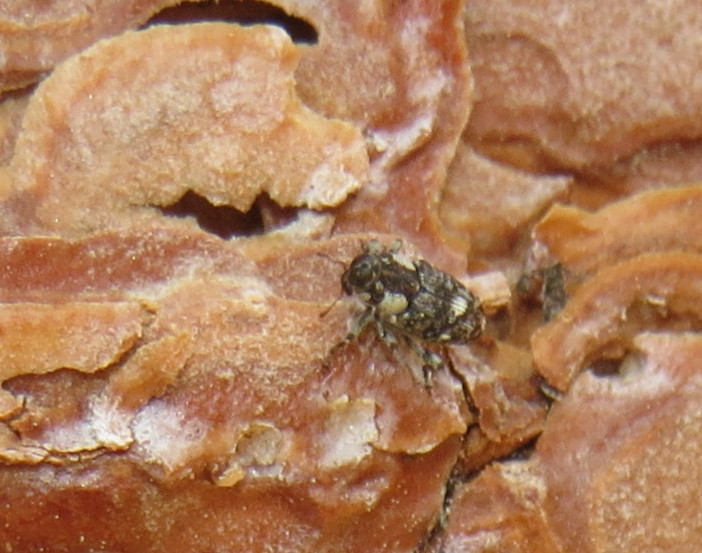
Tiny weevil, Lechriops californica maybe

Another predatory beetle was a very small clown beetle, family Histeridae. It may belong to the genus Platysoma, which live under bark and hunt the larvae of flies and beetles.

Clown beetle, Platysoma sp.

There were non-beetle insects, too, of course. The most common were the syrphid fly Chalcosyrphus piger. Females were alighting on the logs, presumably to oviposit (lay eggs) there. The larvae of these flies feed on decaying wood, and perhaps fermenting sap.

Syrphid fly, Chalcosyrphus piger

The most exciting find was a female aulacid wasp, family Aulacidae, in the genus Pristaulacus. They are easily mistaken for ichneumon wasps at first glance, but the ovipositor is downcurved at the tip; and the abdomen is connected high on the back of the thorax. These wasps are more closely allied to ensign wasps (Evaniidae) and carrot wasps (Gasteruptiidae). They are parasites of wood-boring beetles, surprise, surprise.

Aulacid wasp, Pristaulacus sp.

I am looking forward to returning to this site, as long as I am welcome. Those towering stacks of big pine logs are a bit intimidating, I have to admit, but worth braving for the bounty of beetles.

Male longhorned beetle, Acanthocinus obliquus

Sources: Cowan, B.D. and W.P. Nagel. 1965. "Predators of the Douglas-Fir Beetle in Western Oregon," Technical Bulletin 86, Agricultural Experiment Station, Oregon State University, Corvallis, Oregon. 32 pp.
Furniss, R.L. and V.M. Carolin. 1977. Western Forest Insects. Miscellaneous Publication No. 1339, U.S. Department of Agriculture, Forest Service, Washington, DC. 654 pp.
Smith, David R. 1996. "Aulacidae (Hymenoptera) in the Mid-Atlantic States, with a Key to Species of Eastern North America," Proc. Entomol. Soc. Wash.. 98(2): 274-291.

Wednesday, September 26, 2012

Wasp Wednesday: Pigeon Tremex Horntail

People who have minimal knowledge of wasps can’t really be faulted for having a startled or panicked reaction when confronted with one of these creatures, especially if it is a large insect. Among the more intimidating of wasps are the horntails in the family Siricidae. They do not sting, but they look like they can. Here in the Front Range of the Rockies, the most common species of Siricidae is the “Pigeon Tremex,” Tremex Columba.

So far, I have encountered only male specimens, resting quietly on foliage at about eye-level. They can be approached easily and closely if you are careful. This is a native species ranging widely from Nova Scotia, New Brunswick and Quebec, south to Florida, and west to Mexico, Arizona, Utah, and Colorado. There are even a few records from southern California.

Siricids in general are more closely related to sawflies than any other wasps. The abdomen is joined broadly to the thorax, giving the entire creature a cigar-shaped appearance. They are about a third the size of a stogie, too. Adult females range from 37-50 millimeters (1.5-2.0 inches). Males average smaller, from 18-37 millimeters. Note that western specimens of Tremex Columba are usually much paler in coloration than eastern specimens.


© Andrew Williams

The females are equipped with what looks like two stingers, one short one protruding from the top of the tip of the abdomen, and another longer, needle-like rod at the bottom of the abdomen. The wasps are, in fact, non-venomous. The top “horn” is called the “cornus,” and both genders possess this spur, which gives the family its common name of “horntails.” I have been unable to find an explanation of the function of the cornus, if there is one. The longer appendage is an egg-laying organ called the “ovipositor.” The female uses this complex part of her anatomy to insert eggs into dead, dying, or weakened hardwood trees. Maple, beech, elm, apple, pear, poplar, oak, hickory, sycamore, and hackberry are all known hosts of this wasp, but other deciduous trees in poor condition are probably utilized as well.

The ovipositor acts like a drill and hypodermic needle. It is housed in a two-part sheath that helps to brace the sawtoothed egg-laying organ as it works its way into bark and wood. Lumberjacks have a vulgar nickname for these wasps, owing to what the wasps appears to be doing when they oviposit into a bole or stump. I’ll leave that epithet to your imagination.


© Andrew Williams

Not only does the wasp lay her eggs in the tree, she also delivers a wood-rotting fungus, Cerrina unicolor to the site of each egg insertion. She stores the fungus in special abdominal glands called mycangia, until she is ready to deploy it. The fungus breaks down cellulose, and both fungus and decayed wood are then consumed by the larval wasp.

Larval horntails are grub-like, and easily mistaken for beetle grubs save for the cornus on the very tip of their worm-like bodies. It usually takes more than one year for the horntail to complete metamorphosis.


© Project Gutenberg (Google)

You would think that a larva tunneling inside a tree or log would be safe from its enemies, but such is not the case. Huge wasps called giant ichneumons can drill down and reach the horntail grubs. One of my most popular blog entries chronicles the life cycle of these Megarhyssa wasps. Yet another kind of wasp attacks younger larval stages of horntails. Wasps in the family Ibaliidae (and genus Ibalia) drill down to reach horntail larvae that are at a more shallow depth.


Female Ibalia sp. © Mark MacMillan/Colorado State University

Pigeon Tremex horntails that survive the perils of youth eventually pupate, emerging as adults most often in late summer or fall. Right now is the ideal time to find them, but you have to look at a lot of dead, standing trees to find them. Horntail species that use coniferous trees as hosts are often attracted to wildfires, since fire often weakens trees. Many wood-boring beetles are also active in the wake of conflagrations.

Please help spread the word that with few exceptions (introduced species like Sirex noctilio for example), horntails are not pests, but merely exploit trees that are already damaged by environmental stress, and/or diseases or other destructive insects. They are important to forest ecology and the average homeowner has no need to control them.

Sources: Cranshaw, Whitney and Boris Kondratieff. 1995. Bagging Big Bugs: How to identify, collect, and display the largest and most colorful insects of the Rocky Mountain region. Golden, CO: Fulcrum Publishing. 324 pp.
Drees, Bastiaan M. and John Jackmann. 1999. A Field Guide to Common Texas Insects. Houston: Gulf Publishing Co. 359 pp.
Evans, Arthur V. 2008. National Wildlife Federation Field Guide to Insects and Spiders of North America. New York: Andrew Stewart Publishing, Inc. 497 pp.
Schiff, Nathan M., Steven A. Valley, James R. LaBonte, and David R. Smith. 2006. Guide to the Siricid Woodwasps of North America Morgantown, WV: USDA Forest Service Forest Health Technology Enterprise Team (FHTET-2006-25). 102 pp.