Sunday, July 10, 2011

Spider Sunday: Twobanded Antmimic

You would think that by virtue of the fact that spiders are venomous they have few enemies willing to tangle with them. Such is not the case. Some spiders have therefore evolved to look like other animals that are even more distasteful or hazardous to potential predators. Many spiders resemble ants, for example, and one common example is the Twobanded Antmimic, Castianeira cingulata.

The only reason I was able to get clear images of this particular female specimen was because she had climbed to the top of a doorknob and seemed perplexed as to where to go next. She actually “danced” in place, raising her abdomen and making choreographed movements with her legs. While antmimic spiders in the family Corinnidae are adept hunters, they do not see quite as well as wolf spiders and jumping spiders. I am not sure whether she detected my presence or not, though it seems likely that she did.


At only 7-8 mm in body length for females, and 6-7 mm for males, these are not imposing creatures. Their size does match that of carpenter ants, though, and so does their coloring and overall body shape. The two pale bands on the abdomen may serve to give the impression that there are actually three body segments instead of two. Even more astonishing is that the spiders behave like ants, even appearing in the company of ants to reinforce their disguise. They move reasonably slowly when prowling, bobbing their abdomens and even waving their front legs like a pair of antennae.

Why bother mimicking ants? Carpenter ants in particular are pugnacious creatures that can bite fiercely and also emit formic acid, a very repulsive chemical compound. Few other insects, or spiders and other predators want to take on such an aggressive dynamo, so looking and acting like an ant has its advantages.

Castianeira cingulata ranges from the northeastern U.S. and adjacent southern Canada east to South Dakota and south to Arkansas and Florida. It inhabits woodland habitats, scouring the leaf litter on the forest floor for insect prey. The spiders are active both day and night. The spiders can overwinter in dense silken sacks that they spin in sheltered situations such as rock crevices and the recesses of decaying logs. It is suspected that they can potentially live several years, at least in the southern reaches of their range.

Sources: Kaston, B.J. 1978. How to Know the Spiders (Third Edition). Dubuque, Iowa: Wm. C. Brown Company Publishers. 272 pp.
Gaddy, L.L. 2009. Spiders of the Carolinas. Duluth, Minnesota: Kollath+Stensaas Publishing. 208 pp.
Weber, Larry. 2003. Spiders of the North Woods. Duluth, Minnesota: Kollath+Stensaas Publishing. 205 pp.

Saturday, July 9, 2011

Beast Into Beauty: Aphidlions

Perhaps no insects embody “beauty and the beast” better than the green lacewings of the family Chrysopidae. The average person would be hard-pressed to make the connection between the hideous larva and the delicate adult it is destined to become. Who could blame them? Gardeners might easily mistake the sickle-jawed immature stage as a villain rather than a hero.

The family name Chrysopidae translates to “gold eye,” and indeed the adults of some species of green lacewings have eyes that seem to have fallen out of a kaleidoscope. The family belongs to the insect order Neuroptera or “nerve-winged insects.” This name comes from the dendritic pattern of wing venation and is not to imply that the wings of these insects feel any kind of sensation, at least any more so than in any other insect.

There are fourteen genera and at least 85 species of green lacewings occurring in North America. No doubt more species await description by scientists. These are very abundant animals, and just about everyone, from city center to rural countryside, has had an adult green lacewing or two (or several) visit their porch light at night. What can easily escape attention, however, are the other stages in the life cycle of chrysopids.

Let’s start with the egg stage. Believe it or not, the little white balls on the ends of these hairlike stalks are lacewing eggs. One could mistake the egg clusters for the fruiting bodies of some kind of fungus, and when they appear on a leaf or stem, cause a gardener some degree of concern. The female lays her eggs on these stalks for good reason: to keep them out of reach of predators like….well, her offspring’s siblings for example. So voracious are larval lacewings that they will not hesitate to cannibalize a brother or sister right off the bat.

Larval lacewings are undeniably ugly: worm-like bodies studded in clusters of spines, with a head dominated by jaws that look like ice block tongs. As if they are aware of their own ugliness, the larvae of some species conceal themselves under a layer of debris that they stick on those clusters of spines along their backs. What goes into this “garbage pile” might include bits of lichen, dust, or even the bodies of their victims. The real reason the larvae disguise themselves is not to redeem their ugly appearance, of course, but to make them appear innocuous to their prey and hide them from their own predators.

Lacewing larvae prey mostly on aphids, which has earned them the nickname “aphidlions.” They won’t pass up the opportunity to kill a caterpillar or other insect, either. They simply approach a prey insect and grab it with their jaws. Puncturing the body of their prey, they inject fast-acting paralytic compounds and digestive enzymes that go to work immediately on the victim, essentially liquefying its internal organs and tissues. The aphidlion then draws out a fluid meal, also through its hollow jaws.

Aphidlions are themselves vulnerable to various predators, namely the ants that guard colonies of aphids. Aphids secrete a sweet, liquid waste product called honeydew, and this is highly coveted by ants. The ants therefore vigorously defend the aphids from their predators and parasites. So, those lacewing larvae hidden under a blanket of debris might more easily escape detection by ants than a naked aphidlion would.

Once it emerges from the egg, an aphidlion proceeds through only three instars (intervals between molts). A mature larva will then spin an opaque, silken cocoon before transforming into the pupal stage. The mature adult will chew its way out of the cocoon, leaving the empty vessel looking like a tin can with the lid hanging by a hinge of remaining metal.

The adult insect is delicate-looking but durable, and highly colorful. They find mates by a kind of Morse Code, drumming their abdomens in a species-specific rhythmic pattern that the opposite gender recognizes. So precise is this courtship “song” that some species can be separated only by differences in their tune. The species themselves are physically identical. The adults do feed. Some continue their predaceous lifestyle, but others feed on aphid honeydew, or nectar or pollen.

Green lacewings are best appreciated as living creatures. The color of their bodies and eyes quickly fades after death. Be on the lookout for the larvae, but be careful. There have been reports of bites from larvae that fall out of trees and onto people, with reactions to bites varying from a nuisance to extremely painful with relatively persistent effects. Mostly, lacewing larvae should be considered among your best friends when it comes to waging war on garden and crop pests.

Wednesday, July 6, 2011

Wasp Wednesday: European Paper Wasp

The Fourth of July holiday here in the United States celebrates our successful declaration of independence from British rule. Who would have thought that a bunch of settlers could pull that off? Well, the tradition continues as other European species continue to establish themselves on American soil. One of the most successful has been Polistes dominula, known here as the European paper wasp.

Note that this species has also been known as Polistes dominulus, but that name was a violation of Latin “gender” rules according to the International Commission on Zoological Nomenclature. No, there really is such an organization. I don’t fully understand the change, either, but I acknowledge that the Kaufman Field Guide to Insects of North America is in error. My bad, to be corrected whenever we are directed to turn out a revised edition.

The first observation of P. dominula in North America was made by G. C. Eickwort near Boston, Massachusetts in 1978. It is native to Eurasia, occurring over most of central and southern Europe, east to China and south to northern Africa and the Middle East. It therefore has a long history of living alongside people, and that affiliation is reflected in the largely urban distribution of the species here in the states. My own experience while collecting in Cincinnati was shocking. The European Paper Wasp went from an uncommon novelty in 1994 to probably the dominant species of Polistes by 1998. Now this species is known from most states and southern Canada, except for much of the Great Plains and Prairie Provinces (and apparently the Appalachian region as well).

Paper wasps are social, forming relatively small colonies. They build exposed combs from woody fibers they chew into a durable papery material. While the European Paper Wasp seems to prefer to nest in cavities (making them an enemy to those who put out bird boxes and check them), the species will also nest under the eaves of buildings and even among the tangled branches of shrubs. Nests peak at only a few dozen individual wasps, usually in late autumn.

Polistes dominula is rather small for a paper wasp, with a forewing length measuring 9-13 mm. Its compact body, relatively short legs, and bold black and yellow color pattern has contributed to it being mistaken for one of the yellowjackets, a different kind of social wasp in the same family, Vespidae. The orange antennae of P. dominula help one to identify the species with ease. No other social wasp in North America has orange antennae.

Like other paper wasps, the European Paper Wasp feeds its larval offspring pulverized caterpillars. The adult “worker” wasps are very efficient hunters, and there has been worry that some of our native butterfly and moth species may suffer from this new predatory pressure. The flip-side of that concern is that garden pests like cutworms and armyworms are probably being suppressed by the added predator species. P. dominula will take other insect prey, too, which allows it to be even more successful than our caterpillar-focused native species.

Adult wasps can be found nectaring on flowers, especially grape and other umbelliferous blossoms. The wasp above, imaged on the campus of the University of Massachusetts (Amherst) was chasing off all other insects attempting to visit the flower it was stationed at. This species can also damage ripening grapes in vineyards, and cherries in orchards (at least in western Colorado). Paper wasps are also very fond of “honeydew,” the sweet liquid waste products produced by aphids, scale insects, and related true bugs.

This wasp has been studied intently, and one headline-making investigation demonstrated that female dominance hierarchy in a given colony is predicated on the facial markings of the individual wasps. This does not necessarily correspond to overall fitness, though larger specimens tend to overwinter more successfully.

Only the female paper wasps survive the winter, tucked into insulated crevices where they achieve a state of lowered metabolism known as “torpor.” They then emerge the following spring to found or co-found new nests. Ultimately, only one female will lay eggs in the nest, even if another female cooperated in building the nest.

Interestingly, while most of our native paper wasp species are plagued by stylopids, the “twisted-wing insects” of the order Strepsiptera, P. dominula appears to be immune to these parasites, or nearly so. Paper wasps with what appear to be seeds wedged between abdominal segments are victims of stylopids.

There is much information about this species online, but be careful where you surf. Perhaps the most comprehensive and accurate species account is from the Identification Atlas of the Vespidae of the Northeastern Nearctic Region. A PDF article on Polistes dominula found in South Dakota, USA” also offers good information.

Sunday, July 3, 2011

Spider Sunday: Marbled Cellar Spider

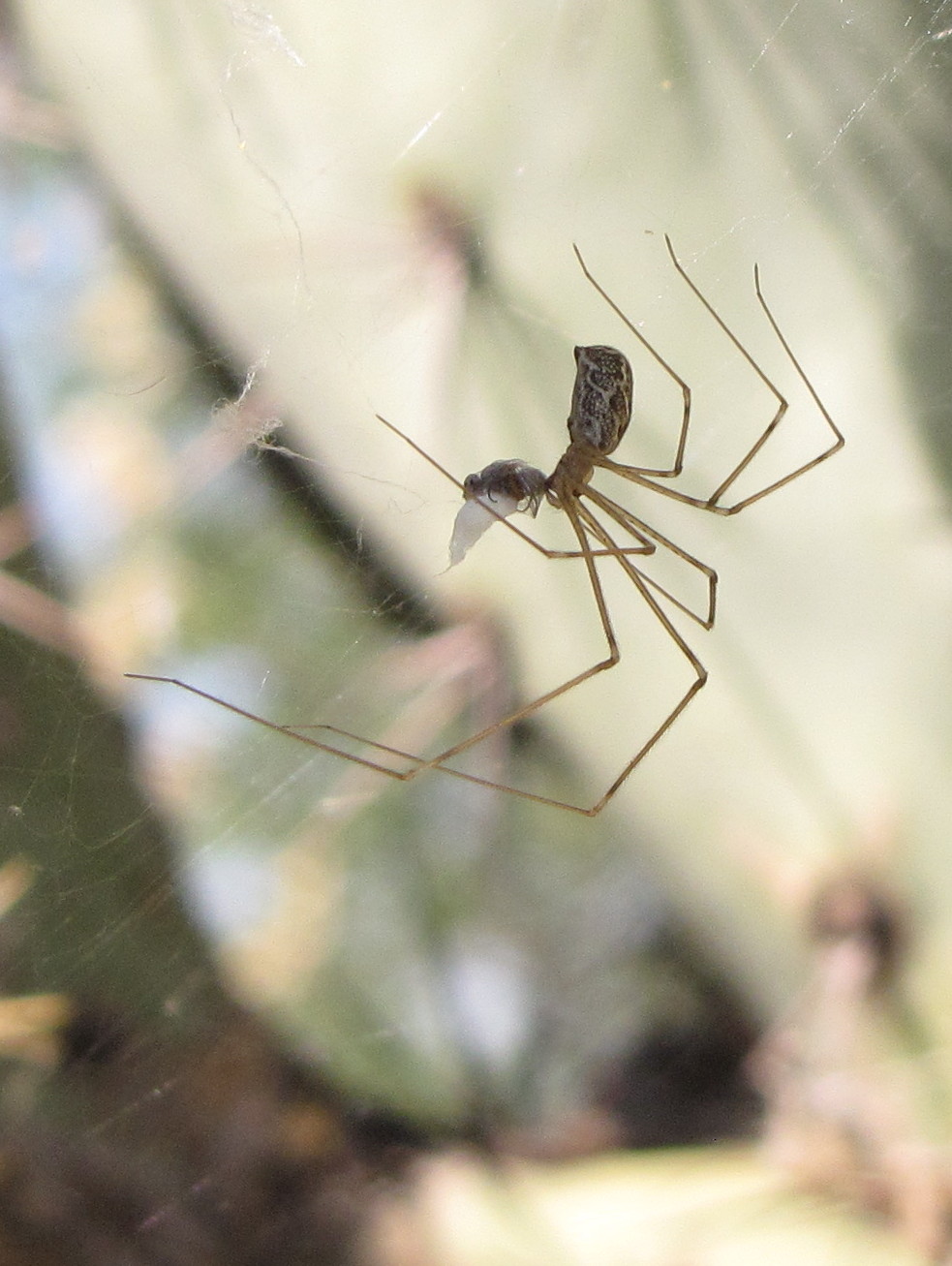
Cellar spiders are named for their habit of building their webs in cool, dark places such as basements, old mine shafts, wells and the like. Indeed, many members of the family Pholcidae do frequent such situations. However, this is not true of the Marbled Cellar Spider, Holocnemus pluchei.

The Marbled Cellar spider is actually native to the Mediterranean region of Europe. The earliest known record in North America comes from Sutter County, California in 1974. Because this species closely resembles the common Long-bodied Cellar Spider, Pholcus phalangioides, it is possible that it became established prior to 1974. The current U.S. distribution of the Marbled Cellar Spider ranges east to at least central Texas, and north to southern Oregon.

I find this species to be far more common outdoors than I do indoors here in southern Arizona. The webs of Holocnemus are irregular but decidedly dome-like, at least when one individual spider is off by itself. This is rarely the case, though, and many specimens will together form nearly contiguous webs that stretch far and wide. Dr. Elizabeth Jakob of the University of Massachusetts (Amherst) has found that up to fifteen individual spiders may share a communal web at any one time, with “membership” changing periodically. The spiders do compete over prey items, but skirmishes are rarely protracted.

Nearly any building overhang or dense tangle of vegetation will do for a web location. The primary criterion seems to be that the spiders do need shade from the unrelenting sun. At the Tucson Botanical Gardens I find a favorite place for this species to build its webs is among the leathery, spine-studded leaves of agave plants. Not many enemies of these spiders want to pursue them among the botanical equivalent of barbed wire.

The body length of mature female Holocnemus pluchei spiders is only 6-8 millimeters (males 5-7 mm, see image above), but their long, sprawling legs make them appear much larger. While this species is not regarded as dangerously venomous to people or pets in terms of the virulence of its venom, it has recently been discovered to have allergenic properties. According to this article, the species produces arginine kinase, a newly-described asthma-inducing allergen.

You want even more information and images? Some fantastic close-ups of this species can be found at the EuroSpiders and Spider Pharm websites. Austin Bug has a great article discussing common pholcid spiders of the Austin, Texas area, including the Marbled Cellar Spider. There is a PDF file available of the article ”Contests Over Prey by Group-Living Pholcids (Holocnemus pluchei)” in the Journal of Arachnology. Another PDF article discusses ”Food Level and Life History Characteristics in a Pholcid Spider (Holocnemus pluchei)” in the journal Psyche.