Wednesday, July 3, 2013

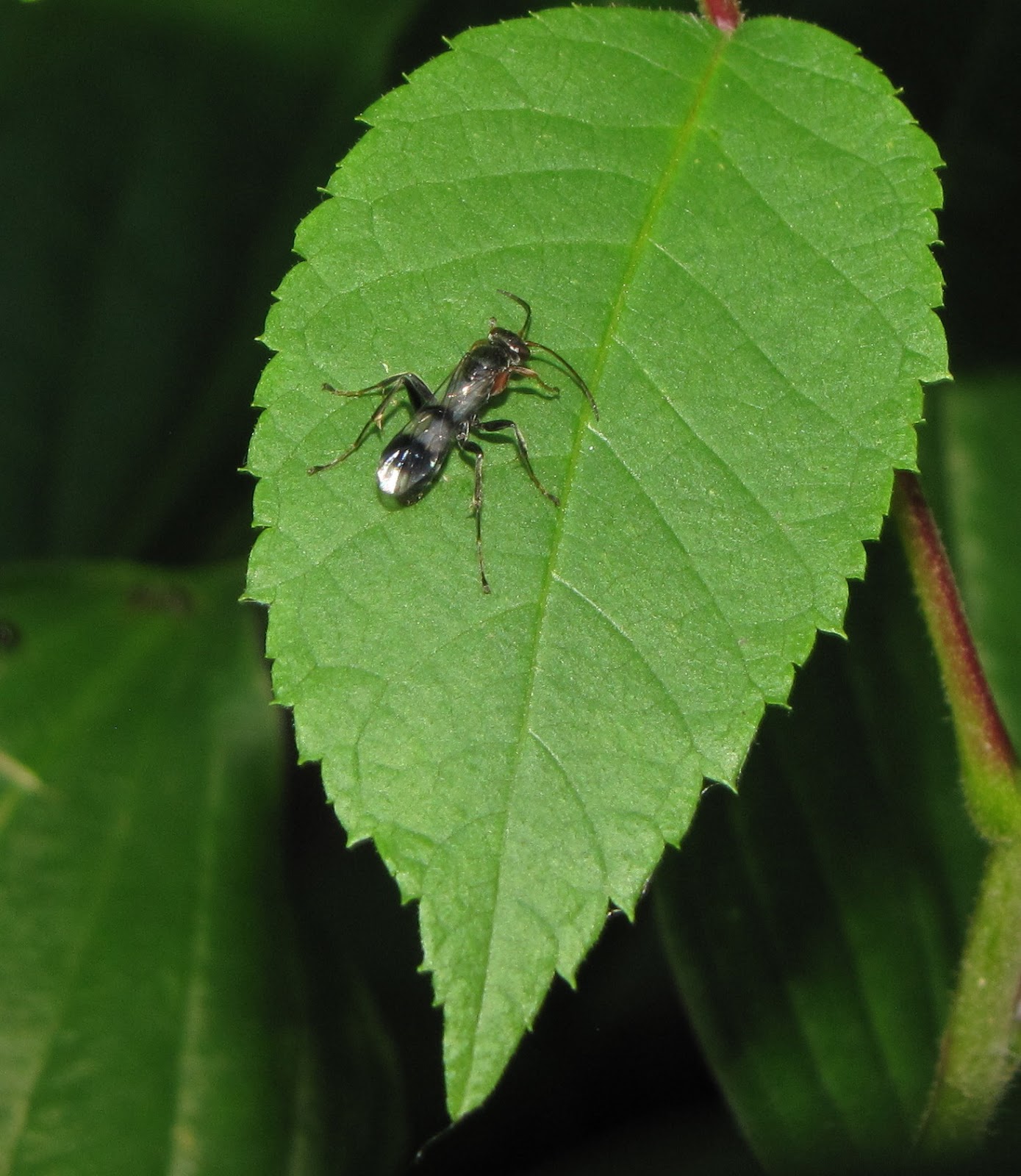
Spider wasp, Dipogon calipterus

Forest edges are a great place to look for wasps. Male wasps may perch on leaves to defend territories and look for passing females. Female wasps often hunt for prey among foliage, flowers, and stems. Both genders may pause to groom and rest on sunlit leaves. I was lucky enough to catch a rarely-seen spider wasp, Dipogon calipterus, grooming herself on a leaf at the edge of a wooded area near Bloomington, Indiana on June 20 of this year.

Dipogon spider wasps are mostly forest-dwellers that hunt for spider prey on tree trunks. Most species have dark bands on the wings, which have the effect of making them look a lot like ants. Considering that many predators dislike ants, it is an effective disguise. Add to that the fact that there is frequently a good deal of ant traffic going up and down any given tree bole, and it is no wonder these wasps are rarely observed.

These are not very large wasps, either. Townes (1957) measured wasps by length of the forewing rather than body length, and male D. calipterus have a forewing length of only five millimeters, females a forewing length of 5.7-7.4 millimeters. The wooded habitat and banded wings help to identify these wasps to genus. The reddish front legs help identify the species.

The distribution of Dipogon calipterus is scattered according to the three recognized subspecies. The one depicted here is D. calipterus calipterus, and it ranges from Massachusetts to North Carolina, Indiana, and Illinois, though it is important to note that our knowledge of the geographic distribution of most insect species is incomplete. D. calipterus duplicatus occurs in Georgia and Florida, and D. calipterus nubifer ranges from southern California to Panama. Slight differences in color and pattern seem to be the factors used in segregating the subspecies.

Females of Dipogon rarely, if ever, visit flowers for nectar, but are among the few wasps that will sometimes kill prey specifically to feed themselves rather than their offspring (or they feed on the spider before using it to provision a nest). Dipogon are probably opportunists, attacking whatever spiders they encounter while searching tree trunks, but the collective prey records for the genus are rich in crab spiders (family Thomisidae, especially the genus Xysticus). Other spiders known to be prey include jumping spiders (Salticidae) and ground spiders (Gnaphosidae). There is at least one record of a hacklemesh weaver, genus Amaurobius, as prey for D. calipterus calipterus.
Prey is stung into deep paralysis, or perhaps killed outright, by the female wasp. She carries her victim by grabbing the spinnerets at the tip of the abdomen and walking sideways or backwards, dragging the limp spider in the process.

It is suspected that the female wasp finds a suitable nesting site before she begins hunting. Nests are in typically in pre-existing, tubular cavities such as the abandoned tunnels of wood-boring beetles, or the soft pith in dead or broken plant stems such as sumac. Pre-drilled wood nest blocks put out for solitary bees may be used by these wasps. The linear cavity is divided into cells. After a spider is stored in the first, bottom-most cell, the wasp lays an egg on it and then builds a curtain of mud and/or other material that serves as the ceiling of that cell and the floor of the next cell.

The conglomerate nature of the cell partitions and closing plug is rather unique and helpful in identifying the nests of these wasps. Besides mud, particles of leaves, insect body parts, and even caterpillar frass (poop) may be incorporated into the nest partitions and closures. The female wasp uses the “beard” of hairs on her maxillary palps to carry such material back to the nest. The hairy palps are the only sure way to identify the genus Dipogon, but they are seldom visible on live specimens in the field.

Keep an eye out for these ant-mimicking wasps, even in your own backyard. Yes, it may take looking at a lot of tree trunks, or foliage, but you will eventually be rewarded with at least a glimpse of these unique pompilids.

Sources: Evans, Howard E. and Carl M. Yoshimoto. 1962. “The Ecology and Nesting Behavior of the Pompilidae (Hymenoptera) of the Northeastern United States,” Misc. Publ. Entomol. Soc. Am. 3(3): 67-119.
Krombein, Karl V., Paul D. Hurd, Jr., David R. Smith, and B.D. Burks (eds). 1979. Catalog of Hymenoptera in America North of Mexico vol. 2, Apocrita (Aculeata). Washington, DC: Smithsonian Institution Press. Pp. 1199-2209.
Townes, Henry. 1957. “Nearctic Wasps of the Subfamilies Pepsinae and Ceropalinae,” Bull. U.S. Natl. Mus. 209: 1-286.

Thursday, June 27, 2013

The Big-headed Grasshopper

It’s “OrThoptera Thursday” once again, and time for another grasshopper. My go-to place for grasshoppers here in Colorado Springs is a vast open space just up the street from my home. It is a shortgrass prairie in the literal sense in most spots, with extremely short, sparse turf in a mostly dusty, sandy, hilly plain that is dotted with scattered elm trees, sunflower, yucca, cacti, invasive weeds, and other low-growing herbs. This year it is even less lush.

Grasshoppers are usually abundant and diverse, but they are confined to only a few areas with herbs this year. Surprisingly, the dominant species I found yesterday was the Big-headed Grasshopper, Aulocara elliotti. It is technically one of the slant-faced grasshoppers, but it can easily be mistaken for one of the band-winged grasshoppers. It is easily identified by the very bright blue hind tibiae (“shin” segment on the hind leg), and large, rounded head.

I was still baffled initially, until I realized that last year I saw and photographed females, and what I was looking at yesterday were mostly males. One especially photogenic specimen, depicted here in the top- and bottom-most images, was also thermoregulating. Relying on camouflage and stillness is fine, unless the ground temperature is over 90° Fahrenheit like it was yesterday. Then you stand on tiptoe and even alternate which feet are in contact with the soil.

The Big-headed Grasshopper is fairly large as an adult, males ranging from 16-25 millimeters in length, females 22-35 millimeters. The species ranges across the entire western half of the U.S., north into the Prairie Provinces of Canada, and south well into central Mexico. While it prefers mostly shortgrass prairies and desert grasslands with sparse vegetation, I have encountered it at higher elevations (~8,500 feet) in coniferous woodlands. The adult insect can be found from June to September.

Nymphs emerge in mid-spring, having overwintered in the egg stage. They grow quickly, completing development to adulthood in 36-42 days. This may give them a head start in competing with other rangeland species. Males have only four instars (an instar is the period between molts), while females have five, so males mature sooner.

Aulocara elliotti feeds mostly on the green blades of grasses and sedges, but will also consume dry, cut grass, seeds, bran, and other ground litter it encounters while foraging. This species can occasionally reach pestiferous population levels and become damaging to crops and rangeland. Historical survey records show that it may reach densities of 20 specimens per square yard in mixedgrass prairie habitat, and up to 40 per square yard in desert grasslands. Not only does the feeding of the grasshoppers reduce available forage for livestock, but it can expose the soil to wind and water erosion.

The Big-headed Grasshopper is also capable of migrating, but apparently only for short distances. Observations in Arizona show that populations may move from one to seven miles in a season.

The continuing extreme drought in eastern Colorado would seem to guarantee that the Big-headed Grasshopper will continue to prosper while other species struggle. It will be interesting to follow the progress of this species in my neighborhood prairie patch.

Sources: Branson, David H. and Bethany Redlin (eds.). 2004. Grasshoppers: Their Biology, Identification, and Management (2nd Edition). US Department of Agriculture, Agricultural Research Service (PDF citation).
Capinera, John L., Ralph D. Scott, and Thomas J. Walker. 2004. Field Guide to Grasshoppers, Katydids, and Crickets of the United States. Ithaca: Comstock Publishing Associates (Cornell University Press). 249 pp.

Wednesday, June 12, 2013

Ibaliid Wasps

I am constantly surprised. I am also fortunate to have an extra set of keen eyes whenever my wife and I go exploring together. The evening of June 9 we decided to enjoy Sinton Pond Open Space here in Colorado Springs. While trying to get a picture of a damselfly, Heidi spied something even more interesting: a sleeping wasp in the family Ibaliidae.

I know, I’d never heard of them, either, at least until I found a specimen in Cincinnati when I lived there. I tried to turn it into some kind of ichneumon wasp, but it simply didn’t fit any of the characters for Ichneumonidae. I don’t recall how I finally found the answer, but I was certainly shocked to learn its nearest relatives are gall wasps.

There is one genus, Ibalia, in North America, with six species, the most widespread of which appears to be Ibalia anceps. Its distribution extends from Nova Scotia, Ontario, and Wisconsin south to Florida and Texas and west to Colorado. Geographic variation accounts for different color patterns in the wings. Ibalia anceps adults fly mostly in late May and early June.

Ibalia are parasites of horntail woodwasps in the family Siricidae. The female wasp lays an egg on the horntail grub, which is inside a dead, dying, or weakened deciduous tree, such as hickory. The larva that hatches from the ibaliid egg then penetrates the cuticle of the horntail larva and begins feeding as an internal parasite. Later, as the larva grows, it exits the host and finishes feeding as an external parasite.

Here locally, the only common horntail is the Pigeon Tremex, Tremex columba, so that must be the host. Indeed, elsewhere across its range, I. anceps is associated most often with T. columba. Please see my post on the Pigeon Tremex for more information about that wasp.

Ibaliids may be recognized by the laterally compressed abdomen. The abdomen is so thin that it conveys the impression that the rear end of the insect was smashed between the pages of a heavy book. Male Ibalia have fifteen segments in each antenna, while females have only thirteen segments. Females also possess an ovipositor (egg-laying organ). Specimens average about 12-14 mm in length, which is gigantic compared to their tiny relatives in the superfamily Cynipoidea, most of which are around three millimeters.

Keep your eyes open for these unique wasps. Take images if you are able, and share them with other naturalists and entomologists.

Sources: Goulet, Henri and John T. Huber (eds.) 1993. Hymenoptera of the World: An identification guide to families. Ottawa: Agriculture Canada. 668 pp.
Nendick-Mason, Hannah, et al. 2006. “Species Ibalia anceps,” Bugguide.net.
Smith, David R. and Nathan M. Schiff. 2002. “A review of the siricid woodwasps and their ibaliid parasitoids (Hymenoptera: Siricidae, Ibaliidae) in the eastern United States, with emphasis on the mid-Atlantic region,” Proc. Entomol. Soc. Wash. 104(1): 174-194.

Wednesday, June 5, 2013

Wasp vs. Wasp

My wife and I went down to Fountain Creek Regional Park in Fountain, Colorado recently (the evening of June 2, 2013), and I happened upon an interesting scene. About five or six female mason wasps, Symmorphus sp., were nesting in beetle borings in a cottonwood log by the side of the trail. About four cuckoo wasps, Chrysis sp., were hanging out around the holes the wasps were using as nests. Heidi said I must have spent 45 minutes taking pictures of them all, but it was worth it because I got to observe what was happening.

The above image is one of only two really nice shots I got of the female Symmorphus mason wasps. They would alight near their nest hole, and dive in very quickly. If I approached too quickly with the camera, the wasp would fly off before entering. If I waited too long, I would get a shot of the wasp’s abdomen disappearing, or a seemingly empty hole. Waiting for the wasp to emerge was basically futile, as she would exit much more quickly than was possible to focus.

You have to have an appreciation of the size of the players and the beetle borings to know what I was up against. The borings are probably the exit holes of deathwatch beetles, family Anobiidae, which bore in dead, solid wood as larvae. The diameter of each hole is about the same as the end of a retracted ballpoint pen (about 3 millimeters). Yes, both the mason wasps and cuckoo wasps could fit through those holes.

”Science has strict rules against anthropomorphism, but if you ask me, those chrysidids were cunning and calculating.”

Meanwhile, the bright metallic green cuckoo wasps were not as easily disturbed as the mason wasps. They might run randomly around between holes, but most of the time they sat quietly in the vicinity of a group of holes. Science has strict rules against anthropomorphism, but if you ask me, those chrysidids were cunning and calculating. They were waiting for the wasps to show them which holes were active nests worthy of their attention.

Cuckoo wasps are parasitic in the nests of other solitary wasps. They can’t sting, but the last few segments of the abdomen of the female telescopes into an egg-laying organ that can reach into the bottom of one of those nest tunnels. The cuckoo wasp lays an egg in the nest of its host, and the larva that hatches generally consumes the meal intended for the host offspring.

In the case of Symmorphus, females catch and paralyze leaf beetle larvae that are free-living, or are leaf-miners (living between the layers of a leaf). At least one species of Symmorphus attacks leaf-mining moth caterpillars on occasion. The larval victims are packed into a cell along the length of the beetle boring, and the mother wasp lays her own egg on the last victim. She then creates a partition of mud or chewed wood fibers, and begins a new cell. The process is repeated such that several cells usually occupy one tunnel.

The mason wasps, for their part, were also quite cognizant of the cuckoo wasps. I witnessed at least one altercation whereby a female mason wasp fended off a too-eager chrysidid at the entrance to her nest. Cuckoo wasps, while they can’t sting, have a dense, pitted exoskeleton that effectively repels the bites and stings of their hosts. They can even roll into a ball as a last resort, becoming virtually impregnable.

Without collecting specimens of the wasps, which I did not do, I cannot conclude the species I was observing. Process of elimination narrows the possibilities to Symmorphus cristatus or S. canadensis for the mason wasps. The cuckoo wasps could represent one or more species in the Chrysis coerulans species group. Scientists are still trying to sort out how many species there actually are in that complex.

After getting up from my baseball catcher’s stance, I could feel how my legs had stiffened. The pain was worth the gain, though, and I encourage my readers to endure for the sake of personal and collective knowledge. Field observations are not the scientific priority they once were in the fledgling years of ethology (study of animal behavior). It could easily be you who makes history with a new host record for a predator or parasite, or records some other hitherto unknown association between species.

Sources: Bohart, R.M. and Lynn S. Kimsey. 1982. “A Synopsis of the Chrysididae in America North of Mexico,” Mem. Am. Entomol. Inst. 33: 1-266
Buck, M. Marshall, S.A., and Cheung, D.K.B. 2008. “Identification Atlas of the Vespidae (Hymenoptera: Aculeata) of the Northeastern Nearctic Region,” Canadian Journal of Arthropod Identification No. 5: 492 pp.
Krombein, Karl V. 1967. Trap-nesting Wasps and Bees: Life Histories, Nests, and Associates. Washington, DC: Smithsonian Press. 570 pp.