Showing posts with label Pompilidae. Show all posts

Wednesday, February 10, 2016

Tiny Wasp Hero Slays Redback Spiders in Australia

Spider wasps in the family Pompilidae are fearless hunters of arachnids as small as jumping spiders and as large as tarantulas (the "tarantula hawk" wasps), but I was unfamiliar with any species of pompilid going after cobweb weavers in the family Theridiidae. That was until late last week when these stunning images came across my Facebook news feed.

Abel González snapped these images of a female Agenioideus nigricornis spider wasp carting a paralyzed Redback Spider, Latrodectus hasselti, back to a nest burrow in Oldbury, Western Australia. The significance of this behavior requires a bit of backstory.

The Redback Spider is one of the most dangerously venomous arachnids in Australia. Indeed, it is in the same genus as the widow spiders of North America: Latrodectus. Any organism that targets such a potentially lethal animal deserves some acclaim. Oddly, we have species of the wasp genus Agenioideus here in the U.S. as well. I witnessed a female A. humilis hauling a comatose orb weaver here in Colorado Springs last year, and even posted about it, complete with video, in this blog entry. Our New World species do not go after cobweb weavers, let alone widows.

The initial discovery of the relationship between the Australian A. nigricornis and the Redback Spider is credited to a nine year-old boy, who spotted a wasp dragging a spider in his backyard in Beaconsfield, Western Australia. The young lad pointed out the drama to his father, who was astute enough to collect the two animals and photograph the habitat. The specimens eventually crossed the desk of Andy Austin, a professor at the University of Adelaide, who identified them.

This is not a big wasp. Females are only 8.24-13.11 millimeters in body length. Perhaps their diminutive size helps them navigate the labyrinth that is a Redback Spider's web. It is apparently still a mystery how the wasp manages to subdue its prey to begin with.

Back here in the U.S., the only spider wasp thought to be a potential predator of widows is Tastiotenia festiva, based on one circumstantial record from Rodeo, New Mexico. The range of T. festiva is restricted to the extreme southwestern U.S. One other wasp is very well known as a predator of widows. It is the Blue Mud Dauber, Chalybion californicum, a very widespread member of the family Sphecidae.

The Australian wasp was known to science as far back as 1775, when it was first described from specimens collected by Captain James Cook in 1768; and it is a common insect found throughout Australia. The fact that its host was unknown until the 21st century speaks to how much we have yet to learn about even the most familiar of invertebrates.

Sources: Krogmann, Lars, and Andrew D. Austin. 2012. "Systematics of Australian Agenioideus Ashmead (Hymenoptera: Pompilidae) with the first record of a spider wasp parasitizing Latrodectus hasselti Thorell (redback spider)," J. Aust. Entomol. Soc. 51: 166-174.
Staff. 2012. "Killer Spider Meets Its Match in Tiny Wasp," LiveScience.
Wasbauer, M.S. and L.S. Kimsey. 1985. "California Spider Wasps of the Subfamily Pompilinae," Bulletin of the California Insect Survey. Vol. 26: 1-130.

Wednesday, July 1, 2015

Spider Wasp, Agenioideus humilis, Caught on Video

I am finally remembering to shoot video of interesting insect behavior when I'm presented with the opportunity. Please do not come to expect movies and clips as a regular part of this blog, but know that I am trying to get that kind of documentation. For example, I recently happened upon a female spider wasp, which I later identified as Agenioideus humilis, dragging an unidentified, comatose orbweaver down the rockwork on the exterior of an outbuilding in North Cheyenne Cañon park here in Colorado Springs, on June 27.

This is a small wasp, females ranging from 5.5-10.5 millimeters in body length (8 mm average), males even more diminutive at 4-9.5 millimeters (6.5 mm average). Both genders are dull black, with a dorsal white spot near the base of the tibia ("shin" segment) on the hind leg. The wings are clear, but with a dark edge and broad dark band on the front wing.

Agenioideus humilis ranges across the entire U.S. save for the northern Rockies, northern Great Plains, most of Minnesota, Wisconsin, and northern Michigan. Nowhere does it appear that this species is common, and it is scarce in collections. The wasp does not appear to feed on flower nectar or aphid honeydew, the favorite foods of most adult spider wasps in the family Pompilidae.

I almost missed seeing this female completely, as she had ducked behind a drainpipe running vertically down the building. The shadow cast by her and her prey is actually what caught my attention. Despite being startled by my approach, she maintained a grip on her spider victim and continued here zig-zag descent down the wall, as reflected in the video clip below.

Once she reached the ground, she deposited her burden and commenced grooming herself briefly. She then ran about a foot away, to the base of the building, where it appeared she had already started a nest burrow. This next clip shows her digging at warp speed, sand flying between her legs and behind her.

Prior records for this species show it will also nest in pre-existing cavities such as cracks and crevices in rocks or the walls of buildings. The single victim is paralyzed by the wasp's sting and hauled to a suitable location for....burial. The wasp lays a single egg on the spider, then covers her tracks by scraping soil over the nest entrance and compacting it with blows from her abdomen. She then departs to begin the process again.

While this wasp was actively engaged in nesting, another wasp lurked nearby, on the wall of the building. Initially, I thought this was some kind of parasitic wasp, but upon closer examination, it turned out to be a male of her own kind. He was substantially smaller and of considerably different body type than the female.

Male A. humilis

Prey records for Agenioideus humilis reflect that the preferred prey are orbweavers in the family Araneidae, with several different species represented: Acacesia hamata, Larinioides cornutus, and Araneus pegnia among them.

This spider wasp apparently favors woodland habitats with sandy soil, and indeed the landscape where I encountered this one was a mixed conifer (mostly pine) forest with Gambel's Oak, chokecherry, and other shrubs in the understory.

I rarely find wasps toting prey, but I hope the next time that I do I will have means to record the event. Keep your own camera handy, you never known when you will happen upon entomological drama.

Sources: Evans, Howard E. 1950. "A Taxonomic Study of the Nearctic Spider Wasps Belonging to the Tribe Pompilini (Hymenoptera: Pompilidae), Part I" Trans. Amer. Entomol. Soc. Vol. LXXV[75], pp. 133-270
Krombein, Karl V., Paul D. Hurd, Jr., David R. Smith, and B.D. Burks. 1979. Catalog of Hymenoptera in America North of Mexico Vol. 2. Washington, DC: Smithsonian Institution Press. 2209 pp.
Wasbauer, M.S. and L.S. Kimsey. 1985. "California Spider Wasps of the Subfamily Pompilinae (Hymenoptera: Pompilidae)," Bull. Calif. Insect Survey. Vol. 26. 130 pp.

Wednesday, September 10, 2014

A Spider Wasp, Aporus luxus

When I lived in Oregon, one of the most common spider wasps I encountered was a lovely little iridescent blue-black species, Aporus luxus. My wife and I traveled to Oregon earlier this year, and on July 12 I found the two specimens pictured here at a rest stop on Interstate 5.

One of the easiest ways of identifying the seven members of the genus Aporus is by the way the front of the thorax slopes gradually toward the head, giving a very streamlined appearance. The front legs are short, and indeed all the legs are proportionately shorter than in other spider wasps. The antennae are relatively short and thick, a trait they share with the unrelated genus Evagetes, but the latter has a much blockier thorax.

At only 8-15 millimeters in body length, these are not large insects that are apt to attract your attention in the field, but they are common wasps on flowers of Queen Anne's Lace (aka Wild Carrot), Daucus carota, and other umbelliferous blossoms that afford the wasps nectar and an unobstructed view of potential incoming danger. While thus occupied they are fairly easy to approach. Constantly moving, they still make a challenging target for photography.

Aporus luxus has also been found on flowers of buckwheat (Eriogonum spp.), rabbitbrush (Chrysothamnus spp.), gumweed (Grindelia spp.), spurge (Euphorbia spp.), Woollyhead Parsnip (Sphenosciadium capitellatum), sweetbush (Bebbia sp.), elderberry (Sambucus spp.), mesquite (Prosopis spp.), Desert Willow (Chilopsis linearis), and saltcedar (Tamarix spp.). The wasps also visit the extrafloral nectaries of Common Sunflower, Helianthus annuus, and the honeydew secreted by aphids, and exudates of galls on oak trees.

The life history of the larval stage is almost wholly unknown. An adult male wasp was reared from a wafer-lid trapdoor spider, Aptostichus sp., in the family Euctenizidae. The spider is stung into paralysis by the adult female wasp, and she utilizes the spider's own burrow as her nest, depositing a single egg on her victim. There is only one generation in most cases, though in southernmost latitudes there are apparently two generations annually.

This species ranges from central British Columbia to central Baja California, eastward to western Idaho and Utah, and most of Arizona. There is one record from Montezuma County, Colorado (Evans, 1997). Adult specimens are most common between the months of May and October.

Sources: Evans, Howard E. 1997. "Spider Wasps of Colorado (Hymenoptera, Pompilidae): an Annotated Checklist," The Great Basin Naturalist 57(3): 189-197.
Fensler, Nick. 2006. "Genus Aporus," Bugguide.net.
Wasbauer, M.S. and L.S. Kimsey, 1985. "California Spider Wasps of the Subfamily Pompilinae," Bull. of the California Insect Survey vol. 26. Berkeley: University of California Press. pp. 1-130.

Wednesday, May 21, 2014

Masters of Mud: Auplopus Spider Wasps

The first image in this post is not of the insect I will be discussing today. That is because I am far more frequently asked what these little mud barrels are, and what makes them. Indeed, you are more apt to stumble upon these nests than you are to see their maker. While most spider wasps in the family Pompilidae dig burrows for their nests, or exploit pre-existing cavities, those in the genus Auplopus create free-standing mud cells.

I have few images of these wasps, and detest “stealing” images from others for my posts even though I give full credit when I do, so I hadn’t done an entry about Auplopus until now. It took a Facebook post by Eileen Miller to remind me that I was overdue to address them. Eileen was kind enough to share her own images in exchange for learning more about the wasps and their nests.

© Eileen Miller

There are ten recognized species of Auplopus in North America, but the genus is in dire need of revision. Collectively, the genus occurs across the entire continent. One species, A. carbonarius, is introduced from western Europe, and has been documented in New York and Michigan, but probably has a wider distribution in the U.S. than is currently known.

Several species are bright metallic blue-green, and the females at least are basically inseparable externally. Males can be identified by differences in the genitalia. Auplopus are small, averaging about 10 millimeters in length. Females have an oval spot on top of the abdomen near the tip called a “pygidial plate” that they use like a masonry trowel to manipulate mud pellets into segments of their mud nests. The female curls her abdomen beneath her during such work, so that the pygidial plate can contact the mud.

© Yurika Alexander via Bugguide.net Auplopus mellipes female

The nests are usually constructed inside pre-existing cavities in wood, or at least in sheltered niches such as under bark on standing trees, crevices in rock walls, or even inside the abandoned nests of other wasps like Sceliphron caementarium (Black and Yellow Mud Dauber), Trypoxylon politum (the Pipe Organ Mud Dauber), and paper wasps (Polistes spp.). The tiny barrel-shaped cells are roughly 15 millimeters in length and 7-10 millimeters wide, often stacked end-to-end, two to five per row.

Nest inside hole where a bolt used to be

The wasps appear to be mostly opportunistic hunters of spiders that do not spin webs.

Documented prey includes spiders from thirteen different families: Crab spiders (Thomisidae), jumping spiders (Salticidae), sac spiders (Clubionidae), ground sac spiders (Trachelas sp. in Corinnidae), ghost spiders (Anyphaenidae), longlegged sac spiders (Cheiracanthium sp. in Miturgidae), ground spiders (Gnaphosidae), nursery web spiders (Pisauridae) being the usual victims of North American Auplopus.

© Marie L. Schmidt via Bugguide.net Female wasp with spider prey

Adult or immature spiders may be taken, and the wasps usually amputate several, if not all, the legs of their prey. This allows the wasp to feed on the blood of the spider, but also facilitates easier transport of the victim over the ground. Presumably, more than one spider is placed in each mud cell before the female lays an egg on the last victim and then seals the cell.

© Eileen Miller, inside of cell showing pupa in cocoon

In at least one species, the emerging adult wasp regurgitates liquid to soften the mud cap on its cell, allowing it to more easily chew its way to freedom.

Auplopus seldom visit flowers, but can often be found around aphid colonies on honeyvine milkweed (Ampelamus albidus, Cynanchum leave), sunflower, and other plants. They feed on “honeydew,” the sweet liquid waste products that aphids secrete.

© Eileen Miller

Look for these little wasps from May to October, but especially July through September when they are most abundant. It should be noted that other Hymenoptera make very similar mud nests, particularly some of the Osmia mason bees, and some mason wasps (family Vespidae, subfamily Eumeninae). Auplopus are surprisingly well-studied insects, but information is scattered over articles in many different scientific journals and books.

Sources: Eiseman, Charley and Noah Charney. 2010. Tracks & Signs of Insects and Other Invertebrates. Mechanicsburg, Pennsylvania: Stackpole Books. 582 pp.
Evans, Howard E. and Carl M. Yoshimoto. 1962. “The Ecology and Nesting Behavior of the Pompilidae (Hymenoptera) of the Northeastern United States,” Misc. Publ. Entomol. Soc. Am. 3(3): 66-119.
Krombein, Karl V. 1967. Trap-nesting Wasps and Bees: Life Histories, Nests, and Associates. Washington, DC: Smithsonian Press (Publication 4670). 570 pp.
Kurczewski, Frank E. 1989. “Observations on the Nesting Behavior of Auplopus caerulescens subcorticalis and Other Auplopodini (Hymenoptera: Pompilidae),” Gt. Lakes Entomol. 22(2): 71-74.
Kurczewski, Frank E. and Mark F. O’Brien. 1991. “Auplopus carbonarius, a Palearctic Spider Wasp, Extends its Range to Michigan (Hymenoptera: Pompilidae),” Gt. Lakes Entomol. 24(3): 185-186.
O/Neill, Kevin M. 2001. Solitary Wasps: Behavior and Natural History. Ithaca, New York: Comstock Publishing Associates (Cornell University Press). 406 pp.

Wednesday, July 3, 2013

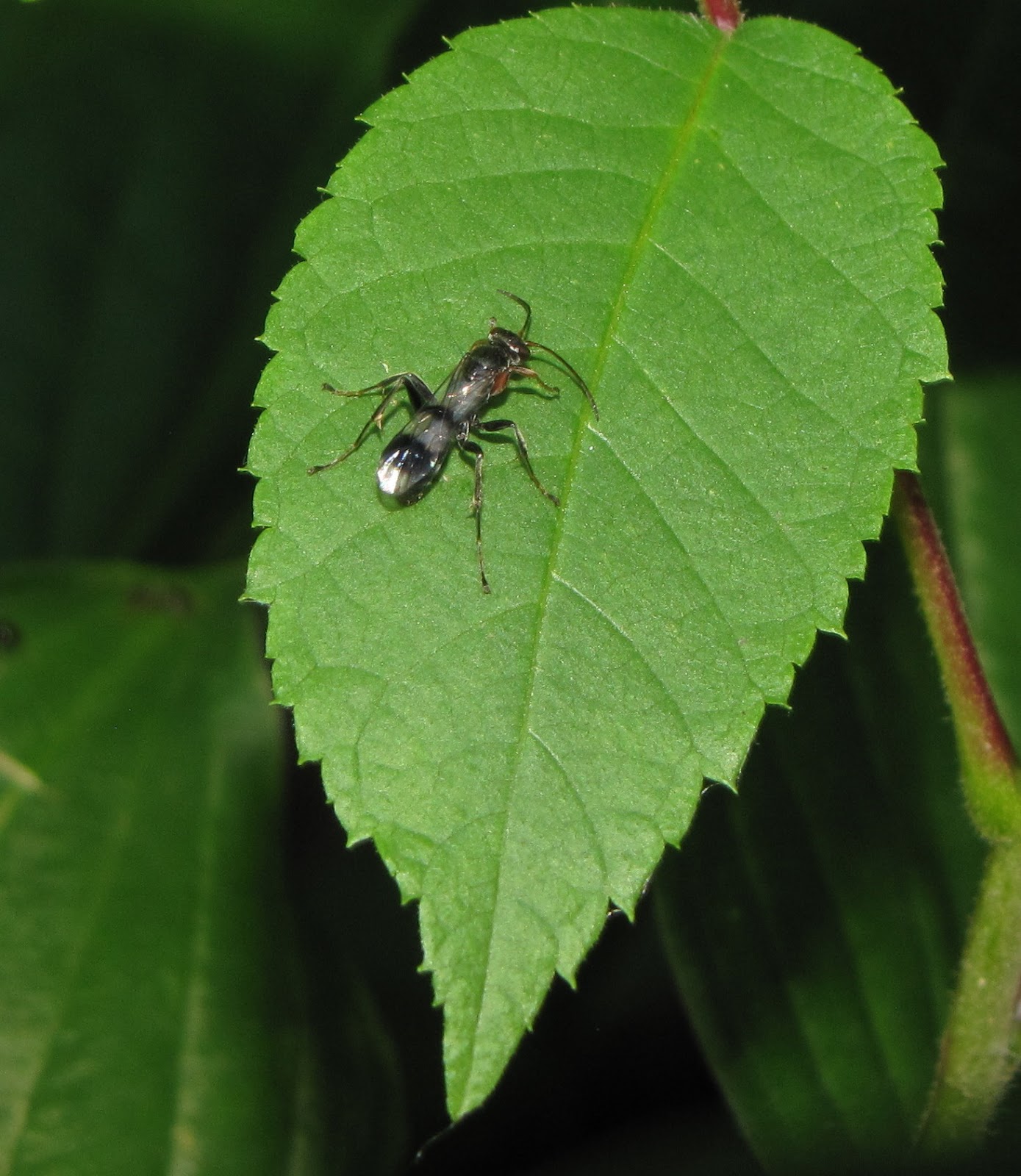
Spider wasp, Dipogon calipterus

Forest edges are a great place to look for wasps. Male wasps may perch on leaves to defend territories and look for passing females. Female wasps often hunt for prey among foliage, flowers, and stems. Both genders may pause to groom and rest on sunlit leaves. I was lucky enough to catch a rarely-seen spider wasp, Dipogon calipterus, grooming herself on a leaf at the edge of a wooded area near Bloomington, Indiana on June 20 of this year.

Dipogon spider wasps are mostly forest-dwellers that hunt for spider prey on tree trunks. Most species have dark bands on the wings, which have the effect of making them look a lot like ants. Considering that many predators dislike ants, it is an effective disguise. Add to that the fact that there is frequently a good deal of ant traffic going up and down any given tree bole, and it is no wonder these wasps are rarely observed.

These are not very large wasps, either. Townes (1957) measured wasps by length of the forewing rather than body length, and male D. calipterus have a forewing length of only five millimeters, females a forewing length of 5.7-7.4 millimeters. The wooded habitat and banded wings help to identify these wasps to genus. The reddish front legs help identify the species.

The distribution of Dipogon calipterus is scattered according to the three recognized subspecies. The one depicted here is D. calipterus calipterus, and it ranges from Massachusetts to North Carolina, Indiana, and Illinois, though it is important to note that our knowledge of the geographic distribution of most insect species is incomplete. D. calipterus duplicatus occurs in Georgia and Florida, and D. calipterus nubifer ranges from southern California to Panama. Slight differences in color and pattern seem to be the factors used in segregating the subspecies.

Females of Dipogon rarely, if ever, visit flowers for nectar, but are among the few wasps that will sometimes kill prey specifically to feed themselves rather than their offspring (or they feed on the spider before using it to provision a nest). Dipogon are probably opportunists, attacking whatever spiders they encounter while searching tree trunks, but the collective prey records for the genus are rich in crab spiders (family Thomisidae, especially the genus Xysticus). Other spiders known to be prey include jumping spiders (Salticidae) and ground spiders (Gnaphosidae). There is at least one record of a hacklemesh weaver, genus Amaurobius, as prey for D. calipterus calipterus.

Prey is stung into deep paralysis, or perhaps killed outright, by the female wasp. She carries her victim by grabbing the spinnerets at the tip of the abdomen and walking sideways or backwards, dragging the limp spider in the process.

It is suspected that the female wasp finds a suitable nesting site before she begins hunting. Nests are in typically in pre-existing, tubular cavities such as the abandoned tunnels of wood-boring beetles, or the soft pith in dead or broken plant stems such as sumac. Pre-drilled wood nest blocks put out for solitary bees may be used by these wasps. The linear cavity is divided into cells. After a spider is stored in the first, bottom-most cell, the wasp lays an egg on it and then builds a curtain of mud and/or other material that serves as the ceiling of that cell and the floor of the next cell.

The conglomerate nature of the cell partitions and closing plug is rather unique and helpful in identifying the nests of these wasps. Besides mud, particles of leaves, insect body parts, and even caterpillar frass (poop) may be incorporated into the nest partitions and closures. The female wasp uses the “beard” of hairs on her maxillary palps to carry such material back to the nest. The hairy palps are the only sure way to identify the genus Dipogon, but they are seldom visible on live specimens in the field.

Keep an eye out for these ant-mimicking wasps, even in your own backyard. Yes, it may take looking at a lot of tree trunks, or foliage, but you will eventually be rewarded with at least a glimpse of these unique pompilids.

Sources: Evans, Howard E. and Carl M. Yoshimoto. 1962. “The Ecology and Nesting Behavior of the Pompilidae (Hymenoptera) of the Northeastern United States,” Misc. Publ. Entomol. Soc. Am. 3(3): 67-119.
Krombein, Karl V., Paul D. Hurd, Jr., David R. Smith, and B.D. Burks (eds). 1979. Catalog of Hymenoptera in America North of Mexico vol. 2, Apocrita (Aculeata). Washington, DC: Smithsonian Institution Press. Pp. 1199-2209.
Townes, Henry. 1957. “Nearctic Wasps of the Subfamilies Pepsinae and Ceropalinae,” Bull. U.S. Natl. Mus. 209: 1-286.

Wednesday, May 15, 2013

Priocnemis minorata

One of the more conspicuous wasps of springtime in deciduous forests of the eastern United States is the spider wasp Priocnemis minorata. Indeed, it is usually the first member of the family Pompilidae to be seen. You can find them right now, as I did in Missouri last week.

These are medium-sized insects, the length of the front wing varying from 6-12 millimeters, the entire insect a bit longer. Their long legs make them appear even larger overall. They are shiny black in color, with the wings having a smoky and/or iridescent appearance. Note the serrated top surface of the tibia (“shin” segment) on the hind leg. This character immediately sets them apart from other black spider wasps you are likely to encounter. Look for them hunting among leaf litter in places where there is dappled sunlight through the tree canopy. The wasps are active from late March to mid-June, with peak activity in April and May.

While this species is most abundant in the U.S. east of the 100th meridian, it has also been recorded from the Pacific Northwest in southeast British Columbia and western Oregon. Additional Canadian records include Nova Scotia, Quebec, and Ontario.

Priocnemis minorata is a generalist predator of spiders, and probably an opportunist. Known host records include Coras juvenilis, Wadotes calcaratus, Wadotes hybridus (hacklemesh weavers, family Amaurobiidae), Hibana gracilis (ghost spiders, family Anyphaenidae), Clubiona obesa (sac spiders, family Clubionidae), Dolomedes tenebrosus (fishing spiders, family Pisauridae), Trochosa terricola, Gladicosa gulosa, Arctosa rubicunda, and Varacosa avara (wolf spiders, family Lycosidae).

Last week I found the female specimen shown here at The Inn on Crescent Lake in Excelsior Springs, Kansas, that oddly persisted in staying in one place. Eventually, I figured out that she was in the process of carting off a paralyzed, immature nursery web spider, Pisaurina mira (family Pisauridae). It turns out this is not a new host record, as this spider species was discovered as a host for Priocnemis minorata previously (Kurczewski, et al., 1987).

Dick Walton has captured some stunning video of this species in action, including what might be a new host record: a running crab spider in the genus Thanatus (family Philodromidae). He also shows another specimen dispatching a wolf spider.

The female wasp digs a burrow prior to going hunting. The entrance is usually hidden under dead, dry leaves. The tunnel itself is vertical or slightly angled, and may reach a depth of 27.5 centimeters. One cell is constructed at the bottom of the shaft, with as many as six other cells branching off progressively from the bottom up. One spider is apparently stored in each cell, on its side, with an egg laid on the spider’s abdomen. The egg hatches in two days and the larva that hatches matures in about a week. The remainder of the year is spent in the pupa stage, until the adult wasp emerges the following spring.

When I lived in Cincinnati, Ohio, I could always tell when spring had really arrived by when the spider wasps were out. I encourage you to look for this species in your own neck of the woods, among the trilliums, violets, and other wildflowers on the forest floor.

Sources: Evans, Howard E. and Carl M. Yoshimoto. 1962. “The Ecology and Nesting Behavior of the Pompilidae (Hymenoptera) of the Northeastern United States,” Misc. Publ. Entomol. Soc. Am. 3(3): 67-119.
Kurczewski, Frank E. and Edmund J. and Roy A. Norton. 1987. “New Prey Records for Species of Nearctic Pompilidae (Hymenoptera),” J. Kans. Entomol. Soc. 60(3): 467-475.
Townes, Henry. 1957. “Nearctic Wasps of the Subfamilies Pepsinae and Ceropalinae,” US Nat. Mus. Bull. No. 209. 286 pp.

Wednesday, January 30, 2013

Wasp Wednesay: Hemipepsis ustulata

The term “tarantula hawk” applies to more than one species of large wasp. It even applies to more than one genus. Here in the United States, the genera Pepsis and Hemipepsis are the only tarantula hawks, and the largest of our spider wasps in the family Pompilidae. Hemipepsis ustulata is a common species across much of the western U.S., one I have encountered in both Arizona and Colorado.

It is not easy to separate Hemipepsis from Pepsis, but I find that Hemipepsis are matte black in color, not the iridescent blue-black that their relatives are. Hemipepsis also tends to fly earlier in the season than Pepsis, especially in the southwest, but both genera can be found together in the fall, Hemipepsis being in the second generation in autumn. Wing venation is apparently the only sure way to tell the two apart, but most folks understandably don’t want to get that close to such a large, stinging insect to find out which is which.

Tarantula hawks in general have interesting behaviors, especially the males. Dr. John Alcock has studied in-depth the territorial behavior of male Hemipepsis ustulata in the Superstition Mountains near Phoenix, Arizona. They are among the first insects seen in spring, but as the season wears on they become early risers, taking advantage of the brief window of time when Sonoran Desert temperatures are not too cool, but not incinerating, either. They are looking for prominent outposts, often Palo Verde trees atop hills.

Once a male wasp claims a lookout tree, it vigorously defends it from competing males. Most interactions consist of the resident male flying off his perch in a brief foray to chase away the intruder. There is usually only feeble resistance, if any, from the interloper. Males that have been displaced from their own territories, however, are more likely to try and displace another male. This takes the form of long, ascending flights in which the wasps spiral around each other as they climb to heights of thirty feet or more. Sometimes they escalate to altitudes where they can no longer be observed without binoculars.

These aerial duels are contests of both endurance and speed. The faster and fitter male is thus the one more likely to win.

Female wasps cruising past an occupied tree elicit an entirely different response. The resident male gives chase and, if he successfully reaches her, attempts to couple with her in the air and descend to the ground. There, they mate briefly if she is receptive. The male then returns to his perch, which he hopes has not been claimed by another male while he was um, otherwise engaged.

This form of territoriality is called “landmark defense,” and it is the strategy of choice in situations where defense of a resource used by females is impractical or impossible. While blooming palo verde trees might seem to be a nectar source for female tarantula hawks (and they are, for Pepsis chrysothemis), females of Hemipepsis ustulata seem to prefer the flowers of creosote bush, which has a wide and scattered distribution in the landscape.

Once mated, a female tarantula hawk goes about the business of finding occupied tarantula burrows and baiting the spider into battle aboveground. These burrows are also widely scattered. So, male wasps can’t stake out a tarantula “colony” because there is no such thing, at least not for spiders the size needed by the female wasp.

Some of the hunting activities of these wasps may take place at night, or at least at dusk, for I have found females in southeast Arizona coming to blacklights at night. I have also found females feeding on oozing sap of Desert Broom (Baccharis sarothroides). Here in Colorado Springs I have seen both genders at a blooming saltcedar tree (Tamarix sp.), though the female simply circled the tree and flew off again.

Hemipepsis ustulata ranges from southern California east through Nevada to Texas, Oklahoma, and Kansas. It would be well worth it to accumulate more records of this species. More county records are certainly possible, and perhaps state records, too.

Sources: Alcock, John. 1984. “Ridgetop Rendezvous,” Natural History 93: 42-47.
Evans, Howard E. 1997. “Spider Wasps of Colorado (Hymenoptera, Pompilidae): An Annotated Checklist,” Great Basin Naturalist 57(3): 189-197.

Wednesday, November 21, 2012

Wasp Wednesday: Pepsis grossa

There are many species of “tarantula hawk” wasps in the western U.S., but the largest is Pepsis grossa, formerly known as Pepsis formosa. Interestingly, this insect exhibits both an orange-winged (xanthic) form, and a black-winged (melanic) morph. The two are almost never found together in the same location.


female xanthic form

My experience with P. grossa has been confined to southeast Arizona, but the species ranges from southern California and Nevada to Kansas, Texas, Arkansas, and Missouri. It also occurs throughout the Caribbean islands, Mexico, Central America, and northern South America. The xanthic form is found from Arizona north and east, and also in central Mexico. In southern Ecuador and northwest Peru, there is a “lygarochromic” variation whereby the wings are dark at the base, with a median patch of dark amber, and a pale wingtip.

These are enormous wasps impossible to overlook. Females average a whopping 43 millimeters in body length (30-51 mm). Males are smaller, 24-40 millimeters.


male melanic form

These giants can still be confused with the very similar, but smaller P. mexicana. Males of P. grossa can be distinguished by the fact that they have twelve antennal segments. No other Pepsis species has that number of segments. Females of P. grossa have long, coarse hairs beneath the femur of the front leg, though this feature can be abraded in older, worn specimens.

Females hunt for their tarantula prey mostly in the morning and evening to avoid overheating in the intense summer sun. Flying low over the ground, they may detect the presence of a tarantula burrow by sight or smell. Occupied tarantula burrows have a silk curtain over the entrance by day, and perhaps the wasp is tuned in to chemicals in the silk that indicate a spider is at home. The wasp may also land randomly and scour the soil on foot, flicking her wings and bobbing her antennae feverishly.

Once she does find a burrow with a spider inside, she cuts away the silk curtain and cautiously enters the burrow. Soon, both wasp and spider erupt from the burrow. This eviction behavior is crucial to the wasp’s success in securing her prey. She would have far less room to maneuver inside the spider’s tunnel.

The wasp steps back, grooms herself thoroughly, and then sizes up her adversary. She uses her antennae to entice the spider into raising itself off the ground; or even antagonizes the arachnid into a threat posture whereby the tarantula raises its front legs high, exposing its fangs. The wasp then seizes the second leg and thrusts her stinger between the base of its leg and its sternum. She strikes a nerve center in that location which causes the spider to become paralyzed.

The wasp may feed on fluid from the wound created by her stinger, or groom herself again before commencing the laborious procedure of carrying her prey away.

Tarantula hawks often simply drag their paralyzed burden into back into its old burrow, but on occasion they may dig another burrow and bury the spider there. I am pretty certain I witnessed the very end of this sequence one evening at Tohono Chul Park in northwest Tucson. The female shown below was busy filling a shallow depression by scraping sand into it.


female melanic form

The female lays a single egg on the tarantula and then seals the burrow. The larva that hatches from the egg will then consume the spider. Once finished, the larva will spin a silken cocoon, metamorphose into the pupal stage, and eventually emerge as an adult wasp sometime later.

Look for both male and female tarantula hawks on flowers, especially milkweeds (Asclepias spp.), where they fuel themselves on nectar. During the heat of midday, they will seek shelter amid foliage on trees and shrubs, sometimes gathering by the dozens on one plant. Males, and the odd female, may also spend the night in such aggregations.

Despite their intimidating size, these are rather placid animals unless provoked. An agitated tarantula hawk adopts a threat posture with wings splayed and abdomen curled under. They also secrete a strong, but not unpleasant, odor. Take heed! Stings from Pepsis are not life-threatening unless you are prone to allergies, but the pain is incredible. According to Justin Schmidt, you are in agony for about three minutes, and then it is pretty much over (the pain). Actual results may vary, so I am not volunteering to experiment any time soon. Neither should you.

Sources: Alcock, John. 2000. “The Tarantula Hawk Wasp’s Potent Sting Stuns and Kills the Much Larger Tarantula,” Arizona Highways, 76(10): 40-41.
Hurd, Paul David, Jr. 1952. “Revision of the Nearctic Species of the Pompilid Genus Pepsis (Hymenoptera, Pompilidae),” Bull. Am. Mus. Nat. Hist. 98(4): 261-334.
Punzo, Fred. 2007. “Interspecific Variation in Hunting Behavior of Pepsis grossa (Fabricius) and Pepsis thisbe Lucas (Hymenoptera: Pompilidae): A Field Study,” J. Hym. Res. 16(2): 297-310.
Schmidt, Justin O. 2004. “Venom and the Good Life in Tarantula Hawks (Hymenoptera: Pompilidae): How to Eat, Not be Eaten, and Live Long,” J. Kans. Entomol. Soc. 77(4): 402-413.
Vardy, C.R. 2002. “The New World tarantula-hawk wasp genus Pepsis Fabricius (Hymenoptera: Pompilidae) Part 2. The P. grossa- to P. deaurata-groups,” Zool. Verh. 337: 1-134.

Wednesday, October 17, 2012

Wasp Wednesday: Anoplius aethiops

The western states may have the giant “tarantula hawks,” but most of the U.S. and adjacent Canada has another fierce spider wasp in the family Pompilidae. On our trip to Cape May, New Jersey, September 30-October 5, we encountered several big females of Anoplius aethiops. Ok, they were most likely that species, but it requires microscopic examination to separate them from the similar Anoplius cleora.

The first one I saw was so large that I at first mistook it for a Great Black Wasp, a wasp in an entirely different family. Both wasps are large, jet black, with black wings that reflect blue or violet. The spider wasps do not, however, have the abdomen separated from the thorax by a thin petiole (stalk). When I got a side view of the wasp, it became clear it was not in the genus Sphex. Still, it goes to show how difficult it is to identify insects in the field.

Female Anoplius aethiops measure 13-23 millimeters in body length, males 9-18 millimeters. Though black in color, their bodies reflect a hint of bluish or purplish color in the right light.

My “Spider Sunday” post was about a species of large wolf spider, the kind that these big spider wasps target. Each female Anoplius aethiops digs her own burrow, usually originating inside an existing burrow or crevice, and then goes off to find a spider to stash inside the tunnel. Heidi and I encountered one female wasp toting a good-sized wolf spider down the path we were on in Cape May Point State Park.

The wasp was walking backwards quite rapidly, while using her jaws to hoist her heavy prey completely off the ground. This feat of strength would be like you or me lifting a recliner with our teeth and backing across the street.

The spider is not even dead, but only paralyzed by the wasp’s venom when she stung it in a nerve center. Unfortunately, even in my rather careful efforts to get more images of wasp and spider, she ended up abandoning her prize. An abandoned, paralyzed spider may or may not eventually “come to” from its comatose state.

All known host spiders for Anoplius aethiops are lycosid wolf spiders: Hogna helluo, H. carolinensis, H. aspersa, H. baltimoriana, H. frondicola, Rabidosa santrita, Gladicosa gulosa, and Schizocosa ocreata. Once she places a spider in the bottom of her underground nest, the wasp lays a single egg on the spider, exits, and then closes the burrow. She will repeat the process as long as she is able. This is a wasp most common in late summer, and persisting into late fall. Most of the specimens we saw in New Jersey had tattered wings, indicating they had been active for quite some time already.

Look for Anoplius aethiops in open areas like fields, forest edges, meadows, and prairies. It tends to be replaced by A. cleora in open sand dune habitats. Both genders visit flowers such as wild carrot, goldenrod, sweet clover, milkweed, and throughwort for nectar. Anoplius cleora rarely visits flowers, so that is another way to distinguish the two species.

This wasp ranges coast to coast in the United States, save for North Dakota, plus southern British Columbia and southeast Canada to the north; and Mexico and Guatemala to the south. It is apparently less common in the southeast U.S. than in other parts of its range. Late July through mid-September is the typical seasonal range for this wasp.

Sources: Evans, Howard E. 1951. “A Taxonomic Study of the Nearctic Spider Wasps Belonging to the Tribe Pompilini (Hymenoptera: Pompilidae) Part II: Genus Anoplius Dufour,” Trans Am Entomol Soc LXXVI, 207-361.
Evans, Howard E. and Carl M. Yoshimoto. 1962. “The Ecology and Nesting Behavior of the Pompilidae (Hymenoptera) of the Northeastern United States,” Misc Publ Entomol Soc Am 3(3): 67-119.
Kurczewski, Frank E. 1975. “Host Records for Some Species of Pompilidae From the Southwestern United States and Mexico,” Pan-Pac Entomol 51(2): 147-151.
Kurczewski, Frank E. and Edmund J. 1968. “Host Records for Some North American Pompilidae (Hymenoptera) With a Discussion of Factors in Prey Selection,” J Kans Entomol Soc 41(1): 1-33.
Kurczewski, Frank E. and Edmund J. and Roy A. Norton. 1987. “New Prey Records for Species of Nearctic Pompilidae (Hymenoptera),” J Kans Entomol Soc 60(3): 467-475.
Wasbauer, M.S. and L.S. Kimsey. 1985. “California Spider Wasps of the Subfamily Pompilinae (Hymenoptera: Pompilidae),” Bulletin of the California Insect Survey vol. 26, 130 pp.

Wednesday, August 29, 2012

Wasp Wednesday: Ageniella accepta/conflicta

Expert entomologists caution that species-level identifications cannot always be made from images of live specimens in the wild. Such is the case with most spider wasps of the family Pompilidae. It is difficult enough to get any image, unless the wasp is enjoying flower nectar and oblivious to anything else, or digging a burrow and intent on her activities. So, I preface this article by stating that I can’t be certain the species depicted here is Ageniella accepta or A. conflicta.

When I first spotted one of these wasps running around on a sunflower plant here in Colorado Springs, I passed it off as just another kind of ant. Indeed, ants rule the sunflowers, driving off any insects that want to lick the sweet, sticky substance exuded by the plant. Closer inspection revealed that this was no ant. The extra-long legs were one clue. So was the fact that it was winged, but the dark bands across the wings give the impression of the “nodes” that link an ant’s abdomen to its thorax.

Why mimic an ant? Ants are, like wasps, members of the order Hymenoptera. They defend themselves and their nestmates by biting viciously, stinging, or squirting formic acid. Not many predators want to mess with them. Further, where there is one ant there are usually more, quick to come to the aid of a fellow worker in distress. Any insect (or even spider) that looks like an ant is probably going to be left alone by its enemies.

From previous experience, I know that small orange and brown pompilids with banded wings are likely going to be females in the genus Ageniella. I encountered the one below at the Orange Municipal Airport in Massachusetts on September 7, 2009. She was toting a spider, its legs amputated to presumably facilitate easier transport. Nick Fensler, an expert on spider wasps of eastern North America, kindly identified it for me as probably Ageniella conflicta.

Females of that species apparently hunt immature wolf spiders (family Lycosidae) as food for their larval offspring. Varacosa gosiuta, V. avara, Arctosa littoralis, and Pardosa valens are among the recorded hosts for Ageniella conflicta. Jumping spiders have also been recorded as prey, but that was before even the experts could tell conflicta from accepta.

The amputation of the legs also makes it easier for the female wasp to stuff her victims into narrow openings. The wasps dig short burrows that originate in pre-existing crevices in the soil. Little else is known of their nesting habits and life cycles.

It should be noted that males of both species look completely different from females: They are black with some reddish markings on the legs, and a white spot on the tip of the abdomen, as shown below. Neither gender is very large. The forewing length for females is 5-8 millimeters, and 4-5 millimeters for males.

Ageniella accepta visits other plants besides sunflowers, including nectaries of Chamaecrista nictitans (Sensitive Partridge Pea), and flowers of Euphorbia marginata (Snow-on-the-Mountain), Baccharis salicifolia (Seep Willow or Mule-fat), and Bifora Americana (Prairie Bishop).

Ageniella accepta ranges across most of the southern half of the United States and into Mexico. This is one of at least three North American species in the “accepta species group.” The widespread A. conflicta and the western A. blaisdelli are the others, according to Townes (1957).

The scarcity of information about our species of Ageniella means that your own observations could be quite meaningful. Next time you think you see an ant, double check and see if it isn’t actually one of these unique spider wasps.

Sources: Evans, Howard E. and Carl M. Yoshimoto. 1962. “The Ecology and Nesting Behavior of the Pompilidae (Hymenoptera) of the Northeastern United States,” Misc Publ Entomol Soc Am 3(3): 67-119.
Kurczewski, Frank E. 1975. “Host Records for Some Species of Pompilidae From the Southwestern United States and Mexico,” Pan-Pac Entomol 51(2): 147-151.
Kurczewski, Frank E. and Edmund J. 1968. “Host Records for Some North American Pompilidae (Hymenoptera) With a Discussion of Factors in Prey Selection,” J Kans Entomol Soc 41(1): 1-33
Townes, Henry. 1957. “Nearctic Wasps of the Subfamilies Pepsinae and Ceropalinae,” U.S. Nat. Mus. Bull. 209: 1-286.

Wednesday, April 11, 2012

Wasp Wednesday: Anoplius

Spider wasps are already active over much of North America. Here on the Front Range in Colorado Springs, Colorado, the genus that is out now is Anoplius. A visit to the Starsmore Discovery Center at the entrance to North Cheyenne Cañon Park produced three specimens in a small area. I patiently followed one as she dug her burrow.

Unfortunately, most spider wasps in the family Pompilidae are wholly blue-black in color, with few features one can distinguish in the field, or even from images of live specimens. Only years of experience has me the least bit confident in concluding a genus for these Colorado specimens. I did note that the outer edge of the hind tibiae (“shins”) on these wasps are smooth, which pretty much rules out any spider wasp in the subfamily Pepsinae. Since she was digging her own burrow and not invading that of another wasp, I can rule out the subfamily Ceropalinae (cuckoo spider wasps are also vividly marked).

There are five subgenera within the genus Anoplius. Roughly 26 species occur in Colorado. The majority of them are black, and 10-20 millimeters in body length. The one depicted here was about 12 millimeters.

Interestingly, this particular female wasp appeared to be digging three or four burrows simultaneously. Whether she would ultimately choose one to finish, or complete all of them, remains a mystery to me. The soil was full of pebbles, so perhaps she was seeking the path of least resistance. Even so, she unearthed several pebbles that to her must have been like boulders. The persistence, strength, and agility of these insects is amazing. They appear tireless, pausing only periodically to groom soil particles from their eyes and antennae.

It is difficult to generalize about Anoplius because of their diversity in habits. Most species prey on wolf spiders (family Lycosidae), either exclusively or in part. A few are generalists, catching mostly other kinds of wandering spiders. Prey records include crab spiders (Thomisidae), jumping spiders (Salticidae), ground spiders (Clubionidae, Corinnidae, and Gnaphosidae), and grass spiders (Agelenidae).

The female wasp stings its prey into paralysis, then excavates a burrow or transports the spider to a burrow she dug previously (or a pre-existing cavity). An egg is laid on the victim and then the burrow is closed. This process is repeated as often as the wasp is able.

We are still learning the biology of most Anoplius species, so observations you document could represent something new to science. Collecting specimens is helpful in this case, where the wasps cannot be reliably identified without voucher specimens. It is also perfectly permissible to simply enjoy watching these wasps without taking notes or images.

Sources: Evans, Howard E. and Carl M. Yoshimoto. 1962. “The Ecology and Nesting Behavior of the Pompilidae (Hymenoptera) of the Northeastern United States,” Miscellaneous Publications of the Entomological Society of America 3(3): 67-119.
Krombein, Karl V. and B. D. Burke. 1979. Catalog of Hymenoptera in America North of Mexico Volume 2 Apocrita (Aculeata). Washington, DC: Smithsonian Institution Press. Pp 139-2209.
Kurczewski, Frank E. and Edmund J. 1968. “Host Records for Some North American Pompilidae (Hymenoptera) With a Discussion of Factors in Prey Selection,” Journal of the Kansas Entomological Society 41: 1-33.
Wasbauer, M. S. and L. S. Kimsey. 1985. “California Spider Wasps of the Subfamily Pompilinae (Hymenoptera: Pompilidae),” Bulletin of the California Insect Survey, vol. 26: 1-130.