Wednesday, April 27, 2011

Wasp Wednesday: Ampulex canaliculata

How can you not like a wasp whose life cycle involves killing cockroaches…slowly? Meet the cockroach wasp, Ampulex canaliculata. These diminutive wasps were once considered primitive members of the family Sphecidae, but are now placed in their own family, the Ampulicidae. There are six genera in the family, but only Ampulex occurs in North America.

Cockroach wasps have been considered relatively uncommon, but mostly they are overlooked. A. canaliculata is small, only 10-12 millimeters or so, and looks much more like an ant than a wasp. Their wings, which appear too short for their body, are spotted in a pattern that intensifies their ant mimicry. Indeed, while they can fly, they are much more likely to be seen running up and down the trunks of trees in search of their cockroach prey. I found them to be reasonably abundant in Cincinnati, Ohio, but I looked at lots of tree trunks.

What does the female wasp do when she finds a cockroach? She uses her mandibles and clypeus (“upper lip”) like a clamp, grasping the edge of the roach’s pronotal shield while curling her abdomen beneath the roach, stinging it in a nerve center located on the ventral side of its thorax. The effect of the sting slows down the roach and it loses its “flight” reflex. The roach is very much alive, but unable to flee. The wasp takes advantage of this. Gripping the roach’s antennae in her jaws like a pair of reins, she walks backwards, leading the roach to some pre-existing cavity where she will lay an egg on it and entomb it. The cockroach essentially cooperates in its own transport, saving the wasp the labor of dragging a limp, heavy body around. It is an ingenious strategy, if not downright diabolical. The wasp sometimes amputates the roach’s long antennae to better facilitate her control over her victim.

The wasp larva that hatches from the egg consumes the weakly paralyzed roach, eventually pupating and then emerging as an adult wasp. The favored cockroach prey are wood cockroaches in the genus Parcoblatta which are common in deciduous forests.

There are two species of Ampulex in North America. A. canaliculata is widespread in the eastern U.S. west to Wisconsin, Missouri, and Kansas. A. ferruginea is recorded only from Florida and Texas. Much better images than mine can be had at Bugguide.net.

Interestingly, not all ampulicids are small and drab. The “Emerald Cockroach Wasp,” Ampulex compressa, is a jolly, metallic green giant that hunts the American Cockroach (Periplaneta Americana) in many parts of the world, including the Ethiopian and Oriental regions, Australia, and various islands including Hawaii. Also known as the “jewel wasp,” its antics have also been captured in several YouTube videos.

We were fortunate to have had an energetic specimen of this species at the Cincinnati Zoo and Botanical Garden when I worked there in the late 1980s. It had free run of a large cage with gravel in the bottom and a cardboard toilet paper roll to hide in. We introduced a roach and it went to work, eventually caching the roach in the toilet paper roll and plugging it with heaps of gravel it piled stone-by-stone in the open end.

Look for our domestic species this spring, running on the trunks of dead standing trees in particular, as those old snags are also frequented by the wood cockroaches. You might even see one dragging its “zombie” prey. Happy hunting!

Monday, April 25, 2011

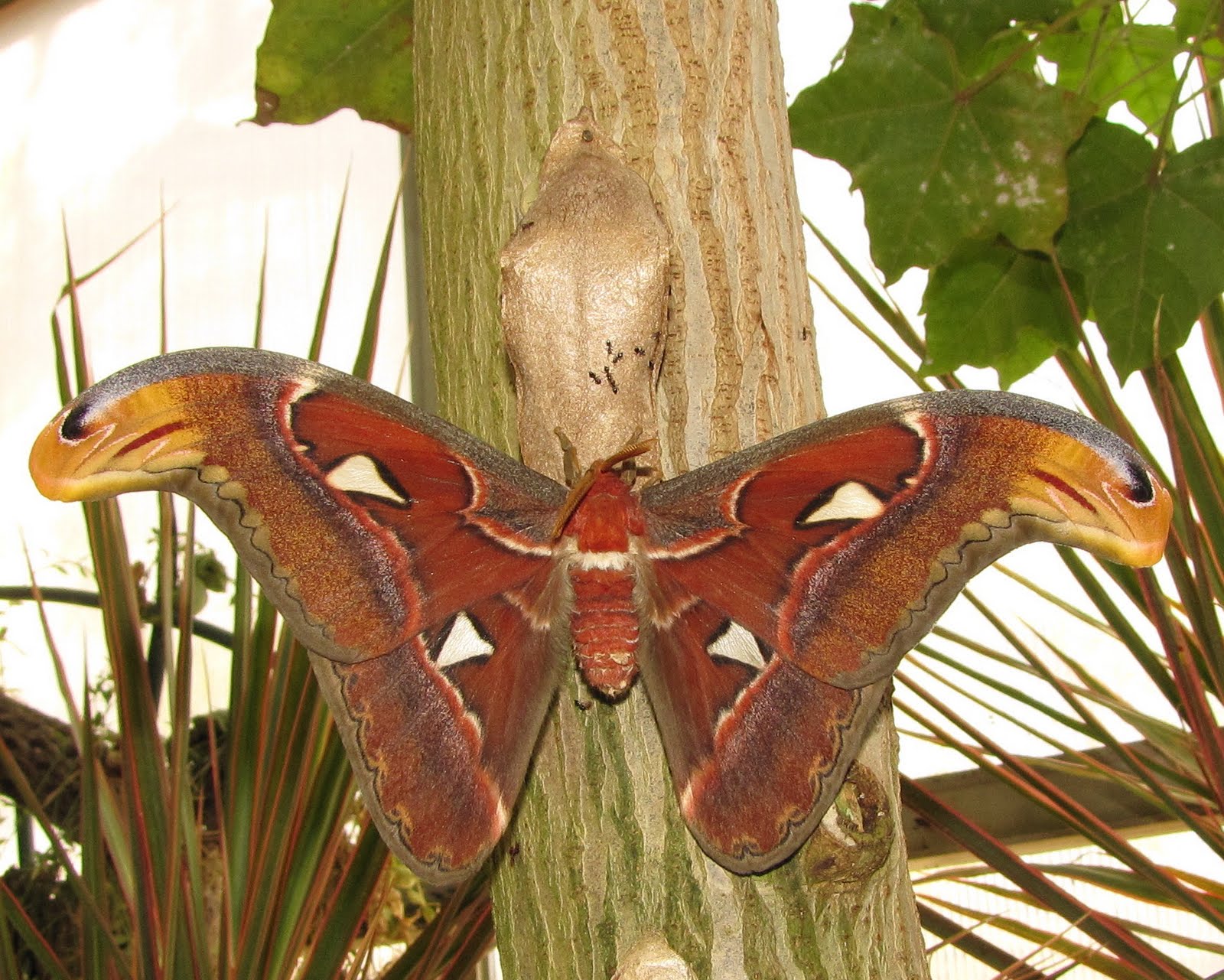
Giant Silkmoths

We were fortunate to have hosted three species of giant silkmoths (family Saturniidae) in Butterfly Magic this year. They are spectacular insects, but so unique and short-lived that one cannot generalize to moths as a whole from their life cycle and behavior.

Estimates differ as to how many species are in the Saturniidae, but somewhere between 1,300 and 1,500 is fairly accurate. Gene sequencing could result in more or fewer species than currently recognized. Giant Silkmoths are found the world over in forest habitats, but are especially diverse in the neotropics (Mexico, Central and South America). You are probably already familiar with some U.S. species: the Luna Moth, Cecropia Moth, Polyphemus Moth, Royal Walnut Moth, Imperial Moth, and Cynthia Moth. Not all the silkmoths are giants. Buck moths (genus Hemileuca) are much smaller, and fly during the day.

The adult moths do not feed. They have vestigial mouthparts at best and fuel their flight on fat reserves accumulated as caterpillars. Consequently, the caterpillars of giant silkmoths are large and heavy at maturity. The “hickory horned devil,” larva of the Royal Walnut Moth, approaches the size of a frankfurter. It looks menacing but is harmless.

Meanwhile, the larvae of other silkmoths are studded in venomous spines. Beware the caterpillars of buck moths (I can attest from personal experience!), the io moth, and especially the South American Lonomia (see also more recent articles in medical journals).

The Forbes Moth, Rothschildia lebeau forbesi, is frequently mistaken for an Atlas Moth by our visitors. Both species have “windows” in their wings that are devoid of scales. The Forbes Moth ranges from the Lower Rio Grande Valley through much of eastern Mexico and south to Brazil. Relatives of this moth figure prominently in the culture of indigenous peoples. Bushels of cocoons are harvested to make rattles worn on the ankles during ceremonial dances.

The African Moon Moth, Argema mimosa, occurs over most of sub-Saharan Africa. Their cocoons are distinctive: compact, and made of dense silk with numerous small perforations. The adult moths are spectacular: a wingspan averaging 125 mm, yellowish green in color with long, streaming “tails” on the hindwings. What purpose those tails serve is open to speculation, but perhaps it further camouflages the insect when it is at rest among foliage.

Last but not least is the Atlas Moth, Attacus atlas, a real giant with a wingspan of 240 mm (compare that to the Forbes Moth, only 90-100 mm from wingtip to wingtip). The Atlas Moth is widely distributed, from India to Hong Kong, tropical Asia in general, plus Taiwan and Indonesia. The front wings have a conspicuous lobe with markings that suggest the head of a serpent, but whether this is real mimicry or not is debatable.

The adult females of all the silkmoths rarely stray far from their cocoons after emerging. They invest most of their energy in egg production, so instead of exerting calories in flight, they simply sit and emit a species-specific sexual attractant called a pheromone. This scent, while usually imperceptible to us, is potent when it comes to drawing males. The males, with broad wings and streamlined bodies, use their sensitive antennae to home in on the pheromones, following the scent trail up to a mile or more to find its source. Females, once mated, will then finally fly to appropriate host trees and deposit their eggs. Even unmated females will dump their eggs in great quantities, as is often seen in our greenhouse. Both genders live only a few days, assuming they can avoid predation by bats.

Breeding silkmoths in captivity is becoming quite the hobby and cottage industry. My friend Liz Day has a web page devoted to helpful hints for rearing common eastern U.S. species. Considering the threats faced by these magnificent moths, from suburban sprawl and light pollution to introduced parasites, our domestic species could use some help.

I would like to conclude by recommending Wings of Paradise by John Cody, published by University of North Carolina Press, 1996. Cody renders giant silkmoths in stunning watercolor paintings. He features all three species in the greenhouse, plus scores more. The art is complemented with anecdotes and factual information.

Wednesday, April 20, 2011

Wasp Wednesday: Colpotrochia

Prowling around outdoor lights at night to look for insects can be fraught with difficulty, especially in a small town. The first time I went out to investigate the lights of South Deerfield, Massachusetts, I was confronted by the local constabulary. Hey, can I help it if the best-lit buildings are banks and the U.S. Post Office? I cleared a background check and was rewarded in the long run by encounters with many six-legged personalities, including this ichneumon wasp in the genus Colpotrochia on June 23, 2009. Oh, by the way, I found it by the lights on the police station.

The genus Colpotrochia is placed in the subfamily Metopiinae, the members of which all lay eggs in the host larva, emerging as adult wasps from the host pupa. According to the Database of Hymenoptera in America North of Mexico there are four North American species in the genus, all ranging from the Atlantic coast to barely west of the Mississippi River. Two of those are known in Massachusetts: C. crassipes and C. trifasciata. These are not very large insects, averaging between six and ten millimeters in body length.

Gardeners will be delighted to learn that the female wasps use their very short ovipositor to lay eggs in caterpillars, especially leafrollers in the family Tortricidae. The wasp grub that hatches inside the caterpillar slowly consumes its host, avoiding disruption of the caterpillar’s life cycle until after it pupates. Instead of a moth emerging from the pupa, out comes a wasp.

Those interested in identifying ichneumons to the subfamily level (no mean feat) might start with this PDF file, an Identification Key to the Subfamilies of Ichneumonidae, by Gavin Broad. It provides a very good start for learning how to tell ichneumons from braconids, and other basic information, all well-illustrated.

Special thanks goes to Bob Carlson for identifying my image after I posted it to BugGuide.

Wednesday, April 13, 2011

Wasp Wednesday: Not Wasp II

I like to throw my readers a curve periodically, and present a wasp mimic instead of a true wasp, just to keep everyone on their toes. Today’s installment features a family of flies that not only look like wasps, but some species are parasites of them.

The thick-headed flies in the family Conopidae are fairly common, but not often seen. Their common name does not come from a belief that they are especially stubborn or “dense,” but because their heads are quite large in proportion to the remainder of their bodies. Most of them do like to frequent flowers where they imbibe nectar, but they have a far more sinister side. About 66 species occur in North America, in nine genera.

Thick-headed flies can be recognized in part by their beak-like mouthparts, used to sip nectar, not blood. Those in the genera Physocephala and Physoconops greatly resemble potter wasps. The abdomen is elongated, like a “wasp waist,” and the front margin of the wing is heavily pigmented, mimicking the longitudinal fold in a potter wasp’s wings when the wasp is at rest. Pictured above is Physocephala tibialis, 12-15 millimeters long, imaged in a butterfly garden on the University of Massachusetts campus in Amherst.

Conopids lurk among flowers for more than just nectar. This species is looking for bumble bees. The female fly will accost the bee in mid-air, maybe forcing it to the ground, and ramming an egg between the bee’s abdominal segments. The larva that hatches from the egg then feeds as an internal parasite of the bee, eventually killing it in about ten to twelve days. The larva then pupates inside the hollow exoskeleton of its host. An adult conopid fly emerges the next summer (in similar European species. Our species may have more than one generation in southern climates).

Other species of Physocephala are known to attack solitary wasps in a similar manner. P. texana is a known parasite of several species of sand wasps in the genus Bembix. Members of the genus Zodion, of which Z. intermedium is imaged below, also from Massachusetts (South Deerfield) also attack solitary wasps. They are much smaller in size than Physocephala, only 5-7 millimeters.

Next time you are afield, keep a sharp eye out for these living missles. Look for them on flowers and foliage and see if you can catch one in the act of assaulting a wasp or bee.

Sources: Goulson, Dave. 2010. Bumblebees: Behaviour, Ecology, and Conservation (Second Edition). Oxford: Oxford University Press. 317 pp.
Evans, Howard E. and Mary Jane West Eberhard. 1970. The Wasps. Ann Arbor: University of Michigan Press. 265 pp.