Sunday, September 28, 2025

Book Festivals, Royalties, and Other Author Things

Here at the end of September, I am gearing up for the Heartland Book Festival in Kansas City, Missouri, on Saturday, October 11. With your help, we can recruit a legion of new bugwatchers, and change how we relate to other species, and each other. Allow me to let you in on upcoming events, and some secrets of the author profession that might surprise you.

Got my poster, courtesy of Poor Richard's here in Leavenworth, Kansas.

I cannot tell you how excited and honored I am to be participating as a vendor in the Heartland Book Festival. I will be one of only twenty-five authors selected from over two hundred applicants. This is perhaps the first time I have truly felt like a professional writer and author. I am hoping that this is only the beginning. Please recommend to me, in the comments, other book festivals that you have enjoyed, where nonfiction authors are celebrated alongside the novelists.

Speaking engagements are another way for authors to get traction in the marketplace. I will be presenting a talk on spiders for Topeka Audubon the evening of October 7, then another bugwatching presentation for Gardeners Connect on November 11 in Kansas City, Missouri.

There are already dates taken up on my 2026 calendar, too. On January 8, I will be presenting a webinar for Smithsonian Associates. I will announce when tickets go on sale. February 10, 2026, you will find me at the Plan it Native Landscapes Conference in Kansas City, Missouri, where I will present “Beyond Bees and Butterflies: Embracing and Conserving Local Insects.” After that program, I am open to invitations for any other events you may want to suggest.

There is a persistent myth that authors earn much of their living from royalties on sales of their books. This may be true for Stephen King, but certainly not for those of us in niche markets like natural history. What usually happens is that the publisher pays an author a cash advance to begin the book, maybe another once the manuscript is completed, and perhaps another once the book goes on the market. Ideally, brisk sales quickly make up for the advances and the book breaks even. Only after that point do royalties start producing positive numbers. None of my books, to this point, have produced royalties. That is not uncommon, but there is no reason we can’t buck that trend. How do we do that?

Much as I loathe Amazon, the retail giant, posting positive reader reviews there can boost sales considerably. The same can be said for Goodreads, and other such platforms. Book reviews in magazines, newspapers, blogs, podcasts, and social media are also helpful. Thank you for considering.

Invitations to do book signings, or present at conferences and meetings, are always welcome. Obviously, remote, virtual appearances are easiest at this time, when airline travel is undependable at best, Covid is making a resurgence, and clubs and organizations are facing financial hardship due to cuts in federal grants and other sources of funding. That said, if I can string together more than a couple of engagements in any given city, or small region, I will certainly entertain in-person events.

Thank you for all of your moral support, book purchases, in-kind donations, and other help to this point. I hope that I am doing right by you, and that I get the chance to express my appreciation in person at some point.

Thursday, August 14, 2025

Bugwatching Book Launch

My new book, Bugwatching: The Art, Joy, and Importance of Observing Insects, had its first event last Saturday at the Linda Hall Library in Kansas City, Missouri, USA. It was well attended both in person and via a livestream, with over 600 individuals registered.

Linda Hall Library is a science library with many historically important holdings. They also create professional quality in-house exhibits, and host speakers on a variety of topics. With any luck I will be invited back to present again. The staff is friendly, and a true joy to work with.

This past Wednesday I was one of the panelists for a Grow Native! webinar, titled “Dispelling Myths of Native Gardening.” Grow Native! is the native plant marketing, and educational arm, of Missouri Prairie Foundation, another excellent organization. I think I gained as much from the other panelists as I gave in my own expertise and experience.

Please consider booking me for your own event, as I have few scheduled thus far. I do have one high profile engagement on Thursday, January 8, 2026, but I am not at liberty to disclose additional information at this time. Watch this space and I will update as I am able.

I apologize for not keeping up with the comments over the last month. I was on vacation, and then had these two programs to prepare for. I am currently caught up, and intend to stay that way. I typically review comments every Tuesday, at the least.

I have been trying to remember to use my phone to take photos, like this one tonight of an immature female Round-tipped Conehead katydid in our yard.

My photos are also severely backlogged. I have become frightened by the potential of losing them in the uploading process (I frequently cannot safely eject the SD card from my laptop, for example). Consequently, I have not uploaded cards in their entirety since mid-September, 2022. I take far too many photos, and that makes the process daunting as well. I wish I was better organized, but this is the current situation. Thank you for your patience and understanding.

My dear friend Alexandra Rose (an oceanographer), and her mom, Pam, have always been supportive of my work.

As we continue to face collective challenges such as the effects of climate change, the rise of authoritarian regimes at home and abroad, and the uncertainties of labor and the marketplace, I wish all of you the best. Please keep up your own ”good trouble,” your art, your science communication, or whatever gives you joy, hope, peace, and confidence.

Wednesday, July 16, 2025

Accidental Achievement

When we lived in Colorado Springs, I would walk our neighborhood regularly, if not daily, unless the weather was severe. Little did I know that one such constitutional would yield something globally significant.

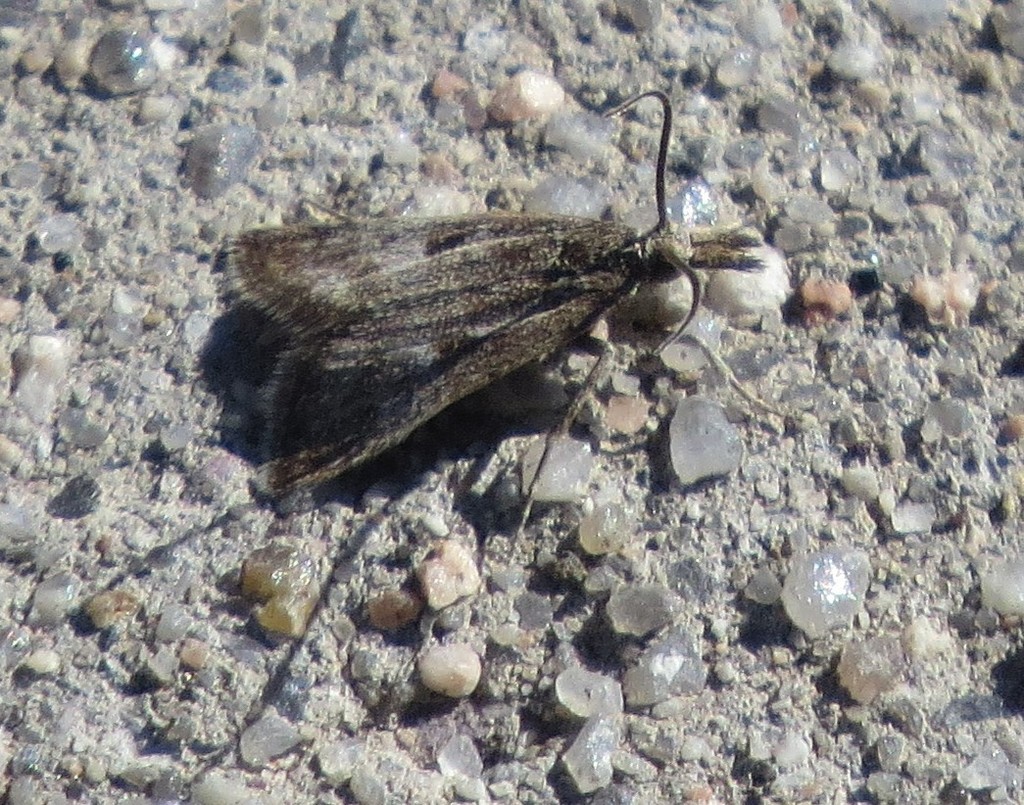
My photo of the male moth.

On the afternoon of November 5, 2020, passing a vacant lot up the street that I had passed by almost daily, I noticed small moths flying around. Many moth species fly late into autumn, so that alone did not intrigue me. Many moths fly during daylight hours, so that was not unusual, either. Curious me wanted to document the thing anyway, but that was easier said than done. The moths were wary, and quickly disappeared into weeds when they landed, camouflaged.

Finally, one of them landed on the sidewalk, and as I recall a bit of a breeze kept it from taking flight again immediately. Not the best of photos, but I put it on iNaturalist anyway. I wasn’t even completely sure of the family, but I figured something so common would be recognized by an expert eventually.

My iNaturalist entry.

Fast forward to November of 2024, and I receive an email from Andrew Warren informing me that not only was this moth a species new to science, but that it also qualified to be in a new genus. I was shocked. How could something that abundant be completely overlooked until now?

It turns out I had the correct family (Crambidae), but obviously could not have put a more specific name to it. It didn’t have one! The paper describing the moth is now published, and anyone can view it here. I was not at liberty to share this story until after the publication, as a common courtesy to the authors.

Better image of a male, photo © Andrew Warren.

Allow me to briefly summarize, if you do not want the long story in the journal article. The moth has so far been collected between October 20 and November 22. Mine is so far the only record for El Paso County, but it is suspected to occur all along the Front Range, possibly into Wyoming in the north and New Mexico in the south. This is based on the host plant for the caterpillar, which is a grass known as Sand Dropseed, Sporobolus cryptandrus.

The larvae probably feed on the roots of the plant, because the moths have only been found in situations where the dropseed was either mowed or trampled. Seriously. Where the plants are upright, no moths. Sure enough, the vacant lot where I found mine was mowed regularly, much to my dismay until I learned this story.

The female moth, photo © Christian Nunes.

The females of the moth, which now bears the name Coloradactria frigida, are flightless, with heavy bodies and short wings. No wonder I never saw those. They certainly must emit a pheromone to attract the males.

Other known localities for the moth are in Douglas County around Castle Rock, and in Weld County, all in Colorado. Late autumn searching elsewhere should certainly turn up new records.

A mating pair of the moths, photo © Christian Nunes.

The lesson I have learned from this is that you can, and should, never assume anything when it comes to entomology. You do not even have to know what you are doing to make an earth-shattering discovery. We collectively know very little. It is your curiosity that counts. That, and your willingness to share what you find with others. Do the documenting with photographs, videos, and sound recordings, and put them out there. Please.

Source: Warren, Andrew D., Clifford D. Ferris, Bernard Landry, Jeremy Authier, Theo Leger, Julia Bilat, and Christian A. Nunes. 2025. “A New Genus and Species of Crambinae (Pyraloidea: Crambidae) With Brachypterous Females From Colorado, U.S.A.,” Journal of the Lepidopterists’ Society 79 (2): 73-84.

Friday, July 4, 2025

You Made Bugwatching Number One!

I learned recently that my new book, Bugwatching: The Art, Joy, and Importance of Observing Insects, is, or was, number one in the "Outdoor and Nature Reference" category of new releases for Amazon books. This would not have happened without your loyalty, preorders, and promotion among your friends and neighbors. Thank you!

I do not habitually pay attention to rankings like these, but maybe I should. Someone on social media tagged me in a post by fellow author Rebecca Lexa, who has a new book of her own, The Everyday Naturalist. She held number one until my book "dethroned" hers. Obviously, we are both on "team nature," so I hope you will consider purchasing her book, too. We have already agreed to trade books between us, and I can't wait to read hers.

People frequently ask me which avenue of purchase benefits me the most, and my answer that there is no great difference from one outlet to another. Personally, I like supporting local, independent booksellers, and BookShop. Electronic versions of the book do not benefit authors much, but if you prefer that format, please buy that. I cannot sign it for you, though.

Attention to my book is not all about a revenue stream. I may not live to see much in the way of royalties, as it takes awhile to break even with the initial advances an author receives ahead of the book's release. My entire goal is to get more people excited about the natural world around them, and insects are a perfect vehicle for that.

When you are curious, you go to the effort to learn more, and the more you learn the more curious you become. Your passion swells, and with that comes a commitment to protecting other species and the ecosystems they inhabit. You also share your personal discoveries with others on platforms like iNaturalist, Project Noah, Bugguide, and others. Maybe you write a book, or decide to keep a nature journal.

Thank you again for your unwavering support for what I do. Please let me know how else I can advance your own endeavors.

Stay tuned, in the next week or so I will have a remarkable personal story to share with you.