Showing posts with label medical entomology. Show all posts

Monday, April 6, 2020

Coronavirus, Entomology, and This Blog

May this latest post find you healthy, still sane, and abiding by the directives of your local, state, provincial, and national governments and health care professionals (not necessarily in that order). We are collectively stressed more than usual, and for some of you, normal stress was already almost intolerable. We were eager to greet spring by rushing outdoors, and are now told we should stay inside as much as possible. The coronavirus (covid-19, SARS-CoV-2) pandemic has impacted everyone, including entomologists, and sponsors of this blog. Never fear, we will persevere, and recover.

Ouch! Another reason to stay indoors!

The closure of all non-essential businesses and agency offices has had a profound impact on the field of entomology. Notably, nearly every university and museum entomology department is unoccupied or nearly so. There is little or no maintenance of our valuable insect and arachnid collections. Agricultural offices, pest control operators, and related agencies and enterprises are operating with skeleton crews, if not closed indefinitely. Little, if any, field work is being done. The advancement of our scientific knowledge in these disciplines is at a standstill, or proceeding at a snail’s pace compared to normal standards.

One of the more troubling scenarios is whether medical entomology will be a casualty, if only by attrition, or by the recruitment of medical entomologists into the current epidemiological crisis response. Already I am seeing posts on social media of ticks and mosquitoes that citizens are encountering as they go outside for exercise and fresh air. Should the bite of a fly or tick result in illness, who is going to treat those victims? Will those people be seen at all, and if so, how, in the interest of complying with social distancing, and the increasing pressure to devote all hospital and medical facilities to containing and treating covid-19 cases? If any of my readers know the answers, and I am all ears.

Meanwhile, many small businesses are suffering incalculable economic damage that will only get worse the longer we fail to comply with proven methods of “flattening the curve” of virus cases. We all personally know employees and proprietors who are facing agonizing layoffs, or the prospects of having to make those tough decisions. This includes the two major sponsors of this blog.

I made the decision earlier in the year to suspend payment for advertising here, from Tender Corporation (After Bite®), and BioQuip Products and BioQuip Bugs (see right sidebar for links). It had nothing to do with the impending pandemic at the time. I am in a fortunately solvent financial situation for the time being, and I also knew I would be posting here more infrequently. It is not fair to demand revenue for a product or service that is decreasing in frequency (but, hopefully, not quality).

Please consider purchasing goods from my sponsors if possible. Tender Corporation manufactures all manner of outdoor medical products that remain useful even during the pandemic, when we may be confined to our own property, but still confronted by biting insects and arachnids. BioQuip is the premiere outlet for high quality entomology equipment, from nets to pinning supplies, plus products related to botany and other scientific disciplines. They provide merchandise for every level, from hobbyist to professional. They offer one of the most complete listings of books and educational materials found anywhere. Can’t go collecting because you are restricted to your home? No problem. BioQuip Bugs sells many specimens from all over the globe, responsibly sourced.

Besides browsing the blog, including the clickable tabs at the top of the page about how to build an insect collection and how to take amazing images of insects with your phone, there are other ways to further your interest in entomology. Investigate online classes. Join social media groups centered around an interest in insects or arachnids. Look in on iNaturalist, Project Noah, and Bugguide. Go on an indoor bug hunt. Make drawings, paintings, or sculptures of your favorite insect. Read books and articles about bugs. Watch documentaries about insects, like Microcosmos. There are endless possibilities in the digital age, which may be the saving grace of the timing of this unfortunate and mournful epidemic. Please stay safe, healthy, and sane, and know that you have my empathy and appreciation.

Tuesday, January 7, 2014

Kissing Bugs

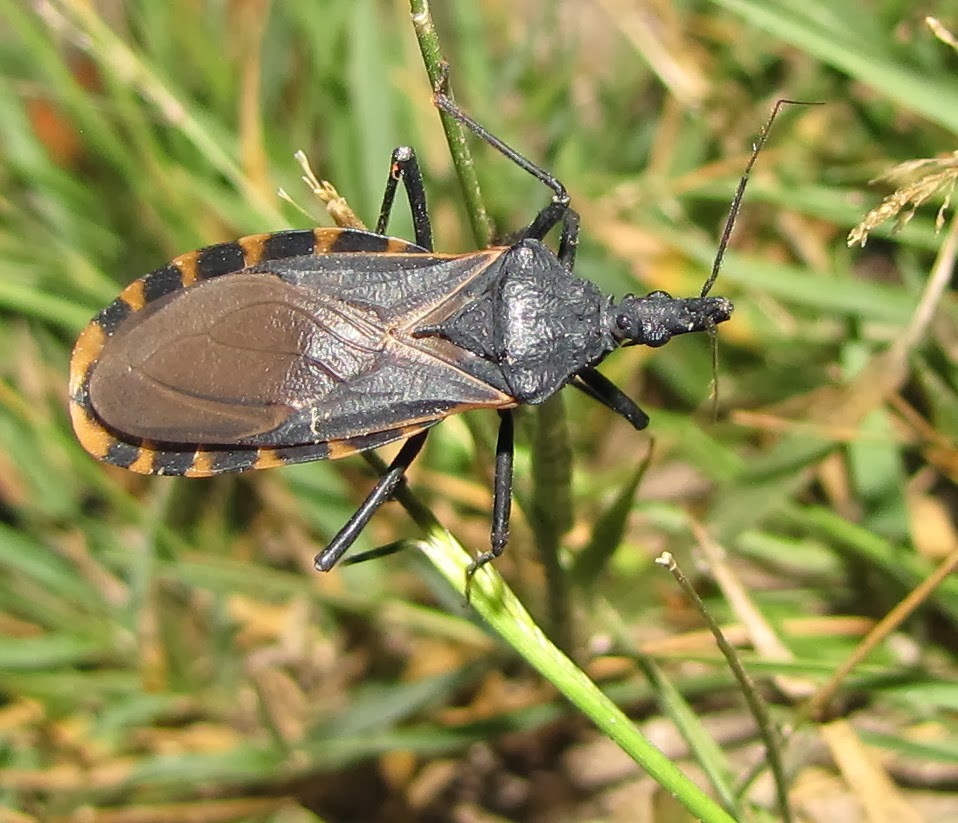
The holidays may be over, but the last thing you would want to cuddle up to under the mistletoe would be the subject of today’s “True Bug Tuesday.” Assassin bugs in the subfamily Triatominae are known as “kissing bugs.” There is nothing romantic about these vampires, especially considering that they can carry a lethal disease. Eleven species of Triatoma occur north of Mexico, most of them found in the southwest U.S.

Triatoma rubida from Arizona

Villains by Many Names

Like any notorious outlaw, the triatomines have their share of aliases: conenose, blood-sucking conenose, big bedbug, Mexican bedbug, Hualupai tigers (Arizona), vinchuca (in several South American nations), chipo or pito (in Colombia and Venezuela), chirimacho (in Peru), bush chinch (in Belize), and barbeiro or bicudo (Portugese, in Brazil). The name “kissing bug” derives from the fact that triatomines do not like to be confined under blankets and sheets while feeding on human victims, preferring to tap blood from the uncovered face, especially around the mouth.

Life Cycle

Kissing bugs begin life as eggs, dropped singly by an adult female. The nymph that hatches may take its first blood meal only two or three days after emerging from its egg. Blood meals are required for the insect to grow, each nymph passing through five instars (an instar is the interval between molts) before reaching adulthood. The adult insect is sexually mature, and has functional wings in most species. Mature triatomines range from 12-36 millimeters depending on the species.

Triatoma gerstaeckeri from Texas

Host of Last Resort

People are not the normal hosts of triatomine assassin bugs. Here in the U.S., Triatoma is mostly associated with woodrats (aka “packrats,” genus Neotoma), but several species accept blood meals from other vertebrates including opossum and raccoon, and sometimes livestock and pets. The nymphs of kissing bugs dwell mostly in the middens of woodrat nests, in the burrows of other rodents, or sheltered situations where hosts may be encountered regularly. People encounter kissing bugs when the adult insects disperse to find new rodent host populations during late spring, summer, and early fall. At that time, the bugs may be attracted to outdoor lights, and then sneak indoors. Their extremely flat bodies allow them to slip into the thinnest crevices.

Triatoma sanguisuga from Ohio

How to Stalk a Sleeping Human

The process by which a triatomine finds a host is akin to how a shark approaches a victim: with caution, and by relying on a series of different senses. Most pestiferous triatomines live in Mexico, Central, and South America. They dwell in the thatched roofs of rural homes, or in cracks in walls or beams. Hiding by day, they stir at night, usually simply dropping to the floor to begin the hunt. The bug uses its antennae to first detect gases in the breath of a potential target. Homing in on carbon dioxide, it begins its assault. As the insect gets closer, it switches to thermal detection, much like pit vipers. It is suspected that special pits in the antennae not only detect heat, but can determine whether the temperature is appropriate (too hot, too cold, or just right). The bug may even be able to calculate the size of the heat-emitting animal by “triangulating” with its antennae. A warm-blooded creature with the right attributes elicits the feeding response, and when the bug is within a few inches its proboscis extends like a divining rod for blood vessels.

Triatoma gerstaeckeri from Texas

Chagas’ Disease

As if blood loss is not enough of an insult, the victim of a kissing bug bite may contract a deadly disease. In Latin America, several species of triatomines can transmit Chagas’ disease, also known as American trypanosomiasis. The ailment is caused by a parasitic organism called a trypanosome, related to the one responsible for African sleeping sickness. Unlike the tsetse fly vector of sleeping sickness, triatomines do not inject the microbes in the course of biting. Instead, the trypanosomes proliferate in the digestive tract of the bug, and are excreted in the feces. Due to the unrefined bathroom habits of these bugs, they may defecate while feeding, liberating the disease organisms. Victims inoculate themselves by scratching the microbes into the itchy bite wound, or contacting mucous membranes of the eyes or nose. Species of Triatoma in the U.S. are certainly capable of harboring trypanosomes, but they are “potty trained,” going to the bathroom about twenty to thirty minutes after feeding, usually having left their victim by then. Still, isolated cases of Chagas’ disease have been recorded in Texas, California, and Tennessee.

Our smallest species, Triatoma neotomae of south Texas

Aftermath

Bites from kissing bugs are painless while the insect is feeding, but the victim typically experiences itching and swelling the next morning. Most human victims wake up with a fat lip, but some may have an allergic reaction, going into anaphylactic shock with low blood pressure, swollen airways, and rashes being symptoms. This situation requires emergency medical treatment. Repeated bite episodes may make one more vulnerable to anaphylaxis, and also have the potential to become disfiguring. Many rural citizens in Latin America are horribly scarred from constant victimization by triatomines.

Mistaken Identity

Several other true bugs enter homes in North America, and may be misidentified as kissing bugs. Those species include other assassin bugs that are not blood feeders, like the Black Corsair, Melanolestes picipes, and the Masked Hunter, Reduvius personatus. The Western Conifer Seed Bug, Leptoglossus occidentalis, is a completely harmless insect that seeks shelter indoors during late fall and winter. All of these insects can be mostly excluded by sealing cracks and crevices, repairing worn weatherstripping around doors, mending holes in window screens, and taking care to inspect firewood and other material and objects brought indoors from outside.

The big Triatoma recurva of Arizona

Sources: Flores, Graciela. 2005. “In the heat of the night,” Natural History 114(6), July/August, 2005: 32-37.
Schmidt, Justin O., et al. 2011. “Kissing Bugs in the United States,” The Kansas School Naturalist 57(2): 1-16.