Showing posts with label true bugs. Show all posts

Wednesday, January 31, 2024

Hibiscus Scentless Plant Bug Life Cycle

It is a rare occasion when I am able to document all life stages of an insect species, let alone in the same location, or over a period of a couple of days. That is what happened, though, when I photographed a population of a scentless plant bug, Niesthrea louisianica, sometimes called the Hibiscus Scentless Plant Bug. Indeed, hibiscus and related plants in the family Malvaceae are their hosts. Our saga takes place in Okawville, Illinois, USA, in October of 2023.

While exploring the yard at my sister-in-law's home, I happened to notice adults and nymphs of this insect on buds of what I learned later was the plant known as Rose-of-Sharon, Hibiscus syriacus. Even the adults are not very large, measuring only 6.5-8.5 millimeters in body length. They are noticeable because they are so brilliantly colored in orange and red, with legs annulated (banded) in black and white. Niesthrea louisianica is a mostly southern U.S. species, but ranges from New York to Florida, and west to Iowa, Texas, Arizona, Utah, and California.

Apparently it is not unusual to find all stages in the life cycle at the end of the plant's growing season, and the adult insects overwinter anyway. Females can live about two months, males roughly fifty days. There can be at least three or four generations per year in southern latitudes, fewer farther north. Females deposit eggs in small batches, up to 36 in number, on the underside of leaves, beneath the bracts of the flower buds, or on the seed heads. One female can lay up to seven hundred eggs in her lifetime. I spotted a couple of egg clusters, one being guarded, presumably by the female that laid them.

The first instar nymphs that emerge from the eggs are so tiny! This species goes through five instars, an instar being the interval between molts. Like all true bugs, metamorphosis is "simple," each instar incrementally larger than the last, with the final molt to adulthood resulting, in this case, in a winged, sexually-mature individual. All life stages feed on the flower buds and seeds of the host plant, inserting the stylets of their rostrum to reach the interior fluids and tissues.

The activity period of the Hibiscus Scentless Plant Bug differs with latitude, but the life cycle begins in April or May, when the overwintered females lay eggs. It concludes with the end of the growing season, in October or even later.

One interesting aspect of Niesthrea louisianica is its potential role in controlling a problematic plant called Velvetleaf, Abutilon theophrasti. The bugs can carry pathogenic fungi in the genera Fusarium and Alternaria, which ride on the insects and infect the seeds of the plant, weakened from the feeding activities of the insect.

The "scentless plant bug" moniker may not apply in the case of the Hibiscus Scentless Plant Bug. They possess metathoracic glands, and a single dorsal abdominal gland, that produce copious amounts of exocrine chemicals for self-defense. Not that this deters spiders, one of their chief enemies, nor does it prevent parasitoid tachind flies, genus Leucostoma, from attacking the adult bugs. Scelionid wasps, genus Telenomus, exact a toll as parasitoids of the bug's eggs.

This is one of those species that fits the entomological addage of "Once you see one, you will see them everywhere." They are "locally abundant," like many host-specific phytophagous (plant-feeding) insects. They will not be on every plant because the defensive chemicals of the host plant vary from one individual plant to the next. Be on the lookout for them in Ohio, Indiana, and northern states currently out of their accepted range. Climate change may be driving a northerly range expansion.

A pair of less colorful specimens from Cape May, New Jersey, September, 2017

Sources:Baker, James. 2016. "Hibiscus Scentless Plant Bug," NC State Extension Publications
Kremer, Robert J. 1992. "Integration of a Seed-feeding Insect and Fungi for Management of Velvetleaf (Abutilon theophrasti) Seed Production," Proceedings of the Eighth Annual Symposium on Biological Control of Weeds.
Jones, Walker A., H.E. Walker, P.C. Quimby, and J.D. Ouzts. 1985. "Biology of Niesthrea louisianica (Hemiptera: Rhopalidae) on Selected Plants, and its Potential for Biocontrol of Velvetleaf Abutilon theophrasti (Malvaceae)," Annals of the Entomological Society of America 78(3): 326-330.
Slater, J.A., and R.M. Baranowski.1978. How to Know the True Bugs. Dubuque, Iowa: Wm. C. Brown Company Publishers. 256 pp.
Moorehouse, Angella. 2023. Flower Bugs: A Guide to Flower-associated True Bugs of the Midwest. Minnetonka, Minnesota: Pollination Press, LLC. 360 pp.
Steill, Jennifer, and Jason Meyer. 2003. The Rhopalidae of Florida "Scentless Plant Bugs." Insect Classification Project. 23 pp.

A group of juveniles on an unidentified host plant, New Jersey

Sunday, December 17, 2023

Book Review: Flower Bugs

I must preface this review by stating that the author, Angella Moorehouse, and publisher, Heather Holm, are personal friends. That is not why I am conflicted in my reaction to this book. Neither is it because I view this book as being in competition with any of my own works. We cannot have enough literature devoted to promoting public understanding and appreciation of insects. It boils down in part to my own biases and expectations. With that, you will still receive an honest appraisal.

Pollination Press, LLC produces plant-based books about insects, usually restricted to a particular geographic region. Holm's comfort zone is clearly in botany, though her prior books about bees and wasps, as they relate to flowering plants, demonstrate a command of general entomological knowledge, and dedication to thorough research. There is no question that her books deliver accurate, factual information. From my perspective, as an entomologist with little familiarity or interest in plants, I immediately see what is "missing" in terms of species, even families, because those insects are not associated with forbs.

There is a desperate need for more books that illustrate the ecological networks of different organisms, but Flower Bugs: A Guide to Flower-Associated True Bugs of the Midwest is limited to the flowers of herbaceous flowering plants, and almost exclusively those true bugs that may play a role in pollination, or those species that frequent flowers as a place to ambush other pollinators. The territory covered is eight states (Illinois, Minnesota, Wisconsin, Iowa, Missouri, Michigan, Indian, and Ohio), and adjacent southern Ontario, Canada. The book is in fact based mostly on a detailed survey of locations in western and central Illinois, over a period of seven years.

The true bugs treated are further restricted to the suborder Heteroptera, which includes the larger, more obvious examples like stink bugs, assassin bugs, mirid plant bugs, and seed bugs, but leaves out the families of aquatic bugs, plus the other two suborders that include cicadas, leafhoppers, spittlebugs, and aphids. All of these specifics are stated explicitly in the introduction of the book.

The layout of Flower Bugs includes the trademark features of Pollination Press' other books: prolific and quality imagery, geographic range maps, seasonal distribution bars showing what months the adult insect is present, tables of plant species associated with each insect species addressed, diagrams of taxonomic relationships, a glossary, checklists, and a visual index.

The front matter of the book is, as usual for this press, presented to near perfection in degree of detail, and coverage of morphology and ecology. It is an excellent introduction to true bugs as a whole, for the intended audience of native plant gardeners, naturalists, resource management personnel, and others.

The species accounts cover the overall geographic range, variation in physical appearance, life cycle, feeding, habitat, and native plant associations. The images are occasionally redundant, but frequently include photos of the immature stages, which most field guides fail to do. In cases of the mirid plant bugs, assassin bugs, and other families for which there are few flower associates, there are photos of other species for comparison, and to better indicate the full diversity of these groups. Given the lack of any other contemporary guides to true bugs, this gesture is appreciated.

The last book to cover the true bugs for a popular audience was probably Bugs of the World, by George C. McGavin, published in 1993 and 1999 by Blandford, an imprint of Cassell, in London. Back then, the true bugs were classified much differently. In 1978, How to Know the True Bugs, by James A. Slater and Richard M. Baranowski, was published by Wm. C. Brown Company Publishers in Dubuque, Iowa, as part of their "Pictured Key Nature Series." That reference also covered the suborder Heteroptera, but assumed the user had a pinned specimen and a microscope at hand.

The fact that Flower Bugs is the most up-to-date popular reference to North American Heteroptera, no matter how limited the scope, is enough to recommend it. You will no doubt find yourself stalking the true bugs in your own yard, neighborhood park, or other favorite habitat. You can be confident that this book will provide you with an accurate ecological perspective, and interpretation of the behaviors of these insects.

Friday, March 23, 2018

Pinyon Problems? Maybe, Maybe Not

I always seem to be caught off guard by the first insects to emerge in spring, and this year was no exception. The chance finding of a male scale insect prompted me to investigate an ornamental Pinyon Pine in our Colorado Springs townhouse complex, and that revealed yet another insect, or at least signs of one.

Walking in our neighborhood as I do most days, weather permitting, I happened upon what I figured must be a tiny midge or winged aphid, about one millimeter in length, on a wooden fence. Upon closer inspection it turned out to be a male scale insect of some sort. Scale insects generally give the impression of anything but an insect, a small, unmoving, button-like bump on a twig or branch. Mature male scale insects on the other hand often have wings and fly to find females. I was not aware they can appear so early in the season.

Male Pinyon Needle Scale

Back home, I took images of the specimen and tried to match it with something online. Male scale insects are so rarely noticed, let alone imaged, that I was not optimistic. Surprisingly, I found a close match in the genus Matsucoccus, family Matsucoccidae. This is a relatively new family, separated from its previous placement as part of the Margarodidae or "ground pearls." The tiny black and yellowish bug, with white waxy streamers emanating from its posterior, most resembled the Pinyon Needle Scale, Matsucoccus acalyptus, but I was hesitant to jump to conclusions. Our neighborhood is more in the high plains than a forest, though we do have many ornamental conifers.

Sure enough, I noticed a Pinyon Pine between two buildings in our townhouse complex. Now that I knew what I was looking for, I checked for sessile female scales, and managed to find a few. They are barely over one millimeter themselves. It turns out that the life cycle of this species is rather complex, with a lot going on at this time of year.

Adult female Pinyon Needle Scales

Mature females back out of the waxy covering that forms the "bean stage," and render themselves sexually receptive. As near as I can tell, the adult females have this mosaic pattern to them, whereas the "bean" stage does not. Once mated, the female crawls to an appropriate place to lay her oval cluster of yellowish eggs, encased in loose, white, silky webbing. Favored sites for egg laying include the root collar of the tree, in the crotches of large branches, the underside of large branches, or in deep fissures in the bark of the trunk.

"Crawlers" emerge from the eggs roughly five weeks after they are laid. This tiny, orange, first instar immature stage migrates up the tree to begin feeding on needles that grew the previous year. The insects use their piercing-sucking mouthparts to tap fluids inside the foliage. As they feed they begin secreting the wax coating that covers them. That coat turns black shortly after it is produced. The nymphs also molt into their second instar. This is the "bean" stage in which the immobile females pass the winter.

"Bean stage" of Pinyon Needle Scale

Second instar males crawl to the ground in October or November. There they go into a prepupal stage, wrapping themselves in white silken webbing beforehand. Three or four days later the males molt again into the pupa stage, spending the winter there. The female nymphs resume feeding the following spring, molt into adults, mate, and start the cycle anew.

The Pinyon Needle Scale is a native insect, but heavy infestations can severely weaken trees, making them vulnerable to subsequent attack by Pinyon Pine Beetles, Ips confusus, in natural ecosystems. Landscape trees are even more at risk because they are not always planted at appropriate elevations, in proper soils, with proper sun exposure. They are often planted in isolation, too.

Galls of Pinyon Spindle Gall Midge

While looking for the scales, I could not help but notice that many of the needles on the tree on our property were greatly swollen and yellowing. This is the work of an entirely different insect, the Pinyon Spindle Gall Midge, Pinyonia edulicola. It is a tiny fly in the gall midge family Cecidomyiidae. Its life cycle begins when a female lays several eggs in a developing needle in mid-summer. The larvae that hatch crawl to the base of the needle and their feeding activity stimulates the plant to grow needle tissue around them. From five to forty larvae occupy the resulting gall, continuing to feed and grow within it. They pupate in late spring of the following year. The adult flies emerge in mid-June to mid-July.

More Pinyon Spindle Gall Midge galls

Our Pinyon Pine tree seems to be doing ok despite the onslaught, and we tend to underestimate the resilience of plants in the face of insect attack. Our current drought is no doubt undermining the tree's natural defenses, but the insects feeding on it are also not immune to their own predators, parasites, and other enemies. It may be a good idea to keep tabs on the trees in your own yard, but resist the temptation to intervene at the first sight of some insect. Do your homework, ask for expert assistance, and then decide what, if anything, to do.

Sources: Cranshaw, Whitney. 2004. Garden Insects of North America. Princeton, New Jersey: Princeton University Press. 656 pp.
Furniss, R.L. and V.M. Carolin. 1977. Western Forest Insects. Washington, DC: U.S. Department of Agriculture Miscellaneous Publication No. 1339. 654 pp.
Phillips, Gene. 2018. "Pinyon Needle Scales, Matsucoccus acalyptus," Nevada Division of Forestry

Thursday, September 7, 2017

My Personal National Moth Week, 2017

Given the stormy weather during National Moth Week here in Colorado Springs, I took advantage of the few opportunities to find moths here. The nights of July 24 and 30 I draped a sheet over the door of our backyard shed, hung a blacklight, and hoped for the best. I am rarely disappointed, even if beetles, bugs, and flies are more prevalent than moths.

Identifying what comes in is a real challenge, too. Taxonomy, the classification of organisms, is constantly changing as we learn about new evolutionary relationships. For example, this moth, in the genus Acrolophus, family Acrolophidae, used to be placed in the family Tineidae (clothes moths and their kin). Acrolophus species are known as "grass tube moths" because the caterpillar stage of many species spin silken tubes at the base of grasses, or grass roots, to conceal themselves as they feed.

Acrolophus sp.

The genus Ethmia, very abundant in oak woodlands in the foothills here, but a rarity at my blacklight on the high plains, used to be in the family Coleophoridae. Now it is in the family Depressariidae. It can be depressing to me to try and keep up with all these changes. This specimen is probably Ethmia discostrigella, which feeds as a caterpillar on Mountain Mahogany, a woody shrub. Most Ethmia feed on plants in the Boraginaceae family.

Ethmia sp.

Here is another member of the Depressariidae family that I have not yet identified. They can be confused with tortricid leafrolling moths but for the upturned palps, mouthparts that in this case resemble horns between the antennae.

Moth, family Depressariidae

One might expect that pest species would dominate in urban settings, but that is not necessarily the case. Still, the ornamental crabapple trees in a neighbor's yard probably breed the Codling Moths, Cydia pomonella, that do appear with some frequency at my blacklight. The caterpillar stage is the "worm" in the apple.

Codling Moth

Some other pests include the Diamondback Moth, Plutella xylostella, a tiny insect (6-8 mm) that feeds as a caterpillar on pretty much everything in the mustard family, including cauliflower and cabbage. It may not be native here, its suspected region of origin being Eurasia, but it is now found in all corners of the world thanks to global commerce.

Diamondback Moth

I believe this moth is an adult Spruce Budworm, Choristoneura fumiferana, in the leafroller moth family Tortricidae. The adult moth is highly variable in color, and prone to wear and tear that further compromise identification. We can at least conclude it is likely in the "fumiferana species group," which includes several other conifer feeders, some of which are notorious pests of western forests.

Spruce Budworm moth or close relation

Another related species is the Large Aspen Tortrix, Choristoneura conflictana, of which I think this is an example. As one might guess, the caterpillar stage feeds on aspen, but also poplar, willow, and alder. The caterpillars overwinter, and the older instars roll leaves tightly around them to thwart predators and parasites.

Large Aspen Tortrix

Another conifer-feeder is the Ponderosa Pine Coneworm, Dioryctria auranticella. The caterpillar stage feed in cones, but occasionally on twigs, too.

Ponderosa Pine Coneworm moth

The Pink-fringed Dolichomia, Hypsopygia binodulalis, is named for the genus it was formerly placed in: Dolichomia. Little is known of its biology.

Pink-fringed Dolichomia

The Belted Grass-veneer moth, Euchromeus ocellea, is one of the more ornate "snout moths" in the family Crambidae, most of which are associated with grasses as caterpillars. This one may be lovely to look at, but its larva feeds on the roots of corn. It may have originated in Europe, where the species was first described.

Belted Grass-veneer

Only a couple larger moths surfaced at my place during National Moth Week, and those were both in the owlet moth genus Lacinipolia. One cannot tell the species apart just by looking. One was a mottled gray, with reflective scales on its wings; the other was a lovely green, and probably rests by day on lichen-covered tree trunks.

Owlet moths, Lacinipolia spp.

Some insects can be mistaken form moths, and chief among them are caddisflies like this one. Indeed, caddisflies, order Trichoptera, are essentially aquatic moths. Their larvae typically build cases of plant or mineral matter, or spin nets to filter microbial organisms from stream currents.

Caddisfly

Brown lacewings in the family Hemerobiidae, order Neuroptera, also resemble moths at first glance. Their larvae are voracious predators of aphids and other small insect pests, so their appearance is always welcome.

Brown lacewing

When you begin looking at the smaller moths, you may be fooled by leafhoppers like Norvellina pullata that can be as colorful as moths. Leafhoppers are true bugs that have piercing-sucking mouthparts they use to tap plant sap.

Leafhopper, Norvellina pullata

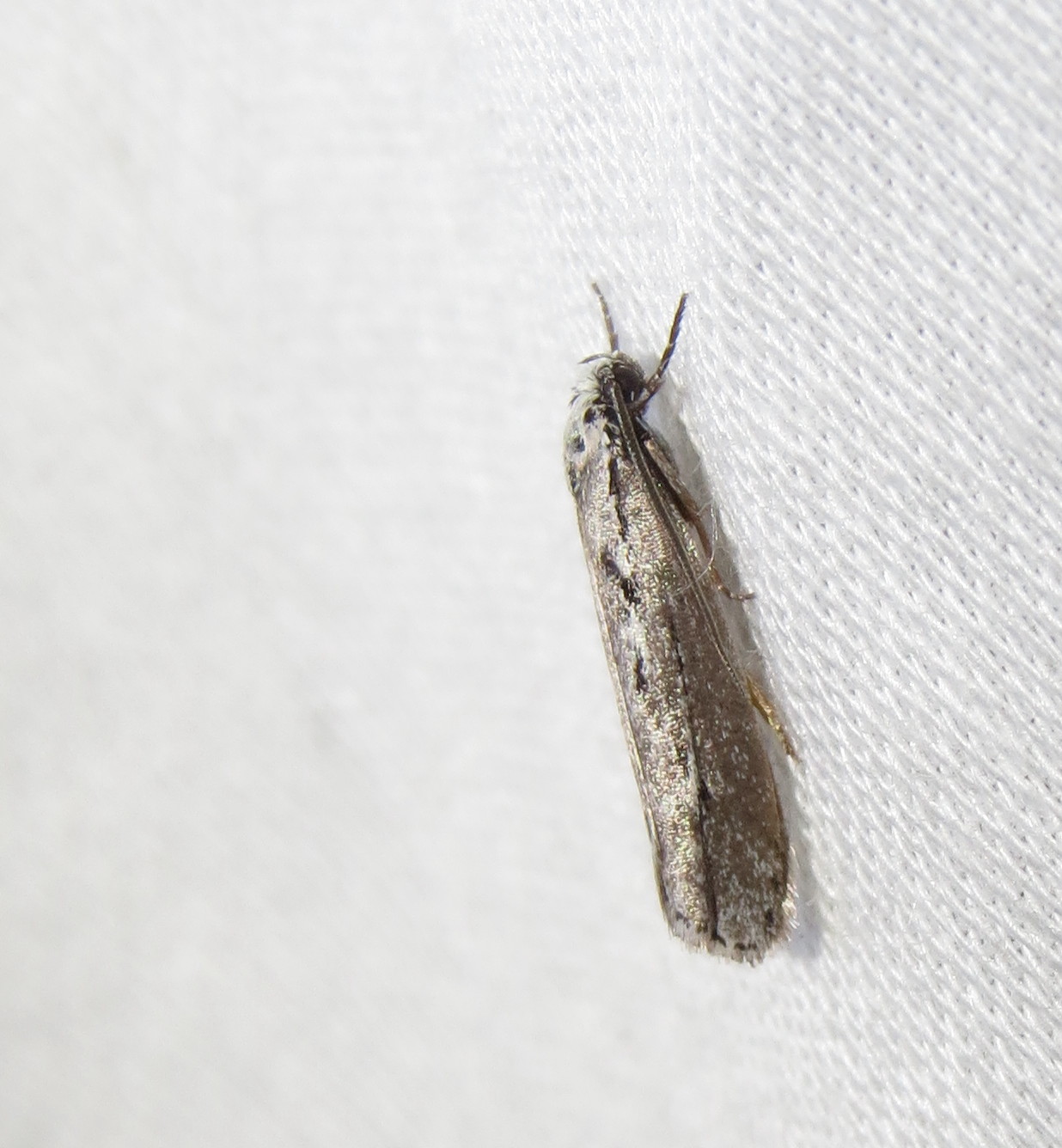
Oh, look, here is an actual moth, about the same size, if not a bit smaller, probably in the genus Phyllonorycter, family Gracillariidae (Leaf blotch miner moths).

Unidentified micro-moth, maybe a leaf blotch miner moth

Many other insects come to lights at night, and the most obvious are probably beetles. Predatory species like the Punctured Tiger Beetle, Cicindela punctulata, normally a swift, day-active hunter of other insects, and various ground beetles are common at lights.

Punctured Tiger Beetle
Ground beetle, tribe Harpalini
Ground beetle, maybe Bembidion sp.

A real surprise on July 24 was the appearance of a Pole Borer, Neandra brunnea. This insect is in the longhorned beetle family Cerambycidae, but it is anything but typical for that group. The antennae are short and bead-like, the jaws suggestive of a ground beetle or small stag beetle. The larval stage bores in decaying wood, including poles and posts in contact with moist soil.

Pole Borer, Neandra brunnea

Click beetles in the family Elateridae are also very commonly drawn to lights at night. They are bullet-shaped, and often covered in short, dense hairs that make them slick. Try grabbing one and it will likely slip right through your fingers. If you are successful, you may be startled by a jarring "click" as the beetle snaps a spine into a groove on its chest. This can free the beetle from many small predators, and catapult it away from danger, too.

Click beetle, family Elateridae

Tinier beetles include shining flower beetles, family Phalacridae; deathwatch beetles, family Ptinidae; and ant-like flower beetles, family Anthicidae.

Shining flower beetle, family Phalacridae
Deathwatch beetle, family Ptinidae
Antlike flower beetle, Notoxus sp.

True bugs, besides leafhoppers, are always a fixture at lights at night, too. Plant bugs in the family Miridae are diverse if not abundant. Phoytocoris spp. are usually gray or brown, and mostly plant-feeders. They will occasionally prey on smaller insects, though. Orthotylus spp, Ceratocapsus spp, and the distinctive Reuteroscopus ornatus, are typical visitors to my blacklight, along with Lygus spp (or a lookalike genus).

Mirid plant bug, Phytocoris sp.
Mirid plant bug, probably Orthotylus sp.
Mirid plant bug, maybe Ceratocapsus sp.
Mirid plant bug, Reuteroscopus ornatus
Mirid plant bug, possibly Lygus sp.

The large dirt-colored seed bug Balboa ampliata visited on July 24. It may be a more common species than I first suspected, as I have found it in other prairie and foothill habitats around Colorado Springs. As the name suggests, these bugs feed on plant seeds.

Seed bug, Balboa ampliata

One cannot escape the presence of true flies at any time of day or night, and many species are attracted to lights. Crane flies in particular are almost guaranteed visitors.

Crane fly, family Limoniidae

Tiny gall midges in the family Cecidomyiidae are also common. Larvae of many species live in galls on plants.

Gall midge, Lasioptera sp.

Biting midges in the family Ceratopogonidae, the "no-see-ums," are also present. Fortunately, most members of this family feed on the blood of other insects, not people or pets.

Biting midge ("no-see-um"), family Ceratopogonidae

Non-biting midges in the family Chironomidae can be overwhelmingly abundant, but they do not bite. They look enough like mosquitoes to cause needless consternation, but neither gender usually feeds on anything. They live their very short adult lives by using the fat reserves they accumulated in the aquatic larva stage.

Non-biting midges, family Chironomidae, various species

I am rarely plagued by mosquitoes here on the Front Range, but one female did bite me on the arm on July 24. A male, the gender that does not bite, showed up on July 30.

Female mosquito, Ochlerotatus dorsalis
Unidentified male mosquito

Maybe some of the predators and scavengers, like spiders, earwigs (omnivores), and harvestmen ("daddy long-legs," related to spiders in the class Arachnida) are keeping the mosquitoes and other nuisance insects at bay around our townhouse. We can only hope.

Longlegged sac spider, Cheiracanthium sp.
European Earwig female
Harvestman, arachnid order Opiliones