Showing posts with label Reduviidae. Show all posts

Wednesday, November 25, 2015

New Report on Chagas Disease Causes Storm of Concern

There has been a great increase in concern, and spread of misinformation recently in response to a press release and policy paper earlier this month. The publication advocates for more research into Chagas disease, caused by a parasitic organism, Trypanosoma cruzi, carried by assassin bugs in the subfamily Triatominae. The result in social media especially has been the misidentification of nearly every indoor "bug" or assassin bug as a "kissing bug" carrying Chagas.

Our most common U.S. "kissing bug," Triatoma sanguisuga

I wrote about our U.S. species of Triatoma in an earlier blog post, and that information remains largely correct. The post also includes information about species regularly confused with Triatoma species.

There is no question that it is in the best interest of governments and scientific institutions to devote more resources to treating and preventing tropical parasitic diseases as the climate continues to warm and new disease vectors spread northward; and as parasitic organisms develop resistance to conventional medicines. The elephant in the room, however, is the increasing population of human immigrants to the northern hemisphere in response to economic suffering and political violence or unrest.

Rural poverty continues to be the reason that many parasitic diseases proliferate, and the driving force behind immigration to nations experiencing relative prosperity and economic opportunities not found in the countries from which immigrants originate.

Victims often carry Chagas disease without showing obvious symptoms, serving as a reservoir for the parasite. Pets, especially dogs, and livestock can also carry the parasites responsible for Chagas. This should not make immigrants, legal or otherwise, enemies of native U.S. citizens, but I fear it is only a matter of time before it becomes a political football, just another excuse to "reform" our immigration policy.

Furthermore, our native species of Triatoma are poor vectors of the disease, which is transmitted when the insect defecates while feeding. The victim of the bite then scratches the parasite-infected feces into the bite wound, or may absent-mindedly rub their eye or other mucous membrane. Our kissing bug species are "potty trained" and nearly always poop after they have left their host.

My friend Richard Fagerlund gave a succinct and accurate assessment of the status of kissing bugs in New Mexico for a television news report, but his advice applies to the rest of the southern U.S. as well: There is simply nothing to be concerned about in urban areas, and simple preventive measures in rural areas, such as keeping your property free of wood rats, almost completely eliminates the prospect of encountering them.

Please help me spread the message that there is no need to panic, especially at this time of year. Kissing bugs are late spring and summer insects, only rarely showing up in autumn. If you are finding an insect in your home right now, it is almost certainly not a Triatoma.

Tuesday, October 27, 2015

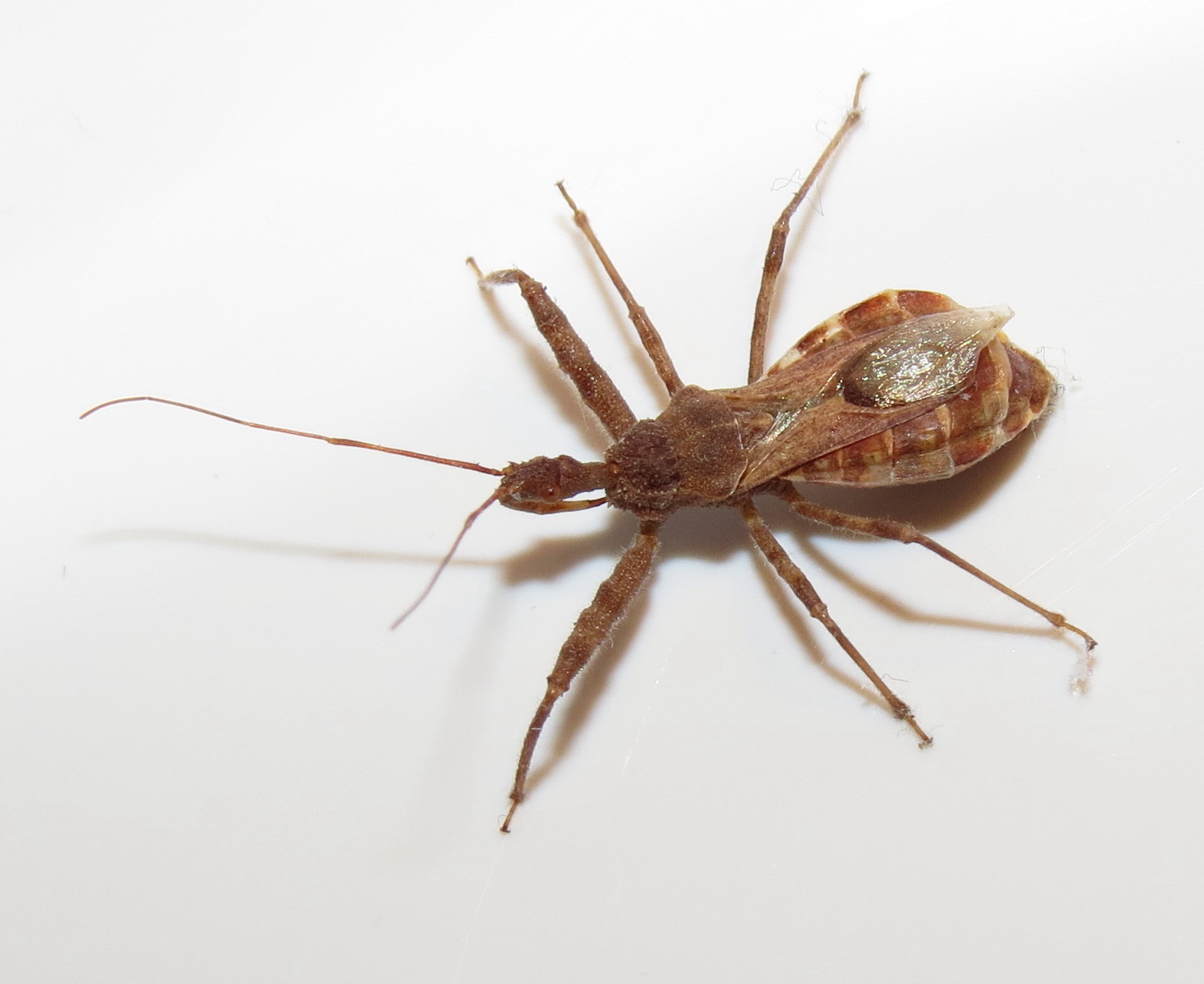
Autumn Assassins: Acholla spp.

Everyone has their own icon for a harbinger of fall, but mine has to be the assassin bugs in the genus Acholla (Gesundheit!). Adult specimens can actually be found regularly beginning in July, at least in some localities, but are most obvious in autumn, perhaps because foliage is falling and prey insect populations are beginning to decline.

A. multispinosa, Massachusetts

I first encountered these assassins in Massachusetts in 2009. I found one climbing on a signpost at the Mount Sugarloaf State Reserve in South Deerfield on November 1. Acholla multispinosa is our most widespread species, the only one found in eastern North America from New England south along the Appalachia Mountains to Tennessee and North Carolina, west through the Great Lakes, to Kansas, Nebraska, and southeast Iowa.

Male A. ampliata, Colorado

Here in Colorado, our common species is A. ampliata, which also occurs in California, Utah, Arizona, and New Mexico. Last year I found one on September 2, and another on September 8, both apparently males. I found what I assume to be a gravid female just last Friday, October 23, 2015. All the specimens were found beneath a large cottonwood tree in our reasonably urban, residential neighborhood. The bugs had apparently fallen out of the tree and were on a tall, plastic utility box beneath it.

Gravid female A. ampliata, Colorado

Acholla is easily mistaken for the more common Sinea species, but lacks the "thorny" appearance of that genus, and has no prominent spines on the inner surface of the tibia ("shin" segment) on the front leg. Acholla average slightly larger, too, ranging from 12-16 millimeters in body length compared to 12-14 for Sinea.

There is a third species of Acholla, A. tabida, found in California and Mexico.

Another male A. ampliata

What do these assassin bugs feed on? According to one reference, A. multispinosa is an enemy of the Pine Webworm, Pococera robustella, a caterpillar in the moth family Pyralidae. Another source reports the bug to prey on caterpillars of the Codling Moth, Cydia pomonella, family Tortricidae (the "worm" in the apple). Acholla in general are mostly arboreal (tree-dwelling) and thus feed upon insects associated with trees. Indeed, woodlands and orchards seem to be this insect's primary haunts.

A. multispinosa, Massachusetts

Acholla overwinters in the egg stage. The eggs are adhered to a substrate with, and protected by, a hardened secretion from the female's subrectal glands. This material probably insulates the eggs from weather and dessication, but may also repel potential egg predators. Diligent searching has failed to turn up any further information on the life history of Acholla. More appears to be known about its chromosomes, ironically enough.

So, before you put away your field gear for the winter, take one last look for these autumn assassins. You might easily add to our knowledge of their geographic distribution and natural history.

Sources: Drooz, Arnold T. 1985. Insects of Eastern Forests. Washington, DC: U.S. Department of Agriculture Forest Service, Miscellaneous Publication No. 1426. 608 pp.
Hoffman, Richard L. 2006. "Assassin Bugs of Virginia," The Insects of Virginia. No. 15. Martinsville: Virginia Museum of Natural History. 74 pp.
Slater, J.A. and R.M. Baranowski. 1978. How to Know the True Bugs. Dubuque, Iowa: Wm. C. Brown Company Publishers. 256 pp.
Swanson, D.R. 2011. "New State Records and Distributional Notes for Some Assassin Bugs of the Continental United States (Heteroptera: Reduviidae)," Great Lakes Entomologist 44(3-4): 117-138.

Tuesday, September 2, 2014

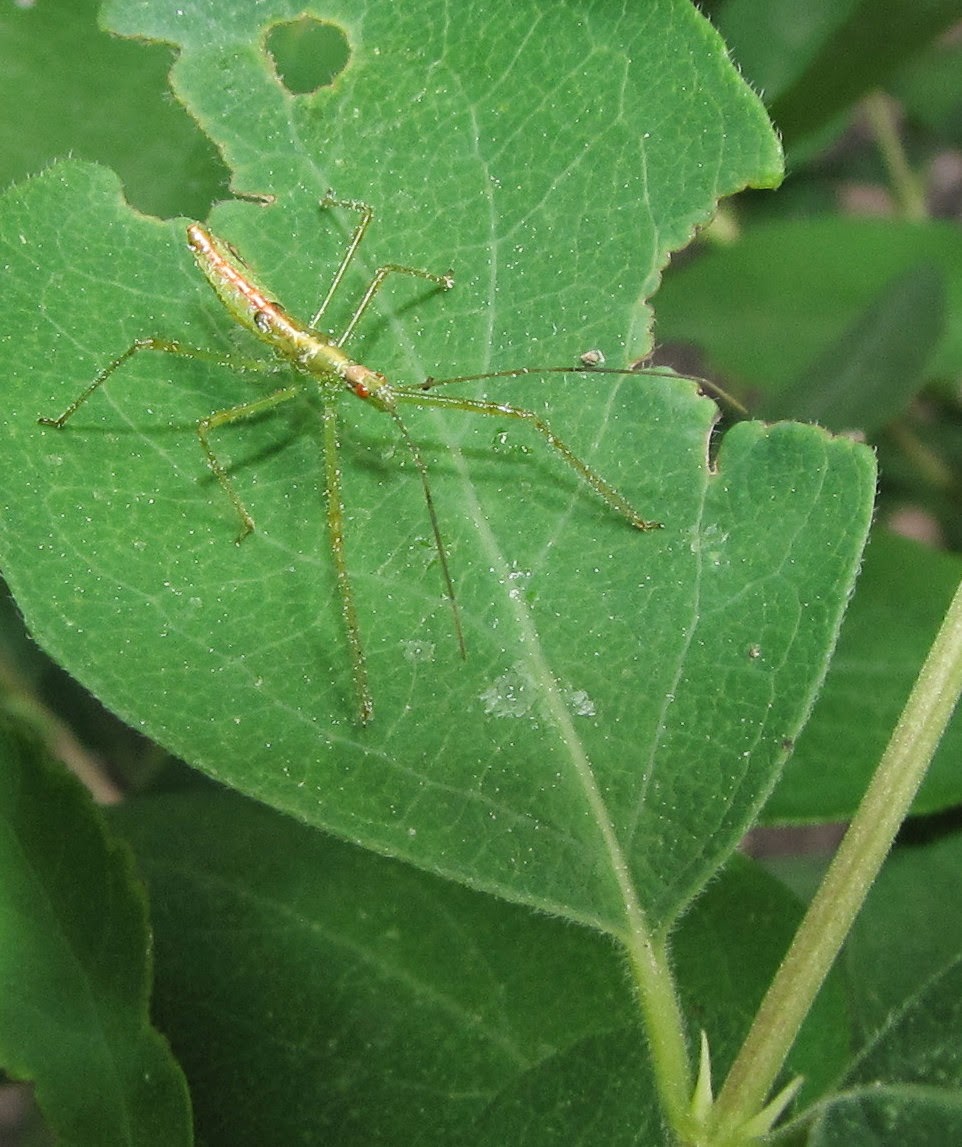
Sundew Assassin Bugs: Zelus

Your garden is full of amazing predators, easily overlooked among the foliage and flowers. No matter where you live in the U.S. and southern Canada, save perhaps for the northern Rocky Mountains, you probably have sundew assassin bugs of the genus Zelus lurking in the yard. These leggy insects move slowly about, or wait in ambush for potential prey.

Zelus luridus female, Colorado

There are currently five recognized species of Zelus north of Mexico, most with wide geographic distributions. Few are readily identifiable to species just by looking at them, but common ones include: the lovely green Zelus luridus with a sharp spine on either side of its thorax; the bright red and black Milkweed Assassin Bug, Z. longipes found in the southeast U.S.; and the non-descript Z. tetracanthus with its four small "knobs" across the top of its thorax. The Leafhopper Assassin Bug, Z. renardii, is common in the southwest U.S. and has been entertained as a potential biocontrol agent for pest reduction in agricultural settings.

Zelus longipes, South Carolina

Sundew assassins get their common name from the unique physiology that allows them to catch prey. While ambush bugs have extremely muscular front legs that snap shut on prey with stunning force, sundew assassins look like the 90-pound weakling by comparison. Their appendages are thin and seemingly delicate or flimsy. The tibiae ("shins") of the front legs (and to some degree the middle legs) are densely covered in short hairs, and this is part of their secret weapon.

Zelus tetracanthus, Colorado

Special glands in the exoskeleton of the legs secrete a glue-like material that that the insect intentionally smears over those hairs. This creates a sticky layer that small prey cannot escape from once the assassin grabs them. The prey-catching scenario is analogous to the insect-eating plant known as the sundew, which inspires the name "sundew assassin bugs."

When they hatch from the egg, nymphs do not have the ability to produce the glue they need. No matter, mom has covered the egg cluster in sticky goo to help repel egg parasites like tiny wasps, and the nymphs simply wipe their "arms" along the base of the egg mass to gather some glue (Weirauch, 2006).

Zelus luridus nymph, Colorado

Nymphs go through five instars (an instar is the interval between molts) on their way to adulthood. They are noticeably larger after each molt, with wing pads evident in the last couple of stages.

Zelus hatchlings

The egg mass reminds me of a tiny crème brûlée, but perhaps I need to eat lunch and return to finish this post later....I was delighted to stumble upon a couple of egg masses in the act of hatching at the Cheyenne Mountain Zoo here in Colorado Springs back on July 21. It seems remarkable that such long-legged creatures could be packaged in such small vessels.

Zelus hatchlings

There are at least two generations annually here along the Front Range in Colorado, probably three or more generations in southerly latitudes. I notice nymphs of Z. luridus in spring, so it is likely that winter is passed in the egg stage.

Zelus species range from 14-21 millimeters in body length as adults, and are relatively easy to recognize with their slender build, long legs and antennae, and diurnal period of activity. They are largely arboreal, so you will find them mostly on foliage and flowers of trees, shrubs, and herbs.

Zelus renardii, Texas

Assassin bugs in general are indiscriminate predators of other insects, and Zelus is no exception. So, while they will dine on leafhoppers, small caterpillars, and other pests, they will also capture beneficial insects such as small bees.

Despite our tendency to classify insects as "good" or "bad" for our own selfish reasons, sundew assassin bugs should be welcomed for the benefits they provide in occasional pest control, and their unique behavior and "personality," if I dare use that word for an invertebrate.

Zelus luridus male, Colorado

Sources: >Valerie. 2014. "Reduviidae ~ Assassin Bugs," Austin Bug Collection.

Weirauch, C. 2012. "Taxonomic Revision of Zelus Fabricius," Heteropteran Systematics Lab @ UCR
Weirauch, C. 2006. "Observations on the sticky trap predator Zelus luridus STÅL (Heteroptera, Reduviidae, Harpactorinae), with the description of a novel gland associated with the female genitalia," Denisia 19, zugleich Kataloge der OÖ. Landesmuseen Neue Serie 50 (2006), 1169-1180.
Wolf, Klaus Werner and Walton Reid. 2001. "Surface Morphology of Legs in the Assassin Bug Zelus longipes (Hemiptera: Reduviidae): A Scanning Electron Microscopy Study With an Emphasis on Hairs and Pores," Ann. Entomol. Soc. Am. 94(3): 457-461.

Tuesday, May 13, 2014

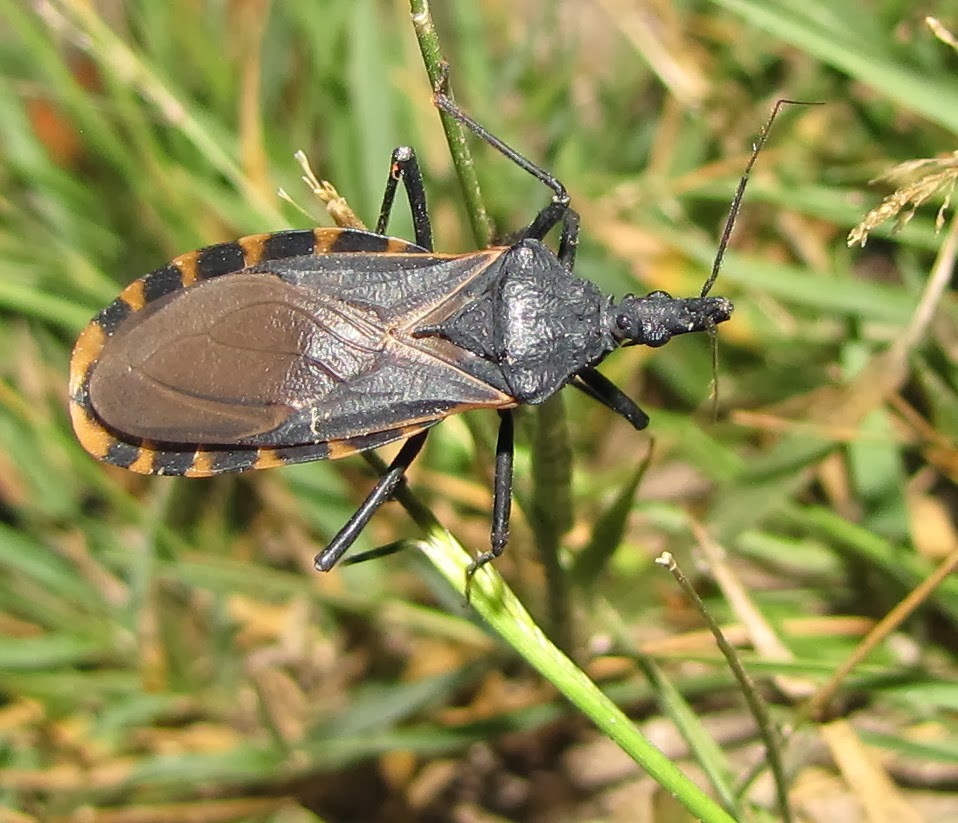
The Black Corsair

Turn on an outdoor light anywhere in the eastern U.S. at night at this time of year and you are likely to attract one, if not several, individual males of the assassin bug known as the “Black Corsair,” Melanolestes picipes. Why only males? More on that in a moment. What are they doing there? They are likely looking for other insects to prey upon.

This species exhibits what is called sexual dimorphism. Adult males are fully winged and are strong fliers. Females usually lack hind wings and have the front wings reduced to mere pads, though there are exceptions. They are nocturnal, like the males, hiding under stones, boards, and other objects by day.

Female M. picipes, Taney County, Missouri

This is among one of the most abundant assassin bugs in the United States, found from New England to Florida, and west to Colorado, Utah, and California. It is often confused with the Masked Hunter, but the Black Corsair averages smaller, at 15-20 millimeters in body length.

Most specimens from the northern part of its range are wholly jet black, but southern specimens may have a red or orange edge to the abdomen, or even have the abdomen entirely red. Those specimens are sometimes confused with the bordered plant bugs I wrote about last week. The red-bordered forms of Melanolestes picipes were formerly considered a separate species, M. abdominalis. The two are now recognized as a single species.

Male M. picipes, Taney County, Missouri

A highly distinctive feature of these agile assassin bugs are the “ankle weights” or “leg-warmers” they seem to be wearing on the first and second pair of legs, at the distal end of the tibial (“shin”) segment. The inflated attribute is called the fossula spongiosa, a pad composed of a dense mat of hairs, with pores beneath them that exude a thin film of oil to the flared tips of the hairs. The whole affair allows the bug to chase prey over slick substrates, cling to struggling victims, and grip a mate in the case of males.

M. picipes from Cape May, New Jersey, after a bad molt

Be careful that you don’t ever mindlessly swat one of these insects if it lands on you. The defensive bites of assassin bugs in general are excruciating, and the odds of being bitten go up when the Black Corsair comes to town. Because they are attracted to lights, and run and fly with great speed and agility, the males may find their way indoors.

It is just this scenario that played out in the notorious “kissing bug scare” in the summer of 1899 in the eastern United States. Accounts vary, some stating the panic began with a single incident of a woman being bitten in Washington, DC (Freiberg, et al, 1984); others claiming there really was a higher incidence of bites from bugs that year. That sensationalized newspaper reporting helped fan the flames of paranoia is a subject of unanimous agreement. Whether the assassin bug responsible was the Black Corsair, or the Masked Hunter, neither species would have been lusting after human victims, simply looking for insect prey in the wrong places.

Male M. picipes, Manhattan, Kansas

Sources: Berenbaum, May. 2009. “Kiss and telmophage,” Am. Entomol.. 55(2): 68-69, 112
Freiberg, Marcos and Jerry G. Walls. 1984. The World of Venomous Animals. London: T. F. H. Publication, Inc. Ltd. 191 pp.
McPherson, J.E., S.L. Keffer, and S.J. Taylor. 1991. “Taxonomic Status of Melanolestes picipes and M. abdominalis (Heteroptera: Reduviidae),” Fla. Entomol. 74(3): 396-403
Slater, J.A. and R.M. Baranowski. 1978. How to Know the True Bugs. Dubuque, Iowa: Wm. C. Brown Company Publishers. 256 pp.

Tuesday, January 7, 2014

Kissing Bugs

The holidays may be over, but the last thing you would want to cuddle up to under the mistletoe would be the subject of today’s “True Bug Tuesday.” Assassin bugs in the subfamily Triatominae are known as “kissing bugs.” There is nothing romantic about these vampires, especially considering that they can carry a lethal disease. Eleven species of Triatoma occur north of Mexico, most of them found in the southwest U.S.

Triatoma rubida from Arizona

Villains by Many Names

Like any notorious outlaw, the triatomines have their share of aliases: conenose, blood-sucking conenose, big bedbug, Mexican bedbug, Hualupai tigers (Arizona), vinchuca (in several South American nations), chipo or pito (in Colombia and Venezuela), chirimacho (in Peru), bush chinch (in Belize), and barbeiro or bicudo (Portugese, in Brazil). The name “kissing bug” derives from the fact that triatomines do not like to be confined under blankets and sheets while feeding on human victims, preferring to tap blood from the uncovered face, especially around the mouth.

Life Cycle

Kissing bugs begin life as eggs, dropped singly by an adult female. The nymph that hatches may take its first blood meal only two or three days after emerging from its egg. Blood meals are required for the insect to grow, each nymph passing through five instars (an instar is the interval between molts) before reaching adulthood. The adult insect is sexually mature, and has functional wings in most species. Mature triatomines range from 12-36 millimeters depending on the species.

Triatoma gerstaeckeri from Texas

Host of Last Resort

People are not the normal hosts of triatomine assassin bugs. Here in the U.S., Triatoma is mostly associated with woodrats (aka “packrats,” genus Neotoma), but several species accept blood meals from other vertebrates including opossum and raccoon, and sometimes livestock and pets. The nymphs of kissing bugs dwell mostly in the middens of woodrat nests, in the burrows of other rodents, or sheltered situations where hosts may be encountered regularly. People encounter kissing bugs when the adult insects disperse to find new rodent host populations during late spring, summer, and early fall. At that time, the bugs may be attracted to outdoor lights, and then sneak indoors. Their extremely flat bodies allow them to slip into the thinnest crevices.

Triatoma sanguisuga from Ohio

How to Stalk a Sleeping Human

The process by which a triatomine finds a host is akin to how a shark approaches a victim: with caution, and by relying on a series of different senses. Most pestiferous triatomines live in Mexico, Central, and South America. They dwell in the thatched roofs of rural homes, or in cracks in walls or beams. Hiding by day, they stir at night, usually simply dropping to the floor to begin the hunt. The bug uses its antennae to first detect gases in the breath of a potential target. Homing in on carbon dioxide, it begins its assault. As the insect gets closer, it switches to thermal detection, much like pit vipers. It is suspected that special pits in the antennae not only detect heat, but can determine whether the temperature is appropriate (too hot, too cold, or just right). The bug may even be able to calculate the size of the heat-emitting animal by “triangulating” with its antennae. A warm-blooded creature with the right attributes elicits the feeding response, and when the bug is within a few inches its proboscis extends like a divining rod for blood vessels.

Triatoma gerstaeckeri from Texas

Chagas’ Disease

As if blood loss is not enough of an insult, the victim of a kissing bug bite may contract a deadly disease. In Latin America, several species of triatomines can transmit Chagas’ disease, also known as American trypanosomiasis. The ailment is caused by a parasitic organism called a trypanosome, related to the one responsible for African sleeping sickness. Unlike the tsetse fly vector of sleeping sickness, triatomines do not inject the microbes in the course of biting. Instead, the trypanosomes proliferate in the digestive tract of the bug, and are excreted in the feces. Due to the unrefined bathroom habits of these bugs, they may defecate while feeding, liberating the disease organisms. Victims inoculate themselves by scratching the microbes into the itchy bite wound, or contacting mucous membranes of the eyes or nose. Species of Triatoma in the U.S. are certainly capable of harboring trypanosomes, but they are “potty trained,” going to the bathroom about twenty to thirty minutes after feeding, usually having left their victim by then. Still, isolated cases of Chagas’ disease have been recorded in Texas, California, and Tennessee.

Our smallest species, Triatoma neotomae of south Texas

Aftermath

Bites from kissing bugs are painless while the insect is feeding, but the victim typically experiences itching and swelling the next morning. Most human victims wake up with a fat lip, but some may have an allergic reaction, going into anaphylactic shock with low blood pressure, swollen airways, and rashes being symptoms. This situation requires emergency medical treatment. Repeated bite episodes may make one more vulnerable to anaphylaxis, and also have the potential to become disfiguring. Many rural citizens in Latin America are horribly scarred from constant victimization by triatomines.

Mistaken Identity

Several other true bugs enter homes in North America, and may be misidentified as kissing bugs. Those species include other assassin bugs that are not blood feeders, like the Black Corsair, Melanolestes picipes, and the Masked Hunter, Reduvius personatus. The Western Conifer Seed Bug, Leptoglossus occidentalis, is a completely harmless insect that seeks shelter indoors during late fall and winter. All of these insects can be mostly excluded by sealing cracks and crevices, repairing worn weatherstripping around doors, mending holes in window screens, and taking care to inspect firewood and other material and objects brought indoors from outside.

The big Triatoma recurva of Arizona

Sources: Flores, Graciela. 2005. “In the heat of the night,” Natural History 114(6), July/August, 2005: 32-37.
Schmidt, Justin O., et al. 2011. “Kissing Bugs in the United States,” The Kansas School Naturalist 57(2): 1-16.

Tuesday, November 19, 2013

Dinosaur Bug

Few insects cause more head-scratching bewilderment or jaw-dropping awe than adult Wheel Bugs, Arilus cristatus. They look like the offspring of a beetle and stegosaurus with that remarkable cog-like crest on the top of their thorax. These strange “dinosaur bugs” are members of the assassin bug family Reduviidae. While they should be welcomed in the garden as predators of pest insects, they should be treated with respect, too.

Wheel Bugs begin life looking much like other true bugs because they do not have the big crest until they reach adulthood. Young Wheel Bugs are black with a bright red abdomen. You will likely see them crawling about on foliage individually. Similar true bug nymphs, like leaf-footed bugs (family Coreidae), are usually seen in groups.

Wheel Bug nymphs go through five instars (the intervals between molts), gradually losing their bright colors and becoming covered in silvery hairs that give them a coarse, grizzled appearance.


They become larger in size with each molt, and acquire wing pads that will transform into fully functional wings as adult insects. All this time they are stalking other insects as prey, moving in a slow, methodical, deliberate manner that may only amplify the “creepiness” factor for someone prone to fear or dislike insects in general.

The final transformation from nymph to adult, accomplished in the last molt, is a dramatic one. A freshly-emerged adult Wheel Bug is a stunning pink or orange in color, and that trademark crest is now apparent. Two sets of wings are now fully developed. As its new exoskeleton hardens, the insect becomes darker, becoming gray and/or brown.

All assassin bugs use beak-like mouthparts to pierce their prey, injecting paralyzing venom and digestive enzymes into their victim. The internal tissues of the prey are liquefied by this chemical cocktail, and then withdrawn by the assassin through the same channels in its beak. Wheel Bugs are capable of taking prey larger than themselves, but small beetles and moths are among their favorites.

It is not a good idea to handle Wheel Bugs because they can deliver an excruciating bite in self-defense. They may deploy other behaviors to startle potential attackers, too. Assassin bugs have a groove in their “chest” that is flanked by ridges. Their beak normally rests inside this groove, but if alarmed the bug can bob its head vigorously, raking the tip of the beak across those ridges to make a very audible squeaking sound.

Besides making noise, female Wheel Bugs can evert a pair of stink glands from the tip of the abdomen to repel a predator. The glands are large and bright red, creating quite the visual display as well as a fragrant deterrent.

Arilus cristatus is a large insect, adult males being up to 28 millimeters in body length and females up to 32 millimeters. Females have a wider abdomen than males, when viewed from above.

Adult Wheel Bugs are seen most often in late summer and fall, earlier in more southerly latitudes. The species is found from eastern New Mexico north and east to Kansas, Iowa, southern Michigan, and southern New England. It is perhaps most abundant in the southeast states; it also occurs in Mexico.

Mated female Wheel Bugs lay their eggs in distinctive hexagonal masses. The number of eggs in such a cluster varies from about forty to 180. Look for the egg masses on tree trunks and other vertical surfaces where they will overwinter, protected by a shellac-like coating that insulates them from harsh weather, parasites, and other potential mortality factors. Nymphs hatch the following spring.

This is one of the “mystery bugs” I am most often asked about. It is so distinctive that even the most minimal description is enough to determine what the person is talking about. I like that people are curious about this species, and appreciate the opportunity to enlighten them about the unique biology of these predators.

Sources: Eaton, Eric R. 2003. “Amazing Assassins,” Missouric Conservationist. 64(6): 24-27.
Hoffman, Richard L. 2006. Assassin Bugs of Virginia. The Insects of Virginia Number 15. Martinsville: Virginia Museum of Natural History. 74 pp.
Mead, F.W. 2011. “Wheel Bug, Arilus cristatus (Linnaeus) (Insecta: Hemiptera: Reduviidae),” University of Florida IFAS Extension.
Slater, J.A. and R.M. Baranowski. 1978. How to Know the True Bugs. Dubuque, Iowa: Wm. C. Brown Company Publishers. 256 pp.

Tuesday, January 8, 2013

True Bug Tuesday: Masked Hunter

Note: This is the debut installment of a semi-regular feature I am dubbing “True Bug Tuesday.” It will likely include reposts of previous entries that cover members of the order Hemiptera.

Remember when your parents told you there were no monsters under your bed? Perhaps they were wrong. Have you ever wondered if you were hallucinating when you swore you saw a self-propelled dust bunny crawling across the floor? You might have been perfectly sane. There is a predatory insect that qualifies as both a miniature monster and an animated dust ball, and it is most often encountered indoors rather than outside.

The Masked Hunter, Reduvius personatus, is a member of the assassin bug family Reduviidae. Fortunately, the only thing it “assassinates” is other insects and related invertebrates. The piercing-sucking mouthparts are sleeved inside a short, stout, segmented beak bent under the insect’s “chin” when not in use.

The most remarkable trait of this species is the appearance of the immature stages, called “nymphs.” True bugs in general go through “gradual” metamorphosis, such that the juvenile stages look much like the adults, except that they are smaller, not sexually mature, and lack wings (if the species in question has wings at maturity). This is true of the Masked Hunter, except that the nymphs actively cover themselves in lint, sawdust, and other debris.

Their bodies are covered in short and long trichomes (hairs) connected to glands that produce a sticky substance. Fine particles adhere to the short trichomes close to the body of the insect, while longer trichomes anchor coarser particles in a second layer of camouflage. A “tarsal fan” of dense, long hairs on the foot of each hind leg helps the nymph apply the trash to the trichomes (Weirauch, 2006).

Each time the baby assassin molts (sheds its exoskeleton to grow in the brief interval before the new exoskeleton hardens), it must repeat the self-decorating process. The disguise helps protect it from potential predators, but might also make it appear harmless to its own prey. The Masked Hunter is probably a generalist predator, but it is often found in association with people and/or colonial birds and bats. It is well known for preying on bed bugs and swallow bugs (true bugs in the family Cimicidae). Other prey records include silverfish, booklice, and at least one harvestman (Arachnida: Opiliones).

Masked Hunters go through five instars. An instar is the period between molts. The nymphs are the ones that overwinter, usually in the fifth instar, but in Canada the life cycle may take two years, the nymphs overwintering in the third and fifth instar (Scudder, 1992). During the winter they are in diapauses, ceasing activity until the following spring. The sixth molt produces the adult insect, a dark, winged animal measuring from 15-22 millimeters in length.

Today, the Masked Hunter is found throughout the Northern Hemisphere. It is assumed that it is European in origin and has been transported to other continents through human travel and commerce. While it can be a common species, it is not prolific, and populations are usually small. Few specimens will occupy any given home or other building.

Assassin bugs are able to produce sound by rubbing one body part against another, a phenomenon known as “stridulation.” In this case, the insect rocks its head up and down, rubbing the tip of its beak across a series of transverse ridges on its "chest." The result is a very audible squeaking sound that may startle any other creature that grabs the bug.

The Masked Hunter is found throughout the Northern Hemisphere. It is assumed to be European in origin and has been transported to other continents through human travel and commerce. Most adult specimens of Reduvius personatus are seen in June and July. Look for them at lights at night where they are occasionally attracted by the buffet of potential prey insects. By day, they hide under bark on logs and in other sheltered situations. Be careful, though, Masked Hunters can deliver a painful bite in self-defense.

Sources: Hoffman, Richard L. 2006. “Assassin Bugs of Virginia,” The Insects of Virginia 15: 1-74.
Scudder, G.G.E. 1992. “The distribution and life cycle of Reduvius personatus (L.) (Hemiptera: Reduviidae) in Canada,” J. Entomol. Soc. B.C. 89: 38-42.
Weirauch, Chrstiane. 2006. “Anatomy of Disguise: Camouflaging Structures in Nymphs of Some Reduviidae (Heteroptera),” Am. Mus. Novit. 3542: 1-18.

Thursday, September 17, 2009

Ambush Bugs


Goldenrod has been flowering for several weeks now here in western Massachusetts, as it has been over most of North America. The blooms attract an incredible number of bees, wasps, flies, moths, and butterflies that come for the nectar, but one other insect stakes out goldenrod to make a meal of those other visitors.

Ambush bugs, once placed in their own family Phymatidae, are squat, diamond-shaped insects now considered members of the Reduviidae, collectively known as “assassin bugs.” Fortunately, the only thing ambush bugs assassinate is other insects.

Colored in shades of yellow or cream with darker markings, ambush bugs are well-concealed among the buds and blossoms of a variety of flora. Often the only indication of an ambush bug’s presence is its prey: another insect posed motionless in an awkward position among the petals of a flower.

Ambush bugs seize their prey with amazing speed and strength. The entire adult insect is only about ten millimeters in length, but what they lack in size they make up for in muscle power. Their front legs are “raptorial,” heavily modified like a praying mantis for grabbing and holding a victim. The femur is heavy and almost club-like, while the tibia is blade-like. The two leg segments fold against each other like a jack-knife against its handle.

The attack is so forceful as to be an audible “snap.” Sometimes the bug literally bites off more than it can chew. I once saw an ambush bug attack a hovering leafcutter bee. The startled, retreating bee literally yanked its attacker off the flower and the bug was forced to abandon its effort and fly off to another flower to try its luck again.

While the bug’s grip is so strong that it can often subdue a victim with only one front leg, it is the bug’s bite that ultimately dooms its prey. Beak-like mouthparts deliver saliva containing paralytic compounds and enzymes that pre-digest the meal from the inside out. The ambush bug then sucks up the liquefied contents, leaving the prey insect as an empty exoskeleton.

Female ambush bugs are larger and heavier than the males, and able to snatch larger prey items. This fact has not been lost on the smaller sex, and males will ride piggy-back atop females, sharing in the female’s successful kills. Such couples may or may not end up as a mating pair, and given the male gender’s freeloading tendencies, it seems a wonder they reproduce at all.

It is not just another ambush bug that might share in the spoils, though. Tiny flies of the family Machiidae will congregate like vultures at the scene of the crime, lapping up any tasty liquids oozing from the deceased.

Our most common and widespread North American ambush bugs are in the genus Phymata, of which there are at least seventeen species. Look (carefully) on almost any flower at this time of year and you may be surprised to find one of them lurking there.