Showing posts with label Dermestidae. Show all posts

Saturday, April 16, 2016

What's in Dat Scat?

Sometimes you have to literally get down and dirty to find interesting insects. Poking into animal dung, affectionately known as "scat," is a pretty smelly, gross business, but it can yield a diversity of insect life you are unlikely to see otherwise. A case in point came on April 13 when I visited the Bluestem Prairie Open Space along the edge of Johnson Reservoir just southeast of Colorado Springs.

Two half-buried Trox sp. and one red and black dung beetle, Aphodius fimetarius under coyote scat.

While dogs are not permitted in the area, I suspect the locals probably bring them in anyway, judging by the tracks and the scat I come across. Still, the overwhelmingly most common canines are coyotes, and their dung invariably contains lots of fur from their prey. This makes their excrement attractive to beetles more commonly found on carrion and mummified carcasses.

Hide beetle, Trox sp., on coyote scat, facing left

Hide beetles in the family Trogidae normally visit the dried-out remains of an animal body when little is left but skin and bones. Indeed, that is what they eat as adults and larvae, along with feathers, fur, and connective tissue. Apparently coyote dung is the next best thing to a dead body. I found a total of three Trox sp. on just one piece of manure. These beetles are almost invariably caked in gunk so as to be nearly unrecognizable as insects, or animals of any sort, really. When disturbed they go voluntarily comatose, so convincingly that I have given them up for dead, stiff specimens. I've been startled by having them re-animate in a vial or cup after several minutes.

Fully active Trox sp.

Another surprise on this chunk of poop was a skin beetle, Dermestes fasciatus or D. marmoratus, I am not sure which. Again, these beetles are usually much more common on carcasses in advanced stages of decomposition, including wet bones.

Skin beetle, probably Dermestes marmoratus

There were, however, some honest-to-goodness dung beetles in another piece of coyote scat that was a little....fresher, if one can apply that term to anything that doesn't smell the part. Aphodius fimetarius is a little red and black dung beetle that was introduced to North America from Europe probably a century or more ago. It is now widespread and common here, usually in cow pats. The larvae live and feed in the manure, then dig into the soil beneath it to pupate. There is probably one generation per year.

"Tumblebug," Canthon simplex, unfortunately lying trampled on a trail

The other dung beetle I found was one of the dung-rollers or "tumblebugs" as they are affectionately called. This species, Canthon simplex, is relatively tiny, adults measuring only 7-8 millimeters. The adults tear off a pea-sized chunk of poo and roll it into a ball, either females alone or in pairs with males. Rolling the ball away minimizes conflict with other dung beetles. Once a suitable site is located, the female buries the "brood ball" and lays a single egg inside. The grub that hatches feeds inside, eventually pupating within the now hollow sphere.

"Tumblebug," Canthon simplex

While I was looking for the dung beetles, a very small rove beetle, family Staphylinidae, raced up a grassblade and flew off before I had a chance to secure it. Rove beetles are predators of other insects, and many species visit dung and carrion to feed on fly maggots. Rove beetles are slender, almost serpentine, with shortened wing covers (elytra), and so may be mistaken for earwigs at first glance. Staphylinids are so diverse that identifying them is next to impossible for anyone but an expert; and it also frequently involves detailed examination of the male's genitalia.

Typical rove beetle, family Staphylinidae

Maybe you are not "into" dung fauna, at least not if it requires pawing through it with or without gloves and/or various instruments. Ok, no one can blame you; but before you dismiss the power of poo altogether, consider my upcoming post "What's on dat scat?" You will be surprised all over again.

Source: Ratcliffe, Brett C. 1991. "The Scarab Beetles of Nebraska," Bull Univ Nebr State Mus. Vol. 12: 333 pp.

Sunday, November 2, 2014

Black Carpet Beetles, Attagenus spp.

Among the more common household pests you are likely to encounter are the Black Carpet Beetles in the genus Attagenus, family Dermestidae. They are slightly larger, more oval, and jet black compared to the usually more abundant Anthrenus carpet beetles, but they share similar feeding habits.

Adult Black Carpet Beetle

There are nine species of Attagenus known from north of Mexico. Most are about 3-5 millimeters in length as adults. The larvae are distinctive in being tapered from front to back, with a bundle of long hairs extending from the rear end. At maturity the larva is about 9.5-12.7 millimeters, excluding the "tail" of hairs.

Larva of Black Carpet Beetle

As is the case with other carpet beetle larvae, the hairs can cause dermatitis in some people. The patient may frequently interpret the symptoms as insect "bites," resulting in misdiagnosis by physicians. It usually takes years of exposure to carpet beetle infestations to begin exhibiting reactions, but in rare instances, inflammation of the respiratory tract and eyes can also occur.

While the larvae feed mostly on dried animal products such as shed hair and skin cells from people and pets, wool garments and blankets, silks, furs, animal hides, and dead insects that collect in spider webs, light fixtures, and along window sills, they also consume dried plant matter on occasion, especially cereals and grains. So, they can be a pantry pest as well as a clothes closet pest.

Adult Attagenus feed on flower pollen

Control and prevention of a Black Carpet Beetle infestation is best achieved by thorough cleaning of one's domicile, through vacuuming up accumulated pet hair, and dust (most of which is flakes of dead skin from people and pets). Discard any infested items. Outdoors, remove abandoned mammal, bird, and wasp nests. Understand that despite all your efforts, it is next to impossible to become immune to the occasional infestation.

Insects are incredibly adept at exploiting human behavior and household ecosystems. Few are as efficient as Black Carpet Beetles when it comes to scavenging our food and clothing. They are to be despised, no doubt, but also admired for their adaptability.

Sources: Evans, Arthur V. 2014. Beetles of Eastern North America. Princeton, NJ: Princeton University Press. 560 pp.
Gahlhoff, Jerry G., Jr. 2013. "Black Carpet Beetle," Featured Creatures. Entomology and Nematology, University of Florida/Institute of Food and Agricultural Sciences. Publication Number EENY-18. Note the image of the adult beetle depicts a Dermestes species, not Attagenus.
Jacobs, Steve. 2010. "Carpet Beetle Dermatitis," Insect Advice from Extension. College of Agricultural Sciences, Pennsylvania State University.
White, Richard E. 1983. A Field Guide to the Beetles of North America (Peterson Field Guides). Boston: Houghton Mifflin Company. 368 pp.

Tuesday, October 14, 2014

Carpet Beetles, Genus Anthrenus

As a volunteer answer-man for AllExperts.com, I receive many questions pertaining to carpet beetles, tiny coleopterans in the family Dermestidae. In fact, I venture to say that at least seventy percent of the queries I get are related to carpet beetles and their larvae. Ironically, I now live in a region where these beetles are relatively scarce.

Anthrenus sp. larva, Colorado

Yesterday, I finally found a living larva of the most troublesome genus most people find: Anthrenus. The hairy grub was only about four millimeters in length, and crawling up the bathroom wall. This is an unfortunate commentary on our housekeeping habits, I suppose, but even the cleanest homes will have carpet beetles at one time or another. It takes precious little to feed them.

Carpet beetle larvae eat all manner of dried animal products, especially the shed hair and skin cells of pets and people. This food supply accumulates faster than you might imagine and, despite vacuuming regularly, can persist in out-of-the-way corners and beneath furniture.

Additional items on the carpet beetle menu include wool blankets and garments, furs (but you don't have animal hides, right?), taxidermy mounts, dry pet food, and insect collections (including my own, horror of horrors!).

Adult Anthrenus lepidus, Colorado

Getting rid of an infestation of dermestids is a real challenge. Traditional methods are of questionable effect. One of my good friends in entomology and pest control, Bill Warner, has found that moth balls, which have the active ingredient of naphthalene, are not just useless. He has observed carpet beetle larvae eating the substance. Ok, so what about moth crystals, with the active ingredient PDB (paradichlorobenzene)? At high enough concentration, that seems to work, and I have used moth crystals to protect my own insect collection. Unfortunately, PDB is potentially carcinogenic, according to the World Health Organization. The U.S. Environmental Protection Agency claims it is "not likely to be carcinogenic to humans" (National Pesticide Information Center website).

The best course of action when faced with numerous carpet beetle larvae is to discard the infested item. If you cannot bear to part with whatever is under attack, then a cycle of freezing and thawing over the course of several weeks may do the trick. This is how most museums now handle pest control in their entomology collections.

Prevention is the best cure for dermestids. Store vulnerable foodstuffs, like dried meats and dry pet food, in metal, glass, or durable plastic containers with tight-fitting lids. Store woolens, silks, and furs in a cedar chest when not in use. Cedar has proven repellent qualities and is not toxic to people or pets. Vacuum and clean your home regularly.

Adult Anthrenus sp., Massachusetts

Adult carpet beetles are pretty tiny (2-4 mm), and frequently mistaken for lady beetles since they are round, and often patterned with bands or spots of brown, black, and white. The beetles fly well and seek escape to the outdoors. Consequently, they are most often observed on windowsills, or discovered in light fixtures.

While carpet beetle larvae are pretty much "juvenile delinquents," the adult beetles can be surprisingly efficient pollinators of some flowers, especially in spring. The Buffalo Carpet Beetle, Anthrenus scrophulariae, is particularly common in flowers.

Larva of Anthrenus verbasci, © Canada Dept. of Agriculture

Carpet beetle larvae are covered in tiny hairs called setae, and these hairs can break off and become airborne, especially from the molts (shed "skins") of the larvae. These setae can cause irritation, or even trigger rhinitis or asthma in people prone to allergic reactions. Contact dermatitis is a more uncommon reaction, and an infestation has to be pretty severe to result in any kind of medical consequences (Peacock, 1993).

There are eighteen (18) species in the genus Anthrenus currently recognized in North America, and several of those are cosmopolitan pests now found worldwide as a result of international commerce. There are other common types of carpet beetles as well, with the genera Trogoderma and Attagenus being common in households. I will address those in separate blog posts.

Sources: Boone, Mike. 2013. "Genus Anthrenus - Carpet Beetles," Bugguide.net.
Gibson, Arthur and C.R. Twinn. 1931. Household Insects and Their Control. Ottawa: Department of Agriculture, Canada. 87 pp.
National Pesticide Information Center.
Peacock, Enid R. 1993. Adults and Larvae of Hide, Larder, and Carpet Beetles and Their Relatives (Coleoptera: Dermestidae) and of Derodontid Beetles (Coleoptera: Derodontidae). London: Royal Entomological Society of London. Handbooks for the Identification of British Insects, vol. 5, part 3. 84 pp.

Thursday, April 24, 2014

More Beetles from Bones

Last week I wrote about a few beetle species that I recovered from nearly dry bones here in Colorado Springs. I now have an update, plus additional species found in carrion on a recent trip to a private ranch northeast of Pueblo. It is interesting to note the succession of carrion beetle fauna over time; and the differences in diversity depending on whether the carcass is a large mammal, small mammal, bird, herp (reptiles and amphibians), or fish.

I went back to the bones I found earlier, and discovered some changes as of April 18. I spotted another Northern Carrion Beetle, Thanatophilus lapponicus, before it quickly disappeared, and more dermestids that I previously identified as Dermestes marmoratus. However, a different, smaller species was now more abundant.

Hide and Tallow Beetle, Dermestes talpinus?

I have decided I cannot readily conclude what species are involved here. Twelve species of Dermestes are recorded from Colorado, many of which look nearly identical to each other. The smaller species present on the bones appears to be the Hide and Tallow Beetle, D. talpinus. It is covered in gold or coppery scales on the pronotum (top of thorax), and silvery scales on the elytra (wing covers).

I also found a single specimen of yet another species that is possibly the Fringed Dermestid, D. frischii.

Dermestes frischii?

My wife and I travelled to Chico Basin Ranch on Monday, April 21, mostly seeking spring migrants of the feathered variety. This is a sprawling, working ranch that straddles El Paso and Pueblo Counties, and is managed for both livestock and native wildlife.

Unfortunately, one of the first birds we came across was a deceased Bobwhite quail. Turning it over revealed a shocking diversity of beetle life.

Rove beetles in the family Staphylinidae are predatory, and the ones that visit carrion feed mostly on fly maggots. They are easily recognized by the shortened elytra (wing covers), and are perhaps reminiscent of earwigs.

Hairy Rove Beetle, Creophilus maxillosus

The Hairy Rove Beetle, Creophilus maxillosus, is enormous by staphylinid standards, measuring 11-23 millimeters. These insects fly well, but quickly dig themselves out of sight when uncovered.

Rove beetle, Philonthus politus

Another rove beetle species, Philonthus politus, was also present. It is much smaller, about 10 millimeters. Special thanks to Philip Howe and Max Barclay for suggesting the genus, and Adam Brunke for volunteering the species. Facebook interest groups are a wonderful thing.

Sexton beetle, Nicrophorus sp.

Two species of the family Silphidae were also under the bird carcass: Thanatophilus lapponicus again, and one of the sexton beetles, Nicrophorus sp. Sexton beetles, also known as burying beetles, are big (11-22 mm or so), stocky, and strong. They often work in pairs to dig under the corpse of a small animal, sinking it into the ground. They then chew the carcass into a literal “meatball,” and the female then deposits a small number of eggs in a crater atop the food ball. She’ll chew up small bits of meat and feed them to her larval offspring, cleaning the food of mold and other potential contaminants in her spare time.

Clown beetle, Saprinus lugens

Clown beetles in the family Histeridae are small, spherical, highly-polished insects that play dead or dig when disturbed. They are predatory on other small insects found in carrion, dung, and other unsavory mediums. This one is Saprinus lugens, a common and widespread species measuring 5-8 mm. Thanks to Alexey Tishechkin for the species identification.

Male Scooped Scarab, Onthophagus hecate

Many dung beetles will also visit carrion, such as the little “Scooped Scarab,” Onthophagus hecate. Males have a broad, forked horn projecting over their heads from the top of the thorax. They battle each other for the right to mate with a female. At only 6-9 millimeters, O. hecate is one of the smaller dung beetles.

Hide beetle, Trox sonorae

Last but not least, were cryptic “hide beetles,” Trox sonorae, in the family Trogidae. They are closely allied to scarab beetles. Trogids are rough in texture, and usually so caked in debris as to be nearly unrecognizable as insects. They also play dead so convincingly as to be easily dismissed as living creatures. They freeze in a random, rigid posture when disturbed. This species is only 8-11 millimeters in size, which only makes it even harder to spot. Trox consume dried skin, feathers, and other material when carcasses are in the last stages of decay.

Silphid carrion beetle larva
Dermestes larva

Later in the day, Heidi and I came across the remains of a large livestock mammal, and virtually none of the beetles found on the dead quail were on this much larger vertebrate. Instead, it was carrion beetle larvae, dermestid larvae and adults, and Red-legged Ham Beetles, Necrobia rufipes. There are three common species of Necrobia, all in the family Cleridae. While most clerids are predators, Necrobia adults and larvae actually do feed on carrion, cured meats, and other dried animal products. They can be pests in museums and taxidermy businesses. Ham beetles are about 4-7 mm., but are a lovely metallic blue. They glint in the sunlight as they run over the surface of a dried corpse.

Red-legged Ham Beetle, Necrobia rufipes

Forensic entomology is the study of insects that infest dead bodies. Blow flies (family Calliphoridae) play the most prominent role in crime scene investigations because they can help ascertain the time of death. The life cycle of flies progresses in a predictable fashion, faster at higher temperatures, slower at cooler temperatures. By collecting adults, larvae, and pupae, a criminalist can determine at what time a body was first visited by ovipositing female flies.

Obviously, other insects play a critical role in decomposition as well, and beetles are chief among them. Those of you with strong stomachs may want to examine animal carcasses you come across, as the insects found there can usually be found nowhere else. Just remember to pack the hand sanitizer.

Friday, April 11, 2014

Beetles from Bones

This past Wednesday, April 9, I went exploring near my home to see what insects are out and about here in Colorado Springs this spring. In my wanderings I stumbled upon a few bones of some large mammal, providing an opportunity to find insects specific to carrion.

I am not terribly keen on handling carcasses, but these leg bones were mostly dry. The ligaments were still intact on one leg, but flies had long lost interest in these remains. Still, it takes little to attract ants, and some kinds of beetles. I managed to find three species large enough for photos, plus a couple very tiny rove beetles (family Staphylinidae) that quickly vanished when I turned over the bones.

The first insect I saw was, oddly, a Small Milkweed Bug, Lygaeus kalmia. Many normally herbivorous Hemiptera are opportunistic scavengers, though, so perhaps the appearance of this insect should not have been terribly surprising. The second insect was one I expected, and present in fair numbers considering the relative size of the carcass: Common Carrion Beetles, Dermestes marmoratus.

Dermestid beetle and Small Milkweed Bug

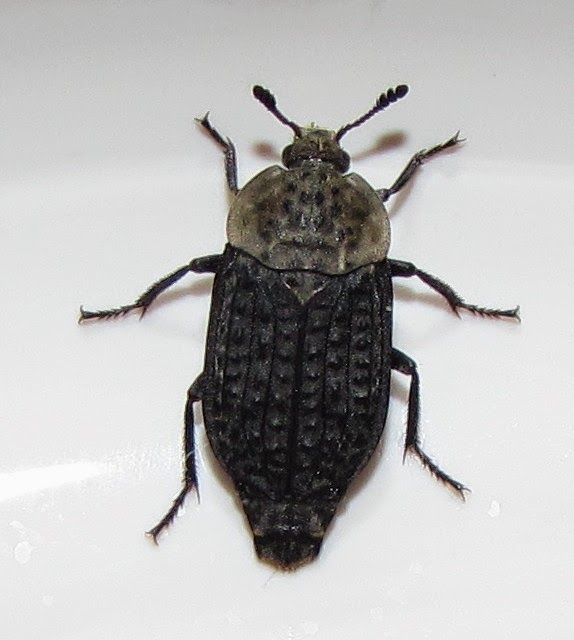
Dermestids are so efficient at scouring the last vestiges of flesh from bone that natural history museums employ colonies of the beetles to clean skeletons. This particular species, a relative of that indoor pantry pest the Larder Beetle, is a handsome insect measuring 10-13 millimeters. The silvery-gray scales on its otherwise black body make it look quite dapper considering the situations it frequents. D. marmoratus is found from southern California through the southwest, southern Rocky Mountains, and Great Plains states.

Dermestes marmoratus

The most spectacular specimen uncovered was a Northern Carrion Beetle, Thanatophilus lapponicus, also known as the Silky Carrion Beetle. It looks superficially like a giant dermestid, 8-15 millimeters in length, but it belongs to an entirely different family, the Silphidae. This species is holarctic, meaning it ranges across the entire northern hemisphere. In North America it is found in Alaska, Canada, and the northern tier of states in the U.S., plus the Pacific states to Baja, Mexico, and the Rocky Mountain states. The adult beetles have been found from March to October. Perhaps its hairy body helps to insulate it against cooler temperatures.

Thanatophilus lapponicus

The last beetle species I collected was a type of sap-feeding beetle in the family Nitidulidae. At only 3-5 millimeters, Nitidula ziczac is difficult to spot, let alone get a clear image of. Despite their name, sap-feeding beetles are highly diverse in their appetites. Some species are found in abundance inside yucca flowers, for example. N. ziczac is a well-known associate of carrion, found in North America mostly from the Great Plains westward, as near as I can tell from various references.

Nitidula ziczac

What truly amazes me about carrion-inhabiting insects is how they manage to locate such a scarce resource. They need the energy to fly to far-flung bodies, at just the right time. Certainly their olfactory powers are light years ahead of us humans (I detected absolutely no odor from these particular bones), and tuned specifically to aromatic compounds liberated during decomposition. However they do it, thank goodness they do, or we would be forever tripping over dead animals, before becoming deathly ill ourselves.

Source: Evans, Arthur V. and James N. Hogue. 2006. Field Guide to Beetles of California. Berkeley: University of California Press. 336 pp.

Friday, November 29, 2013

Larder Beetle

Thanksgiving is an American holiday where we share a big meal with family and friends. Chances are, you might be sharing the leftovers with the Larder Beetle, Dermestes lardarius, as well.

Larder Beetles are members of the family Dermestidae, collectively known as skin beetles and carpet beetles. They feed as larvae and adults on all manner of dried animal products, the larger species enjoying cured meats, dry pet food, furs, taxidermy mounts, even cheeses. Their alias of “Bacon Beetle” gives a clue as to their food preferences. They can also be attracted to the carcasses of dead rodents between walls; or even accumulations of dead insects in light fixtures. I found this Larder Beetle larva crawling out from under our dog’s food bowl earlier this month, probably looking for a place to pupate.

Larvae of Dermestes lardarius average about 12-13 millimeters in length just prior to pupation. They are covered in long hairs like most dermestid larvae, but are distinguished by the pair of hook-like spines on the rear end.

Under optimal conditions, the life cycle from egg to adult can be completed in 40-50 days, but more commonly there is one generation per year. Eggs hatch in an average of less than twelve days after being laid in clutches of 6-8 by the female beetle in a food source. Larvae that eventually become adult male beetles undergo five molts, while female beetles pass through six molts in the larval stage. The insects may spend anywhere from 35-80 days as larvae, probably depending on how easy it is to secure enough food to complete the transition to adulthood. Larvae may wander in search of new food sources, too.

The pupa is enclosed in the last shed larval exoskeleton (“skin”). The larva bores into soft, but relatively solid material such as cork before pupating. The adult insect emerges in about fifteen days.

Adult Larder Beetles are 7-9 millimeters long, and blackish with a broad yellowish band across the elytra (wing covers) as shown. They can fly well. Note the relatively short, clubbed antennae that help distinguish them from other household insects and many other beetles. Adults can be long-lived, sometimes persisting for a year-and-a-half under ideal conditions. The species overwinters in the adult stage, too.

Prior to the age of refrigeration, the Larder Beetle and its cousins were serious competitors for stored food. Today, they are more of a nuisance pest. Prevention is the best way to control them. Store your vulnerable foodstuffs (including dry pet food) in durable plastic, glass, or metal containers with tight-fitting lids. Store furs, wool blankets and garments, and other fibers of animal origin in a cedar chest. Cedar has proven repellent qualities and is quite effective. Forget mothballs (utterly useless) and moth crystals (at least potentially carcinogenic).

I personally find these to be handsome beetles; and I admire their adaptability to exploit our own weaknesses in protecting resources we think are rightfully ours. In this season of giving, sometimes we give by accident. Happy holidays, everyone.

Sources: Bennett, Stuart M. 2003. “Dermestes lardarius (Bacon or Larder Beetle),” Stored Product Insects.
IPM.WG. 2012. ”Larder Beetle,” Museum Pests. Integrated Pest Management Working Group.
Klass, Carolyn. 2011. “Larder Beetle,” Horticulture Diagnostic Laboratory. Cornell University, Cooperative Extension of Suffolk County.