Showing posts with label Moth Monday. Show all posts

Monday, October 19, 2015

National Moth Week Recap, 2015

Better late than never, allow me to share with you the experiences we had here in Colorado during National Moth Week, July 18-25. I participated in three events here along the Front Range, and all of them exceeded expectations in terms of public participation and excitement over the insects we encountered. While I approached two of these venues about doing Moth Week events, Bell Mead of the Mile High Bug Club carried out all the liaison and organizational work.

Watching the female sphinx moth lay eggs at Cheyenne Mountain State Park event

The first event was held at Cheyenne Mountain State Park, located just south of Colorado Springs, on July 18. Park staff arranged for us to set up at the camper services building, hoping to draw campers in the park, but there was enough publicity that people came from elsewhere, too (like "moths to a flame?"). One family even supplied their own lights and sheet. It turns out one of their children raises moths, and dad had to secure interstate permits to legalize the rearing of species not found in Colorado.

Can't beat the view of Colorado Springs from Cheyenne Mountain State Park © Bell Mead

The landscape surrounding the building is mostly grassland, with Gambel's Oak thickets and scattered mixed conifers. This diversity in flora produced a corresponding diversity of moths. Among the more spectacular specimens were a female sphinx moth, Smerinthus ophthalmica, which began laying eggs right on one of the sheets.
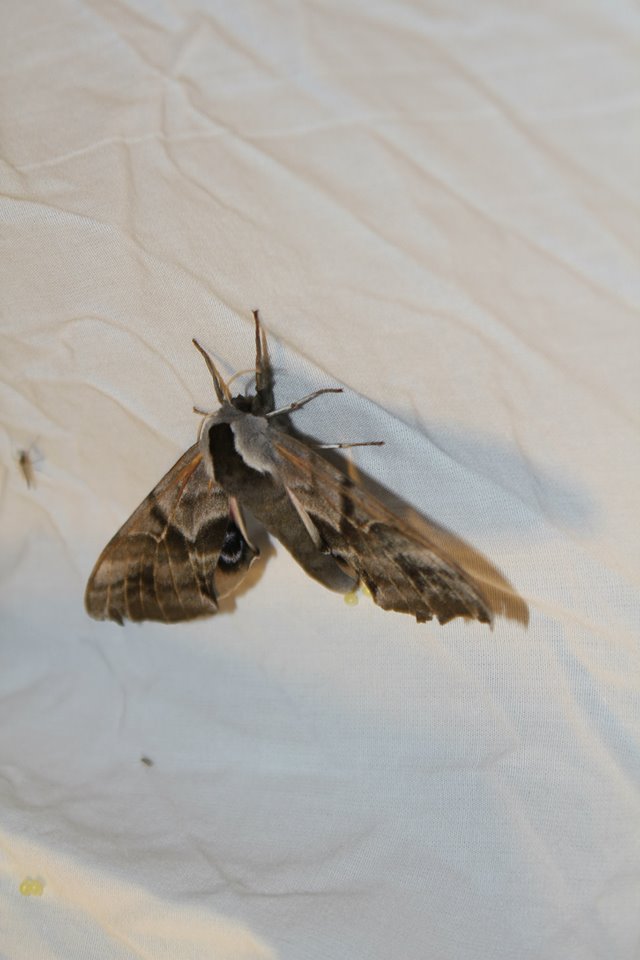
The sphinx moth laying eggs © Bell Mead

The public portion of this event ended around ten PM, but the Mile High Bug Club folks held an "after party," visiting illuminated outposts such as restrooms, self-pay kiosks, and the visitor center. Moths may be a "gateway drug" to a fascination with other nocturnal arthropods, and indeed we found many interesting beetles, true bugs, scorpions, a large centipede, and two "camel spiders" (non-venomous arachnids in the order Solifugae).

© Bell Mead

The second event was held Wednesday, July 22 at Hudson Gardens & Event Center in Littleton, Colorado, just outside Denver. Amanda Accamando, the Education and Volunteer Manager there, provided many supplies, creative publicity, and volunteer support. It paid off. We had thirty (30) attendees.

Visitors to the Hudson Gardens event © Amanda Accamando

We chose the "Hobbit Hole" as our station, located beside a long pond that we assumed would be a natural flyway for moths. Unfortunately, we were overwhelmed by caddisflies instead. The few moths that did make it to our sheets were interesting species, though, and no one felt the least bit disappointed given the myriad other insects that flew in.

Bell Mead helping a visitor photograph a moth © Amanda Accamando

Our finale was a repeat of a private event the Mile High Bug Club held last year in Rock Creek Canyon, southwest of Cheyenne Mountain State Park. Our co-sponsor was the May Natural History Museum, which boasts the world's largest, publicly-accessible private collection of insects and other arthropods. The Golden Eagle Campground and RV Park is also here, affording even more lit-up facilities after dark.

One of the light stations in Rock Creek Canyon © Bell Mead

We were thrilled to have moth guru Sam Johnson on hand to set up his own stations, and help us paint bait on trees. "Sugaring" for moths consists of slathering a thick mixture of fermenting fruit puree, stale beer or other alcoholic beverages, and brown sugar onto tree trunks. Many moths that don't come to lights will come to bait. Glowsticks attached to the trees helped us locate the bait stations after dark.

American Bird's-wing moth, Dypterygia rozmani, at bait © Bell Mead

No sooner had the sun gone down on this pine-and-oak forest habitat than in came the moths, plus Ten-lined June Beetles (Polyphylla decimlineata), enormous root borers (Prionus californicus longhorned beetes), and many other insects. Here's a video of part of the fun.

Male Ten-lined June Beetle

This year, the area experienced an outbreak of the Douglas-fir Tussock Moth, Orgyia pseudotsugata, but most were in the cocoon stage, so we weren't inundated. A few males showed up at the lights, but females are wingless and call males to them from their cocoons.

Douglas-fir Tussock Moth

The bait was effective, and drew at least one species of underwing moth, Catocala amestris, that Sam identified as being a new record for southern Colorado. Last year, Same collected Catocala delilah, another unusual species for the region at this same location.

Catocala amestris © Sam Johnson

We were so excited by the success of these three events that we held another one, this time at Bell's home near Garden of the Gods Park in Colorado Springs, on August 15. Despite thunderstorms raging around the city, her neighborhood remained mostly rain-free.

Mothing at Bell's place © Bell Mead

We even took a stroll up to the American Mothers Chapel at the edge of Rock Ledge Range, to see what came to the lights on that little white building. We saw several familiar moth species, but plenty of new ones, too, given the later date.

Maple Spanworm moth, Ennomos magnaria at Bell's place

I want to again thank Bell Mead for coordinating with personnel at all the event locations, securing lights and other equipment, and generally organizing everything. Additional thanks to Brian Kelly and Rick Baker of Mile High Bug Club for their assistance, too, and my wife Heidi for enjoying the same odd recreational experiences that I do.

We're already looking forward to National Moth Week, 2016, but we probably won't wait until July to start "mothing." After all, the IO Moth and other big, exciting moths emerge earlier than that.

Monday, September 9, 2013

White-lined Sphinx ("Hummingbird Moth")

Here it is, “Moth Monday,” and one species rises to the top of the priority list because it is experiencing a real population boom here on the Front Range in Colorado. The White-lined Sphinx, Hyles lineata, is common across most of North America, but in both the adult and larval stage it can make headlines and baffle the average citizen.

Several species in the family Sphingidae go by the informal name of “hummingbird moth” because they approach or exceed the size of hummingbirds (wingspan 6.3-9 centimeters), and are frequently seen hovering in front of flowers like their namesake feathered friends. At first glance, many people believe they are indeed seeing a hummingbird. Then that long proboscis comes into focus. Out comes the smart phone or camera, and several Facebook posts later the person may finally get a proper identification.

The adult moth can be active at almost any time of day or night, and visit a wide variety of flowers for the nectar they use to fuel their rapid, energetic flight. Below is a video I made of one of two specimens I saw in a butterfly garden in downtown Colorado Springs on August 30, 2013. I subsequently saw several more visiting an ornamental butterfly bush (Buddleja or Buddleia sp.) across the street from our townhouse….but they are everywhere right now, profiting from summer rains that made larval food plants available by the bushel.

It is the caterpillar stage that often causes people consternation. They superficially resemble the tomato hornworm, but are more conspicuous and often more numerous. The image below depicts the typical appearance, but the larvae can be yellow, or mostly black, with much variation in between.

The caterpillars are general feeders on a variety of plants, shrubs, and trees, but seem partial to those in the evening primrose family. Oenothera primrose plants are not terribly substantial, so it takes more than one plant for a caterpillar to mature. The larva simply finishes off one plant and walks on to another. When there are lots of caterpillars (one female moth can lay up to 500 eggs), food plants can quickly become scarce as they are consumed, and the caterpillars are forced to “march” in search of literally greener pastures. These large scale “migrations” may cross rural roads creating a slick hazard as they are crushed under tires.

Once finished feeding, the caterpillar again begins walking in search of a place to pupate. Each larva burrows into the soil and creates a chamber several inches underground. There it molts into the pupa stage. This is how the species overwinters, though there is usually more than one generation per year, especially under favorable conditions.

The White-lined Sphinx also ranges south to Argentina. A very similar species, Hyles livornica occurs in Eurasia and Africa, and may account for persistent claims that H. lineata is found in the Old World.

Look for the adult moths at dusk and dawn, for they are mostly crepuscular in their activities. Still, they may show up at your porch light after dark as well. By day they usually hide among tangled grasses where the moth’s pattern of lines serves it well as camouflage.

This is an animal of open habitats, so they are most abundant in prairies, deserts, agricultural lands, vacant lots, and gardens. In the western U.S., the White-lined Sphinx is a resident species only from southern California to west Texas. It immigrates annually farther north. Rarely is this moth a pest, though the caterpillars occasionally do damage to grapes and tomatoes in Utah.

Hyles lineata, as prolific as it is, is not without enemies. Pallid bats and large mantids eat the adult moths. Tachinid flies in the genera Belvosia, Drino, Winthemia, and Compsilura among others, are internal parasites of the caterpillars. Certainly ichneumon wasps and braconid wasps are also parasites.

Sources: Arnaud, Paul Henry. 1978. Host Parasite Catalog of North American Tachinidae (Diptera). Washington, DC: U.S. Department of Agriculture, Miscellaneous Publication No. 1319. 860 pp.
Oehlke, Bill. 2001. Sphingidae of the Americas.
Opler, Paul A., Kelly Lotts, and Thomas Naberhaus (Coordinators). 2013. Butterflies and Moths of North America.

Monday, March 18, 2013

Moth Monday: Hubbard's Silkmoth

Southern Arizona is blessed with some of the most attractive moths in the U.S. One of the more subtle beauties is a member of the giant silk moth family Saturniidae. We tend to think of the spectacular Luna Moth, Cecropia Moth, or Polyphemus Moth as popular examples of that family, but many species are much smaller. Hubbard’s Silkmoth, Syssphinx hubbardi, has a wingspan of only 56-76 millimeters, females at the higher end of the spectrum.

The overall gray color might make it seem to be rather drab, but the hind wings are bright pink, exposed when the moth is startled. The males are often attracted to lights at night, even in urban areas like Tucson.

The caterpillars are the truly colorful life stage for this species, but still amazingly cryptic. The natural host plants are Catclaw Acacia (Acacia greggii variation wrightii), Honey Mesquite (Prosopis glandulosa), and Little-leaf Palo Verde (Cercidium microphyllum). The larvae feed actively at night, and can be observed with a flashlight. Young caterpillars sit individually on the underside of leaf petioles and feed on the leaf bases. Older caterpillars cut the petiole and bend the leaves downward to access more of the foliage. Some larvae can proceed from egg to pupa in under three weeks, while others, even from the same batch of eggs, take longer.

Mature larvae are around 55 millimeters in length. They pupate underground in a cell at a shallow depth, where they spend the winter. The adult moths emerge in the early evening and begin seeking mates between 11 PM and 2 AM. There is one generation each year throughout most of its range, with the adult moths on the wing between June and September, especially in July and August. Populations in Texas may have multiple generations as evidenced by adults found at lights in November.

The geographic range of Hubbard’s Silkmoth is central Texas west through southern New Mexico and Arizona to southern California, in the mountain ranges of northeastern San Bernadino County. It also occurs in Mexico south to Veracruz, where it is even more common.

There is quite a cottage industry in rearing silk moths, and much of our knowledge of the various species comes from the community of moth enthusiasts who keep careful records and experiment with alternate host plants. Those who have kept Syssphinx hubbardi note that the caterpillars will accept Honey Locust, Black Locust, and Jerusalem Thorn as well as their native favorites.

It should be noted that many references use the genus name Sphingicampa instead of Syssphinx for this species. The adult moth imaged at the top of the page was found in Rio Rico, Arizona on July 30, 2011. The other moth and the caterpillars were found in Florida Canyon near the Santa Rita Experimental Range research station on September 3, 2011. Note that individual caterpillars are highly variable in color and pattern; and larvae of the closely-related Syssphinx Montana are nearly identical and difficult to separate from S. hubbardi in the field or by photos.

Sources: Boone, Mike, et al. 2005. Moth Photographers Group. Mississippi Entomological Museum, Mississippi State University.Oehlke, Bill. 2004. “Sphingicampa hubbardi (Dyar, 1902),” Silkmoths.bizland.com
Butterflies and Moths of North America
Powell, Jerry A. and Paul A. Opler. 2009. Moths of Western North America. Berkeley: University of California Press. 369 pp.

Monday, March 11, 2013

Moth Monday: Sophora Worm

One of the challenges I enjoy is matching caterpillars to their adult moths, and vice versa. Usually one of the two is spectacular and obvious, and the other is cryptic and/or scarce. Such was the case when I encountered the larvae known as the Sophora Worm, Uresiphita reversalis, of the family Crambidae.

I found many of the caterpillars amid their silken webbing on a common ornamental shrub in Tucson, Arizona on May 20, 2010. Turns out the plant was Texas Mountain Laurel, Sophora secundiflora, easily identified by its large, purple flowers and resulting robust pea-like pods. This is a native host for the moth, but the caterpillars are also known to eat non-native “broom” plants such as French Broom (Genista monspessulana), and other Genista species. This habit has given rise to an alternate name for the Sophora Worm: “Genista Broom Moth.”

Additional host plants include lupines (Lupinus), acacia (Acacia), false indigo (Baptisia), and other leguminous plants. It is also reported from Crapemyrtle (Lagerstroemia indica) and honeysuckle (Lonicera), but these are probably incidental.

The caterpillars feed out in the open, in groups, and during the day, in stark contrast to most caterpillars that are solitary and nocturnal, the better to avoid potential predators. The bold colors suggest that Uresiphita reversalis is distasteful to their enemies, and indeed they accumulate the toxins of their host plants for use in their own self-defense. They sequester the quinolizidine alkaloids found in their leguminous host plants, incorporating the chemicals into their exoskeleton. Even so, damsel bugs and other predatory insects with piercing-sucking mouthparts simply bypass this external defense by puncturing the cuticle and feeding on the internal tissues of the caterpillars (Bernays and Montllor, 1989).

The length of the life cycle of this species varies considerably depending on season and latitude. It can be as short as five weeks from egg to adult under optimal summer conditions in southern climes, and as long as 25 weeks in winter in the more northerly reaches of its range. There may be four or five generations annually. In Berkeley, California there are two major flight periods, one from March to May and the other from July to October. Overwintering usually occurs in the pupal stage, but adults are sometimes found during this season as well.

Eggs are laid in clusters (averaging about 19 per clutch in the lab) on the upper- or underside of leaves. The larvae go through five instars (an instar is the interval between molts). Pupation occurs inside an opaque, white cocoon woven amid dense webbing.

The adult moth has a wingspan of 27-34 millimeters. They are seen most often during the day and are easily startled from their resting place. The body and legs of the moth are bright white. The hind wings, usually not visible when the insect is at rest, are bright yellow or orange.

One reference asserts that the Sophora Worm is native to Mexico and the southwest U.S. and has spread with its hosts up the coast of California to the Bay area; and also north and east to the Great Lakes and mid-Atlantic states, even Maine and Nova Scotia. It became established in Los Angeles in 1930, spreading rapidly from there. By the 1980s it was spreading through the San Joaquin and Sacramento Valleys (Powell and Opler, 2009).

I didn’t find an adult moth until more than a year later. The specimen imaged here was in the same neighborhood where I found the caterpillars, on June 11, 2011.

Note that this moth was formerly classified in the family Pyralidae, and is often still placed there incorrectly on several internet resources. It is currently in the family Crambidae, subfamily Pyraustinae.

Sources: Bernays, E.A. and C.B. Montllor. 1989. “Aposematism of Uresiphita reversalis Larvae (Pyralidae),” J. Lep. Soc. 43(4): 261-273.
Leen, Rosemary. 1995. “Biology of Uresiphita reversalis (Guenée) and Comparison With U. polygonalis maorialis (Felder) (Crambidae),” J. Lep. Soc. 49(2): 163-170.
Powell, Jerry A. and Paul A. Opler. 2009. Moths of Western North America. Berkeley: University of California Press. 369 pp.

Monday, March 4, 2013

Moth Monday: Palo Verde Webworm

Palo Verde trees are a fixture of the Sonoran Desert landscape in southern Arizona, so it comes as something of a surprise that so little is known about one of the most obvious insects that lives on that plant. The Palo Verde Webworm, Faculta inaequalis, remains rather mysterious despite its abundance.

This insect is a member of the family Gelechiidae (twirler moths), all of which are quite small. The adult moth varies from about 5-7 millimeters in length. Mature caterpillars are at most 12.5 millimeters.

It is the activities of the larvae that are most conspicuous. Amazingly, I can find no images of the immature stages other than these that I took myself on May 25, 2010 in Greasewood Park on the western edge of Tucson, Arizona. The caterpillars spin silken tubes along the lengths of twigs on the host tree. These silk sleeves they decorate with their droppings (frass), perhaps to increase the degree of shade they can enjoy during the heat of the day. The tubes appear to be connected to each other by a random network of additional silk threads, the “webbing” that gives these insects their common name.

The larva ventures out during cooler hours to nibble on leaves or even the bark. Palo Verde trees photosynthesize both with their leaves and their limbs; and they don’t hesitate to shed their leaves during periods of draught. Damage done by caterpillars is therefore negligible, and Faculta inaequalis seldom, if ever, becomes more than a nuisance or cosmetic pest.

The adult moths are not at all uncommon at lights at night, even in urban areas where the host trees are often planted as ornamentals. The Foothills Palo Verde, Parkinsonia microphylla, is the preferred host of this moth, and the tree is common in upland areas of the Sonoran Desert in coarse soils. Whitethorn Acacia (Acacia constricta) is an alternate, occasional host.

Part of the problem in finding out more about this peculiar lepidopteran is that it has previously been known by different scientific names, including Gelechia inaeaqualis and G. clistrodoma. Werner and Olson summarized the biology of the species in their book Insects of the Southwest, under the name Bryotropha inaequalis. Online references frequently do not use any scientific name.

The range of the Palo Verde Webworm is apparently restricted to southern California, Arizona, southern New Mexico, and Baja California Sur. Adult moths have been taken from January to April, and also August, so there are probably several generations per year.

Sources: Powell, Jerry A. and Paul A. Opler. 2009. Moths of Western North America. Berkeley: University of California Press. 369 pp.
Werner, Floyd and Carl Olson. 1994. Insects of the Southwest. Tucson, AZ: Fisher Books. 162 pp.

Monday, February 25, 2013

Moth Monday: California Oak Moth

Welcome to the first post in a semi-regular feature I call “Moth Monday.” When possible I will include images of the adult, caterpillar, and pupa stages. I will strive to update previous posts if I am able to obtain images of adults or larvae that I did not have at the time of the original posting. Note that this feature is irregular in part because my family’s “weekend” is Sunday and Monday rather than Saturday and Sunday.

Rarely am I able to complete the life cycle of any insect in images, even over months if not years, let alone in one day at one location, but this improbable event occurred on March 25, 2011 in Carpinteria, California. My wife and I (we were dating at the time) were visiting her uncle and his wife, and strolling the neighborhood we came across one tree that was full of every life stage of the California Oak Moth, Phryganidia californica.

This species is legendary for its periodic population outbreaks that can, in epidemic years, result in the complete defoliation of oak trees along the California coast. California Live Oak, Quercus agrifolia, is the preferred host, but other species are on the menu. Incidental hosts include eucalyptus, chestnut, Tan Oak (Lithocarpus densiflorus), and azalea. The California Oak Moth also occurs in southwest Oregon where it eats Giant Chinkapin (Castanopsis chrysophylla) and Canyon Live Oak, as well as Tan Oak.

Despite the visually devastating effects of its caterpillars, the moth is rarely, if ever, responsible for the outright death of trees. We tend to severely underestimate the resilience of plants in general to withstand the attacks of insects and other herbivores.

Female moths lay their eggs in loose clusters on the foliage, limbs, or trunks of the host. Eggs laid on the underside of leaves late in the season are often able to overwinter there.


The caterpillars that hatch begin skeletonizing the leaves, grazing on the tissue between veins on the undersurface.


Older caterpillars are eventually able to consume all but the major leaf veins. The caterpillars undergo five molts, eventually reaching about 25 millimeters in length before they pupate.

The pupa may be mistaken for a butterfly chrysalis, as there is no silken cocoon encasing it, and it is boldly marked in black and white or yellow. Pupae are generally suspended by silken threads from the host tree or any vertical object close by.

The caterpillars and/or pupae are hosts themselves for a number of parasites. Among them are the tachinid flies Actia flavipes, Hyphantrophaga virillis, and a species of Ceranthia. An ichneumon wasp in the genus Mesochorus is also recorded from California Oak Moth caterpillars (Carmean, Miller, and Scaccia, 1989). There is also a nuclear polyhedrosis virus (NPV) and a fungus (Beauveria bassiana) that kill the caterpillars. The virus leaves the caterpillars hanging as limp, lifeless brown corpses from foliage, while the fungus may manifest itself as a white, powdery coating on the larvae, with an unpleasant odor as an accompaniment (S. Swain, et al., 2012).

The adult moths are dull brown, with a wingspan varying from 25-35 millimeters. They fly weakly, but well enough to disperse effectively. Males have pectinate (comb-like) antennae, the better to locate a female by the pheromones (scents) she releases to attract potential mates. Rarely do these moths fly to lights at night. You are much more apt to see them randomly during daylight hours in places where populations are abundant.

The California Oak Moth is also known as the California Oakworm, which is perhaps a better name since it is the caterpillars that do the damage. Formerly placed in its own family, the Dioptidae, it has recently been reclassified as one of the “prominent” moths in the family Notodontidae (subfamily Dioptinae).

Anyone living in the western half of California, from the Oregon state line to the Mexican border, is likely to encounter this species. During population booms it finds its way inland from the coast to central valleys. There are two generations each year in northern California, and three generations per year in southern California.

Sources: Carmean, David, Jeffrey C. Miller, and Brian Scaccia. 1989. “Overwintering of Phryganidia californica in the Oregon Cascades and Notes on its Parasitoids (Lepidoptera: Dioptidae),” Pan-Pac. Entomol. 65(1): 74-76
Essig, E.O. 1958. Insects and Mites of Western North America. New York: The Macmillan Company. 1050 pp.
Furniss, R.L. and V.M. Carolin. 1977. Western Forest Insects. Washington, DC: U.S. Department of Agriculture Forest Service Miscellaneous Publication No. 1339. 654 pp.
Powell, Jerry A. and Charles L. Hogue. 1979. California Insects. Berkeley: University of California Press. 388 pp.
Swain, S., S.A. Tjosvold, and S.H. Dreistadt. 2012. “Pest Notes: California Oakworm,” UC IPM Online.