Showing posts with label jumping spiders. Show all posts

Sunday, September 8, 2024

Spider Sunday: Red Velvet Jumper

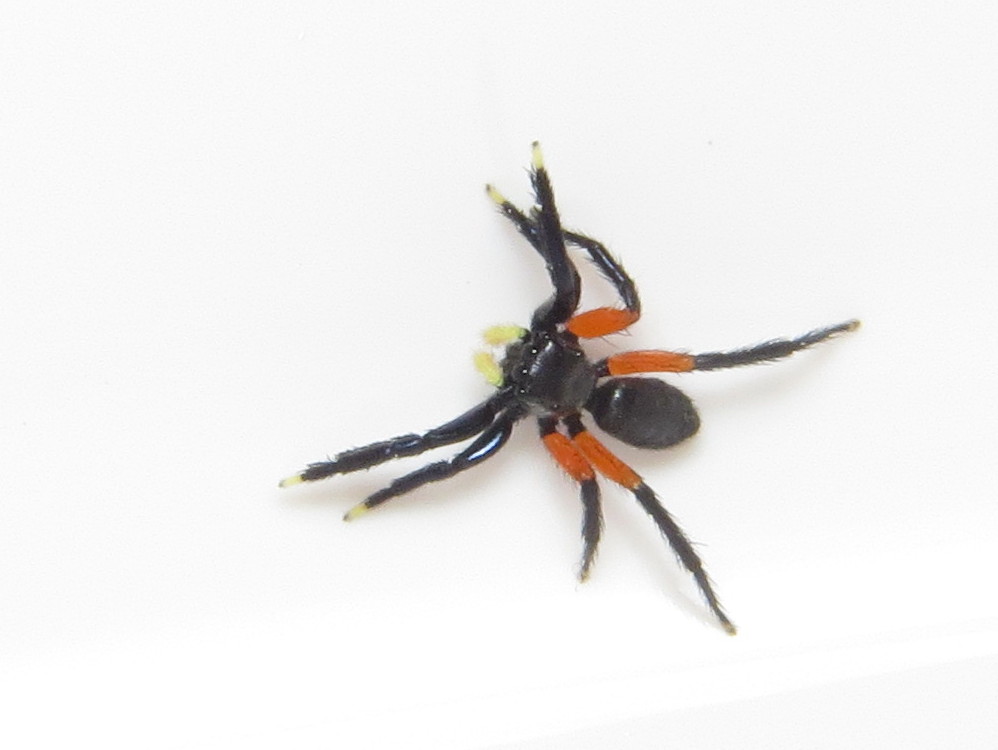
Whenever I discover a species new to me, I am compelled to illuminate the known biology of the organism for anyone who will listen, or read. This happened recently, when I encountered a little jumping spider on a sidewalk during a late afternoon walk here in Leavenworth, Kansas, USA, on August 20.

I managed to capture the creature in a plastic vial, to take home for closer observation. At the time, I anticipated that it would be an immature male in the genus Phidippus, as they are common, especially along this pathway through lawn and wannabe prairie that parallels a major street on the north end of town.

I am prone to neglecting or procrastinating in taking photos of captive specimens, so it was August 25th before I finally sat down for a spider photo shoot in the white casserole dish we have dedicated as a “studio” for insects and arachnids. I was fortunate the spider was still alive, albeit perhaps a little more slender than when I first found it.

Throughout the process of capture and photography, the spider was surprisingly slow, which is not at all like most of the fast, bouncy jumpers that I am familiar with. Viewing my photos, it became apparent that whatever this spider was, it was a mature male (fully formed terminal segment on each pedipalp); and it lacked the iridescent chelicerae (jaws) of most Phidippus species.

Puzzled, I uploaded some of the photos to my Facebook page in hopes that some of my friends who are spider experts might be able to point me in the proper direction. It was after posting that I tried looking in some of my books to see if there was anything remotely similar to my specimen. The family Salticidae is highly diverse, and not every book about spiders will include every genus, let alone species. This time I got lucky.

I soon received replies to my social media post, the first of which was from Sarah Rose, author of Spiders of North America from Princeton University Press. That field guide does not include the species she suggested: Ghelna canadensis, but I reached the same conclusion in perusing Common Spiders of North America by Richard A. Bradley. Ian Wright also suggested the genus in his comment on the Facebook post, and Alicia Lips and Dani Marie agreed. Alicia included images of a female of the species that she found on her front porch in June of this year.

Ok, more about the actual spider. The community science platform iNaturalist gives a common name of Three-lined Ground Jumping Spider for Ghelna canadensis. Somewhere I recall reading the name “Red Velvet Jumper,” but that could apply to many other species, even though it is appropriate to the color and texture of this one. Most sources offer no common name. Mature males measure 4-5 millimeters in body length, females 4.6-6.4 mm. Females are darker, gray or brownish, with indistinct markings.

This is a ground-dwelling species, unusual compared to the arboreal species in its cohort, the subtribe Dendryphantina. It occurs over much of the eastern United States, except for the southernmost tier. Data points on iNaturalist have it as far west as Minnesota in the north, and near Dallas, Texas in the south. The "Checklist of Kansas Jumping Spiders" mentions records in Douglas and Jefferson counties, but not Leavenworth. Older references may use the former name, Metaphidippus canadensis. There are also three other species in the genus Ghelna, at least one of which, G. barrowsi, also occurs in my area.

After I finished the photo session, I provided the spider with some water from the tip of a soaked cotton swab. He was thirsty! Then I took him back to where I found him, releasing him well off the sidewalk this time.

Sources: Bradley, Richard A. 2013. Common Spiders of North America. Berkeley: University of California Press. 271 pp.
Guarisco, Hank, Bruce Ctuler, and Kenneth E. Kinman. 2001. “Checklist of Kansas Jumping Spiders,” The Kansas School Naturalist 47(1): 1-13.
World Spider Catalog
GBIF
Bugguide

Sunday, May 24, 2020

A Case of Predator Mimicry in the Bee Fly Genus Epacmus? (Diptera: Bombyliidae)

In the course of photographing insects in Colorado Springs, Colorado, USA, at a nearby vacant expanse of prairie, soon to be a new housing development, I stumbled upon something interesting. Not until I got home and reviewed my images did I recognize something startling on an otherwise ordinary little bee fly in the genus Epacmus (assuming my identification is correct). Whether this has been documented before I do not know, but the phenomenon is well known in other insects.

Epacmus sp. bee fly. Nothing to see here....yet

Predator mimicry, or elusive mimicry, or aggressive mimicry, is when a prey species mimics one of its predators. This is probably a more widespread strategy than we currently recognize because we are not at the same scale as the predator and prey, and cannot easily interpret what constitutes such mimicry. We do not even enjoy the same perspective, so rarely experience the full effect.

It was not formally recognized, or at least not published, until 2006, that metalmark moths in the genus Brenthia have underside wing patterns that greatly resemble the face and legs of an oncoming jumping spider. They eye arrangement, chelicerae (jaws), and front two pairs of legs are all illustrated on the wings of the moth, when properly displayed by the insect. The moth would make an easy meal for the spider, but not if it presents the illusion that it is a spider. Evolutionary genius.

Spider mimicry is also exploited by other insects, including some fruit flies (family Tephritidae) and planthoppers (Fulguroidea). The bold patterns on the wings of some fruit flies greatly resemble the leg posture of some spiders. Some of the flies enhance the graphic imagery by moving their wings deliberately in a manner utterly convincing of a spider’s movements.

Whoah! Spider eyes and "mustache"

This brings me to the little bee fly I noticed on flowers in that prairie habitat. Viewed from above, Epacmus is an attractive, tapered, fuzzy insect about 7-10 millimeters in length, with delicate wings and something of a smiley-face pattern where the abdomen meets the thorax. Cute. Look at one directly from behind and you get an entirely different picture. Suddenly, you see the big black eyes of a jumping spider. Four black, polished, hemispherical bumps on the rear of the thorax are a perfect match for the eyes of a small salticid (jumping spider). This is reminiscent of raised features on the thorax of the Brazilian fruit fly Ceratitis alba (See Hill, David E., et al. 2019).

Habronattus sp. jumping spider stalking a Andrena sp. mining bee

Ok, so how often might the fly encounter a jumping spider? More frequently than you might imagine, even on flowers. Another photo I took of a mining bee revealed a jumping spider right on her tail. I hadn’t noticed the spider until I looked at the image later, at home. Habronattus jumping spiders are abundant in this prairie habitat, and hunt exactly where you expect to see bee flies: on the ground, vegetation close to the ground, and on flowers. The spiders are small and cryptic, easily overlooked.

Male Epacmus bee fly

What else are we missing in our observations of insects and their spider predators? Keep observing and you, too, may make a startling addition to our collective scientific knowledge.

Note: At least one world authority on bee flies (Bombyliidae) asserts that Epacmus may not be a valid genus, but a subset of the genus Aphoebantus instead.

Female Epacmus bee fly

Sources:Rota, Jadranka, and David L. Wagner. 2006. “Predator Mimicry: Metalmark Moths Mimic Their Jumping Spider Predators,” PlosOne.
Mather, Monica H. and Bernard D. Roitberg. 1987. “A Sheep in Wolf’s Clothing: Tephritid Flies Mimic Spider Predators,” Science 236: 308-310.
Hill, David E., A.P.C. Abhijith, and Joao P. Burini. 2019. “Do jumping spiders (Araneae: Salticidae) draw their own portraits?,”Peckhamia 179.1
Melander, Axel Leonard. 1950. “Aphoebantus and its Relatives Epacmus and Eucessia,” Annals Ent. Soc. Amer. 43(1): 1-45.
Hull, Frank M. 1973. Bee Flies of the World. Washington, DC: Smithsonian Institution Press. 687 pp.
Cole, Frank R. 1969. The Flies of Western North America. Berkeley: University of California Press. 693 pp.

Spider or fly?

Thursday, June 15, 2017

What a Spider!

Sometimes you find something that you think might be a major discovery, only to learn that is not the case. Does it diminish your enthusiasm for the whole experience? Not at all. That is especially true when you find something as colorful as a male of the jumping spider Euophrys monadnock. Your expertise is in fact enhanced no matter what expectations you start out with.

The morning of June 8 I found myself granted access to part of Cheyenne Mountain State Park where the public is...."discouraged" from going. It is close, too close, to NORAD installations on the mountain, an important part of national security. One of the perks of being a park volunteer is getting opportunities like this to investigate more pristine and unique habitats.

Anyway, on the ground beneath Ponderosa Pines and understory thickets of Gambel's Oak and other shrubs, I spotted a little (3-4 millimeters) jumping spider hopping over the grass and leaf litter. My initial assumption was that it had to be a species of Habronattus. Members of that genus are often about the same size, usually ground-dwellers rather than arboreal, and frequently adorned with ornate colors in the male gender. Colorado also appears to be an epicenter of Habronattus diversity. I captured the spider in a plastic vial so I could get better images later.

Imagine how puzzled I was when, back at home, an internet search could find no matches with any Habronattus species. I think I finally "Googled" something like "Salticidae, black, orange legs," and lo and behold, I got some image results for Euophrys monadnock. It was not recorded (yet) for Colorado in Bugguide, by online standby. Additional research did find several records of the species for Colorado, even of recent vintage.

The Colorado Spider Survey, based at the Denver Museum of Nature and Science* and supervised by Dr. Paula Cushing, is an amazing resource. There, I found records of this species from Roxborough State Park in Douglas County, on August 9, 2014; Upper Maxwell Falls in Jefferson County, July 29, 2010; Lump Gulch in Gilpin County, June 24, 2009; and 1.6 miles along FR 175 NW of Mt. Pisgah, also in Gilpin County, on August 10, 2009. Using the World Spider Catalog, which has PDF files of almost all the scientific publications devoted to spiders, I found perhaps the original record of Euophrys monadnock for Colorado: collected in the 1890s in "West Cliff," now spelled "Westcliffe," by Theodore Cockerell. The species is one of northerly latitudes and high elevation, found across Canada and south to California, North Dakota, Wisconsin, Ohio, and Pennsylvania, and along the Rockies.

A Wikipedia article on the species explains the species was first described in 1891 by James Henry Emerton, a preeminent arachnologist of his day. The male gender, anyway, certainly cannot be confused with any other spider. The female is more....subdued, shall we say, but that is the case for most jumping spiders where there is often extreme sexual dimorphism (graphic differences between genders).

The male makes full use of his contrasting colors in displaying to a female. He lifts his front legs, which are adorned with thick brushes of black hair. He also lifts his third pair of legs to expose those bright orange femora, and orients the fourth pair of legs such that the female can see those orange femora as well. Jumping spiders are, unlike web-building spiders, highly visual, with acute eyesight that is not approached by any other land invertebrate.

My wife and I managed to get a few pictures of this highly active spider inside a casserole dish at home, before she released the spider outside the park, but at roughly the same elevation, same habitat, and same mountain for that matter. From a scientific perspective, it is usually preferable to retain the specimen, but considering the utter uniqueness of this species, we felt it was unnecessary to sacrifice this one.

Sources: Banks, Nathan. 1895. "The Arachnida of Colorado," Annals of the New York Academy of Science. 8: 415-434.
Bradley, Richard A. 2013. Common Spiders of North America. Berkeley: University of California Press. 271 pp.
Kaston, B.J. 1972. How to Know the Spiders (3rd edition). Dubuque, Iowa: Wm. C. Brown Company Publishers. 272 pp.
Jumping spiders (Arachnida: Araneae: Salticidae) of the worldWorld Spider Catalog

Sunday, June 12, 2016

Jumping Spider, Phidippus insignarius

While exploring Cheyenne Mountain State Park on June 3, I caught glimpse of a very colorful jumping spider prowling a dead thistle stalk among some branches of scrub oak (Gambel's Oak). My first thought was it must be a male Phidippus of some kind, but I am used to them being a fair bit larger than this one was. Well, I was excited to find out later that it was indeed a male Phidippus insignarius.

The crazy thing is, I was already familiar with that species, thanks to some simply stunning images by Patrick Zephyr and Raed Ammari. I only remembered these head-on pictures, and forgot what the whole spider looked like.

I had also forgotten, or never knew, that P. insignarius is found here in Colorado. Indeed, it ranges from here east through Nebraska, Iowa, Kansas, eastern Oklahoma, Missouri, southeast Minnesota, Illinois, Indiana, Kentucky, Tennessee, Pennsylvania, southern New England, New Jersey, Virginia, and North Carolina. Look for it in the understory of open woodlands and prairies. The oak thicket with scattered pines in an otherwise grassland habitat where I found this one seems to be the ideal habitat.

P. insignarius is not a terribly large spider. Mature males average just under 5 millimeters in body length, females 5.45 millimeters. The coloration of the female, from all I can gather, is similar to the male, but without the bright white hairs on the carapace, legs, and palps. Both genders have the bushy "eyebrows" that are characteristic of many Phidippus species.

If you are all ready to go searching for jumping spiders now, consider investing in a "beating sheet," or make your own. A friend of my wife who is an accomplished seamstress, whipped one out for me in no time. We chose a heavy, durable canvas (still prone to deformation with a good stiff breeze), about two feet square. Triangular pockets in each corner receive wooden slats arranged in an "x" pattern with a screw in the center to join them.

Beating sheet in use ©knoxnews.com

The beating sheet is held under the branch of a tree or shrub, and a heavy stick or rod is used to sharply strike the branch. All manner of spiders, and insects, of course, can come raining onto the sheet. This is the best way to collect many cryptic arthropods that are seldom seen otherwise.

Sources: Edwards, G.B. 2004. "Revision of the Jumping Spiders of the Genus Phidippus (Araneae: Salticidae)," Occasional Papers of the Florida State Collection of Arthropods. Volume 11. 156 pp.
Hollenbeck, Jeff. 2007. "Species Phidippus insignarius," Bugguide.net

Sunday, May 31, 2015

Dimorphic Jumping Spider, Maevia inclemens

When I lived in Ohio I had the great honor of being introduced to Dr. George Uetz at the University of Cincinnati. At the time he had a graduate student, Dave Clark, who was doing research on the courtship behavior of the Dimorphic Jumping Spider, Maevia inclemens. Ever since then I have had a special place in my heart for this unique member of the Salticidae.

"Tufted form" male, Missouri

What makes this spider so special, you ask? The name says it all. The male of this species comes in two distinct forms: a "tufted form" that is all-black with white legs; and a "gray form" with black pinstripes and orange spots and chevrons. Not only do they look like separate species, but they behave like two different spiders, too. Each male performs a complex dance that is different from that of the other form.

"Tufted form" male, Indiana

The tufted form, named for the triple-Mohawk style hairdo, literally stands on tiptoe, dips his abdomen, and waves his front pair of legs overhead at a prospective mate. The gray form takes a "low rider" position and sidles back and forth.

"Gray form" male, Kansas

Dave Clark capitalized on those differences, as well as his expertise in video, and created animations of a tufted form male doing a gray form dance, and vice versa. He then played his mixed-up dance mix in front of live female spiders. Jumping spiders have better eyesight than any other terrestrial invertebrate, so they could actually watch, and react to, the videos on a monitor. This was back in the late 1980s, so Dave dubbed his lab "MTV" for "Maevia Television."

"Gray form" male, Kansas

The Dimorphic Jumper is a species commonly encountered in the eastern half of the U.S. where it prowls understory foliage, climbs on walls and fences, and occasionally enters homes. These are not overly large spiders, males ranging from 4.8-7.0 millimeters in body length, females 6.5-10 millimeters. Females have consistent markings, being mostly pale with a pair of orange or red racing stripes running down the back of the abdomen.

The first time I saw a tufted form male of this species, it was on a sidewalk in Cincinnati and I initially mistook it for a carpenter ant. This species is not generally considered an ant mimic, but considering that carpenter ants forage in the same places as Maevia, it is not out of the question I suppose.

Juvenile female or gray form male, Massachusetts

So what was the result of those experiments? The dance of the black form male is apparently more successful at attracting the attention of a female from a greater distance, while the dance of the gray form male is better at wooing a lady spider closer to him. You can see videos here on YouTube of both kinds of males performing. There is no word on whether the females presented with the wrong combo of male appearance and dance moves suffered psychological damage.

"Is there a female down there?"

Sources: Bradley, Richard A. 2013. Common Spiders of North America. Berkeley: University of California Press. 271 pp.
Clark, David L. and George W. Uetz. 1993. "Signal efficacy and the evolution of male dimorphism in the jumping spider, Maevia inclemens," Proc. Natl. Acad. Sci. USA 90: 11954-11957.
Guarisco, Hank, Bruce Cutler, and Kenneth E. Kinman. 2001. "Checklist of Kansas Jumping Spiders [illustrated]," Kansas School Naturalist 47(1).
Moffett, Mark W. 1991. "All Eyes on Jumping Spiders," Nat. Geo. Mag. 180(3): 42-63.

Sunday, September 14, 2014

A Jumping Spider, Tutelina similis

When my wife and I were in Atlanta back in June of this year, I had the opportunity to walk from our downtown hotel out to the Fernbank Natural History Museum along a route prescribed by one of the Google services. Taking a detour into a wooded ravine along a creek led to the discovery of a lovely little jumping spider, Tutelina similis.

Since signing a contract to do a new field guide to U.S. spiders for Princeton University Press, I have been crafting a species list. Upon first spotting a male T. similis I thought to myself: "That is not on my list. It sure is now!" I had no idea at the time exactly what it was, other than a member of the Salticidae, but its bold, attractive markings made it stand out.

What are we looking at when we stare into the face of one of these? Well, the pedipalps are the most obvious feature. Those are the short, leg-like mouthparts. In this case, they are black on the outer half, with a fringe of long white hairs on the inner half. The palps usually hide the chelicerae (jaws) unless the spider drops the palps and raises its "head" (cephalothorax). This species also appears to have "eyebrows" in the form of short black lines on the cephalothorax immediately behind the very large anterior median pair of eyes. It makes the spider appear to be in a state of perpetual surprise (or anger, depending on your viewing angle).

Despite their small size (4.0-5.0 millimeters body length), these are pretty conspicuous spiders that in this case were prowling understory vegetation about three to four feet off the ground. The sunlit patches where the deciduous tree canopy opened up seemed to be a favorite hunting ground. Indeed, insect activity peaks in these situations where flies, wasps, bees, and other potential prey bask, and defend territories.

Browsing through Bugguide.net, I was able to identify this species. My friend Troy Bartlett had even photographed a few. The overwhelming number of records on that website are from the month of June, so apparently the spiders mature at that time.

Like most jumping spiders, this species exhibits sexual dimorphism. That means that mature males differ markedly in appearance from mature females. I did not find any females myself, but below is an example of one from Hastings, Ontario, Canada, via Bugguide.net. The females are slightly larger than the males, but not dramatically so.

© Jason King

Tutelina similis is transcontinental in its Canadian distribution, and ranges east of the Rocky Mountains in the U.S. to at least Georgia and New Mexico. It has been found on mailboxes in rural Massachusetts (Edwards & Edwards, 1997), and in the seedheads of pitcher plants in Maine (Jennings, et al., 2008).

At least one population of this species in Utah was found to be a specialist predator on ants, even mimicking ants in color and behavior as it prowled over sagebrush. The front legs of these arachnids are waved about in the manner of ants waving their antennae (Wing, 1983).

It is species like this that make jumping spiders a favorite among people who study spiders. The wide-eyed stare and curious nature of salticids is enough to melt the heart of the most extreme arachnophobe, and endear them to gardeners and homeowners who might level a shoe at any other arachnid. Couple that with the extraordinary hunting skills that make jumpers heroes in the war on pests, and you have pretty much the poster child for why we should embrace spiders as a whole.

Sources: Edwards, Robert L. and Eric H. 1997. "Behavior and Niche Selection by Mailbox Spiders," J. Arachnol. 25: 20-30.
Jennings, Daniel T., Bruce Cutler, and Bruce Connery. 2008. "Spiders (Arachnida: Araneae) Associated with Seed Heads of Sarracenia purpurea (Sarraceniaceae) at Acadia National Park, Maine," Northeastern Naturalist 15(4): 523-540.
Richman, David B., Bruce Cutler, and David E. Hill. 2012. "Salticidae of North America, Including Mexico," Peckhamia 95.3: 1-88.
Wing, K. 1983. "Tutelina similis (Araneae: Salticidae): An Ant Mimic That Feeds on Ants," J. Kans. Entomol. Soc. 56(1): 55-58.

Sunday, May 25, 2014

Zebra Jumper

Last Monday, my wife and I went out to the Rocky Mountain Arsenal National Wildlife Refuge northeast of Denver. We were pleased to find a handful of specimens of the cute little “Zebra Jumper,” Salticus scenicus, family Salticidae. These wonderful jumping spiders should be abundant here, as they seem to be in most other parts of the U.S. and southern Canada, but we don’t seem to see many.

These are small spiders, adult females measuring only 4-7 millimeters in body length, males 4-6 millimeters, but their bold color pattern makes them relatively conspicuous anyway. They also like to prowl walls of buildings, fenceposts, and other vertical man-made objects. Indeed, they seem most common in urban and suburban settings where people are likely to notice them.

Adult male

Adult males and females can be easily separated from each other. Females have a more mottled appearance, the black-and-white pattern broken by streaks of beige or tan. Males are almost exclusively black and white; and they have greatly elongated chelicerae (jaws) with correspondingly long and impressive fangs. Apparently they use these massive body parts to duel with each other when competing for mates. Flaring their jaws and opening their fangs, they interlock with their adversary much like a pair of bull elk.

It is suspected that the Zebra Jumper is native to Eurasia, but has now spread across the temperate areas of the globe thanks to human commerce and travel.

Just about any insect or spider the same size as a Zebra Jumper, or smaller, is fair game. I once watched one stalk and kill a surprisingly large “greenbottle” blow fly (Lucilia sp., family Calliphoridae), on a wall in Cincinnati, Ohio. It slowly walked around the fly until it got directly behind the insect. I watched as it wiggled its abdomen, presumably laying down a launching pad of silk to anchor the ever-present dragline these spiders spin as a safety measure should they miss an intended target when leaping. The spider then leaped onto the back of the fly, pinning its wings in a way that prevented the fly from taking to the air. In a matter of a minute or so, it was all over for the fly.

Look for these charismatic arachnids on almost any vertical surface outdoors. They occasionally stray indoors, too. Mature specimens are common from April through October, males appearing earlier than females. Mating takes place early in the season, with spiderlings growing during the summer months. Subadult specimens overwinter in protected niches.

Here in the United States, Salticus scenicus ranges across the northern tier of states, south to southern California, Colorado, northern Texas, Ohio, and North Carolina.

Jumping spiders in general are very alert, with the best eyesight of any terrestrial invertebrate. They cock their heads (technically the cephalothorax) in the direction of anything that interests them. This curiosity is sometimes interpreted as aggression by the casual human observer, but these are not dangerous spiders. Enjoy their engaging personalities.

Sources: Adams, R.J. 2014. Field Guide to the Spiders of California and the Pacific Coast States. Berkeley: University of California Press. 303 pp.
Bradley, Richard A. 2013. Common Spiders of North America. Berkeley: University of California Press. 271 pp.
Buddle, Chris. 2012. “Salticus scenicus: a fashionable urban spider,” Arthropod Ecology, McGill University
Howe, Amanda, and Eric R. Eaton. 2014. “Salticus scenicus (Zebra Jumper),” Spiders.us.

Sunday, January 26, 2014

A Spider Surprise

Hardly a field outing goes by when I am not confronted by some insect or spider I have never seen before, and such was the case on October 25, 2013. I had been on a mission to take more images of Red-shouldered Bugs, Jadera haematoloma, when seeking the answer to a question I had led to an unexpected spider discovery.

My wife and I had encountered the Red-shouldered Bugs earlier, on October 21, while walking the dog on the Rock Island Trail here in Colorado Springs. The insects were all on the ground, clambering no higher than the tip of a yucca leaf blade. Why were they feeding on fallen seeds and not climbing into the trees, I wondered.

I decided to investigate further on the twenty-fifth, looking more carefully on the trunks of the shrub-like ornamental trees. Ok, there’s one bug on the trunk, still pretty close to the ground. What about higher up? Oh, my! I was startled to find a rather large jumping spider ascending the trunk. With a formidable predator like that stalking the “canopy,” I don’t blame any bugs for not venturing off the ground. Further, the leaf litter provides a cozy layer of insulation from the cold autumn weather, and the bugs were taking advantage, no doubt.

The spider really got my attention and I snapped off a couple of images in the dim light of late afternoon. I decided to capture the arachnid and take it home for closer examination and photography under more controlled conditions. I seemed to recall seeing images of this particular species previously, but a thorough search of books and articles failed to produce anything.

The more I looked, the more puzzled I became. So, I posted images in the forum at Spiders.us, where both amateurs and experts help people like me make identifications. One expert was intrigued enough that he solicited the opinion of renowned jumping spider authority G.B. Edwards. The result was a probable state record for Phidippus arizonensis. My specimen is a male, however, and Dr. Edwards suggested the remote possibility that it could be an undescribed species, the female of which has been collected in New Mexico.

Sticking with the more likely scenario, I learned that despite its name, P. arizonensis is not known from Arizona. Records exist for Mexico, New Mexico, Texas, and now apparently Colorado. I have retained the specimen, which is still alive and eating regularly. When it finally expires I will preserve it for the Colorado Spider Survey at the Denver Museum of Nature and Science.

Males of P. arizonensis average a little over 9 millimeters in body length (8.35-10.02). Females are larger (9.02-13.36 millimeters), and dramatically different in appearance. Females have an overall yellowish appearance with spots and stripes on the abdomen. The vaguely metallic blue-black color of this male is pretty typical; and this is the only species in which the fringe of hairs on the front legs is entirely yellow in color.

Historical collection records indicate this species is most often found in the understory of oak woodlands at elevations between 5,000 and 7,000 feet. Colorado Springs is at 6,025 feet; and indeed the natural habitat in which I found this specimen is a sandstone ridge dominated by Gambel’s Oak that is stunted into tall shrubs.

When you are out looking for arthropods, pay attention to your “gut.” If something looks odd, out of place, or otherwise intriguing, there is a good chance it is worth paying closer attention to. Our collective knowledge of the habits, distribution, and abundance of invertebrates in general is pretty weak, and your spotting could be invaluable.

Source: Edwards, G.B. 2004. “Revision of the Jumping Spiders of the Genus Phidippus (Araneae: Salticidae),” Occasional Papers of the Florida State Collection of Arthropods Vol. 11: 1-156.

Sunday, December 8, 2013

Pantropical Jumping Spider

This week, if you live pretty much anywhere north of Mexico, a tropical vacation sounds pretty appealing. Well, if you were a Pantropical Jumping Spider, Plexippus paykulli, you would probably be enjoying yourself right now. This species is a world traveler, now dispersed to most tropical and subtropical climates across the globe. Envious?

Male

The Pantropical Jumper is pretty easy to find, too, since it hangs out on the exterior of buildings where it can be quite conspicuous. The only problem might be telling it apart from the Gray Wall Jumper which is often seen on buildings, too. Both species are of similar size. Adult females of the Pantropical Jumper are 10-12 millimeters in body length; males average 9.5 millimeters.

Female

Plexippus paykulli is also sexually dimorphic, meaning that the male gender looks radically different from the female sex. In fact, it would be easy to assume they are two different species. This is typical of many jumping spiders: the males are adorned with colorful scales, or tufts of hair on their legs and/or pedipalps which are used to communicate with the female through elaborate displays, often accompanied by vibrations carried through the substrate (surface on which the spiders are sitting).

Male

Pantropical jumpers don’t sit on the beach sipping fruity drinks. Nope. They actively seek prey by day, including small moths, flies, flying ants, and even other spiders. They have the typical behavior of most jumping spiders in the family Salticidae, running a short distance, pausing, pumping their pedipalps up and down, and turning to face whatever piques their curiosity (or perceived threat).

Mated females of this species spin a small, flat egg sac about nine millimeters in diameter that contains anywhere from 35-60 eggs. A larger silken envelope, 25-35 millimeters around, covers the egg case and serves as a retreat for the female to guard her future offspring. Look for these nurseries under eaves of buildings, in cracks and crevices, or under boards and other objects.

Female

Here in the United States, Plexippus paykulli can be found year-round in South Carolina, Georgia, Florida, the Gulf Coast states, and south Texas. Outlying populations in New Mexico, and north along the Atlantic seaboard are probably the result of accidental introductions. You are also likely to see this spider in such exotic locales as Hawaii, Hong Kong, India, Greece, and parts of Africa. It is assumed that the species is native to southeast Asia.

The Pantropical Jumping Spider should be considered an asset to any resort, hotel, or motel, for they are literally a mobile pest control service. They are known to hunt mosquitoes and small cockroaches among other pests. I guess you would call that a “working vacation.”

Male

Sources: Bradley, Richard A. 2013. Common Spiders of North America. Berkeley: University of California Press. 271 pp.Edwards, G.B., Jr. 2002. “Jumping Spiders,” Featured Creatures. Division of Plant Industry and University of Florida.
Gaddy, L.L. 2009. Spiders of the Carolinas. Duluth, MN: Kollath+Stensaas Publishing. 208 pp.
”Pantropical Jumper,” iNaturalist.