Thursday, March 21, 2013

OrThoptera Thursday: Northern Green-striped Grasshopper

No sooner has the grass sprung up in the early spring than there are insects out to eat it. Walk through an open field or meadow and you may be surprised to find that you are startling grasshoppers into flight already. At least they will be hopping. Several species of grasshoppers (family Acrididae) overwinter as older nymphs and mature quickly once temperatures warm consistently and the days lengthen. One of those early season species is Chortophaga viridifasciata, the Northern Green-striped Grasshopper.


Adult female, Colorado Springs

Last year in Colorado Springs I found nymphs of this species along an urban trail on March 10; and adults in an open field on March 27. This year, which has seen a rollercoaster of temperature extremes, I suspect they will mature later.


Nymph, Colorado Springs

Chortophaga viridifasciata is rather variable in color and pattern, which makes it difficult for the average person to identify. Its early appearance is one clue. A distinguishing physical feature is the pronotal ridge, which is strong, straight, and broken by only a single sulcus midway along its length. The pronotum is the top surface of the thorax, and the ridge runs right down the middle, lengthwise. In profile, the ridge is evenly straight. It is at least somewhat arched in early season Arphia species.

Females of the Northern Green-striped Grasshopper are larger (28-38 millimeters) and heavier-bodied than males, and are usually green with brown markings. Males (23-30 millimeters) are mostly brown with few if any green markings. Below is an image that shows males from the same population can still be brown or green.

When the grasshopper flies, the hind wings are exposed. They are pale yellow in color at their base, with the outer half smoky brown to nearly black. This also contrasts with similar Arphia species that have the hind wings bright yellow, orange, pink, or red. Flight covers a short distance, but may be noisy. Male band-winged grasshoppers in general (subfamily Oedipodinae) are capable of making “crepitation flights” whereby the front and hind wings snap together rapidly to make a crackling noise. This is accomplished at the grasshopper’s will, so other flights can be silent. Crepitation flights are often associated with courtship displays, but not always, and females of some species can crepitate as well.


Male from South Carolina

C. viridifasciata is an abundant grasshopper found east of the Rocky Mountains from southern Canada to northern Central America. It also creeps into Arizona and Idaho, with scattered records in extreme southeast British Columbia. The preferred habitat is wet areas with short grass. While there is only one generation in most of its range, there can be two generations in southern areas, where the adults can overwinter.

Southern populations have been considered a separate species, C. australior, but there is reason to suspect this is an artificial distinction. The “two” certainly overlap as far north as the Ohio River Valley and Nebraska. Where there are two generations of C. viridifasciata, the later generation tends to resemble C. australior. Many authorities still separate the two, with C. australior confined in its range to the southeast from Georgia to Florida and west to east Texas.

The only other species in this genus are C. Mendocino, found in Mendocino County, California; and C. cubensis found in Cuba.


Male from western Massachusetts

Be on the lookout for this grasshopper where you live. Even in New England they are likely to be out by the end of May at the latest, and March or April in most other locations.

Sources: Capinera, John C., Ralph D. Scott, and Thomas J. Walker. 2004. Field Guide to the Grasshoppers, Katydids, and Crickets of the United States. Ithaca, NY: Comstock Publishing Associates (Cornell University Press). 249 pp.

DiTerlizzi, Tony and Dave Ferguson. 2012. “Genus Chortophaga,” Bugguide.net.

Tuesday, March 19, 2013

True Bug Tuesday: Exporting the Western Conifer Seed Bug

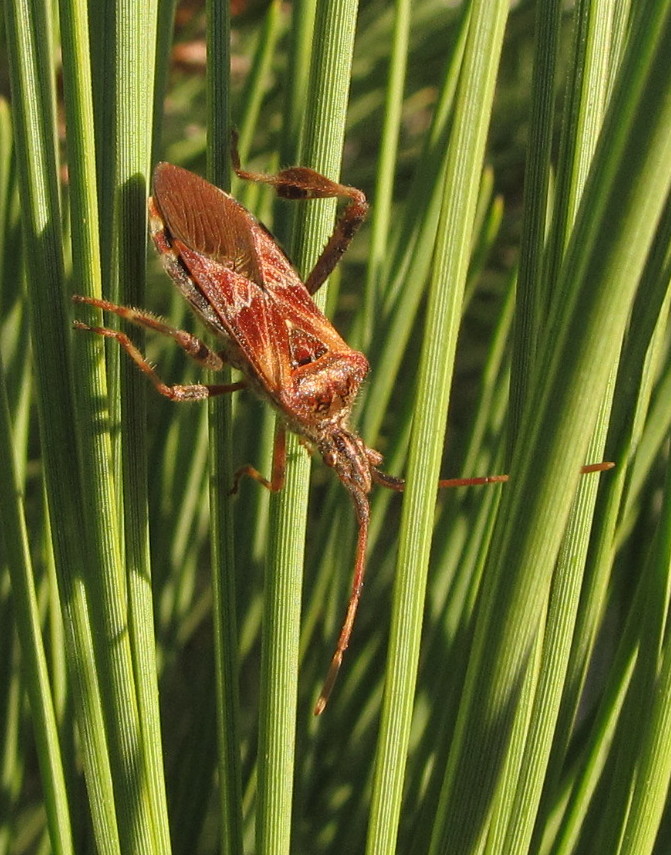
We spend a great deal of time and energy in the U.S. wringing our hands over invasive species from Europe and Asia, but we forget we sometimes export our own pests in return. Last week, a thread emerged on the Entomo-l listserv from a doctoral student in France who inquired about how to control the Western Conifer Seed Bug, Leptoglossus occidentalis. Seems it was first detected in Europe in northern Italy in 1999, but has since spread through most of the continent. It was first found in the United Kingdom at Weymouth College in Dorset in January, 2007.

This rapid colonization should come as no surprise. Here in its native North America, the WCSB has shown the same propensity for expanding its range. Once confined to the western U.S., it began creeping eastward in the 1950s. By the 1990s it had reached the east coast.

Leptoglossus occidentalis is generally considered at most a nuisance pest that likes to spend the winter inside homes where it emerges at inopportune times, flies with a loud droning noise, and produces a disagreeable (to some people at least) odor when accosted.

The conversation on Entomo-l revealed that the bug is not always so innocuous. It has beak-like mouthparts and it can pierce polyethylene (PEX) tubing used in plumbing and radiant heating. The bugs secrete a protein in their saliva that forms a protective sheath around their mouthparts while they feed, and this sheath is left behind as evidence. Hence, investigators were able to sleuth the culprit in the case of the “weeping” pipes that lose water through the pinhole punctures caused by bugs exploring novel surroundings (Bates, 2005).

Obviously, a much more pressing concern for our friends abroad is the prospect of WCSB becoming a forest pest. They feed on seeds inside the cones of conifers, especially pines but also Douglas Fir and Eastern (Canadian) Hemlock. They rarely cause significant damage in natural stands, but are a potential problem in conifer seed orchards.

Indeed, laboratory studies show that late-season feeding in particular can have adverse effects, reducing the storage reserves of lipids and buffer-insoluble (crystalloid) proteins by up to 78% and 97% respectively in seeds of Douglas Fir (Bates, et al., 2001). WCSB certainly impacts second-year cones in orchards. Seed production can be reduced by 75% in Lodgepole Pine under some circumstances (Bates, et al., 2002).

Our collective desire for “free” trade and global commerce guarantees that we will continue to exchange fauna and flora that could become problematic outside their native regions. Are we properly informed of the risks? One is left to wonder about the consequences.

Sources: Bates, Sarah L., Cameron G. Lait, John H. Borden, and Allison R. Kermode. 2001. “Effect of feeding by the western conifer seed bug, Leptoglossus occidentalis, on the major storage reserves of developing seeds and on seedling vigor of Douglas-fir,” Tree Physiol. 21: 481-487.
Bates, Sarah L., Ward B. Strong, and John H. Borden. 2002. “Abortion and Seed Set in Lodgepole and Western White Pine Conelets Following Feeding by Leptoglossus occidentalis (Heteroptera: Coreidae),” Environ. Entomol. 31(6): 1023-1029.
Bates, S.L. 2005. “Damage to common plumbing materials caused by overwintering Leptoglossus occidentalis (Hemiptera: Coreidae),” Can. Entomol. 137: 492-496.
Taylor, Steven J., Gluseppi Tescari, and Mauro Villa. 2001. “A Nearctic Pest of Pinaceae Accidentally Introduced Into Europe: Leptoglossus occidentalis (Heteroptera: Coreidae) in Northern Italy,” Ent. News 112(2): 101-103.

Monday, March 18, 2013

Moth Monday: Hubbard's Silkmoth

Southern Arizona is blessed with some of the most attractive moths in the U.S. One of the more subtle beauties is a member of the giant silk moth family Saturniidae. We tend to think of the spectacular Luna Moth, Cecropia Moth, or Polyphemus Moth as popular examples of that family, but many species are much smaller. Hubbard’s Silkmoth, Syssphinx hubbardi, has a wingspan of only 56-76 millimeters, females at the higher end of the spectrum.

The overall gray color might make it seem to be rather drab, but the hind wings are bright pink, exposed when the moth is startled. The males are often attracted to lights at night, even in urban areas like Tucson.

The caterpillars are the truly colorful life stage for this species, but still amazingly cryptic. The natural host plants are Catclaw Acacia (Acacia greggii variation wrightii), Honey Mesquite (Prosopis glandulosa), and Little-leaf Palo Verde (Cercidium microphyllum). The larvae feed actively at night, and can be observed with a flashlight. Young caterpillars sit individually on the underside of leaf petioles and feed on the leaf bases. Older caterpillars cut the petiole and bend the leaves downward to access more of the foliage. Some larvae can proceed from egg to pupa in under three weeks, while others, even from the same batch of eggs, take longer.

Mature larvae are around 55 millimeters in length. They pupate underground in a cell at a shallow depth, where they spend the winter. The adult moths emerge in the early evening and begin seeking mates between 11 PM and 2 AM. There is one generation each year throughout most of its range, with the adult moths on the wing between June and September, especially in July and August. Populations in Texas may have multiple generations as evidenced by adults found at lights in November.

The geographic range of Hubbard’s Silkmoth is central Texas west through southern New Mexico and Arizona to southern California, in the mountain ranges of northeastern San Bernadino County. It also occurs in Mexico south to Veracruz, where it is even more common.

There is quite a cottage industry in rearing silk moths, and much of our knowledge of the various species comes from the community of moth enthusiasts who keep careful records and experiment with alternate host plants. Those who have kept Syssphinx hubbardi note that the caterpillars will accept Honey Locust, Black Locust, and Jerusalem Thorn as well as their native favorites.

It should be noted that many references use the genus name Sphingicampa instead of Syssphinx for this species. The adult moth imaged at the top of the page was found in Rio Rico, Arizona on July 30, 2011. The other moth and the caterpillars were found in Florida Canyon near the Santa Rita Experimental Range research station on September 3, 2011. Note that individual caterpillars are highly variable in color and pattern; and larvae of the closely-related Syssphinx Montana are nearly identical and difficult to separate from S. hubbardi in the field or by photos.

Sources: Boone, Mike, et al. 2005. Moth Photographers Group. Mississippi Entomological Museum, Mississippi State University.Oehlke, Bill. 2004. “Sphingicampa hubbardi (Dyar, 1902),” Silkmoths.bizland.com
Butterflies and Moths of North America
Powell, Jerry A. and Paul A. Opler. 2009. Moths of Western North America. Berkeley: University of California Press. 369 pp.

Sunday, March 17, 2013

Spider Sunday: Prowling Spiders, Syspira

A great many spiders of other families strongly resemble wolf spiders, creating lots of confusion among those of us who are not experts. Add to that the fact that even males of web-spinning spiders wander in search of mates, sometimes blundering indoors in their quest for the opposite sex, and you can be easily perplexed. I found one non-wolf spider in Arizona that stymied me for quite some time until an expert solved the mystery.

Many wolf spiders are marked with broad, dark, parallel stripes on the carapace (top of cephalothorax), but so are grass spiders (Agelenidae), many ghost spiders (Anyphaenidae), wandering spiders (Ctenidae), and false wolf spiders (Zoropsidae). The specimen above matched none of those, and/or was not in the known geographical range for any of those families. Imagine my surprise when the verdict turned out to be the family Miturgidae, collectively known as “prowling spiders.”

The name fits the habits of these active arachnids, but I was only familiar with the longlegged sac spiders in the genus Cheiracanthium, which look nothing like the above specimen. Sure enough, it turns out the genus Syspira is common in the southwest U.S. from southern California to west Texas, and also desert areas of Mexico.

These are not terribly small spiders, either, body length varying from 10-18 millimeters, though most are on the short end of that spectrum. They have a decidedly “leggy” appearance and can span about 35 millimeters or so. Most of the ones I have seen have been prowling at night around outdoor lights, both on the ground and on walls where they grab unsuspecting moths and other insects attracted there.

There are either three or four species of Syspira currently recognized. One of them, S. pallida, might actually be a member of the genus Zorocrates, which is in an entirely different family: Zorocratidae. Yes, that is just how challenging spider taxonomy can be, even to the authorities. The general consensus is that a revision of this genus is overdue.

One study found that Syspira spiders accounted for almost half of all ground spiders in Baja California Sur, Mexico; and that they are occasionally eaten by rodents (Castañeda, et al.).

The specimens shown here are from the Tucson Mountain Park west of Tucson (Pima County), July 23, 2011; Rio Rico, Arizona (Santa Cruz County), July 25 and 30, 2011.

Note that in older references the family Miturgidae is part of the family Clubionidae. The subfamily Miturginae was given family status in 1967 by P.T. Lehtinen (Ubick, et al., 2005).

Sources: Chamberlin, Ralph V. 1924. “The Spider Fauna of the Shores and Islands of the Gulf of California,” Proc. Calif. Acad. Sci. 12(28): 561-694.Nieto-Castañeda, Irma Gisela, María Luisa Jiménez-Jiménez, and Isaías H. Salgado Ugarte. “Using Stata to anzlyze size frequency in the life cycle of a Mexican desert spider,” (alternate title: “Partitioning between syntopic congeners? A case of desert spiders”), Stata.com.
Richman, David B., David Allen Dean, Sandra Brantley, and Bruce Cutler. 2008. “The Spiders of the Arid Southwest,” New Mexico State University.
Ubick, D., P.E. Cushing, and V. Roth (eds). 2005. Spiders of North America: an identification manual. American Arachnological Society. 377 pp.