Sunday, November 24, 2013

Teachable Moment

I may owe my fascination for natural history to my kindergarten teacher. She was a gifted artist and to this day I recall her very accurate chalkboard drawing of a “torpedo spider” (trapdoor spider). My high school biology teacher only reinforced my interests, even giving me a copy of Essig’s Insects and Mites of Western North America that I still treasure. So, I have the utmost admiration, respect, and love for teachers. A story shared recently on Facebook left me in utter awe. It is one thing to teach subject matter, but another to teach values, especially when confronted with a situation where you could easily react a different way.


© Olivia Kittle

Olivia Kittle teaches science at an elementary school in Ohio, but she is not terribly fond of spiders. She managed to keep her composure in brilliant fashion during a recent arachnid encounter, and relates the events in dramatic and inspiring fashion:

”I didn't particularly want a large spider on my desk all morning. Nope. I didn't plan for it and certainly didn't anticipate it. ....wasn't part of the lesson plan.

Middle of second period, I am standing in front of the room, teaching. I am mid-sentence when I see it. The spider is scurrying across the front of the room, albeit at a slow pace. I stop talking; the kids follow my eyes. They see it too.

Tick tock, tick tock, tick tock..... time stood still. TWENTY-FOUR pairs of eyes on me. Watching me. Studying me. ‘What will she do?,’ they collectively thought to themselves.

No big deal. I grabbed the first cupped item I saw, which happened to be the saucer from my pan balance. Trapped the spider. Found a spare habitat container. Grabbed a piece of paper, maneuvered the paper under the saucer, wrapped the sides of the cup with the paper, transferred the entire apparatus to the habitat, slowly removed the paper, and watched the spider.... do nothing. It just sat there, pleading for its life.

*Whew*. Never let 'em see you sweat!! When it was all over, we took a deep breath. Some kids were fascinated, others were noticeably terrified, and some were just downright curious.... BUT, we all admitted, the experience was exhilarating and a bit of an adrenaline rush.

..... Killing it would have been anticlimactic and a downer. Dead spiders are just squashed and lifeless. Nothing fun or thrilling about that.

"Just squash it", you say? Nah..... not with 24 pairs of impressionable eyes staring at me. That'd make me a bit of a hypocrite. Kids, I try real hard to be authentic. What you see is what you get.”

I am hoping that other adults who read this story stop and think of the examples they set for children when they encounter other life forms. How do we treat other organisms? Do we treat them with curiosity, respect, and reverence? Or, do we smite them with a shoe, shoot them, or otherwise communicate the idea that some creatures don’t deserve their place in the grand scheme of things?

We don’t get to choose what other species exist on the planet Earth with us. We can only choose how we think and behave. My hat is off to those who teach, by profession or passion or both, the difference. Bravo, Olivia!

Friday, November 22, 2013

Robber Fly: Heteropogon macerinus

Happy “Fly Day Friday.” Robber flies in the family Asilidae have to be among the most compelling of all insects, as evidenced by the many professional and amateur entomologists who study them. They are diverse in appearance and behavior, and yet there is still much to be learned about them.

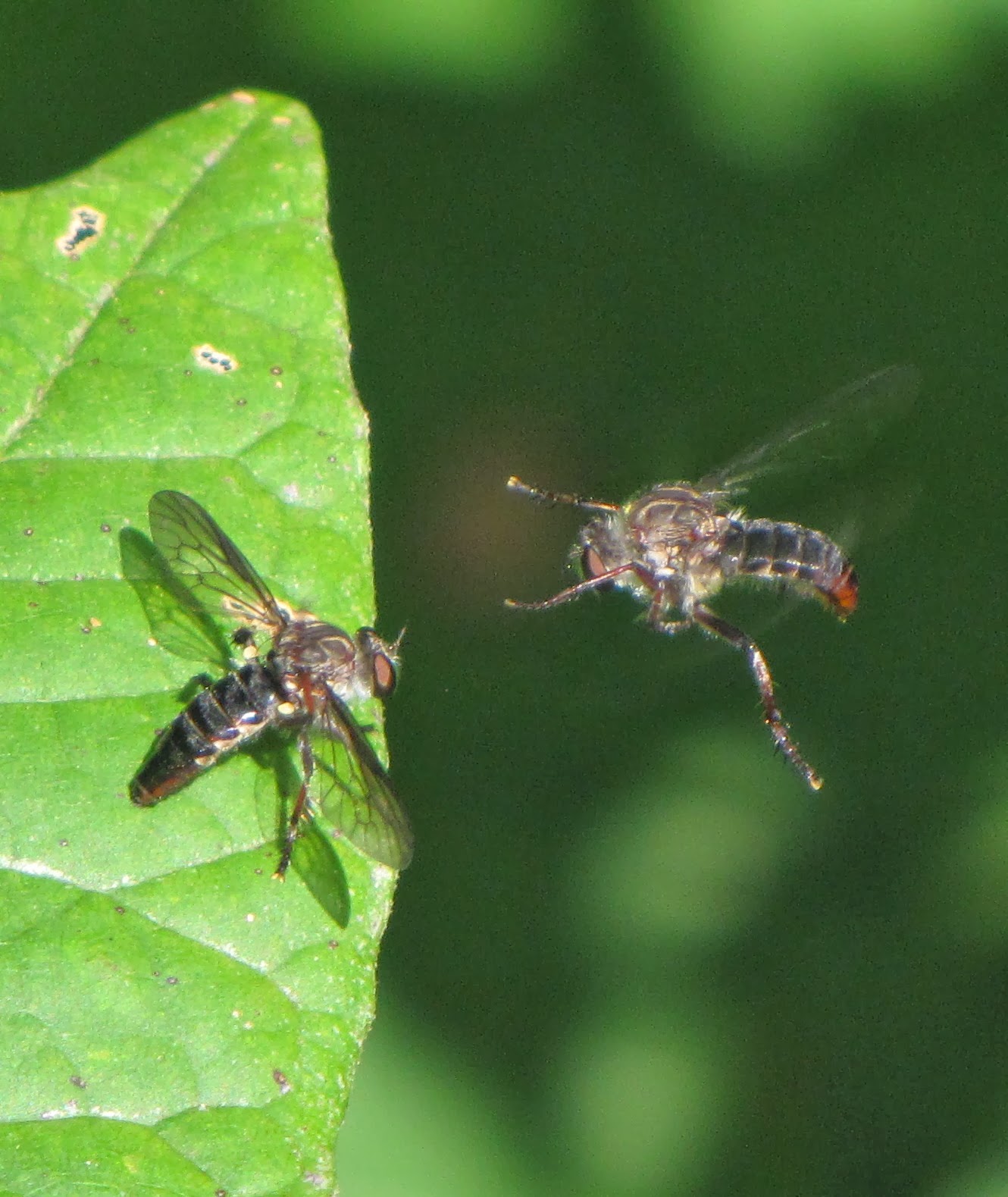
This past August I had occasion to visit southern Ohio, and in several places I found specimens of the species Heteropogon macerinus. They are not terribly large, about 10 millimeters long or so, and fairly drab in appearance as you can see from the images here. They are fairly easy to spot, however, because they tend to frequent forest edges where they habitually perch on the tips of twigs at about eye level.

Robber flies like these remind one of flycatchers in the world of birds. They survey the world from their perch, cocking their head this way and that when an insect passes by. Should a flying bug seem to be a potential meal, the robber fly dashes out, grabs its victim, and returns to its perch to feed.

Robber flies have piercing-sucking mouthparts much like a mosquito, but shorter, stouter, and used to prey on other insects, not to feed on the blood of vertebrates. What is visible to us is the sheath that houses the stylets that do the actual piercing, so while it appears that a robber fly has a thick, knife-like beak, the killing and feeding machinery is virtually hair-like.

Asilids have an uncanny ability to find the weak spots in another insect’s armor, and quickly thrust their mouthparts into those areas. Some species go for the “neck,” stabbing through the thin and flexible exoskeleton that joins the head and thorax. Some are able to drive their stylets into the membranes between abdominal segments; or in the seams between various segments of the thorax as this H. macerinus has apparently done to a winged ant in the image below.

What really got my attention was a courting pair of Heteropogon macerinus that my wife and I spotted at the edge of a cemetery in Lynx, Ohio on August 25, 2013. The tarsi (“feet”) on the front legs of male Heteropogon species are at least slightly decorated with ornamental setae (“hairs”), and he uses these “bracelets” to full advantage. Norm Lavers, on his own robber fly website, describes their behavior most eloquently:

”If you are lucky enough to see the courtship, that will put the identification out of doubt….they all seem to do it the same way. The female makes herself visible by sitting on a twig usually rather high in the air, on the top of a sapling or tall bush. The male hovers before her, his hind legs out wide to the side, perhaps to show off the red coloring. The female responds by throwing up her hind legs (whether that means yes or no I don't know). If the male is allowed to get close enough, he begins stroking her eyeballs with his front claws while he is still hovering, a delicate operation, one presumes. If she likes him, she will eventually let him sit down beside her, where after a while one thing leads to another.”

Fortunately, another person in our party remarked that it would be wonderful to have a video of the aerial dance we were watching there in Ohio, and I remembered my camera has video capabilities. Here is the resulting….pixelage?

Is it any wonder why entomologists become enamored with asilids? The life history of the majority of species remains a mystery. The larval stage of those few that are known seem to be external parasites of beetle grubs, or the larvae of other insects. Your own observations could yield vital new information as to predator-prey relationships, and/or larval hosts.

I have yet to find any place in North America that does not have a pretty diverse assemblage of robber flies, so I challenge you to go looking, even in your own backyard. I will also bet you are likely to get addicted to these charismatic flies once you find them.

Sources: Hull, Frank M. 1962. Robber Flies of the World: The Genera of the Family Asilidae. Washington, DC: Smithsonian Institution Bulletin 224, Parts 1 and 2. 907 pp.
Lavers, Norman. 2007. “Asilidae: Stenopogoninae,” The Robber Flies of Crowley’s Ridge, Arkansas.
Preston-Mafham, Rod and Ken. 1993. The Encyclopedia of Land Invertebrate Behavior. Cambridge, MA: The MIT Press. 320 pp.
Raney, Herschel. 2009. “Heteropogon Page,” Random Acts of Nature.

Tuesday, November 19, 2013

Dinosaur Bug

Few insects cause more head-scratching bewilderment or jaw-dropping awe than adult Wheel Bugs, Arilus cristatus. They look like the offspring of a beetle and stegosaurus with that remarkable cog-like crest on the top of their thorax. These strange “dinosaur bugs” are members of the assassin bug family Reduviidae. While they should be welcomed in the garden as predators of pest insects, they should be treated with respect, too.

Wheel Bugs begin life looking much like other true bugs because they do not have the big crest until they reach adulthood. Young Wheel Bugs are black with a bright red abdomen. You will likely see them crawling about on foliage individually. Similar true bug nymphs, like leaf-footed bugs (family Coreidae), are usually seen in groups.

Wheel Bug nymphs go through five instars (the intervals between molts), gradually losing their bright colors and becoming covered in silvery hairs that give them a coarse, grizzled appearance.


They become larger in size with each molt, and acquire wing pads that will transform into fully functional wings as adult insects. All this time they are stalking other insects as prey, moving in a slow, methodical, deliberate manner that may only amplify the “creepiness” factor for someone prone to fear or dislike insects in general.

The final transformation from nymph to adult, accomplished in the last molt, is a dramatic one. A freshly-emerged adult Wheel Bug is a stunning pink or orange in color, and that trademark crest is now apparent. Two sets of wings are now fully developed. As its new exoskeleton hardens, the insect becomes darker, becoming gray and/or brown.

All assassin bugs use beak-like mouthparts to pierce their prey, injecting paralyzing venom and digestive enzymes into their victim. The internal tissues of the prey are liquefied by this chemical cocktail, and then withdrawn by the assassin through the same channels in its beak. Wheel Bugs are capable of taking prey larger than themselves, but small beetles and moths are among their favorites.

It is not a good idea to handle Wheel Bugs because they can deliver an excruciating bite in self-defense. They may deploy other behaviors to startle potential attackers, too. Assassin bugs have a groove in their “chest” that is flanked by ridges. Their beak normally rests inside this groove, but if alarmed the bug can bob its head vigorously, raking the tip of the beak across those ridges to make a very audible squeaking sound.

Besides making noise, female Wheel Bugs can evert a pair of stink glands from the tip of the abdomen to repel a predator. The glands are large and bright red, creating quite the visual display as well as a fragrant deterrent.

Arilus cristatus is a large insect, adult males being up to 28 millimeters in body length and females up to 32 millimeters. Females have a wider abdomen than males, when viewed from above.

Adult Wheel Bugs are seen most often in late summer and fall, earlier in more southerly latitudes. The species is found from eastern New Mexico north and east to Kansas, Iowa, southern Michigan, and southern New England. It is perhaps most abundant in the southeast states; it also occurs in Mexico.

Mated female Wheel Bugs lay their eggs in distinctive hexagonal masses. The number of eggs in such a cluster varies from about forty to 180. Look for the egg masses on tree trunks and other vertical surfaces where they will overwinter, protected by a shellac-like coating that insulates them from harsh weather, parasites, and other potential mortality factors. Nymphs hatch the following spring.

This is one of the “mystery bugs” I am most often asked about. It is so distinctive that even the most minimal description is enough to determine what the person is talking about. I like that people are curious about this species, and appreciate the opportunity to enlighten them about the unique biology of these predators.

Sources: Eaton, Eric R. 2003. “Amazing Assassins,” Missouric Conservationist. 64(6): 24-27.
Hoffman, Richard L. 2006. Assassin Bugs of Virginia. The Insects of Virginia Number 15. Martinsville: Virginia Museum of Natural History. 74 pp.
Mead, F.W. 2011. “Wheel Bug, Arilus cristatus (Linnaeus) (Insecta: Hemiptera: Reduviidae),” University of Florida IFAS Extension.
Slater, J.A. and R.M. Baranowski. 1978. How to Know the True Bugs. Dubuque, Iowa: Wm. C. Brown Company Publishers. 256 pp.

Sunday, November 17, 2013

Green Lynx Spider

My wife and I recently returned from a road trip to the southern tip of Texas, November 4-ll. One of the spiders we encountered most frequently was the Green Lynx Spider, Peucetia viridans. Several of the specimens we found were females guarding egg sacs.

The Green Lynx is atypical of other lynx spiders in the family Oxyopidae in being much, much larger than average. Adult females may reach 26 millimeters, with a legspan of 70 millimeters, though the typical size range is 14-16 millimeters in body length. Males are only slightly smaller. Most specimens are indeed bright green, though many individuals from the southwest U.S. can be yellowish or even brown, the better to blend in with drier vegetation.

Green Lynx Spiders are agile and can actively pursue prey by running and even jumping, but most of the time you find them sitting motionless among flowers or foliage where they can ambush insects like bees, wasps, and caterpillars. They are also not averse to eating their own kind, as demonstrated in the image below.

I have seen many individuals, both adults and juveniles, on prickly pear cacti (Opuntia spp.), where they are protected from many of their own predators while supplied with prey that visit the flowers or seek shelter on the shady side of the cactus pads.

The scientific literature states that Peucetia viridans does not spin a web, but my own observations reveal that females at least construct what could be described as a “nursery web” around the vicinity of their egg sac. The spiderlings that emerge from the sac may add their own silk strands to the web. Images I have of other specimens show a weak network of silken lines that may help anchor the spider to the substrate should it encounter strong, struggling prey.

The egg sacs of Green Lynx Spiders have a surprising array of predators, so it is no surprise that the mother spider vigorously protects her offspring from danger. One study showed that the longlegged sac spider Cheiracanthium inclusum is a major threat to egg sacs and the spiderlings that hatch from them. Other predators include acrobat ants (Crematogaster sp.), soldier beetle larvae (Chauliognathus pennsylvanicus), and even grasshoppers and tree crickets (Willey and Adler, 1989).

Each egg sac contains between 25 and 600 eggs. The bowl-shaped sac averages 12-25 millimeters in diameter but can be easily embraced by the female’s legs. Females in captivity have produced up to six egg sacs during their lifetime.

Female Green Lynx Spiders are known to spit venom from their fangs to repel perceived attacks by scientists studying them, and probably perform this behavior in the face of threats from other vertebrate predators and/or large invertebrates (Fink, 1984).

Despite their large size as adults, these are highly cryptic spiders, so look carefully to find them. They seem to prefer fields, forest edges, and arid habitats, from Maryland to Florida and across the southern third of the U.S. to California. There is an additional species in the southwest, P. longipalpis, that can be easily confused with P. viridans. It requires examination of the mature sexual organs to tell them apart.

Enjoy hunting for the Green Lynx. It is a truly beautiful and photogenic arachnid.

Sources: Bradley, Richard A. 2013. Common Spiders of North America. Berkeley: University of California Press. 271 pp.
Fink, Linda S. 1984. “Venom Spitting by the Green Lynx Spider, Peucetia viridans (Araneae, Oxyopidae),” J. Arachnol. 12: 373.
Willey, Marianne B. and Peter H. Adler. 1989. “Biology of Peucetia viridans (Araneae, Oxyopidae) in South Carolina, With Special Reference to Predation and Maternal Care,” J. Arachnol. 17: 275-284