Showing posts with label assassin bugs. Show all posts

Sunday, August 23, 2015

One of my Articles Won an Award?

Having "Google Alerts" on my name and blog title provided an unexpected bonus last week. It turns out that one of my magazine articles won an award from the Association for Conservation Information. The award was for first place in the "Magazine Wildlife Article" category, and awarded to Wonderful West Virginia magazine. My article "Stealth Hunters," about assassin bugs, took the prize.

© WVDNR

Curiously, the Google Alert was to a television news story that mentioned me by name. The award itself did not. However, Wonderful West Virginia changed publishers and staff recently, so that may account for why they never notified me themselves.

The full slate of awards is available for viewing in this PDF

I honestly don't think about potential accolades when I am writing. I strive to write captivating, informative, and understandable prose of a quality that I am proud to put my name on. Feedback from readers and blog followers is even more appreciated than recognition in the "red carpet" sense. I have peers who I think far exceed me in skill, knowledge, and initiative, and I hope they are recognized and appreciated, too. It literally "takes a village" to spread the word about fauna, flora, and the need to conserve habitats.

Tuesday, September 2, 2014

Sundew Assassin Bugs: Zelus

Your garden is full of amazing predators, easily overlooked among the foliage and flowers. No matter where you live in the U.S. and southern Canada, save perhaps for the northern Rocky Mountains, you probably have sundew assassin bugs of the genus Zelus lurking in the yard. These leggy insects move slowly about, or wait in ambush for potential prey.

Zelus luridus female, Colorado

There are currently five recognized species of Zelus north of Mexico, most with wide geographic distributions. Few are readily identifiable to species just by looking at them, but common ones include: the lovely green Zelus luridus with a sharp spine on either side of its thorax; the bright red and black Milkweed Assassin Bug, Z. longipes found in the southeast U.S.; and the non-descript Z. tetracanthus with its four small "knobs" across the top of its thorax. The Leafhopper Assassin Bug, Z. renardii, is common in the southwest U.S. and has been entertained as a potential biocontrol agent for pest reduction in agricultural settings.

Zelus longipes, South Carolina

Sundew assassins get their common name from the unique physiology that allows them to catch prey. While ambush bugs have extremely muscular front legs that snap shut on prey with stunning force, sundew assassins look like the 90-pound weakling by comparison. Their appendages are thin and seemingly delicate or flimsy. The tibiae ("shins") of the front legs (and to some degree the middle legs) are densely covered in short hairs, and this is part of their secret weapon.

Zelus tetracanthus, Colorado

Special glands in the exoskeleton of the legs secrete a glue-like material that that the insect intentionally smears over those hairs. This creates a sticky layer that small prey cannot escape from once the assassin grabs them. The prey-catching scenario is analogous to the insect-eating plant known as the sundew, which inspires the name "sundew assassin bugs."

When they hatch from the egg, nymphs do not have the ability to produce the glue they need. No matter, mom has covered the egg cluster in sticky goo to help repel egg parasites like tiny wasps, and the nymphs simply wipe their "arms" along the base of the egg mass to gather some glue (Weirauch, 2006).

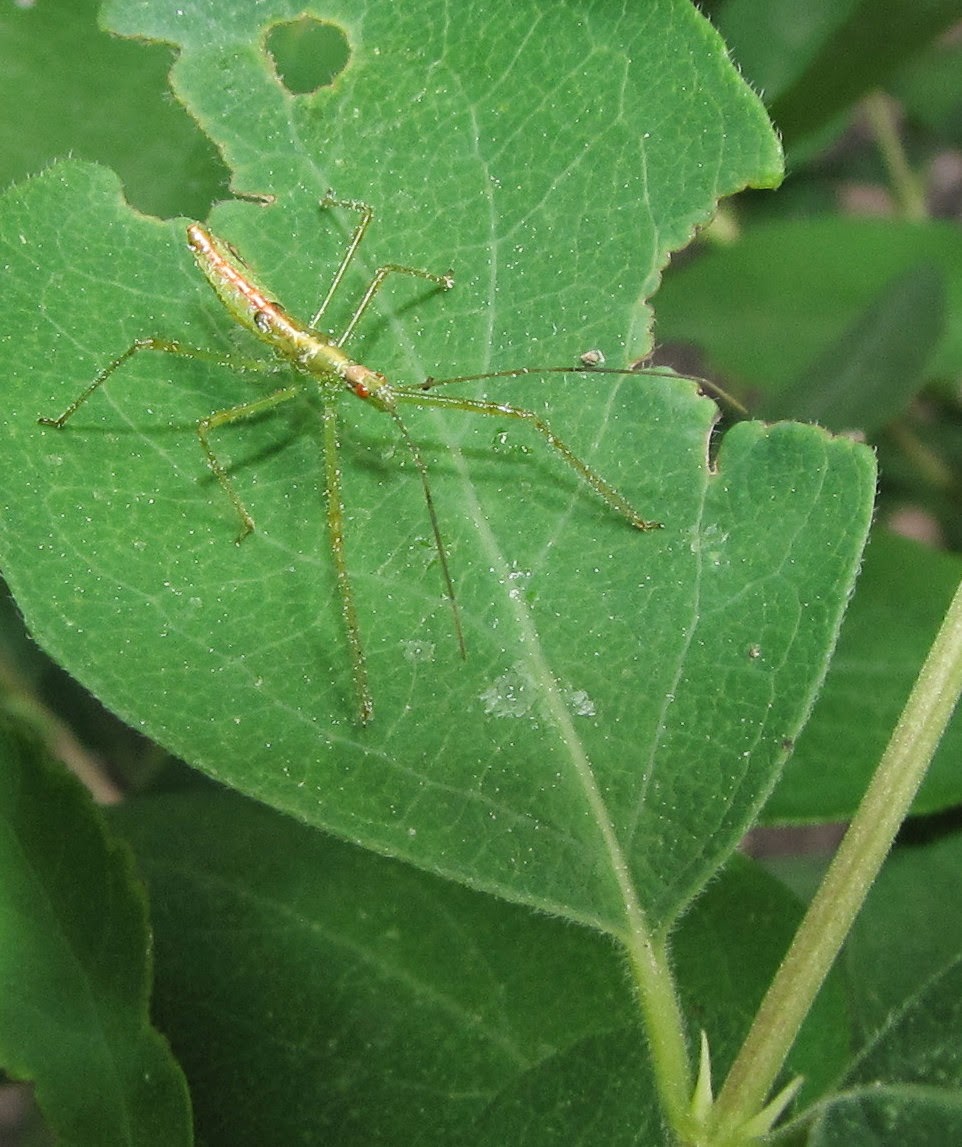
Zelus luridus nymph, Colorado

Nymphs go through five instars (an instar is the interval between molts) on their way to adulthood. They are noticeably larger after each molt, with wing pads evident in the last couple of stages.

Zelus hatchlings

The egg mass reminds me of a tiny crème brûlée, but perhaps I need to eat lunch and return to finish this post later....I was delighted to stumble upon a couple of egg masses in the act of hatching at the Cheyenne Mountain Zoo here in Colorado Springs back on July 21. It seems remarkable that such long-legged creatures could be packaged in such small vessels.

Zelus hatchlings

There are at least two generations annually here along the Front Range in Colorado, probably three or more generations in southerly latitudes. I notice nymphs of Z. luridus in spring, so it is likely that winter is passed in the egg stage.

Zelus species range from 14-21 millimeters in body length as adults, and are relatively easy to recognize with their slender build, long legs and antennae, and diurnal period of activity. They are largely arboreal, so you will find them mostly on foliage and flowers of trees, shrubs, and herbs.

Zelus renardii, Texas

Assassin bugs in general are indiscriminate predators of other insects, and Zelus is no exception. So, while they will dine on leafhoppers, small caterpillars, and other pests, they will also capture beneficial insects such as small bees.

Despite our tendency to classify insects as "good" or "bad" for our own selfish reasons, sundew assassin bugs should be welcomed for the benefits they provide in occasional pest control, and their unique behavior and "personality," if I dare use that word for an invertebrate.

Zelus luridus male, Colorado

Sources: >Valerie. 2014. "Reduviidae ~ Assassin Bugs," Austin Bug Collection.

Weirauch, C. 2012. "Taxonomic Revision of Zelus Fabricius," Heteropteran Systematics Lab @ UCR
Weirauch, C. 2006. "Observations on the sticky trap predator Zelus luridus STÅL (Heteroptera, Reduviidae, Harpactorinae), with the description of a novel gland associated with the female genitalia," Denisia 19, zugleich Kataloge der OÖ. Landesmuseen Neue Serie 50 (2006), 1169-1180.
Wolf, Klaus Werner and Walton Reid. 2001. "Surface Morphology of Legs in the Assassin Bug Zelus longipes (Hemiptera: Reduviidae): A Scanning Electron Microscopy Study With an Emphasis on Hairs and Pores," Ann. Entomol. Soc. Am. 94(3): 457-461.

Tuesday, November 19, 2013

Dinosaur Bug

Few insects cause more head-scratching bewilderment or jaw-dropping awe than adult Wheel Bugs, Arilus cristatus. They look like the offspring of a beetle and stegosaurus with that remarkable cog-like crest on the top of their thorax. These strange “dinosaur bugs” are members of the assassin bug family Reduviidae. While they should be welcomed in the garden as predators of pest insects, they should be treated with respect, too.

Wheel Bugs begin life looking much like other true bugs because they do not have the big crest until they reach adulthood. Young Wheel Bugs are black with a bright red abdomen. You will likely see them crawling about on foliage individually. Similar true bug nymphs, like leaf-footed bugs (family Coreidae), are usually seen in groups.

Wheel Bug nymphs go through five instars (the intervals between molts), gradually losing their bright colors and becoming covered in silvery hairs that give them a coarse, grizzled appearance.


They become larger in size with each molt, and acquire wing pads that will transform into fully functional wings as adult insects. All this time they are stalking other insects as prey, moving in a slow, methodical, deliberate manner that may only amplify the “creepiness” factor for someone prone to fear or dislike insects in general.

The final transformation from nymph to adult, accomplished in the last molt, is a dramatic one. A freshly-emerged adult Wheel Bug is a stunning pink or orange in color, and that trademark crest is now apparent. Two sets of wings are now fully developed. As its new exoskeleton hardens, the insect becomes darker, becoming gray and/or brown.

All assassin bugs use beak-like mouthparts to pierce their prey, injecting paralyzing venom and digestive enzymes into their victim. The internal tissues of the prey are liquefied by this chemical cocktail, and then withdrawn by the assassin through the same channels in its beak. Wheel Bugs are capable of taking prey larger than themselves, but small beetles and moths are among their favorites.

It is not a good idea to handle Wheel Bugs because they can deliver an excruciating bite in self-defense. They may deploy other behaviors to startle potential attackers, too. Assassin bugs have a groove in their “chest” that is flanked by ridges. Their beak normally rests inside this groove, but if alarmed the bug can bob its head vigorously, raking the tip of the beak across those ridges to make a very audible squeaking sound.

Besides making noise, female Wheel Bugs can evert a pair of stink glands from the tip of the abdomen to repel a predator. The glands are large and bright red, creating quite the visual display as well as a fragrant deterrent.

Arilus cristatus is a large insect, adult males being up to 28 millimeters in body length and females up to 32 millimeters. Females have a wider abdomen than males, when viewed from above.

Adult Wheel Bugs are seen most often in late summer and fall, earlier in more southerly latitudes. The species is found from eastern New Mexico north and east to Kansas, Iowa, southern Michigan, and southern New England. It is perhaps most abundant in the southeast states; it also occurs in Mexico.

Mated female Wheel Bugs lay their eggs in distinctive hexagonal masses. The number of eggs in such a cluster varies from about forty to 180. Look for the egg masses on tree trunks and other vertical surfaces where they will overwinter, protected by a shellac-like coating that insulates them from harsh weather, parasites, and other potential mortality factors. Nymphs hatch the following spring.

This is one of the “mystery bugs” I am most often asked about. It is so distinctive that even the most minimal description is enough to determine what the person is talking about. I like that people are curious about this species, and appreciate the opportunity to enlighten them about the unique biology of these predators.

Sources: Eaton, Eric R. 2003. “Amazing Assassins,” Missouric Conservationist. 64(6): 24-27.
Hoffman, Richard L. 2006. Assassin Bugs of Virginia. The Insects of Virginia Number 15. Martinsville: Virginia Museum of Natural History. 74 pp.
Mead, F.W. 2011. “Wheel Bug, Arilus cristatus (Linnaeus) (Insecta: Hemiptera: Reduviidae),” University of Florida IFAS Extension.
Slater, J.A. and R.M. Baranowski. 1978. How to Know the True Bugs. Dubuque, Iowa: Wm. C. Brown Company Publishers. 256 pp.

Tuesday, January 8, 2013

True Bug Tuesday: Masked Hunter

Note: This is the debut installment of a semi-regular feature I am dubbing “True Bug Tuesday.” It will likely include reposts of previous entries that cover members of the order Hemiptera.

Remember when your parents told you there were no monsters under your bed? Perhaps they were wrong. Have you ever wondered if you were hallucinating when you swore you saw a self-propelled dust bunny crawling across the floor? You might have been perfectly sane. There is a predatory insect that qualifies as both a miniature monster and an animated dust ball, and it is most often encountered indoors rather than outside.

The Masked Hunter, Reduvius personatus, is a member of the assassin bug family Reduviidae. Fortunately, the only thing it “assassinates” is other insects and related invertebrates. The piercing-sucking mouthparts are sleeved inside a short, stout, segmented beak bent under the insect’s “chin” when not in use.

The most remarkable trait of this species is the appearance of the immature stages, called “nymphs.” True bugs in general go through “gradual” metamorphosis, such that the juvenile stages look much like the adults, except that they are smaller, not sexually mature, and lack wings (if the species in question has wings at maturity). This is true of the Masked Hunter, except that the nymphs actively cover themselves in lint, sawdust, and other debris.

Their bodies are covered in short and long trichomes (hairs) connected to glands that produce a sticky substance. Fine particles adhere to the short trichomes close to the body of the insect, while longer trichomes anchor coarser particles in a second layer of camouflage. A “tarsal fan” of dense, long hairs on the foot of each hind leg helps the nymph apply the trash to the trichomes (Weirauch, 2006).

Each time the baby assassin molts (sheds its exoskeleton to grow in the brief interval before the new exoskeleton hardens), it must repeat the self-decorating process. The disguise helps protect it from potential predators, but might also make it appear harmless to its own prey. The Masked Hunter is probably a generalist predator, but it is often found in association with people and/or colonial birds and bats. It is well known for preying on bed bugs and swallow bugs (true bugs in the family Cimicidae). Other prey records include silverfish, booklice, and at least one harvestman (Arachnida: Opiliones).

Masked Hunters go through five instars. An instar is the period between molts. The nymphs are the ones that overwinter, usually in the fifth instar, but in Canada the life cycle may take two years, the nymphs overwintering in the third and fifth instar (Scudder, 1992). During the winter they are in diapauses, ceasing activity until the following spring. The sixth molt produces the adult insect, a dark, winged animal measuring from 15-22 millimeters in length.

Today, the Masked Hunter is found throughout the Northern Hemisphere. It is assumed that it is European in origin and has been transported to other continents through human travel and commerce. While it can be a common species, it is not prolific, and populations are usually small. Few specimens will occupy any given home or other building.

Assassin bugs are able to produce sound by rubbing one body part against another, a phenomenon known as “stridulation.” In this case, the insect rocks its head up and down, rubbing the tip of its beak across a series of transverse ridges on its "chest." The result is a very audible squeaking sound that may startle any other creature that grabs the bug.

The Masked Hunter is found throughout the Northern Hemisphere. It is assumed to be European in origin and has been transported to other continents through human travel and commerce. Most adult specimens of Reduvius personatus are seen in June and July. Look for them at lights at night where they are occasionally attracted by the buffet of potential prey insects. By day, they hide under bark on logs and in other sheltered situations. Be careful, though, Masked Hunters can deliver a painful bite in self-defense.

Sources: Hoffman, Richard L. 2006. “Assassin Bugs of Virginia,” The Insects of Virginia 15: 1-74.
Scudder, G.G.E. 1992. “The distribution and life cycle of Reduvius personatus (L.) (Hemiptera: Reduviidae) in Canada,” J. Entomol. Soc. B.C. 89: 38-42.
Weirauch, Chrstiane. 2006. “Anatomy of Disguise: Camouflaging Structures in Nymphs of Some Reduviidae (Heteroptera),” Am. Mus. Novit. 3542: 1-18.