Sunday, January 12, 2014

Celebrity Spiders

I was watching The Tonight Show on Wednesday, December 18, and one of the guests was actress Christina Applegate. I don’t normally pay much mind to celebrities, but when she started talking about a spider that is living outside a window of her home, my ears perked up. She and her daughter have more or less adopted the arachnid and named her “Seymour.”

Ok, obviously, they named the spider before it was determined to be a female. Ms. Applegate has kept a running account of their spider via tweets on Twitter, including the above picture. There has been much chatter on her Twitter page, most of it supportive and helpful. Christina informed The Tonight Show audience that “Seymour” had been identified as a Tropical Orbweaver, Eriophora ravilla, which at first glance it resembles. I remembered that this species does not occur in southern California, though, and took a closer look at the image. Ah, Araneus gemma instead. I tweeted the correction, but never got a response. Gee, Christina can’t be *that* swamped, right?

While she admitted that if a spider that size were found inside her house, “it would be on the bottom of my shoe,” she and her daughter have embraced Seymour as an “outdoor” spider. They even sing to it at bedtime.

We cannot have enough positive stories like this of both parenting and arachnid appreciation. It is encouraging the number of celebrities who share their passion for the eight-legged world.

I had the pleasure of meeting Dominic Monaghan, “Charlie” of Lost fame, when he came through the 25th annual “Bug Fair” at the Los Angeles County Museum of Natural History back in May, 2011. He, too, had been on The Tonight Show, where he had talked about joining an expedition to search for an enormous tarantula species recently re-discovered in a museum collection. I asked if he had gone and he said they hadn’t been able to make it happen. Since, then, Dominic has gone on several expeditions for his BBC America series Wild Things. His “average Joe” approach is refreshing, and he is usually cautious in handling venomous species. He makes a good ambassador for popular entomology, arachnology, and herpetology.

Back on Twitter, Heidi Klum, the supermodel, made headlines by tweeting a photo of herself posing with “Brutus,” a large tarantula, her “new friend for the day.” That one photo op can cause such a sensation should not be dismissed. The American Arachnological Society might do well to find a celebrity spokesperson for arachnids, or even enlist someone from its own ranks, like Dr. Greta Binford.

The point is, we can make a big impact on changing public attitudes towards organisms that are traditionally feared, but we might have to cozy up to the media. Scientists are loathe to speak to journalists since there have been so many misquotes, and information taken out of context, in previous history. We have to keep trying, though, and become the media ourselves through blogs, social media, and other creative outlets. Heck, don’t just read my blog, “re-tweet” it, and more importantly, write your own, too.

Thursday, January 9, 2014

Wrinkled Grasshopper

Before I started taking images of insects, I collected them. It is as equally challenging to go after them with a net as it is a camera. One example is the wary Wrinkled Grasshopper, Hippiscus ocelote, common east of the Rocky Mountains and the desert southwest. Well-camouflaged and alert, it is nearly impossible to approach even if you see where it lands.

The Wrinkled Grasshopper tends to favor habitats with dense grass, and unlike other species that may simply land in a bare patch of soil after being startled into flight, this species actively buries itself amid the tangle of grassblades, further concealing itself.

Mind you, this is not a small insect. Adult males measure 28-40 millimeters from nose to the tips of their folded wings. Females are more robust, and can be 39-53 millimeters. They look even larger in the field, especially when they take flight. The leopard-spotted forewings, called tegmen, open to allow the hind pair of wings to expand into colorful flying gear. Normally folded like Japanese fans and hidden under the tegmen, the hind wings are boldly marked with an orange, pink, red, or yellow area at the base, and a dark brown band near the wing margin.

Hippiscus ocelote can be confused with other “leopard-spot” species in places that they overlap, but the Wrinkled Grasshopper occurs as an adult insect from mid-summer through October. Similar species tend to be found in the spring and early summer. Note that in profile the Wrinkled Grasshopper has only one notch in the crest of the pronotum (top of the thorax), and a shallow notch at that. Despite the common name, the pronotum is only sometimes “wrinkled” or rough and “rugose” in appearance, especially in females. The color of the hind tibia (“shin” segment) is yellow.

This is a plains, prairie, pasture, and field species that is only occasionally found in open woodland habitats, even though its geographic range extends to the Atlantic coast and Gulf coast, save for peninsular Florida.

The winter is passed in the egg stage, females depositing “pods” of about 30 eggs each in the soil before the first frost. Still, in the most southerly reaches of its range, adults can persist well into winter. Nymphs and adults feed preferentially on grasses, especially bluegrass and Japanese brome. They sometimes feed on dead animals including their own kind. Most grasshoppers are, in fact, omnivores. It is not an economic pest of agriculture or rangeland.

The Wrinkled Grasshopper was formerly known by the scientific name Hippiscus rugosus, and can be found in older references under that epithet.

Sources: Capinera, J.L., T.S. Sechrist, and Spencer Schell. 1999. Grasshoppers (Acrididae) of Colorado: Identification, Biology, and Management. Colorado State University Experiment Station, Bulletin No. 584S.
Capinera, John L., Ralph D. Scott, and Thomas J. Walker. 2004. Field Guide to Grasshoppers, Katydids, and Crickets of the United States. Ithaca, NY: Comstock Publishing Associates (Cornell University Press). 249 pp.
Helfer, Jacques R. 1972. How to Know the Grasshoppers, Cockroaches, and Their Allies (2nd Edition). Dubuque, Iowa: Wm. C. Brown Company, Publishers. 359 pp.

Tuesday, January 7, 2014

Kissing Bugs

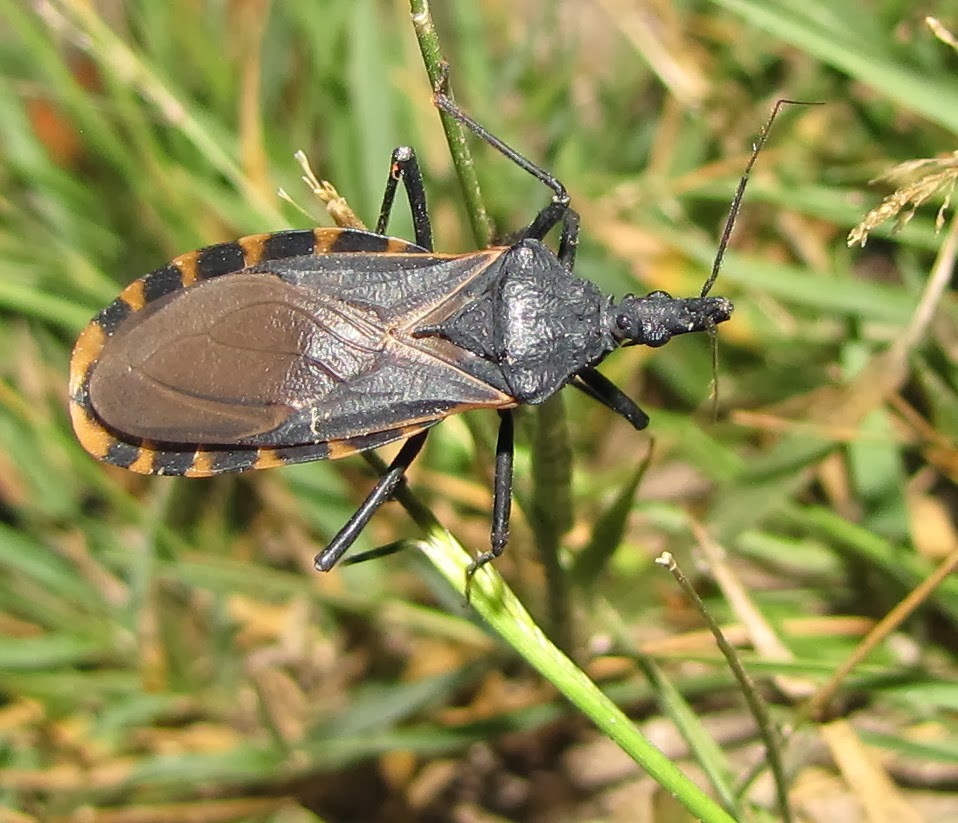
The holidays may be over, but the last thing you would want to cuddle up to under the mistletoe would be the subject of today’s “True Bug Tuesday.” Assassin bugs in the subfamily Triatominae are known as “kissing bugs.” There is nothing romantic about these vampires, especially considering that they can carry a lethal disease. Eleven species of Triatoma occur north of Mexico, most of them found in the southwest U.S.

Triatoma rubida from Arizona

Villains by Many Names

Like any notorious outlaw, the triatomines have their share of aliases: conenose, blood-sucking conenose, big bedbug, Mexican bedbug, Hualupai tigers (Arizona), vinchuca (in several South American nations), chipo or pito (in Colombia and Venezuela), chirimacho (in Peru), bush chinch (in Belize), and barbeiro or bicudo (Portugese, in Brazil). The name “kissing bug” derives from the fact that triatomines do not like to be confined under blankets and sheets while feeding on human victims, preferring to tap blood from the uncovered face, especially around the mouth.

Life Cycle

Kissing bugs begin life as eggs, dropped singly by an adult female. The nymph that hatches may take its first blood meal only two or three days after emerging from its egg. Blood meals are required for the insect to grow, each nymph passing through five instars (an instar is the interval between molts) before reaching adulthood. The adult insect is sexually mature, and has functional wings in most species. Mature triatomines range from 12-36 millimeters depending on the species.

Triatoma gerstaeckeri from Texas

Host of Last Resort

People are not the normal hosts of triatomine assassin bugs. Here in the U.S., Triatoma is mostly associated with woodrats (aka “packrats,” genus Neotoma), but several species accept blood meals from other vertebrates including opossum and raccoon, and sometimes livestock and pets. The nymphs of kissing bugs dwell mostly in the middens of woodrat nests, in the burrows of other rodents, or sheltered situations where hosts may be encountered regularly. People encounter kissing bugs when the adult insects disperse to find new rodent host populations during late spring, summer, and early fall. At that time, the bugs may be attracted to outdoor lights, and then sneak indoors. Their extremely flat bodies allow them to slip into the thinnest crevices.

Triatoma sanguisuga from Ohio

How to Stalk a Sleeping Human

The process by which a triatomine finds a host is akin to how a shark approaches a victim: with caution, and by relying on a series of different senses. Most pestiferous triatomines live in Mexico, Central, and South America. They dwell in the thatched roofs of rural homes, or in cracks in walls or beams. Hiding by day, they stir at night, usually simply dropping to the floor to begin the hunt. The bug uses its antennae to first detect gases in the breath of a potential target. Homing in on carbon dioxide, it begins its assault. As the insect gets closer, it switches to thermal detection, much like pit vipers. It is suspected that special pits in the antennae not only detect heat, but can determine whether the temperature is appropriate (too hot, too cold, or just right). The bug may even be able to calculate the size of the heat-emitting animal by “triangulating” with its antennae. A warm-blooded creature with the right attributes elicits the feeding response, and when the bug is within a few inches its proboscis extends like a divining rod for blood vessels.

Triatoma gerstaeckeri from Texas

Chagas’ Disease

As if blood loss is not enough of an insult, the victim of a kissing bug bite may contract a deadly disease. In Latin America, several species of triatomines can transmit Chagas’ disease, also known as American trypanosomiasis. The ailment is caused by a parasitic organism called a trypanosome, related to the one responsible for African sleeping sickness. Unlike the tsetse fly vector of sleeping sickness, triatomines do not inject the microbes in the course of biting. Instead, the trypanosomes proliferate in the digestive tract of the bug, and are excreted in the feces. Due to the unrefined bathroom habits of these bugs, they may defecate while feeding, liberating the disease organisms. Victims inoculate themselves by scratching the microbes into the itchy bite wound, or contacting mucous membranes of the eyes or nose. Species of Triatoma in the U.S. are certainly capable of harboring trypanosomes, but they are “potty trained,” going to the bathroom about twenty to thirty minutes after feeding, usually having left their victim by then. Still, isolated cases of Chagas’ disease have been recorded in Texas, California, and Tennessee.

Our smallest species, Triatoma neotomae of south Texas

Aftermath

Bites from kissing bugs are painless while the insect is feeding, but the victim typically experiences itching and swelling the next morning. Most human victims wake up with a fat lip, but some may have an allergic reaction, going into anaphylactic shock with low blood pressure, swollen airways, and rashes being symptoms. This situation requires emergency medical treatment. Repeated bite episodes may make one more vulnerable to anaphylaxis, and also have the potential to become disfiguring. Many rural citizens in Latin America are horribly scarred from constant victimization by triatomines.

Mistaken Identity

Several other true bugs enter homes in North America, and may be misidentified as kissing bugs. Those species include other assassin bugs that are not blood feeders, like the Black Corsair, Melanolestes picipes, and the Masked Hunter, Reduvius personatus. The Western Conifer Seed Bug, Leptoglossus occidentalis, is a completely harmless insect that seeks shelter indoors during late fall and winter. All of these insects can be mostly excluded by sealing cracks and crevices, repairing worn weatherstripping around doors, mending holes in window screens, and taking care to inspect firewood and other material and objects brought indoors from outside.

The big Triatoma recurva of Arizona

Sources: Flores, Graciela. 2005. “In the heat of the night,” Natural History 114(6), July/August, 2005: 32-37.
Schmidt, Justin O., et al. 2011. “Kissing Bugs in the United States,” The Kansas School Naturalist 57(2): 1-16.

Sunday, January 5, 2014

The Legend of the Christmas Spider

One of my holiday gifts this year was a unique spider ornament, handcrafted from various materials. It came inside a box that explained its significance. “The Legend of the Christmas Spider” it said, followed by this story:

”A long time ago in Germany a mother was busily cleaning for Christmas. The spiders fled upstairs to the attic to escape the broom. When the house became quiet the spiders slowly crept downstairs for a peek. Oh, what a beautiful tree! In their excitement they scurried up the trunk and out along each branch. They were filled with happiness as they climbed amongst the glittering beauty. But, alas! By the time they were through climbing, the tree was completely shrouded in their dusty gray spider webs. When Santa came with the gifts for the children and saw how happy the spiders were he knew how heartbroken the mother would be if she saw the tree covered with the dusty webs. He turned the webs to silver and gold. The tree sparkled and shimmered and was even more beautiful than before. That’s why we have tinsel on our Christmas tree and every tree should have a Christmas Spider in its’ branches.”

© threeoclockinthemorning.com

Looking online, I find numerous references to the above story, but strangely I find nothing in the two reference books where I would have expected the legend to be recounted. Still, I find folklore like this to be a good sign that spiders are not always the “bad guys,” looked at with disdain, fear, and loathing.

Another thing I find fascinating is that while people may find spiders revolting, those same humans are likely to consider spider webs, especially outdoor orb webs, to be magnificent and beautiful feats of natural engineering. We need to translate that love for webs to spiders themselves, and I think the tide may be turning in this regard.

Next week: Christina Applegate’s spider, “Seymour.”

Sources: Climo, Shirley. 1985. Someone Saw a Spider: Spider Facts and Folktales. New York: Thomas Y. Crowell. 133 pp.
Hillyard, Paul. 1994. The Book of the Spider: From Arachnophobia to the Love of Spiders. New York: Random House. 218 pp.