Showing posts with label natural history. Show all posts

Sunday, November 3, 2024

Grand Finale

Versute Sharpshooter (leafhopper), Graphocephala versuta

Every bugwatcher knows it’s coming in the late fall, and both delights in it, and mourns for the lost spring and summer, quickly fading from memory. That encore of insect abundance, from heavy, arthritic grasshoppers lumbering up wooden fences, to sun-seeking lady beetles, eager to find snug crevices to pack themselves into for the approaching winter.

Differential Grasshopper, Melanoplus differentialis, male.
Multicolored Asian Lady Beetles, Harmonia axyridis, nestle in bark furrows on a tree.

This year, here in Leavenworth, Kansas, the Indigenous Summer has been long, hot, and hopelessly dry. It seems to matter little to most of the insects, but birds stopped visiting our feeders. We saw dozens of gulls passing over for a couple of days, though, bright white against an azure sky, the wind speeding them along.

Juvenile Tuftlegged Orbweaver, Mangora placida

The air is thick with the exuberance of the minute, now that the larger butterflies are scarce, no longer competing for our attention. Dreamcatcher spider orbs snag the micro-confetti of aphids, leafhoppers, and gnats that are on the wing, or that get torn from their perches by the stiff, incessant wind.

Cloudless Sulphur, Phoebis sennae, female.

Falling leaves jerk my eyes in their direction, on the off chance that they are butterflies after all, like Eastern Comma or Question Mark, or the less common Goatweed Leafwings. Leaves that rocket from the ground skyward are grasshoppers sporting autumn yellow, orange, or black hind wings. The largest ones, with clear wings, that land in trees, are bird grasshoppers.

American Bird Grasshopper, Schistocerca americana.

Political campaign signs in our front yard are sometimes briefly occupied by insects or spiders. The spiders try to balloon off, or seek shelter in the little tunnels of the corrugated plastic. I like to think that they are all signaling their approval, but they are actually endorsing the more natural state of our property, our decision to not use chemical treatments of any kind, and otherwise steward the place through benign neglect.

Microleafhopper, Erythroneura calycula
Microleafhopper, Hymetta anthisma
Microleafhopper, Erythridula sp.
Microleafhopper, Balclutha sp.
Microleafhopper, Erythroneura elegans
Leafhopper, Pediopsoides distinctus

Walking the fence line in our back yard, I stir a myriad of tiny leafhoppers that alight briefly on the weathered, algae-stained boards. Despite their size, they are riotously colorful, with streaks and bands across their slender wings. Fireworks come in both bright and muted colors that echo the changing foliage.

A male Fork-tailed Bush Katydid, Scudderia furcata.

Earlier in the season, katydids and lacewings were vivid green. Now, they are dull brown, maybe reddish, with bursts of purple or pink. Little orange skipper butterflies pop as I stroll by the tiny lavender asters that grow low enough to dodge the mower blade, along the very edge of the curb by the busy four-lane. Yellows in the form of Cloudless Sulphurs, on a partly cloudy day, flitting from one cryptic flower to another in someone’s front yard.

A little worn, a Fiery Skipper sips nectar from an aster.

Flowers, too, bloom again. The goldenrod, and taller white asters reboot themselves for one more round of Can I Get a Pollinator?. They do, in flies and bees mostly. Wild Carrot never gave up to begin with, still looking fresh as a daisy, courting potential pollinators. They succeed, in the form of two metallic flies. The flies depart when a lone ant appears to steal nectar.

A flower fly, Helophilus fasciatus, and a Spotted Cucumber Beetle, Diabrotica undecimpunctata, enjoy goldenrod nectar.

Another October surprise….no, wait, today is November the second already….is an immature Carolina Mantis, sitting stock still among our backyard goldenrod. It is probably one molt away from adulthood, but I can’t decide if it is male or female. I wonder if there are any larger insects left to feed it, get it over the hump, or if it will die young, perishing as the teenage equivalent of its kind.

Immature Carolina Mantis, Stagmomantis carolina

There has finally been rain lately, including today, so perhaps there will be yet another burst of activity in its wake. There will still be ground beetles crossing the sidewalks, and grasshoppers basking on the pavement on warm days, to be sure. Fall Cankerworm has yet to even take the stage, but they don’t always, not every year, and I might not see them if the timing isn’t right.

Leaf-footed bug, Leptoglossus oppositus.

There is no metaphor here. This is just how nature works. It varies, it adapts, takes chances, weighing risks at a molecular level. Emerge now, or snooze another calendar year. We are slower to act, built to react instead of evolving to be proactive, and to accept whatever weather befalls us. The warm, sunny days seem to encourage our lazy nature, while nature bustles around us, unnoticed by most.

Aphid, Drepanaphis sp.

Thursday, September 12, 2024

I Am Not a Scientist

It’s cute when someone mistakes me for a scientist, presumably because I have written books about insects, made public presentations, and am active on social media. There are occasions, though, where the confusion wastes the other party’s time, and for that I am truly apologetic. I am still a reliable source of factual information, but please allow me to set the record straight.

This post is prompted by an email exchange I had recently with a dear friend and colleague who truly is a scientist, seeking my help with a project.

Them: “I have a favor to ask….

For the past [few] years I have been conducting a long-term….survey at different nature preserves….in the hopes of trying to get a better idea of conservatisms of these insects….Ultimately I want to be able to look at a species list of insects found within a natural community or natural area and determine….which sites provide high quality critical habitat for plant community specialist insects, separate from the plant C values ranks.

The problem is few people are familiar with a wide diversity of insects. Most experts just know a particular family of insects….I have ranked all 371 taxa based on my field expertise. I'm teaming up with a dragonfly specialist for the statistical analysis. [They have] some experience with developing conservatism ranks for dragonflies and is trying to apply this to my data.

Would you be willing to take a look at the list and provide numerical ranking for the species you readily recognize? I know [specific region] isn't your main stomping ground, but you do know many of the more common species, and your ranks would be most helpful.

If you are interested in getting involved and reviewing our work for a future publication, and possibly coauthoring with us, we are open to that….My goal is to bring attention to the insects here in [specified state].

Let me know if you have any questions.

Thanks so much.”

Me: “I am flattered by the request, and would be willing to help....if I understood the assignment. I have no idea what a "C value" is. I could potentially rank them in terms of the frequency with which I see that particular genus or species on a particular plant. That can still vary significantly from one year to the next. This year, in our area, insect numbers are down significantly. I am not seeing many insects….

If there is a concrete definition of C values, then please provide it. I may or may not be able to assist. Math is my greatest weakness, and I never took statistics (not that it would even be useful given that I was in college in the early 1980s).

I am a writer and sci-comm professional, all else comes in no particular order after that.”

Them: “Yeah, don't ask me to explain statistics either. That's why I team up with the survey biologists.

As far as I know the concept of the C value (or coefficient of conservatism) came about in 1979 to reduce subjectivity in the evaluation of plant communities by placing the subjectivity up front. All plant (or other taxa) are assigned a numeric value that [provides] assessment natural quality repeatability.

In basic terms, ‘how likely is this taxa found in a high quality community?’….It's not just how common it is, though that is a factor as high quality (conservative) species are typically found only in rare habitats and thus are less likely to be encountered. The numbering is from 0-10. Almost all state-listed species are assigned a value of 10….A goldenrod soldier beetle (Chauliognathus pensylvanicus) might be a 1 or 2 as they are common [pretty much everywhere].

We also ask that you rate your confidence level 1 - 3 (3 being very confident in your rank and 1 being much less familiar with the species).

Does that help?”

Me: “Yes, that does help. I am not qualified to undertake that, being unfamiliar with [those] ecosystems at *that level*….I'm sorry, but I would potentially be doing more harm than good if I took a stab at this.

Sorry!”

Them: “….

The point is to ask. I realize it's specialized. If others are unable, then that's part of our argument - we get the best data we can. I don't know if any of this is possible but I'm going to keep at it. The more I do the more I learn.

Thanks”

Me: “My comment wasn't an indictment, apologies if it sounded that way.

You are vastly more capable than I am, and have much more experience in that kind of habitat. Maybe someone at [non-profit organization] can help?

Maybe I do not make it clear enough to anyone that I am not as much an entomologist as an ‘insect identifier.’"

Them: “I didn't take it that way. No worries.”

There is another aspect of my personality at play here. I am inherently lazy. Community science is hard work, with demanding and specific requirements for projects aimed at collecting data. That is not what interests me. I am all about recruiting potential community scientists by sharing fascinating facts and personal experiences. Heck, if I can get someone to put down the fly swatter in favor of a magnifying glass, mission accomplished.

I want to change the behavior of the average Joe or Jane who despises insects and wants them gone. Humanity as a whole, and the entire planet, for that matter, cannot survive the continued loss of biodiversity and insect abundance. More to the point, I can’t survive it. Exploring the natural world and finding insects is one of the few exercises keeping me reasonably sane, and giving me a sense of purpose. Without the “bugs,” I vanish, too.

Sunday, December 17, 2023

Book Review: Flower Bugs

I must preface this review by stating that the author, Angella Moorehouse, and publisher, Heather Holm, are personal friends. That is not why I am conflicted in my reaction to this book. Neither is it because I view this book as being in competition with any of my own works. We cannot have enough literature devoted to promoting public understanding and appreciation of insects. It boils down in part to my own biases and expectations. With that, you will still receive an honest appraisal.

Pollination Press, LLC produces plant-based books about insects, usually restricted to a particular geographic region. Holm's comfort zone is clearly in botany, though her prior books about bees and wasps, as they relate to flowering plants, demonstrate a command of general entomological knowledge, and dedication to thorough research. There is no question that her books deliver accurate, factual information. From my perspective, as an entomologist with little familiarity or interest in plants, I immediately see what is "missing" in terms of species, even families, because those insects are not associated with forbs.

There is a desperate need for more books that illustrate the ecological networks of different organisms, but Flower Bugs: A Guide to Flower-Associated True Bugs of the Midwest is limited to the flowers of herbaceous flowering plants, and almost exclusively those true bugs that may play a role in pollination, or those species that frequent flowers as a place to ambush other pollinators. The territory covered is eight states (Illinois, Minnesota, Wisconsin, Iowa, Missouri, Michigan, Indian, and Ohio), and adjacent southern Ontario, Canada. The book is in fact based mostly on a detailed survey of locations in western and central Illinois, over a period of seven years.

The true bugs treated are further restricted to the suborder Heteroptera, which includes the larger, more obvious examples like stink bugs, assassin bugs, mirid plant bugs, and seed bugs, but leaves out the families of aquatic bugs, plus the other two suborders that include cicadas, leafhoppers, spittlebugs, and aphids. All of these specifics are stated explicitly in the introduction of the book.

The layout of Flower Bugs includes the trademark features of Pollination Press' other books: prolific and quality imagery, geographic range maps, seasonal distribution bars showing what months the adult insect is present, tables of plant species associated with each insect species addressed, diagrams of taxonomic relationships, a glossary, checklists, and a visual index.

The front matter of the book is, as usual for this press, presented to near perfection in degree of detail, and coverage of morphology and ecology. It is an excellent introduction to true bugs as a whole, for the intended audience of native plant gardeners, naturalists, resource management personnel, and others.

The species accounts cover the overall geographic range, variation in physical appearance, life cycle, feeding, habitat, and native plant associations. The images are occasionally redundant, but frequently include photos of the immature stages, which most field guides fail to do. In cases of the mirid plant bugs, assassin bugs, and other families for which there are few flower associates, there are photos of other species for comparison, and to better indicate the full diversity of these groups. Given the lack of any other contemporary guides to true bugs, this gesture is appreciated.

The last book to cover the true bugs for a popular audience was probably Bugs of the World, by George C. McGavin, published in 1993 and 1999 by Blandford, an imprint of Cassell, in London. Back then, the true bugs were classified much differently. In 1978, How to Know the True Bugs, by James A. Slater and Richard M. Baranowski, was published by Wm. C. Brown Company Publishers in Dubuque, Iowa, as part of their "Pictured Key Nature Series." That reference also covered the suborder Heteroptera, but assumed the user had a pinned specimen and a microscope at hand.

The fact that Flower Bugs is the most up-to-date popular reference to North American Heteroptera, no matter how limited the scope, is enough to recommend it. You will no doubt find yourself stalking the true bugs in your own yard, neighborhood park, or other favorite habitat. You can be confident that this book will provide you with an accurate ecological perspective, and interpretation of the behaviors of these insects.

Thursday, March 24, 2022

Book Review: The Social Wasps of North America

Chris Alice Kratzer’s new guide to The Social Wasps of North America stands to revolutionize the future of field guides. It certainly sets a new standard in many ways, through methodology, organization, and sheer honesty. It is my pleasure to recommend this wonderful reference without reservation.

This is a self-published book from Owlfly Publishing, one arm of Kratzer’s company, Owlfly, LLC. The other branch is an engineering firm. Kratzer has not only avoided all the usual pitfalls of self-publishing, she has taken great pains to make every aspect of that enterprise respectful and sustainable, right down to her choice in the packaging vendor she uses.

Why is this book so unique and important? Perhaps the most obvious feature is the geographic coverage. Kratzer rightly defines North America as everything north of South America. Most natural history publishers, and authors, would consider that to be overly ambitious, confusing, and impossible to execute given the increased biodiversity south of the Mexican border. It helps to choose a taxon that has relatively limited diversity, and social wasps in the family Vespidae do fit the bill nicely. However, one should not overlook the statement this book makes about inclusiveness. This book is useful to indigenous peoples in those other nations, as well as people traveling from other places. A Spanish translation, in digital format, will be available by the end of 2021, but if a publishing house is interested in producing a hard copy, please contact Kratzer at Owlfly Publishing.

This book also marks a return to illustrations, rather than photographs, as the best means to visually communicate each species. Kratzer is a master of digital renderings. Social wasps are maddeningly variable in color pattern, so she ingeniously fused the most common xanthic (mostly yellow) and melanic (mostly black/dark) forms of each species into a single drawing, capitalizing on the bilateral symmetry of her subjects to do so. Brilliant. Kratzer essentially crowdsourced her references by utilizing pinned specimens from many curated collections, and images of living specimens from the iNaturalist web portal. She gives credit to every single individual who furnished the material. Unheard of. Each species account includes female and male examples, plus queens, where relevant. Range maps are included. Photos of living specimens, and their nests, are featured under descriptions of the genera.

© Owlfly LLC

The first seventy or so pages of the book serve as an introduction and overview of social wasps, their biology, role within ecosystems, and how they impact humanity. This alone is worth the price of the book. The writing is outstanding in accuracy and honesty:

“All of the information in this book is wrong. All of it. Wasps are an appallingly understudied group of organisms, to the point that even this book – the most complete visual guide of social wasp to date – is built precariously upon the edge of a vast, unsolved jigsaw puzzle.”
The grammar is impeccable, and the tone is exceptionally friendly and empathetic, even to those readers who want nothing to do with wasps. It is easy for someone with an affinity for maligned animals to be unintentionally hostile towards those who do not share the same perspective and opinions. Kratzer is going to make many more “friends of wasps” with this book. Did I mention that there is also a glossary and extensive bibliography with links to online versions of actual scientific papers?

Overall, Kratzer’s embrace and navigation of the scientific ecosystem, inclusive of both academic professionals and well-informed non-professionals, is admirable and even ground-breaking. Rarely does one find a reference or author/illustrator so worthy of emulating. Maybe David Sibley and Kenn Kaufman, but add Chris Alice Kratzer to the list.

Are wasps not your thing at all? Stay tuned for Kratzer’s next effort, a guide to North American cicadas, in the works as I write this. Meanwhile, order The Social Wasps of North America for a friend, directly from Owlfly Publishing.

Tuesday, August 31, 2021

Book Review: In One Yard: Close to Nature Book 2

I was introduced to Warren A. Hatch several years ago by a mutual friend. He sent me a copy of the original In One Yard: Close to Nature, which I regretfully never got around to reviewing. I will not make the same mistake with Hatch’s sequel. This book has much to recommend it, no matter where you live.

Mr. Hatch resides in Portland, Oregon, USA, and every organism shown in the book was discovered on his property, the yard of which is only one-sixth of an acre. Clearly, exploring even this small an area can result in constant discovery and astonishment. A reader is going to be inspired to put the book down frequently so as to go looking for mosses, lichens, insects, arachnids, algae, and other living things right outside their door.

This “ignition switch” alone is what makes this book unique and critically important. One could consider it an exercise in vanity (the first book was self-published), but by documenting various species in depth, and showing the reader how he captured the detail and drama of each creature, it becomes a blueprint for how you can do the same. Why you should go to the trouble is self-evident in the countless, captivating images.

The text both explains the natural histories of the organism, and challenges the reader to make their own observations. The stories are an interesting and effective mix of the author’s personal experience, additional knowledge gleaned from literature and correspondence with world-renowned experts, and a periodic, friendly “Mr. Rogers” query to the reader. The author does not put himself above the reader. He defines scientific words with each use, and understands that occasional repetition is a good thing.

The first book was a large, magazine-like paperback. Book two is a smaller, hardback volume. Both are slightly “busy” in their design and layouts, and if there is any fault to the new book, it is in the literal fine print of “Extra Notes” that may be difficult for those with poor vision to easily read. The images are so overwhelming in their excellence and detail that almost anything else can be forgiven anyway.

The one thing that surprises and disappoints is that this book is flying under the public radar. Mr. Hatch’s prior works have rightly received critical acclaim from the scientific community. Hatch has produced posters and DVDs that have also garnered generous reviews; and he was elected a Fellow of the Linnean Society of London in 2003. This is an exceptional honor, as the society was founded in 1788 and has only about 2,000 members. Admirably, Hatch lives a car-free lifestyle.

In One Yard is the perfect complement to Douglas Tallamy’s books Bringing Nature Home, and Nature’s Best Hope. Hatch’s books show you exactly what can result if you cultivate native plants and make even minimal effort to observe and record. Yes, he has invested heavily in the equipment needed to produce what you see on the pages of the book, but what a payoff.

Ideally, we need more Warren Hatchs. More people should do an ongoing bioblitz of their home and property, and share the results widely through blogs, vlogs, Youtube, Instagram, and other media, if not an actual hardcopy book. Be creative. Buy this book as an inspiration and model. In One Yard: Close to Nature Book 2 is available exclusively through Wild Blueberry Media, LLC for a very reasonable $35.00 (postage paid). Don’t take my word for it, just ask Sir David Attenborough who effuses that the book is “splendid” and “it spurs me on.” When a world class, globe-trotting naturalist asks “….whether I haven’t looked at my yard with the concentration and insight that you have,” that is high praise indeed.

Sunday, August 15, 2021

Home Bioblitz, Ongoing

Ever since we moved into our house in Leavenworth, Kansas, USA, in mid-May of this year, we have been keeping a tally of all the species of animal life we see on our property, or from it in the case of flying birds. As of August 12, we have surpassed seven hundred (700) taxa, and that is likely conservative.

Rove beetles, like this one I have yet to identify, have been a dominant taxon (family Staphylinidae) in our home landscape

A taxon is any level of taxonomic classification: Domain to Kingdom, Phylum, Order, Family, Genus, or species, and various divisions in between. It is often impossible to distinguish various species, or even genera or subfamilies, from images of the living creature in the “wild,” so many of the insects and arachnids we have observed may never be identified specifically.

Leafhoppers abound in diversity, too, including Idiodonus kennicotti....

....and Colladonus clitellarius, the Saddled Leafhopper

A bioblitz is typically a twenty-four-hour event at a specific location that is intended to inventory every kind of living organism within the boundaries of said property. More recently, bioblitzes have been conducted over two days, sometimes more, to enhance the experience of participants and get a more thorough survey accomplished. Sometimes, bioblitzes target one particular taxon of interest, like dragonflies and damselflies, for example.

No water feature in our yard, but still we get visits from odonates like Skimming Bluet, Enallagma geminatum

The website and smartphone app iNaturalist has become a handy platform for recording the results of bioblitzes, such as this one at Corral Bluffs Open Space, a new park near Colorado Springs, Colorado, internationally famous for the discovery of several new fossil species, especially early mammals. Making such data and observations widely accessible to the public, as well as to scholars, is an overriding priority for bioblitzes, and it inspires more bioblitzes.

Ants, like this Temnothorax sp., are always abundant, but more diverse than you think

I have been slowly uploading observations of wildlife at our home, and elsewhere we have traveled, to iNaturalist, but I am over one month behind.

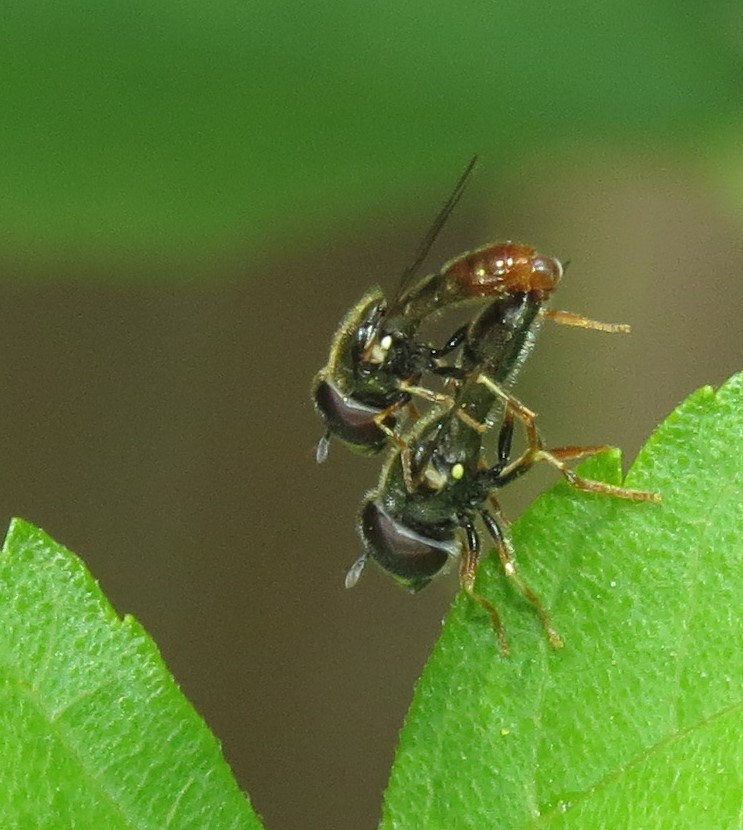
Insects are always making more of themselves, like these Black-backed Grass Skimmer flower flies, Paragus haemorrhous

Our property is modest, with a front and back yard, a back porch and a side porch, and a detached garage. We have not yet planted anything new, save for a handful of daisies and coneflowers from a local nursery. We do mow what passes for the lawn, and intend to replace most of it eventually with native plants, and maybe add a small water feature and bird feeders. The front yard is dominated by an enormous red oak.

Daisy Fleabane, a "weed" that volunteered in the back yard, has a long bloom cycle, attracting insects like this Wavy Mucksucker flower fly, Orthonevra nitida

How have we amassed so many species in so little time? We are privileged to have the luxury of unlimited free time at present. Heidi spends most mornings looking and listening for birds in both yards, and beyond. The pigeons are usually flying over the federal penitentiary located two blocks behind us. A pair of Eastern Wood-pewees raised a family in a tree across the street from our front yard. I make a circuit around the yards at least once per day, usually.

We have lots of spiders, and Blue Mud Daubers like this one hunting them

We have not yet tried much in the way of trapping for insects. We did hang up a bee block under the eave by the living room window, but apparently weren’t watching it at the right time of day. About a week ago I noticed two of the holes had been plugged with mud, likely the work of a mason wasp. We occasionally set out overripe fruits, but those are quickly overrun with ants unless we take precautions like standing a section of log like a pedestal in a container of water that acts like a moat.

We have fireslies that flash, like this Big Dipper Firefly, Photinus pyralis!

We do blacklight fairly regularly, though at present my camera flash has ceased to work. My back-up cameras have repeated lens error issues whereby the extendable lens gets stuck. Finding another camera has been problematic as there are shortages of almost every item now due to the pandemic. That said, blacklighting has been the overwhelming source of our diversity. I frequently find “bonus” insects in images where the intended subject was something else entirely.

Blacklighting has brought us gems like this Black-dotted Glyph, Maliattha synochitis

Here is my challenge to you: although we are no longer confined to our homes by the novel coronavirus, consider staying put anyway and devoting time to bioblitz your own place. Even the most sterile apartment is likely to have a few dozen species. You might have to break out a magnifying lens, but they are there. Share your results on iNaturalist, Project Noah, or similar platforms. Ask for help if you are at a loss for ideas on how to get started. Happy hunting!

Saturday, November 17, 2018

Surprise!

You won't believe me if I tell you that this new book came as a surprise to the authors, but it is true. Dr. Greg Paulson and myself just had the second edition of Insects Did it First published by Xlibris, as of Friday, November 16. These days the wheels of digital presses turn much faster than us old school writers are accustomed to.

The theme of the book is the parallel between human innovations and social behaviors and those evolved by insects. The similarities are uncanny, inspirational, and occasionally downright mind-blowing. Perhaps we should call this the twenty-first century edition of the original, as we added some chapters resulting from discoveries made after the first edition's 1992 publication date. Were I not such a procrastinator, we might have turned the book out even earlier, but thanks to Greg's diligence, here it is at last.

The initial concept was the brainchild of the late Dr. Roger D. Akre and E. Paul Catts, and Greg Paulson, who conspired together at Washington State University where Akre and Catts were professors, and Paulson a graduate student. Dr. Akre spearheaded the campaign, gathering many "insect inventions" over several years, recruiting many of his colleagues and contemporaries for suggestions. Dr. Catts contributed not only his own knowledge, but his artistic talent as well, rendering a wealth of cartoons to illustrate the chapters. The resulting book enjoyed a popular but brief run thanks to Ye Galleon Press.

Thanks to the solid foundation of the first edition, this latest version continues the tradition of strong, lively prose complemented by Catts' whimsical humorous illustrations. We updated the introduction to honor the original "cast," and added an epilogue to set the stage for what we imagine will be an even brighter future full of new discoveries and human plagiarism of natural "patents." Mother Nature is full of limitless surprises that inspire daily.

We are eager for you to enjoy this unique publication, but not exclusively for our own financial benefit. In fact, portions of the proceeds from sales will go toward scholarships in the name of Dr. Akre and Dr. Catts at Washington State University. It is the least we can do to pay our respects to these two giants of entomology.

While the book is also available through Amazon, we respectfully ask you to consider purchasing through the publisher, Xlibris. The sooner we reach the break-even point for publishing costs, the quicker we can begin contributing to those scholarships. When we receive instructions on how to secure our author's discounts, we will also be offering the book through those channels, too, and, as always, I am happy to sign and ship copies to my followers here. I will update this post as developments warrant. Thank you.

Friday, October 28, 2016

Review: The Sting of the Wild

Justin Schmidt is widely acclaimed for creating the Schmidt Pain Index that ranks the potency of the stings of bees, wasps, and ants, based largely on self-inflicted experience. It naturally follows that a book is in order to explain what most would consider a crazy person's pursuit. The Sting of the Wild, from Johns Hopkins University Press, is an odd combination of memoir and study in the scientific method. Does it succeed as either?

Full disclosure is also warranted here. I have known Justin as a friend, mentor, and colleague for decades, and am truly in awe of how his mind works. He asks questions that no other scientist does, then creates ingenious ways to test his hypotheses. No one I know is as innovative, persistent, and hard-working in the name of basic research. I was hoping that his personality and character would be reflected in this book.

The book contains what may be the best explanation of the attraction of certain people to scientific careers:

"Science is an exploratory process more so than a goal to realize. Yes, there are goals, and these must be clearly defined for funding agencies to support the research, but the real excitement and driving force in science is the adventure of seeking the goal, not in attaining the goal."

That is what I was anticipating from this volume: excitement and adventure. I have heard enough stories from Justin to know that he has a nearly limitless source of material, and is able to engage colleagues easily. So, what happened to that? Why did it not translate well to the written page?

If your usual reading in entomology is Howard E. Evans (Life on a Little Known Planet and Wasp Farm), May Berenbaum (Bugs in the System), or Bernd Heinrich (In a Patch of Fireweed), you will likely be disappointed by this book. Those unfamiliar with scientific terms, or chemical molecular structure, will find the book over their head at times, or at least dry and flat. Anecdotes from the field are lively enough, but too few and far between to sustain momentum of the narrative. The reader is forced to weave together the author's timeline from disparate passages and references, so the autobiographical aspect is also broken.

It stings me to say this about the book because its author is someone who should be admired and emulated. Schmidt is profoundly curious, a quality sadly lacking in too many scholars today, if not outright squelched by an academic environment that demands we be more concerned with "managing" nature than understanding it first. He is not some caricature or dare-devil as the media tends to suggest, but this book does little to change that impression, let alone create an understanding of what drives Schmidt's curiosity.

Despite its shortcomings, I learned a good deal from this book, and that alone may be enough to recommend it, at the very least as something worthy from your local library. A general audience is, unfortunately, not going to flock to this book. It reflects the novelty of the author's life, but lacks relevance to the reader unless he or she is also a scientist or aspires to be one. The complete "Schmidt Sting Pain Index," which makes up the appendix, is not enough to push the whole book into the limelight. The best natural history books ignite in the reader the urge to explore and discover. This one might keep them indoors, as a virtual spectator of other adventurers.

Wednesday, August 31, 2016

More Insects From Sunflowers

My last post was devoted to the diversity of insects that find sunflowers (Helianthus spp.) irresistible thanks to the plant's extrafloral nectaries that provide nourishment for a host of wasps, bees, and other insects. Today, let's look at insects that feed on sunflower buds, leaves, stems, and roots. In stands of native sunflowers, these phytophagous (plant-eating) insects are a natural part of the ecosystem; but where commercial sunflower is cultivated for seeds and oil, those species can be pests.

Dectes texanus, 16 mm

Some of the most conspicuous sunflower feeders are beetles. The longhorned beetle Dectes texanus is damaging to sunflower in the larval stage. The female beetle lays her eggs in leaf petioles (the short stalk that attaches the leaf to the stem). The larva that hatches from each egg feeds inside the petiole, then moves down the inside of the main stem, eventually reaching the base of the plant. There, it girdles the inside of the stem and moves below this belt of death to insulate itself for the winter. It packs its own fibrous poop around itself and pupates. An adult beetle emerges the following summer.

Mecas pergrata, 6-12 mm

Mecas pergrata is another longhorned stem- and root-borer that exploits many plants in the sunflower family (Asteraceae).

Sunflower Beetle, 6-12 mm

Sunflower Beetle, Zygogramma exclamationis, is a leaf beetle that feeds on sunflower as an adult and a larva. The adults emerge from hibernation in late spring or early summer, coinciding with the sprouting of sunflower seedlings. The beetles feed on the young leaves. The beetles feed during the day, but their larval offspring feed at night, gathering in small groups among the bracts of flower buds in daylight. There is one generation per year, with adults emerging from the pupa stage in the soil in late summer. They feed briefly before returning to the soil to overwinter.

Pale-striped Flea Beetle, 3-4 mm

The Palestriped Flea Beetle, Systena blanda, is another kind of leaf beetle (family Chrysomelidae), and very small. This species has a wide range of host plants, many of them crops, including sunflower. The adult beetles overwinter, emerging in late spring and doing the most damage to the leaves of young sunflowers. They leave lace-like patterns of injury in their wake. The role of the larval stage in sunflowers is unknown, and perhaps they feed on a different plant.

Sunflower Root Weevil, 6 mm

Weevils, family Curculionidae, are beetles, too, and a whole suite of species is associated with sunflowers. The Sunflower Root Weevil, Baris strenua, feeds on the roots as a larva, and on the leaves as an adult beetle. The adults gnaw holes in the foliage in morning and late afternoon; but they move to the roots near the soil surface to create callous tissue into which the female deposits roughly three eggs at a time. The feeding activity of the larvae that hatch usually results in wilting of the plant due to dehydration. By autumn, each larva has created a soil capsule in which it will pupate. An adult beetle emerges the following year.

Sunflower Stem Weevil, 4-5 mm (generously)

Sunflower Stem Weevil, Cylindrocopturus adspersus, can be seen on the stems of sunflower plants, but they bear a strong resemblance to plant debris and are easily overlooked. Eggs are laid in the stem, and the larvae that hatch bore downward, reaching maturity at about the time they near the base of the plant. They hollow out chambers in the pith in which they will pupate the following year, usually in June.

Red Sunflower Seed Weevil, 2.5-3 mm

The Red Sunflower Seed Weevil, Smicronyx fulvus, is covered in rust-colored scales that rub off as the insect ages. The adults occur in late June and early July, feeding mostly on buds, then pollen once the flowers open. Eggs are laid internally in developing seeds, from the edge of the flower disc inward. Each seed usually feeds one larva, which consumes about one-third of the seed before exiting through a hole it chews, and plummeting to the ground and burrowing beneath the surface. Pupation occurs in the soil the following June or July.

Gray Sunflower Seed Weevil, 3.6 mm

Gray Sunflower Seed Weevil, Smicronyx sordidus, follows a similar life cycle as the Red Sunflower Seed Weevil, except that females deposit eggs externally on developing seeds while the flower is bud is still closed. Feeding by the larva results in an enlarged seed, clearly protruding above surrounding, unaffected seeds.

Sunflower Head-clipping Weevil, 8 mm

The Sunflower Head-clipping Weevil, Haplorhynchites aeneus, belongs to the family Attelabidae rather than Curculionidae. Adults of this species emerge in mid-summer, females feeding on pollen and nectar. Each female prepares for egg-laying by gnawing a perferation around the circumference of the sunflower stem, just below the flower head. She then deposits a single egg in the head. This eventually causes the head to fall off, and her larval offspring feeds in the head, eventually exiting into the soil to pupate.

Black Sunflower Stem Weevil, 3 mm

Black Sunflower Stem Weevil, Apion occidentale, is a member of the family Brentidae, or "primitive weevils." Adult beetles first appear in late spring or early summer, and feed on leaves and stems. Larvae feed internally on the pith of stems and the leaf petioles. Pupation occurs within the plant, adult beetles chewing their way to freedom in late July and August. Again the feed on foliage and stems but eventually move to the flower bracts by the end of summer. From there they enter the soil to overwinter.

Banded Sunflower Moth, 6 mm

Moths are another group of insects with many sunflower specialists. The Banded Sunflower Moth, Cochylis hospes, is a member of the leafroller moth family Tortricidae. The adult moths start showing up in mid-summer, but spend the day mostly away from sunflower plants. Females gravitate to the plants at twilight, laying eggs on the outside of bracts on the sunflower head. The caterpillars that hatch move onto the flower disk where they feed on seeds at all stages of maturity. Each larva eats five to seven seeds before leaving the plant for the soil where they spin a cocoon in which to pupate and overwinter. This moth is a certifiable pest to commercial sunflower growers.

Suleima baracana, 7.5-11 mm

Another tortricid moth is Suleima baracana, the caterpillar of which bores in stems of the Common Sunflower (Helianthus annuus). Look closely for it on the upper surface of leaves, and do not dismiss what you think is a bird turd. This moth looks exactly like the waste of a goldfinch, and appears at about the same time as that avian animal.

Sunflower Moth, 9 mm

Sunflower Moth, Homoeosoma electella, is a pyralid moth (family Pyralidae). The adult females flock to sunflower heads that are just beginning to open, and lay roughly 30 eggs per day on the heads. Young caterpillars feed on pollen and florets, but by the third instar (an instar is the interval between molts) they are tunneling into seeds. They also spin silk webbing over the flower head that becomes littered with caterpillar poop (frass). Mature larvae that have finished feeding then descend the plant to the ground where they spin silk cocoons and spend the winter before pupating in spring.

Several species of cutworms (family Noctuidae) and other moths also affect sunflowers. Even the Painted Lady butterfly may feed on sunflowers as a caterpillar, though they are usually found on thistles.

Sunflower Receptacle Maggot fly, 10 mm

Flies, specifically true fruit flies in the family Tephritidae, make up the last contingent of sunflower consumers. The Sunflower Receptacle Maggot, Gymnocarena diffusa, is a pale, attractive insect with patterned wings. They feed on the extrafloral nectaries. Females begin laying eggs in mid-summer between the second and fourth layers of bracts on the sunflower head. The maggots that hatch bore into the head where they feed. When finished, they usually chew a hole in the head and drop to the ground where they dig more than six inches deep before pupating. Some larvae may pupate within the sunflower head.

Sunflower Seed Maggot fly, 6 mm

The Sunflower Seed Maggot, Neotephritis finalis, first appears around the fourth of July as an adult fly. The female lays her eggs around the corollas of partially-opened florets in the flower disk. The larvae feed within the undeveloped ovaries of the flowers, thereby reducing seed set. Two generations of flies are produced each season. The first generation passes the pupa stage in the flower head; the second generation overwinters in the pupa stage in the soil.

The diversity of insects associated with sunflowers gives you some idea of what most all plants are up against in terms of insect enemies and affiliates. Each part of the plant is a likely target for at least one insect species. We know collectively little about the insects hosted by plants that are of no economic value, so much has yet to be learned. Better get to work, my friends!

Sources: Knodel, Janet J., Laurence D. Charlet, and John Gavloski. 2015. "Integrated Pest Management of Sunflower Insect Pests in the Northern Great Plains," North Dakota State University Extension Service, publication E1457. 20 pp.
"Insects," National Sunflower Association.
"Facts & Information on Sunflower Pests," Kansas State University Department of Entomology.