Sunday, July 3, 2016

Emerald Valley, 2016

For several years now, Heidi and I have been making an annual pilgrimage to Emerald Valley, which lies in the northwest corner of Cheyenne Mountain here in El Paso County, Colorado, and at over 7,500 ft. in elevation. Every third or fourth Monday in June, weather and Old Stage Road conditions permitting, we have joined or led the Aiken Audubon Society outing affectionately titled "Blooms, Birds, and Butterflies." They added "bugs" when I came along in 2012.

This year we had a total of eleven able hikers and flora and fauna enthusiasts. The forest and meadow scenery alone is worth the trip, with conifers and aspens towering overhead, and wildflowers of every description under foot.
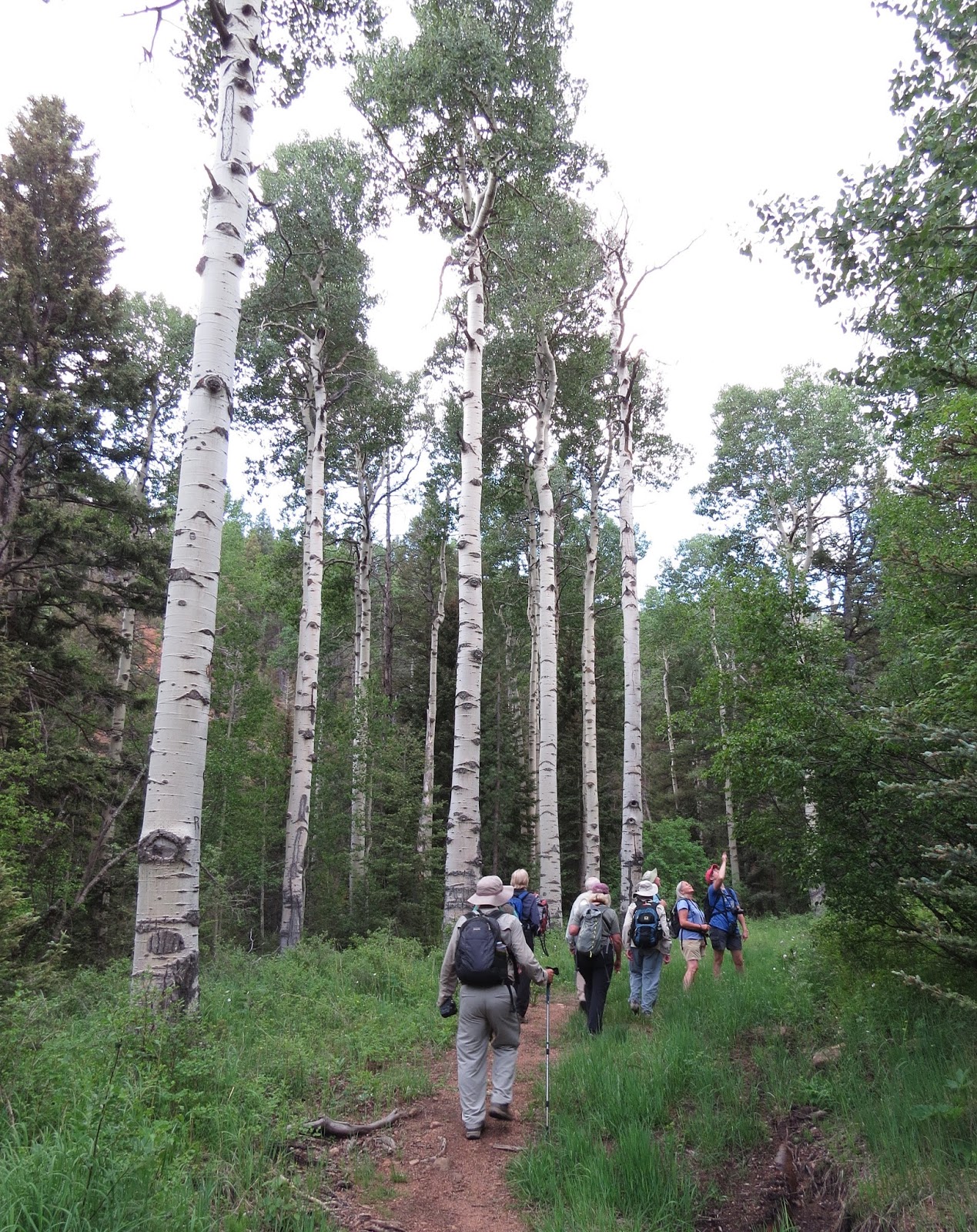
Indeed, one of the major attractions is a trio of orchid species that we seek to count every year as a measure of ecosystem health and vitality. This year, all three species were in veritable profusion.

Most spectacular of all are Yellow Lady Slipper orchids, Cypripedium parviflorum. We tallied something like 287 plants, most in bloom, some not. We speculated on what pollinates this spectacular plant, and I had to look up the particulars online. It turns out that bees are attracted to the blooms by color and fragrance, but upon entering the bulbous "shoe" they find no pollen or nectar. The interior of the flower is disorienting, and forces the bee to exit out the back where it either picks up packets of male pollen that adhere to the insect's back, or deposits existing pollen packets to a female receptacle organ, or both.

Bees are not terribly dumb, and after a couple exercises in futility they learn to avoid the orchid altogether. Consequently, few plants reproduce each year, but fertilized flowers produce a multitude of seeds to make up the deficit. Seeds germinate successfully only if they land in soil populated by a certain symbiotic fungus. Transplanted orchids are destined to fail in the absence of this fungus.

Another common orchid, at least this year, is the Green Bog Orchid, Platanthera aquilonis, which grows almost exclusively along the very edges of streams and in soil prone to flooding or puddling. We tallied roughly fifty or sixty of those, but they are so cryptic that we undoubtedly overlooked dozens more.

The oddest and most scarce orchid was the Spotted Coralroot, Corallorhiza maculata, a species that favors drier conditions than the other two. It is wholly dependent on microrhizal fungi to provide it nutrients, as it does not perform photosynthesis like most plants do. We found all six or eight specimens associated with conifers, growing beneath them.

Red-naped Sapsucker

While birds generally remained out of sight on this trip, we heard plenty, including a MacGillivray's Warbler. We did catch glimpses of Dark-eyed Junco, Steller's Jay, Western Tanager, American Robin, Yellow-rumped Warbler, Brown Creeper, and Northern Flicker. We heard Hermit Thrush and plenty of Warbling Vireos and House Wrens. Our favorite sighting was probably a pair of Red-naped Sapsucker woodpeckers, a species we see almost every time we visit Emerald Valley.

Weidemeyer's Admiral butterfly

Butterflies were common and diverse. Starting early as we do to avoid the inevitable stormy afternoons, we don't see some species, like Common Ringlet, until late morning or early afternoon. Present from the get-go is Weidemeyer's Admiral, males of which are territorial and ever-present along the road/trail.

Arctic Blue butterfly

Arctic Blues are having a good year, too, and you can see them on flowers or "puddling" at wet spots along the trail. Early on they bask on foliage, absorbing some solar radiation to help power their flight muscles.

Dreamy Duskywing skipper

The Dreamy Duskywing, a type of skipper, was a bit of a surprise. They are smaller than many other duskywings, but males perform the same territorial behavior of perching on tall, prominent objects and flying off to chase females or evict rival males.

Mourning Cloak butterflies sipping sap

At one point along the trail we came across a willow that was oozing sap from various wounds on its main branches. This attracted a multitude of Mourning Cloak butterflies, and a couple of Hoary Comma butterflies as well. Both species are "anglewings" that overwinter as adult butterflies.

Hoary Comma butterfly

These specimens represented the next generation, though. They were in excellent condition, with vibrant colors and intact wing edges (Hoary Comma has ragged wing edges by definition, though).

Mating Poplar-and-Willow Borer weevils

Also on the willow were a pair of mating weevils that I later identified as, no surprise here, Poplar-and-Willow Borer, Cryptorhynchus lapathi. They resemble little lumps of lichen, even individually, so it pays to take a second look when seeking them. The species is actually native to Eurasia, having been introduced here decades ago.

Female Trichiosoma triangulum sawfly

Also on the willow was a large female sawfly, Trichiosoma triangulum, probably looking for a leaf to insert her eggs into. The larvae of sawflies are caterpillar-like vegetarians that feed just like moth or butterfly caterpillars.

Male Elm Sawfly, Cimbex americana

Another member of this same family of sawflies (Cimbicidae), but larger still, is the Elm Sawfly, Cimbex americana. Several hefty males of this species were engaging in aerial duels in a meadow farther back down the trail. These are intimidating wasps, but they do not sting and can be approached closely if you are patient and stealthy.

Field Crescent butterfly on Black-eyed Susan coneflower

The meadows that punctuate the forest hold a great deal of insect diversity, but rather than make an exhaustive inventory here, I have created a photo album for "Emerald Valley, 2016" on my Flickr photostream.

Wednesday, June 29, 2016

More Drama at the Bee Block

I was going to write at some point about how one of the other benefits of putting up a bee block ("bee condo") for solitary bees and wasps is that their parasites have a harder time finding them there than in a more natural situation. Well, last week I was proven completely wrong about that. On the positive side, I identified two new tenants in the block in our backyard.

Female mason bee, Heriades sp., on milkweed, before I had identified it

Early in the week I happened to see an insect fly from one of our blooming milkweed plants and literally make a bee line into one of the smaller holes in our bee block. I was not able to make an identification, so swiftly did it disappear.

Stakeout: female Sapygid wasp patiently eyeing potential hosts

Friday, June 24, I happened to glance at the bee block and noticed a very slender insect in one of the corners. I broke out the camera, took a couple pictures, and identified it as a sapygid wasp, family Sapygidae. Sapygids are parasitic on bees in the families Megachilidae and Apidae, and mason wasps in the family Vespidae, subfamily Eumeninae. The larvae of the sapygids either feed on the food stored for the host's offspring, or live as ectoparasites on the host larvae. Great.

Territorial dispute? Another sapygid joins the first one

Oh, here comes *another* sapygid. There were two on the nest block for only a brief time, and though it is not easy to separate the genders, I had no way of telling if it was a pair, or I believe they were two competing females. Males have even longer antennae and a blunter tip to the abdomen.

While photographing one of the sapygids, I got lucky. One of my pictures captured the mystery lodger in the bee block from earlier in the week.

Target detected: Sapygid wasp spies Heriades mason bee giving away its nest location

The insect coming to one of the smallest diameter holes is a type of mason bee in the genus Heriades. There are only eleven species of Heriades in North America north of Mexico, and five species in Colorado. Only Heriades cressoni has been officially recorded in El Paso County, but our bee block resident could still be one of the other species.

The female bee uses a pre-existing tunnel, such as an old beetle boring in a dead tree or log, or a hollow twig, in which to make her nest. She creates a series of cells with a partition of plant resin dividing one from another. She usually leaves one empty cell at the entrance before sealing the completed nest with a resin plug. Should a parasite break in, it might be duped into thinking the nest was empty; or at least dissuaded from having to break through a second "door."

Female Heriades sp. mason bee collecting pollen beneath her abdomen

The mother bee gathers pollen with a brush of hairs on the underside of her abdomen. Back at the nest she mixes the pollen with nectar she regurgitates from her crop (an internal food storage organ). This is "bee bread" that she fashions into a ball or "loaf" for each cell. She then lays an egg in the cell, and finally seals it with the resin partition. She repeats this scenario until the nest cavity is filled.

The sapygid wasp that had been waiting patiently for just the right moment to lay her own eggs in the bee nest finally made her move. She quickly backed halfway into the hole on the bee block and presumably deposited one or more eggs before fleeing the scene. This is the strategy that many, if not most, bee parasites use. They stake out a nest in the process of being provisioned, and enter when the host bee leaves to gather more nectar and pollen, or material used in making a partition between cells.

Game on! Female sapygid wasp laying eggs in Heriades mason bee nest

Another surprise happened when I saw a mason wasp approach and then enter another hole on the block. This one is different from the one I wrote about a couple weeks ago. It is smaller and more ornately patterned. It is either Parancistrocerus sp. or Stenodynerus sp. One cannot tell the two apart from images of live specimens in most cases. Even with actual specimens under a microscope it is difficult to make an identification. Like most cavity-nesting mason wasps, paralyzed caterpillars will serve as food for the larval offspring.

Female mason wasp, Parancistrocerus sp. or Stenodynerus sp.

I can hardly wait to see what comes next to our bee apartment building. Please comment if you yourself have a bee block (or more than one), and share what is coming and going from it, what parasites or predators you have seen lurking, and any other pertinent observations.

Sources: Krombein, Karl V. 1967. Trap-nesting Wasps and Bees: Life Histories, Nests, and Associates. Washington, DC: Smithsonian Press. 570 pp.
Scott, Virginia L., John S. Ascher, Terry Griswold, and César R. Nufio. 2011. "The Bees of Colorado (Hymenoptera: Apoidea: Anthophila)," Natural History Inventory of Colorado No. 23, University of Colorado Museum of Natural History, Boulder, Colorado. 112 pp.
Scott, Virginia. 2015. "Resin Plugs (part 1) and Their Bugs," The Bees' Needs Blog.

Saturday, June 25, 2016

Beetle Bonanza

Back on June 13, while my wife and I were headed to a different destination, we passed by a logging mill operation in Black Forest, northeast of Colorado Springs. I wanted to go back another time, and did so on my own this past Thursday, June23, but not without much trial and error. It was a rewarding outing once I got there, with beetles of all kinds flocking to the freshly-cut Ponderosa Pine logs.

Jewel beetle, Chrysobothris dentipes

It turns out I had not been paying enough attention to the route we had taken the first time, and so on Thursday I became hopelessly lost. I phoned my wife and she informed me I was nowhere near the right road. Consequently, I got to the site in the late morning. When I arrived, there was no one to be seen. I looked around anyway, as there were also no postings against trespassing.

The first insects I saw were what I expected: medium-sized jewel beetles, Chrysobothris dentipes, as depicted above. These members of the family Buprestidae look exactly like little shards of pine bark, but they move often enough to be easily seen. Several males were engaging in "butt-thumping" displays to nearby females. Below is a very brief video depicting this. It is surprisingly audible, and also hilarious. I hope to go back again and get a longer video segment.

Also present were a fair number of the magnificent metallic green Phaenops gentilis. Though they are only about 8 millimeters in length, these buprestids are still conspicuous. Like most jewel beetles they are quick to fly when disturbed, though they usually simply run so erratically as to be nearly impossible to get an image of. Females pause often to lay eggs, though, so that is your one opportunity. The one below took time to groom itself and luckily I was in the right place at the right time.

Jewel beetle, Phaenops gentilis

While I was photographing another insect, I glanced down to see a very large buprestid that had landed on my shoulder. I grabbed it, and it turned out to be a Western Sculptured Pine Borer, Chalcophora angusticollis. Measuring 20-33 millimeters, they are among our largest jewel beetles. When they fly, the lifted elytra (wing covers) expose a bright blue, green, or violet abdomen. I brought it, and another specimen, home to photograph.

Western Sculptured Pine Borer

What surprised me most were the large numbers of predatory checkered beetles, family Cleridae, active hunters of bark beetles and other small insects. I thought that I was seeing one species, with individuals of varying sizes, but upon looking at my images it became apparent there were three species.

Checkered beetle, Enoclerus moestus

Enoclerus moestus was the first one I came across. E. lecontei was likewise common.

Checkered beetle, Enoclerus lecontei

Lastly, the largest species was the "Red-bellied Clerid," E. sphegeus. While the adult beetles will kill and consume a variety of other insects, the larvae appear to prey exclusively on bark beetle larvae. You know, like the Mountain Pine Beetle and its relatives that are often blamed for killing entire forests.

Red-bellied Clerid, Enoclerus sphegeus

Longhorned beetles were present on the log stacks as well. I expected the White-spotted Sawyer, Monochamus scutellatus, and indeed I found a couple of females, one of them ovipositing, and a single male. These are large beetles that live up to the longhorn name. Their antennae are exceptionally long, especially in the males.

Female White-spotted Sawyer laying eggs

The most abundant of the longhorns, though, were flower longhorns in the genus Grammoptera. I even found a pair mating.

Flower longhorned beetles, Grammoptera sp., mating

The freak of the longhorn show was the Ribbed Pine Borer, Rhagium inquisitor. The adults look very little like a typical longhorned beetle, having quite short antennae. Two specimens landed on me or in my vicinity.

Ribbed Pine Borer

They are medium-sized at 12-15 millimeters in body length. They get their name from the woven wreath-like ring consisting of coarse wood fibers that the larva creates for its pupal chamber.

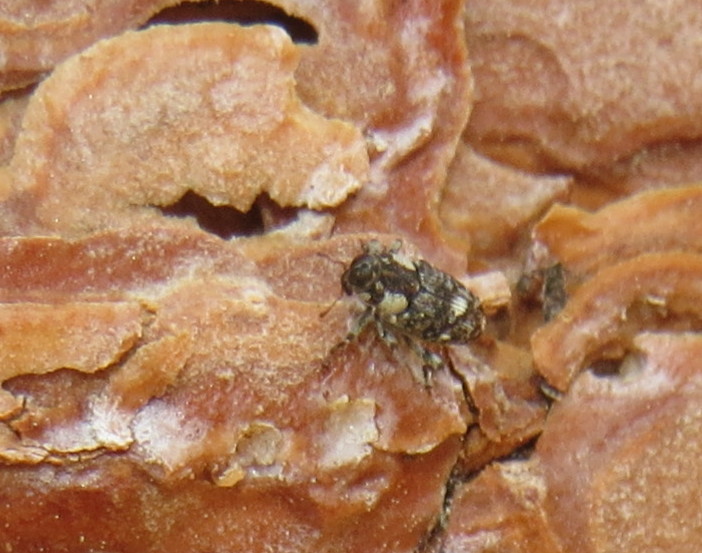
I also found a few oddball beetles including a very tiny weevil, Lechriops californica. At least that is what I think it is. They bore, in the larval stage, under the bark on the trunk and larger branches of various pines.

Tiny weevil, Lechriops californica maybe

Another predatory beetle was a very small clown beetle, family Histeridae. It may belong to the genus Platysoma, which live under bark and hunt the larvae of flies and beetles.

Clown beetle, Platysoma sp.

There were non-beetle insects, too, of course. The most common were the syrphid fly Chalcosyrphus piger. Females were alighting on the logs, presumably to oviposit (lay eggs) there. The larvae of these flies feed on decaying wood, and perhaps fermenting sap.

Syrphid fly, Chalcosyrphus piger

The most exciting find was a female aulacid wasp, family Aulacidae, in the genus Pristaulacus. They are easily mistaken for ichneumon wasps at first glance, but the ovipositor is downcurved at the tip; and the abdomen is connected high on the back of the thorax. These wasps are more closely allied to ensign wasps (Evaniidae) and carrot wasps (Gasteruptiidae). They are parasites of wood-boring beetles, surprise, surprise.

Aulacid wasp, Pristaulacus sp.

I am looking forward to returning to this site, as long as I am welcome. Those towering stacks of big pine logs are a bit intimidating, I have to admit, but worth braving for the bounty of beetles.

Male longhorned beetle, Acanthocinus obliquus

Sources: Cowan, B.D. and W.P. Nagel. 1965. "Predators of the Douglas-Fir Beetle in Western Oregon," Technical Bulletin 86, Agricultural Experiment Station, Oregon State University, Corvallis, Oregon. 32 pp.
Furniss, R.L. and V.M. Carolin. 1977. Western Forest Insects. Miscellaneous Publication No. 1339, U.S. Department of Agriculture, Forest Service, Washington, DC. 654 pp.
Smith, David R. 1996. "Aulacidae (Hymenoptera) in the Mid-Atlantic States, with a Key to Species of Eastern North America," Proc. Entomol. Soc. Wash.. 98(2): 274-291.

Wednesday, June 22, 2016

A "Boring" Place to Nest

Last week I talked about the benefits of putting out bee blocks ("bee condos") for solitary bees and wasps to nest in. I thought it might help to understand why this is important in light of where these insects normally nest in nature.

Passaloecus aphid wasp near her nest hole

Dead, dying, and weakened trees are exploited by a number of different wood-boring beetles. The adult female beetles lay their eggs in bark crevices and the larvae that hatch then bore into the wood, feeding as they go. Eventually they enter the pupa stage near the surface of the wood. The adult beetle that emerges from the pupa then chews its way out. The result is a round or oval exit hole.

Solitary bees and wasps make use of these abandoned beetle borings. In fact, competition for the right size holes is keen. A wasp can modify the entrance to some degree by chewing-off wood fibers to expand the size, or plastering mud or resin to shrink the opening. That is a lot of effort, though, so wasps will look high and low for a hole that fits them perfectly.

A typical deathwatch beetle, family Ptinidae, that makes the holes that many wasps nest in

Among the most coveted of holes are those made by emerging deathwatch beetles in the family Ptinidae (formerly Anobiidae). These are tiny insects, and you might be hard-pressed to fit an entire pin or tack (head and all) into one of their perfectly round exit holes. Deathwatch beetles are also prolific, and so there will be many holes in a given dead tree. It may look like someone fired a load of buckshot into the bole.

A super-slender keyhole wasp, Trypoxylon sp., about to enter her hole

Last week I came across just such a tree, a cottonwood, that was teeming with wasps coming and going from various holes. I recognized at least three genera: Symmorphus mason wasps, Trypoxylon keyhole wasps, and Passaloecus aphid wasps. None measured more than about six millimeters. Mason wasps harvest caterpillars as food for their offspring. Keyhole wasps hunt spiders, and aphid wasps go after aphids. Some yellow-faced bees, also known as masked bees, genus Hylaeus, are also known to use such holes.

A cuckoo wasp, family Chrysididae, bides her time

Meanwhile, metallic green cuckoo wasps, family Chrysididae, and wild carrot wasps, family Gasteruptiidae, were looking for opportunities to lay their own eggs in the nests of the other wasps, at the expense of the host's offspring. Mostly, though, there was competition for nest holes, and male wasps harassing the females for mating opportunities. A male or two might jump on a female, and they would tumble off, leaving the door open for another female wasp to claim the nest hole.

Want to witness this action yourself? Look for dead, standing or half-fallen trees with bark stripped off, and usually in a shaded location or at least on the shady side of the tree itself. You might be surprised to see a wasp enter a hole head first, then exit the hole the same way. Somewhere inside there is enough room for the wasp to turn around.

A mason wasp, Symmorphus sp., checks out her potential new digs

You may have trouble finding dead trees, and this is why solitary wasps and bees need our help. Property owners, and even managers of natural parks, will cut down trees deemed a potential hazard, such that they can avoid potential liability issues including litigation should a tree fall on a person, vehicle, home, or other valuable object. The consequences of this include a housing shortage for everything from flying squirrels, woodpeckers, swallows, wrens, owls, and other birds, to solitary bees and wasps.

Please consider building or buying a simple, but quality, bee block and installing it somewhere on your property. You can find resources to do that in last week's blog post. Let me know what tenants you get as a result. We know precious little about most insects that are not considered economically important in a good or bad way, so all observations are important. Thank you.