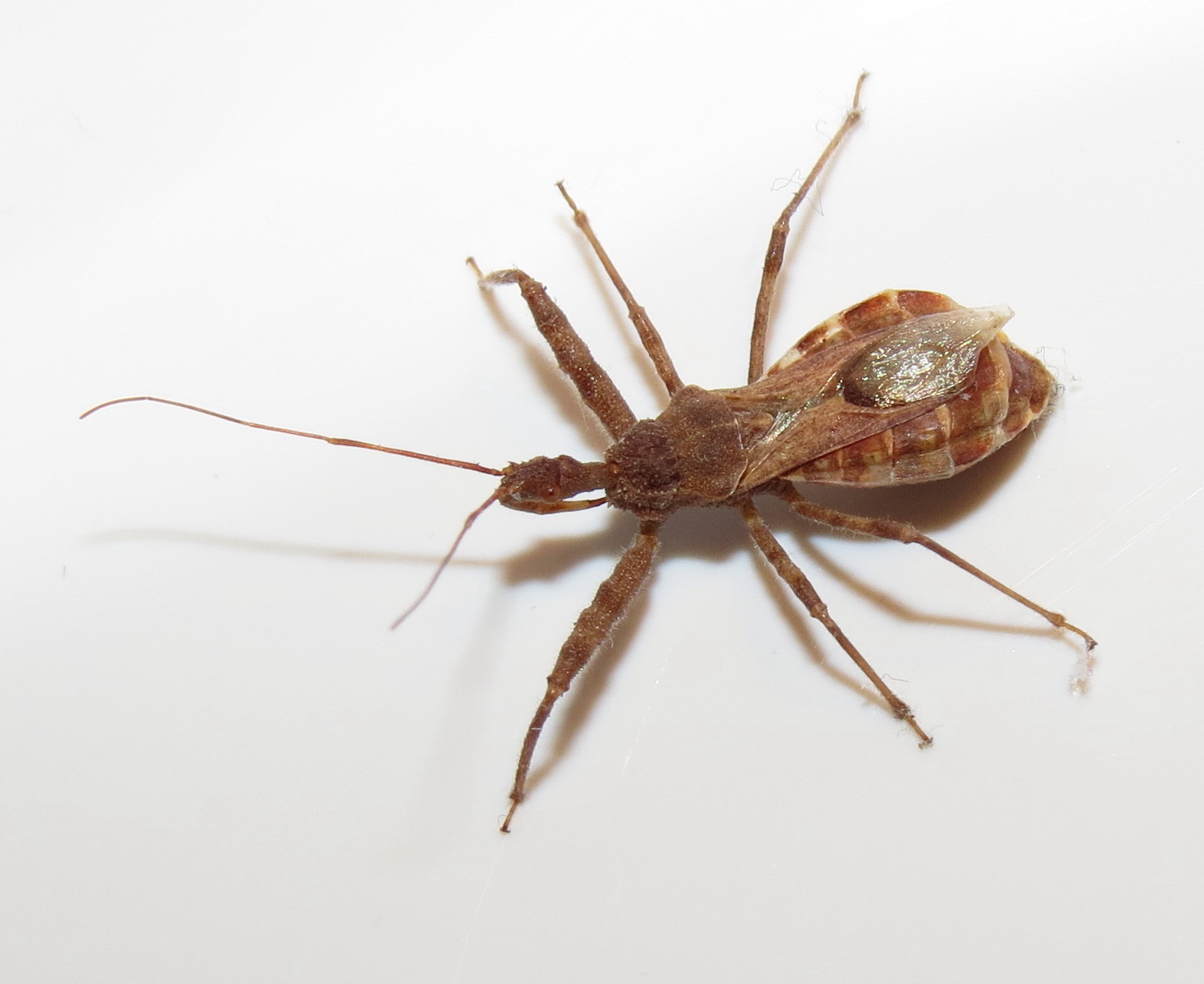
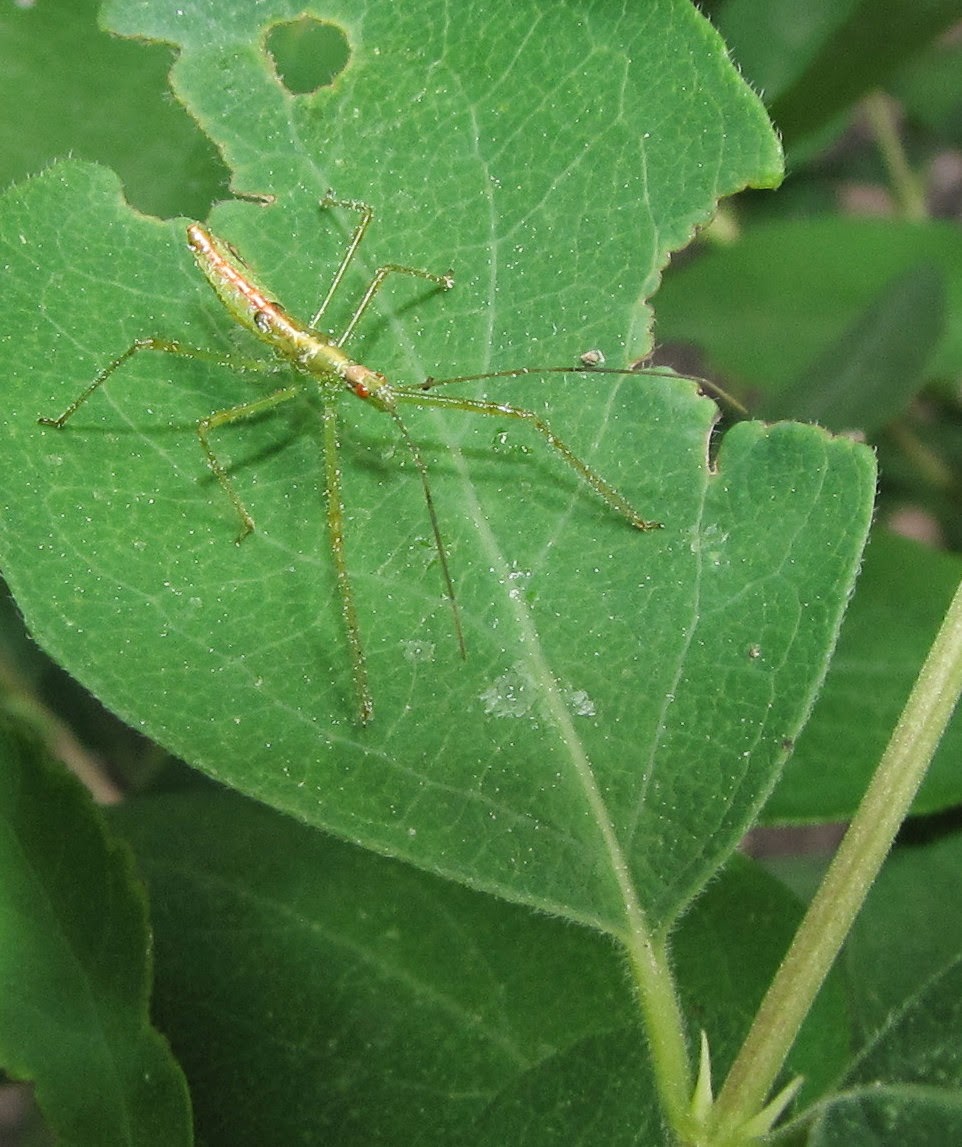
Showing posts with label True Bug Tuesday. Show all posts

Tuesday, February 7, 2017

It's Always Something....

To quote the lovely Ms. Rosanne Roseannadanna, "It just goes to show you, it's always something." It may take months, even years, to learn that something you observed and recorded is noteworthy, or potentially so. Such was a recent case in which an image I posted on Bugguide.net was finally identified, more or less, leaving still more questions than answers.

November 27, 2014, Thanksgiving Day in the U.S., I was at the Cheyenne Mountain Zoo where my wife works as a primate keeper. The zoo restaurant staff caters a holiday lunch, and employees bring potluck dishes to supplement. Before and after the feast, I was out looking for insects, as the weather was reasonably conducive to finding late autumn macro-fauna.

On a wooden fence railing I spotted what at first I thought might be an aphid. Upon closer inspection, it was an aphid relative known as a "jumping plant louse" or psyllid. This is a tiny insect. Total body length is only 2.6 millimeters, or 4-4.5 mm if you measure from head to wingtip. It varies from light green to greenish gray.

Psyllids were once lumped into a single family, but research has shown that there are several families. A few species are very abundant and conspicuous, like hackberry psyllids. A few others are economically impactful, especially in orchard crops. The remaining majority are poorly known, keeping a very low profile on native plants.

The image I uploaded to Bugguide understandably floundered in obscurity until February 2 of this year when I received notification that someone had left comments and even moved the image into genus-level classification. I was grateful, but also surprised by the comments left by Chris Mallory:

"Bactericera nr. arbolensis
In nearly every regard it is consistent with this Shepherdia-associated species originally described from Arboles, CO. However, the medial cell of the forewing is much smaller than described and illustrated, and in this aspect it does not agree with any known described species.
There could be several reasons for this. First, the size of the medial cell of B. arbolensis may be more variable than the literature suggests. Alternatively, this may be an undescribed but related species. In either situation it is a very interesting find. I'd love to see more of them."

Wow. Chris Mallory is an expert on the superfamily Psylloidea; and is also one of the individuals behind the comprehensive online guide SoCalFauna.net, a photographic gallery of most of the animals one is likely to encounter in southern California.

Thanks to the in-depth profile page at Chris's Psyllids.info website, I learned that the species he thinks it might be is known from Silver Buffaloberry, Shepherdia argentea and Canadian Buffaloberry, Shepherdia canadensis. Neither of those plants is very common, if found at all, along the Front Range of Colorado. It is, however, conceivable that the zoo landscapes with one or both of them, so I will have to check out that possibility. Meanwhile, there are few literature records of the psyllid itself: MONTANA: Roosevelt County; WYOMING: Sweetwater County: Green River; COLORADO: Montrose County: Cimarron; LaPlata County: Durango; Archuleta County: Arboles. All but the Montana record are from west of the Continental Divide. The type specimens, those from which the insect was described and named, were 3 males and 4 females collected by C.F. Baker in Arboles.

There are 24 known species of Bactericera found in North America north of Mexico, and mine is potentially a twenty-fifth. This just goes to show you, you never know what you might turn up if you point your gaze, and camera or phone, at a yittle, teeny-tiny bug.

Sources: Crawford, D.L. 1914. A Monograph of the Jumping Plant-lice or Psyllidae of the New World. 85: 186 pp. Government Printing Office, Washington, DC.
Tuthill, L.D. 1943. "The Psyllids of America North of Mexico: (Psyllidae: Homoptera)," Iowa State College Journal of Science. 218 pp.

Tuesday, February 2, 2016

Damsels That Cause Distress

Note: The subject for this post was requested by one of my followers. You, too, are welcome to make requests for subjects or topics. Simply e-mail: bugeric247ATgmailDOTcom.

Nabis sp. from Colorado

You would think that insects called "damsel bugs" would be delicate and and otherwise dainty. Well, many members of the true bug family Nabidae are delicate, and certainly small, there is nothing meek about them. They are mostly nocturnal predators that can subdue other insects even larger than themselves.

Hoplistoscelis pallescens, Massachusetts

There are nine genera and 41 species of damsel bugs in North America north of Mexico. None of them are greater than 12 millimeters in length as adults, most of them smaller than that.

Nabis sp. from Colorado

The femur segment of the front leg is usually muscular and swollen, armed with at least one row of small teeth on the underside. This helps the insect to secure prey.

Some nabids are wingless when mature, or have forms with abbreviated and useless wings. Those that fly are often attracted to lights at night, perhaps to prey on other insects drawn there.

While I was in Massachusetts in 2009, I witnessed a specimen of Nabis roseipennis stalk and assassinate a small braconid wasp. The persistence and fearlessness of the little true bug was impressive.

Nabids are easily mistaken for other kinds of true bugs, and it takes a bit of practice to recognize them. Most assassin bugs (Reduviidae) are larger, but they and damsel bugs both have a short rostrum ("beak") compared to most plant-feeding true bugs.

Plant bugs in the family Miridae are perhaps the most similar to damsel bugs, but mirids have a "cuneus," a pronounced wrinkle or notch in the margin of the front wing near where the leathery portion meets the membrane near the tip. Damsel bugs lack this feature.

Here in Colorado, one of our common damsel bugs is a small, dark, ground-dwelling member of the genus Pagasa. They are almost beetle-like in appearance, and I have mistaken more than one for a ground beetle as it ran across the path in front of me. Pagasa can be fully-winged or have wings reduced to non-functional pads.

Pagasa sp., Colorado

The tip of the tibia on the front leg of Pagasafeatures a specialized pad of hairs called the fossa spongiosa that aids them in climbing slick surfaces and grabbing slippery prey.

Pagasa sp., Colorado

So effective are damsel bugs as predators that they are considered economically important as pest control in agricultural systems. Indeed, they are also among the most abundant of small predators.

Nabis capsiformis from south Texas

Sources: Henry, Thomas J., and Richard C. Froeschner. 1988. Catalog of the Heteroptera, or True Bugs, of Canada and the Continental United States. New York: E.J. Brill. 958 pp.
Kerzhner, Izyaslav M., and Thomas J. Henry. 2008. "Three new species, notes and new records of poorly known species, and an updated checklist for the North American Nabidae (Hemiptera: Heteroptera)," Proc. Entomol. Soc. Wash. 110(4): 988-1011.
Slater, J.A. and R.M. Baranowski. 1978. How to Know the True Bugs. Dubuque, Iowa: Wm. C. Brown Company Publishers. 256 pp.

Tuesday, January 26, 2016

That Internet "Killer Bug" Hoax

I could write blog posts about internet hoaxes from here until the end of time. The latest is a "killer bug" that you should not kill with your bare hands because it spreads a lethal virus that also disfigures your skin. What a crock! Thanks to Hoax-Slayer we have the straight scoop.

Well, I can tell you about the insect pictured. Truth may be stranger than fiction in this case. Males of giant water bugs in the genera Belostoma and Abedus care for the eggs of their mates by carrying them on their backs. That's right, these giant water bugs, far from being people-killers, are the poster children for what a caring father looks like.

Male Abedus sp. giant water bug with eggs

The female giant water bug adheres her eggs to the back of the male, and he then guards them. He keeps the ova free of fungus, and well-aerated.

Ok, so what about the horror of that human hand? According to Hoax-Slayer, it is the work of a make-up artist, wrought of putty rather than some horrid disease. The sponge-like texture and pattern simply resembles the hatched eggs on the back of a male giant water bug.

Similar hoaxes have used photo-editing techniques to merge lotus pods or the mouths of lampreys with human body parts, the better to gross-out viewers.

According to an article on Snopes.com, yet another factor comes into play. The meme may be targeting people with "trypophobia," a supposed fear of holes or fear of irregular patterns of holes. No such phobia is documented in scientific literature, however. So, apparently this hoax is a triple-header: fear of insects, fear of disease, and fear of holes, all wrapped up in one whopper of a tale.

There is a slight grain of truth to this over-dramatized viral meme, though. Giant water bugs are predators of other aquatic organisms, and they deliver a venomous bite to paralyze their prey. The venom contains enzymes that aid in extraoral digestion. That is, the saliva begins breaking down tissues of the prey so that it can be withdrawn through the insect's beak and into its digestive system. The bugs will bite in self-defense, too, so handling them should be discouraged for that reason.

Ah, if only truthful information spread as quickly and effectively as fear-inspiring hoaxes like this. Please do your part by investigating the validity of a given meme before sharing it....or share it with a bold disclaimer. Thank you.

Tuesday, October 27, 2015

Autumn Assassins: Acholla spp.

Everyone has their own icon for a harbinger of fall, but mine has to be the assassin bugs in the genus Acholla (Gesundheit!). Adult specimens can actually be found regularly beginning in July, at least in some localities, but are most obvious in autumn, perhaps because foliage is falling and prey insect populations are beginning to decline.

A. multispinosa, Massachusetts

I first encountered these assassins in Massachusetts in 2009. I found one climbing on a signpost at the Mount Sugarloaf State Reserve in South Deerfield on November 1. Acholla multispinosa is our most widespread species, the only one found in eastern North America from New England south along the Appalachia Mountains to Tennessee and North Carolina, west through the Great Lakes, to Kansas, Nebraska, and southeast Iowa.

Male A. ampliata, Colorado

Here in Colorado, our common species is A. ampliata, which also occurs in California, Utah, Arizona, and New Mexico. Last year I found one on September 2, and another on September 8, both apparently males. I found what I assume to be a gravid female just last Friday, October 23, 2015. All the specimens were found beneath a large cottonwood tree in our reasonably urban, residential neighborhood. The bugs had apparently fallen out of the tree and were on a tall, plastic utility box beneath it.

Gravid female A. ampliata, Colorado

Acholla is easily mistaken for the more common Sinea species, but lacks the "thorny" appearance of that genus, and has no prominent spines on the inner surface of the tibia ("shin" segment) on the front leg. Acholla average slightly larger, too, ranging from 12-16 millimeters in body length compared to 12-14 for Sinea.

There is a third species of Acholla, A. tabida, found in California and Mexico.

Another male A. ampliata

What do these assassin bugs feed on? According to one reference, A. multispinosa is an enemy of the Pine Webworm, Pococera robustella, a caterpillar in the moth family Pyralidae. Another source reports the bug to prey on caterpillars of the Codling Moth, Cydia pomonella, family Tortricidae (the "worm" in the apple). Acholla in general are mostly arboreal (tree-dwelling) and thus feed upon insects associated with trees. Indeed, woodlands and orchards seem to be this insect's primary haunts.

A. multispinosa, Massachusetts

Acholla overwinters in the egg stage. The eggs are adhered to a substrate with, and protected by, a hardened secretion from the female's subrectal glands. This material probably insulates the eggs from weather and dessication, but may also repel potential egg predators. Diligent searching has failed to turn up any further information on the life history of Acholla. More appears to be known about its chromosomes, ironically enough.

So, before you put away your field gear for the winter, take one last look for these autumn assassins. You might easily add to our knowledge of their geographic distribution and natural history.

Sources: Drooz, Arnold T. 1985. Insects of Eastern Forests. Washington, DC: U.S. Department of Agriculture Forest Service, Miscellaneous Publication No. 1426. 608 pp.
Hoffman, Richard L. 2006. "Assassin Bugs of Virginia," The Insects of Virginia. No. 15. Martinsville: Virginia Museum of Natural History. 74 pp.
Slater, J.A. and R.M. Baranowski. 1978. How to Know the True Bugs. Dubuque, Iowa: Wm. C. Brown Company Publishers. 256 pp.
Swanson, D.R. 2011. "New State Records and Distributional Notes for Some Assassin Bugs of the Continental United States (Heteroptera: Reduviidae)," Great Lakes Entomologist 44(3-4): 117-138.

Tuesday, May 26, 2015

Welcome to Brood IV (Periodical Cicadas)

My wife and I scheduled our recent visit to see her parents in Leavenworth, Kansas specifically around the time when Brood IV of the periodical cicadas (Magicicada spp.) would be emerging, singing, and laying eggs. By all historical accounts, we should have timed it almost perfectly. Unfortunately, brutal weather turned that particular goal into an almost total bust.

At any given locality in the eastern United States, Magicicada emergences happen only every 13 or 17 years. Scientists remain puzzled by the potential reasons for such a sporadic, synchronous spectacle in which millions of cicadas erupt from their underground lair to shed their youthful exoskeletons for winged adulthood.

Different populations of periodical cicadas, also known as 17- or 13-year "locusts," have been assigned Roman numerals denoting "broods." Each brood has an emergence on a thirteen or seventeen year cycle. The thirteen-year cicadas typically range in the south, while seventeen-year broods occur mostly in the north. There is usually more than one species represented in each brood. This is an extra-special year because both the 17-year Brood IV and the 13-year Brood XXIII are emerging. This happens once every 221 years.

A shed exoskeleton

Brood IV ranges from southwest Iowa and southeast Nebraska through western Missouri, Eastern Kansas, much of Oklahoma, and extreme northern Texas (eastern half). Brood XXIII emerges from Illinois and southwest Indiana to Louisiana, following the Mississippi River valley.

Initial observations of periodical cicadas by early settlers in 1633 were rife with errors. Those mistaken beliefs were repeated in a 1666 English publication. The only such massive appearances of a single kind of insect that the colonists were familiar with were plagues of migratory grasshoppers, so they assumed that the cicadas, too, were "locusts," hence the incorrect label that has persisted to this day.

Cicadas are actually true bugs in the order Hemiptera, suborder Auchenorrhyncha. Leafhoppers, treehoppers, and planthoppers are all related to cicadas. They all have piercing-sucking mouthparts with which they tap plant juices for food. Despite their overwhelming numbers, periodical cicadas do remarkably little damage in either the nymph or adult stage.

Damage to trees occurs when the female cicada forces her spear-like ovipositor into a twig or branch to lay her eggs. She does this with enough force that it can snap the twig, causing the foliage beyond the break to die and turn prematurely yellow or brown. This phenomenon is called "flagging." It also occurs when more than one female oviposits in the same twig.

Tiny cicada nymphs hatch from these eggs and plummet to the ground where they immediately dig into the soil. There they will spend the next thirteen or seventeen years (depending on the species), feeding on the roots of trees, shrubs, and other plants. At the end of their underground life they surface, sometimes erecting "chimneys" above the surface of the soil. They clamber out, and up the nearest vertical object. Their front legs are like grappling hooks, and they secure themselves to the object. The exoskeleton then splits down the back and out comes a fledgling adult cicada. It is white, with patches of black across the thorax, and bright red eyes. The wings inflate in a matter of minutes, but it takes hours for the new exoskeleton to harden and the black and orange pigments to fully manifest.

Male cicadas have a pair of percussion organs inside their abdomen, and opening on the underside of the insect. They can generate a very loud "song" in this manner and, obviously, the more cicadas the louder the concert. The adult insects live just long enough to procreate before falling victim to predators, a parasitic fungus, sheer exhaustion, or old age.

There are three species of Magicicada with a 17-year cycle, and four species with a 13-year cycle. One of these thirteen-year species, M. neotredecim, was only discovered in the year 2000. The songs of the different species differ perhaps more than the physical appearance of the insects.

There are at least 9 shed exoskeletons in this image

When we happened upon Brood IV in northwest Missouri, the emergence had barely begun. We saw numerous shed exoskeletons, but found only four or five adult specimens, one only hours old. Meanwhile, there was evidence of rampant predation by birds. There were wing fragments everywhere. What a disappointment. Only a week later, I am receiving reports from friends that the emergence has finally overwhelmed mortality factors, and males are forming choruses.

I have no idea when I will get another opportunity to document a Magicicada brood in the manner I want to for all of my readers here. Thankfully, there are plenty of other resources online, including the "Cicada Mania" website, the "Periodical Cicada Page" produced by the University of Michigan, and "Cicada Central,", a project of the University of Connecticut.

Tuesday, January 20, 2015

Rough Stink Bugs

Rough stink bugs in the genus Brochymena, native to North America, have suffered ever since the arrival of the invasive Brown Marmorated Stink Bug from Eurasia. The two are easily confused at first glance, but if you find large numbers of stink bugs in or around your residence, chances are it is the invader, not our natives. Brochymena also overwinters in the adult stage, but usually stays outdoors, tucking itself under loose bark with other members of its kind, or finding some other snug place where conflict with people is minimal.

Last month I had occasion to go to Portland, Oregon, where I encountered the specimen shown above. It is likely Brochymena affinis, but identifying rough stink bugs to species is difficult if not impossible without scrutinizing the (dead) creature under a microscope.

Many times you will find Brochymena out and about on warm, sunny winter days. That does not mean they are easy to spot, however. They resemble both in appearance and texture the lichen-mottled bark on trees. Indeed, their other common name is "tree stink bugs." Adults fly well, and may alight on fences, the sidewalk, or some other similar, contrasting backdrop, and it is then that one usually recognizes them as animate objects.

Brochymena arborea, Manhattan, Kansas

Depending on which authority you consult, there are somewhere between 21 and 23 species of Brochymena found in North America north of Mexico. Adults of our species collectively range from 10-19 millimeters in body length, and are an overall gray color with black and white or ivory speckling. Eggs are laid in small clusters on twigs of trees, and the nymphs that hatch progress through four instars (an instar is the interval between molts) before reaching adulthood. Their development from egg to adult is surprisingly long, so there is but one generation produced annually, at least in temperate climates.

Young Brochymena nymph, Arizona
Fourth instar nymph, Texas

Their ability to withstand cold became abundantly clear to me when I was still collecting and preserving specimens. When I was in Cincinnati I discovered an aggregation of rough stink bugs beneath a shard of bark on a tree. I attempted to kill some of them by placing them in a container inside my freezer. I think I left them there about a week or so, took them out, and found them coming back to life in short order.

Rough stink bugs are not pests in any way, shape, or form, so consequently rather little is known about these insects of non-economic importance. They are suspected of feeding on the sap of host trees and shrubs, though there are persistent rumors that they are occasionally predatory. Since many true bugs (Hemiptera: Heteroptera) are opportunistic predators or scavengers on other insects, this may not be a stretch.

Brochymena sulcata? Colorado

So, how does one tell a harmless Brochymena from a pestiferous Brown Marmorated Stink Bug (BMSB)? First, look at the antennae. The BMSB has white bands on the last two antennal segments. Rough stink bugs have no such contrasting markings on the antennae. Second, look at the leading edge of the pronotum (top surface of thorax), right behind the head. There are fine teeth along that edge in Brochymena, not so in the BMSB.

Brochymena from Colorado: Note dark antennae, teeth on leading edge of thorax
Brown Marmorated Stink Bug: Note banded antennae, no teeth on front edge of thorax

Given their cryptic nature, it amazes me that any other creature could find them and make a meal out of them, but enemies they do have. Rough stink bugs are known to be the prey of the sand wasp Bicyrtes quadrifasciata, for example. The female wasp finds a stink bug, stings it into paralysis, and then flies it back to her nest burrow where she deposits it as food for her larval offspring. Birds, and fence lizards are also recorded as predators of the adult bugs. Feather-legged tachinid flies in the genus Trichopoda glue their eggs to the top of a stink bug's body where the insect cannot reach to groom them off. The fly larva that hatches bores through the exoskeleton of the host and feeds as an internal parasite, usually killing the bug eventually.

Brochymena quadripustulata, New Jersey

The eggs of Brochymena are also parasitized by the tiny platygastrid wasps Trissolcus brochymenae and Telenomus sp.; and the eupelmid wasp Anastatus reduvii.

Look for rough stink bugs in spring and fall when they are emerging from, and entering, hibernation. You'll have to look closely, though, given their camouflage.

Sources: Cuda, J.P. and J.E. McPherson. 1976. "Life History and Laboratory Rearing of Brochymena quadripustulata with Descriptions of Immature Stages and Additional Notes on Brochymena arborea (Hemiptera: Pentatomidae)," Ann. Ent. Soc. Amer. 69(5): 977-983.
McPherson, J.E. 1982. The Pentatomoidea (Hemiptera) of Northeastern North America with emphasis on the fauna of Illinois. Carbondale: Southern Illinois University Press. 240 pp.
Sutherland, Carol, and C. Scott Bundy. 2012. "Real Stinkers in Pecan Production: Stink Bugs, New & Old (plus Leaf-footed Plant Bugs)," Proceedings of the 46th Annual Conference of the Western Pecan Growers Association, pp. 44-55.

Brochymena sp., Colorado

Tuesday, November 11, 2014

Little Bugs with a Big Bite: Minute Pirate Bugs

Sometimes it seems the tiniest of insects is the biggest nuisance. Mosquitoes come to mind, as well as black flies, and "no-see-ums" or "punkies" (biting midges in the family Ceratopogonidae). One other insect often responsible for surprisingly painful bites is the aptly-named "minute pirate bug." There are about 90 species in the family Anthocoridae found in North America, in 22 genera, but only a few cause us grief.

Insidious Flower Bug biting me in Colorado

The Insidious Flower Bug, Orius insidiosus is, appropriately, the species most likely to get under your skin. Well, on your arm, hand, or neck, where it will likely probe you painfully. At only 2-2.5 millimeters, it is possible to overlook it entirely when trying to pinpoint the source of your irritation. In the right light, however, the little bug appears bright white and black.

Despite dispensing unprovoked bites, Orius insidiosus is actually a highly beneficial bug. It is a predator of many crop pests like very young caterpillars of the corn earworm, plus insect eggs, aphids, whiteflies, thrips, and mites. Consequently, this minute pirate bug is reared commercially and sold to farmers as a biocontrol agent.

It takes only twenty days, on average, for O. insidiosus to go from egg to adult. Females lay two eggs per day, and about thirty during their lifetime. Each ovum is deposited in foliage such that the top of the capsule protrudes above the leaf surface. In about four or five days, the first instar nymph emerges from the egg. During the next two or three weeks, the nymph goes through a total of four more instars before transforming into a fully-winged adult bug. The adults live an additional three or four weeks.

Insidious Flower Bug biting me in Kansas

Adult Insidious Flower Bugs overwinter in leaf litter and probably other debris on the ground. Several generations can be produced annually over the insect's wide geographic range. It occurs east of the Rocky Mountains, plus parts of California, and has been introduced to British Columbia. Because it is available commercially, it has likely spread elsewhere, too.

Adult Anthocoris musculus, Colorado

Another species I have found commonly here in Colorado Springs is Anthocoris musculus. It is a real giant by pirate bug standards, measuring 3.4-4.0 millimeters as an adult. I have found it associated with cottonwood trees, and it is well-known from willows and other deciduous trees and shrubs as well as herbaceous plants.

Nymph of Anthocoris musculus, Colorado

It is potentially an important predator in orchards, and has been observed eating red mites and "eye spotted bud moth" in Nova Scotia (Kelton, 1978). This species ranges throughout most of North America including Alaska and northern Canada.

The next time the pirate bug bites, simply utter "Ar-r-r-r!" and remember their beneficial qualities. After all, they are probably keeping your garden free of other tiny pests.

Adult A. musculus feeding on unknown object, Colorado

Sources: "Minute Pirate Bug aka. Orious insidiosus," Evergreen Growers Supply.
Gibb, Tim. 2006. "Have a thick skin when it comes to Insidious Flower Bugs," Purdue Plant & Pest Diagnostic Laboratory, Purdue University Extension
Hull, L.A. and R.L. Horsburgh. "Minute Pirate Bug, Orius insidiosus (Say)," Mid-Atlantic Orchard Monitoring Guide.
Kelton, Leonard K. 1978. The Anthocoridae of Canada and Alaska. Ottawa: Canada Department of Agriculture. Publication 1639. 106 pp. (PDF).
Slater, J.A. and R.M. Baranowski. 1978. How to Know the True Bugs. Dubuque, Iowa: Wm. C. Brown Company Publishers. 256 pp.

Tuesday, September 2, 2014

Sundew Assassin Bugs: Zelus

Your garden is full of amazing predators, easily overlooked among the foliage and flowers. No matter where you live in the U.S. and southern Canada, save perhaps for the northern Rocky Mountains, you probably have sundew assassin bugs of the genus Zelus lurking in the yard. These leggy insects move slowly about, or wait in ambush for potential prey.

Zelus luridus female, Colorado

There are currently five recognized species of Zelus north of Mexico, most with wide geographic distributions. Few are readily identifiable to species just by looking at them, but common ones include: the lovely green Zelus luridus with a sharp spine on either side of its thorax; the bright red and black Milkweed Assassin Bug, Z. longipes found in the southeast U.S.; and the non-descript Z. tetracanthus with its four small "knobs" across the top of its thorax. The Leafhopper Assassin Bug, Z. renardii, is common in the southwest U.S. and has been entertained as a potential biocontrol agent for pest reduction in agricultural settings.

Zelus longipes, South Carolina

Sundew assassins get their common name from the unique physiology that allows them to catch prey. While ambush bugs have extremely muscular front legs that snap shut on prey with stunning force, sundew assassins look like the 90-pound weakling by comparison. Their appendages are thin and seemingly delicate or flimsy. The tibiae ("shins") of the front legs (and to some degree the middle legs) are densely covered in short hairs, and this is part of their secret weapon.

Zelus tetracanthus, Colorado

Special glands in the exoskeleton of the legs secrete a glue-like material that that the insect intentionally smears over those hairs. This creates a sticky layer that small prey cannot escape from once the assassin grabs them. The prey-catching scenario is analogous to the insect-eating plant known as the sundew, which inspires the name "sundew assassin bugs."

When they hatch from the egg, nymphs do not have the ability to produce the glue they need. No matter, mom has covered the egg cluster in sticky goo to help repel egg parasites like tiny wasps, and the nymphs simply wipe their "arms" along the base of the egg mass to gather some glue (Weirauch, 2006).

Zelus luridus nymph, Colorado

Nymphs go through five instars (an instar is the interval between molts) on their way to adulthood. They are noticeably larger after each molt, with wing pads evident in the last couple of stages.

Zelus hatchlings

The egg mass reminds me of a tiny crème brûlée, but perhaps I need to eat lunch and return to finish this post later....I was delighted to stumble upon a couple of egg masses in the act of hatching at the Cheyenne Mountain Zoo here in Colorado Springs back on July 21. It seems remarkable that such long-legged creatures could be packaged in such small vessels.

Zelus hatchlings

There are at least two generations annually here along the Front Range in Colorado, probably three or more generations in southerly latitudes. I notice nymphs of Z. luridus in spring, so it is likely that winter is passed in the egg stage.

Zelus species range from 14-21 millimeters in body length as adults, and are relatively easy to recognize with their slender build, long legs and antennae, and diurnal period of activity. They are largely arboreal, so you will find them mostly on foliage and flowers of trees, shrubs, and herbs.

Zelus renardii, Texas

Assassin bugs in general are indiscriminate predators of other insects, and Zelus is no exception. So, while they will dine on leafhoppers, small caterpillars, and other pests, they will also capture beneficial insects such as small bees.

Despite our tendency to classify insects as "good" or "bad" for our own selfish reasons, sundew assassin bugs should be welcomed for the benefits they provide in occasional pest control, and their unique behavior and "personality," if I dare use that word for an invertebrate.

Zelus luridus male, Colorado

Sources: >Valerie. 2014. "Reduviidae ~ Assassin Bugs," Austin Bug Collection.

Weirauch, C. 2012. "Taxonomic Revision of Zelus Fabricius," Heteropteran Systematics Lab @ UCR
Weirauch, C. 2006. "Observations on the sticky trap predator Zelus luridus STÅL (Heteroptera, Reduviidae, Harpactorinae), with the description of a novel gland associated with the female genitalia," Denisia 19, zugleich Kataloge der OÖ. Landesmuseen Neue Serie 50 (2006), 1169-1180.
Wolf, Klaus Werner and Walton Reid. 2001. "Surface Morphology of Legs in the Assassin Bug Zelus longipes (Hemiptera: Reduviidae): A Scanning Electron Microscopy Study With an Emphasis on Hairs and Pores," Ann. Entomol. Soc. Am. 94(3): 457-461.

Tuesday, May 13, 2014

The Black Corsair

Turn on an outdoor light anywhere in the eastern U.S. at night at this time of year and you are likely to attract one, if not several, individual males of the assassin bug known as the “Black Corsair,” Melanolestes picipes. Why only males? More on that in a moment. What are they doing there? They are likely looking for other insects to prey upon.

This species exhibits what is called sexual dimorphism. Adult males are fully winged and are strong fliers. Females usually lack hind wings and have the front wings reduced to mere pads, though there are exceptions. They are nocturnal, like the males, hiding under stones, boards, and other objects by day.

Female M. picipes, Taney County, Missouri

This is among one of the most abundant assassin bugs in the United States, found from New England to Florida, and west to Colorado, Utah, and California. It is often confused with the Masked Hunter, but the Black Corsair averages smaller, at 15-20 millimeters in body length.

Most specimens from the northern part of its range are wholly jet black, but southern specimens may have a red or orange edge to the abdomen, or even have the abdomen entirely red. Those specimens are sometimes confused with the bordered plant bugs I wrote about last week. The red-bordered forms of Melanolestes picipes were formerly considered a separate species, M. abdominalis. The two are now recognized as a single species.

Male M. picipes, Taney County, Missouri

A highly distinctive feature of these agile assassin bugs are the “ankle weights” or “leg-warmers” they seem to be wearing on the first and second pair of legs, at the distal end of the tibial (“shin”) segment. The inflated attribute is called the fossula spongiosa, a pad composed of a dense mat of hairs, with pores beneath them that exude a thin film of oil to the flared tips of the hairs. The whole affair allows the bug to chase prey over slick substrates, cling to struggling victims, and grip a mate in the case of males.

M. picipes from Cape May, New Jersey, after a bad molt

Be careful that you don’t ever mindlessly swat one of these insects if it lands on you. The defensive bites of assassin bugs in general are excruciating, and the odds of being bitten go up when the Black Corsair comes to town. Because they are attracted to lights, and run and fly with great speed and agility, the males may find their way indoors.

It is just this scenario that played out in the notorious “kissing bug scare” in the summer of 1899 in the eastern United States. Accounts vary, some stating the panic began with a single incident of a woman being bitten in Washington, DC (Freiberg, et al, 1984); others claiming there really was a higher incidence of bites from bugs that year. That sensationalized newspaper reporting helped fan the flames of paranoia is a subject of unanimous agreement. Whether the assassin bug responsible was the Black Corsair, or the Masked Hunter, neither species would have been lusting after human victims, simply looking for insect prey in the wrong places.

Male M. picipes, Manhattan, Kansas

Sources: Berenbaum, May. 2009. “Kiss and telmophage,” Am. Entomol.. 55(2): 68-69, 112
Freiberg, Marcos and Jerry G. Walls. 1984. The World of Venomous Animals. London: T. F. H. Publication, Inc. Ltd. 191 pp.
McPherson, J.E., S.L. Keffer, and S.J. Taylor. 1991. “Taxonomic Status of Melanolestes picipes and M. abdominalis (Heteroptera: Reduviidae),” Fla. Entomol. 74(3): 396-403
Slater, J.A. and R.M. Baranowski. 1978. How to Know the True Bugs. Dubuque, Iowa: Wm. C. Brown Company Publishers. 256 pp.