Thursday, May 8, 2014

Coral-winged Grasshopper

Welcome to another edition of “OrThoptera Thursday,” a randomly-appearing regular feature of this blog. Today’s spotlight shines on the Coral-winged Grasshopper, Pardalophora apiculata, one of the largest spring grasshoppers found across southern Canada and the Great Plains of the U.S. Just yesterday I saw scores of individuals at Wilson Lake north of Russell, Kansas (Interstate 70). Startled off the gravel road and into flight by our car, the insects pummeled our vehicle with alarming frequency.

Female Coral-winged Grasshoppers can reach six centimeters (60 millimeters) in body length, and are true heavyweights. Handle one and you feel her bulk. Males are smaller, but at a minimum are about 30 millimeters in length. Both genders fly strongly despite their mass.

In spite of their stunning size, these are among the most cryptic of the band-winged grasshoppers (subfamily Oedipodinae). The body, legs, and front pair of wings (tegmena) vary in color from light gray to gray-brown, beige, or even olive, the better to blend in with the earth tones of the prairie. A criss-cross of pale lines and dark blotches and spots renders them nearly invisible among short, tangled grasses.

The bland insects turn into another creature entirely when in flight. The hind wings are a lovely pinkish-orange, orange, or pale red, with a dark submarginal band. The edge of the wing is clear. These flight wings are folded accordion-like and concealed by the tegmena when the insect is at rest.

The geographic distribution of P. apiculata is more or less an inverted bell curve extending from southern Canada south through Wyoming, eastern Colorado, New England, western Virginia, and Tennessee to Arkansas and Oklahoma. It reaches well north into the Yukon Territory, Northwest Territories, and central Quebec, too.

Look for the Coral-winged Grasshopper on sandy soil in prairie habitats, as well as forest openings. The adults are usually present in April, May, and June, but can sometimes be seen as early as mid-March. They disappear by July if not a little earlier. Nymphs hatch from eggs laid in “pods” in the soil, emerging in July and August on average. They overwinter and become adults the following spring. The life cycle may take two years in the most northerly latitudes, the insects overwintering as eggs the first year.

This is not a pest species because it is rarely present in large enough numbers to have an economic impact. It is capable of flying long distances as an adult, but is considered non-migratory, existing in relatively compact populations. Nymphs and adults feed mostly, if not exclusively, on grasses.

The Coral-winged Grasshopper can be confused with other species of Pardalophora, but note that the inner face of the hind femur (“thigh”) is uniformly yellow or orange, the hind tibia (“shin”) is yellow, and the tegmena have far fewer spots and blotches than similar Pardalophora, or species like Xanthippus corallipes, which is also a spring and early summer grasshopper that usually has yellow hind wings.

Sources: Coin, Patrick, Tom Bentley, and Dave Ferguson. 2013. “Species Pardalophora apiculata - Coral-winged Grasshopper,” Bugguide.net.
Brust, Mathew L. 2007. “Coral-winged Grasshopper Pardalophora apiculata (Harris),” Species Fact Sheet, University of Nebraska, Lucid Central.

Tuesday, May 6, 2014

Livin' Largus

Among the more conspicuous insects of springtime, at least in the western U.S., are true bugs known as “bordered plant bugs” in the family Largidae. The most obvious of these are in the genus Largus, but they are readily dismissed as simply another kind of “stink bug.” They can also be confused with certain leaf-footed bugs in the family Coreidae, or even “cotton strainers” in the family Pyrrhocoridae. In fact, at one point, largids were classified in the Pyrrhocoridae.

Largus sp. from Colorado Springs

Adult Largus are fairly sizable, at 13-17 millimeters for L. succinctus for example. Most of the twelve North American species are black, with orange trim, and varying degrees of orange speckling.

The nymphs, on the other hand, are a lovely metallic blue, with a central bright red spot on their back (though first instar nymphs are wholly blue-black, or red in the case of L. californicus.

The adult bugs overwinter, females laying eggs in clusters on the ground, an average of 130 per cluster for L. californicus (Booth, 1990). Booth’s study in coastal southern California showed that eggs hatch in about 14 days. Nymphs progress through five instars, an instar being the interval between molts. Approximately 100 days are spent in the nymphal stages. Adults, which are flightless, live from two to seven months. There are two generations of L. californicus annually.

Nymphs often congregate in groups of 100 individuals or more, probably for the purpose of amplifying their “warning colors” of blue and red. Indeed, apparently some lizards find largids distasteful. I have personally observed large congregations of Largus nymphs and adults in Arizona and Vancouver, Washington. They are quite a spectacular sight. Reports of other species suggest eggs are laid on host plants, with other differences in the timing of the life cycle outlined by Booth (Deans, et al., 2011).

Largus sp. from Tucson, Arizona

While the bugs are generalist feeders on a variety of plants, they occasionally eat fecal material and carrion, too. Indeed, many herbivorous Heteroptera appear to be opportunistic scavengers in my own observations.

Largus bipustulatus from Texas

There is rampant disagreement as to exactly how many species of Largus there are in North America, since many “species” have, in the past, been described based on color pattern and geographic distribution. These insects are of little economic importance, so correspondingly little research has been conducted on them.

The greatest diversity in the genus is in the southwest U.S., but species are collectively found across most of the U.S. L. succinctus is apparently the sole eastern species, north of Florida anyway. It ranges from New York to Florida, west to Minnesota, Oklahoma, Colorado, and perhaps Arizona.

Largus sp. from Colorado Springs

Sources: Booth, Carey L. 1990. “Biology of Largus californicus (Hemiptera: Largidae),” The Southwestern Naturalist 35(1): 15-22.
Deans, Andy, et al. 2011. “Insect of the Week – number 74,” Insect Museum blog of North Carolina State University.
Henry, Thomas J. and Richard C. Froeschner, Eds. 1988. Catalog of the Heteroptera, or True Bugs, of Canada and the Continental United States. New York: E.J. Brill. 958 pp.
Slater, J.A., and R.M. Baranowski. 1978. How to Know the True Bugs. Dubuque, Iowa: Wm. C. Brown Company Publishers. 256 pp.

Largus sp. from Texas

Saturday, May 3, 2014

Big Black Beetles: Coelocnemis

Darkling beetles in the family Tenebrionidae are deceptively confusing. They are so diverse that when I am confronted by an unusual beetle I generally start by ruling out tenebrionids. Within the family itself, many genera are very similar in appearance. Most armchair entomologists think that all the big black ones are in the genus Eleodes. Not so fast, my friend! The genus Coelocnemis, with seven species in the western U.S. and adjacent southern Canada, might be what you are looking at instead.

I won’t make you wait. I know you are already asking how to tell the difference between Eleodes and Coelocnemis. In my experience, Coelocnemis usually has a broader, more angular pronotum (top of thorax) than Eleodes, but there is a better character to use in separating the two genera. Coelocnemis has distinct, parallel lines of yellow pubescence (short, soft hair) on the inner surface of the tibia segment on each leg. Eleodes does not have this feature. Indeed, “Coelocnemis” translates roughly to “hollow shin,” describing the groove between the lines of hairs.

Both kinds of beetles lack flight wings, and have fused elytra (wing covers) to help prevent water loss. They actively wander in the cool of the night to further prevent dessication and overheating.

Habitat can be an important clue to the identity of a given specimen as well. While both genera are found most frequently in xeric habitats, Eleodes is more typical of barren, desert ecosystems. Coelocnemis is common in pine forest habitats, or oak-conifer woodlands, where it is usually found in or under rotten logs.

Behavior is not a good way to distinguish the two genera. Both do the “headstand” behavior in self-defense. They both secrete smelly defensive chemicals from glands at the tip of the abdomen that effectively repel all but the most determined vertebrate predators. Grasshopper mice are well-known for disarming the beetles by jamming the bug’s rear end into the ground and then eating the head and thorax.

Coelocnemis in defensive "headstand"

The larvae of tenebrionid beetles are most familiar to us as the “mealworms” we purchase as bait, or to feed captive reptiles, amphibians, and other exotic insectivores. The larvae of Coelocnemis do resemble mealworms, except A.) they are a lot larger in size and B.) they are armed at the rear with a pair of hook-like prongs and a series of much smaller teeth behind the prongs.

The adult beetles feed on plant detritus, lichens, fungi, seeds, and related matter from which they get precious little water. They are durable animals that can live at least three years. They hibernate in small groups in dry, protected niches.

Sources: Eaton, Eric R. and Kenn Kaufman. 2007. Kaufman Field Guide to Insects of North America. Boston: Houghton Mifflin Company. 392 pp.
Evans, Arthur V. 2008. National Wildlife Federation Field Guide to Insects and Spiders of North America. New York: Sterling Publishing Company, Inc. 497 pp.
Evans, Arthur V. and James N. Hogue. 2006. Field Guide to Beetles of California. Berkeley: University of California Press. 334 pp.
Harpootlian, Phillip, et al. 2006. “Genus Coelocnemis,” Bugguide.net

Thursday, May 1, 2014

Exclusive! Important Wasp BOLO

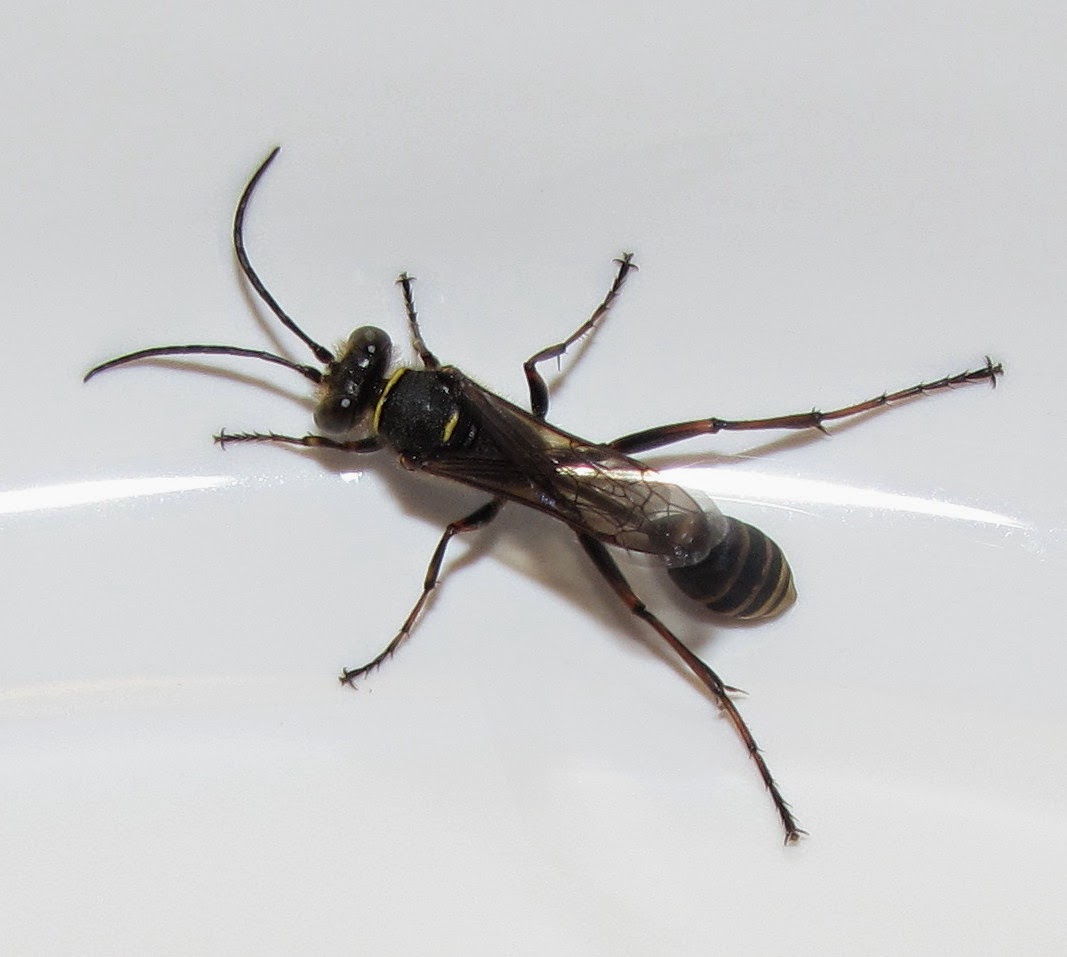
My wife, Heidi, seems to have a knack for finding noteworthy insects at her workplace, the Cheyenne Mountain Zoo. Her most recent discovery is apparently the first confirmed U.S. record of Sceliphron curvatum, an Asian mud dauber wasp in the family Sphecidae. This is a species you need to Be On the Look Out for, and that should be reported to your state or provincial department of agriculture.

Initially, I thought the wasp Heidi captured on April 29 was a blue mud dauber in the genus Chalybion, as it appeared to be dark with few, if any markings, but the container was rather opaque. Removing the wasp from the container and taking images revealed it was actually a species of Sceliphron, of which the native species S. caementarium is locally abundant.

Still, something seemed a bit off. The wasp was indeed dark, devoid of most of the usual bright yellow markings on the legs and body. I quickly uploaded the images to my computer, and posted one on a Facebook interest group for experts in the order Hymenoptera. Meanwhile, I did a little investigating online, and found images in Bugguide.net from Montreal that resembled the specimen.

The Bugguide category is currently “Sceliphron curvatum-or-deforme” because the two species, native to Asia, are apparently difficult to distinguish. I then looked up Google images for S. curvatum and it became clear that the Colorado Springs specimen was at least a close ally of that species.

Back to Facebook. Étienne Normandin of Montreal, and Doug Yanega, an entomologist at the University of California, Riverside, both came to the same conclusion I had, but they have authoritative credentials that I do not.

Sceliphron curvatum is noticeably smaller than our native species, ranging from 15-25 millimeters in body length as opposed to 24-28 millimeters for S. caementarium. Other than size, and differences in color pattern, the two wasps are very similar in their natural history. Each female wasp constructs her own mud nest consisting of one or several cells attached to protected surfaces such as beneath a cliff overhang, under bridges, under the eaves of buildings, or inside old barns. S. curvatum evidently has a propensity for nesting indoors, attaching mud cells to walls, piles of old books, clothing, and furniture. This more “domestic” lifestyle no doubt makes it a prime candidate for spreading far and wide via international commerce. It is easy to overlook a small, earthtone object attached to something.

Mud daubers are predators of spiders, with more generalist tendencies than spider wasps in the family Pompilidae. So, nearly any kind of spider is fair game. Many spiders are paralyzed and piled into a single mud cell before the mother wasp lays a single egg and seals the cell. The larva that hatches feeds on the cache of food, eventually pupating. The adult wasp that emerges then chews its way out of its clay crib

S. curvatum is native to India, Nepal, Pakistan, Kazakhstan, and Tadjikistan, in the foothills of the Himalayas and other mountain ranges. Great. The Front Range of Colorado is essentially the same habitat. It was first reported from Europe in southeastern Austria in 1979. Since then it has spread to Slovenia, Italy, Croatia, Switzerland, France, Hungary, Germany, Serbia and Montenegro, Greece, the Czech Republic, and Slovakia (Bosusch, et al., 2005). Much of its range extension is attributed to the wasp’s own natural dispersal capabilities.

The species has also turned up in and around Buenos Aires, Argentina, as reported in 2008 (Compagnucci and Alsina, 2008). On July 7, 2013, images of a specimen of S. curvatum, next to a mud cell, were posted to Bugguide.net from Montreal, Quebec, Canada, representing the first North American record for the species.

Please put this species on your radar, and maybe pay closer attention to mud daubers in general since it is easy to overlook this newcomer.

Sources: Bogusch, P., P. Liška, J. Lukáš, and A. Dudich. 2005. “Spreading and summary of the knowledge of the invasive sphecid wasp Sceliphron curvatum (Smith 1870) in the Czech Republic and Slovakia (Hymenoptera: Apocrita, Sphecidae),” Linzer Biol. Beitr. 37(1): 215-221.
Compagnucci, Luis A. and Arturo Roig Alsina. 2008. “Sceliphron curvatum, una nueva avispa invasora en la Argentina (Hymenoptera: Sphecidae),” Revista de la Sociedad Entomológica Argentina 67(3/4): 63.